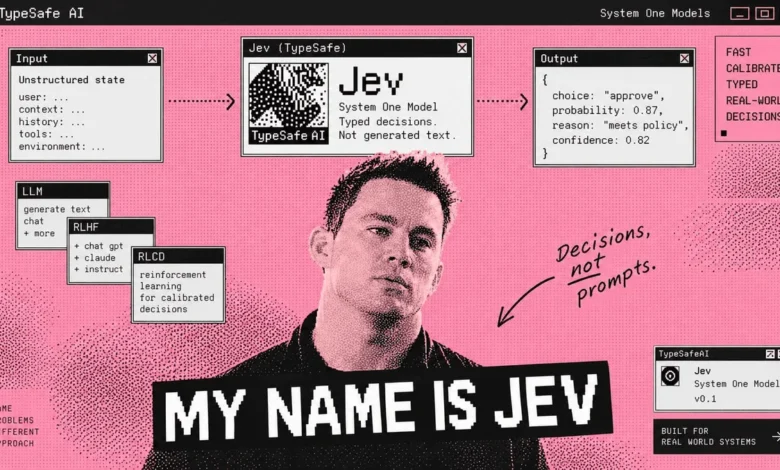
The emergence of Jev, a specialized model developed by TypeSafe AI, has triggered a significant discourse within the machine learning community regarding the trajectory of artificial intelligence development. As the industry grapples with the limitations of massive, general-purpose Large Language Models (LLMs), Jev represents a pivot toward specialized, high-velocity decision-making architectures. While social media narratives often frame Jev as a paradigm-shifting invention, a technical analysis reveals a more nuanced reality: Jev is an optimized evolution of existing Natural Language Processing (NLP) frameworks designed to solve the persistent challenge of efficient, structured output generation.
The Technical Evolution of Decision-Making Models
To understand Jev, one must place it within the historical context of NLP development. For the better part of the last decade, researchers have transitioned from simple bag-of-words classifiers to complex neural architectures. By 2019, the rise of Natural Language Inference (NLI) models, such as those built upon the BART or RoBERTa architectures, solidified the standard for zero-shot classification. These models allowed developers to categorize text into arbitrary labels without the need for extensive retraining.
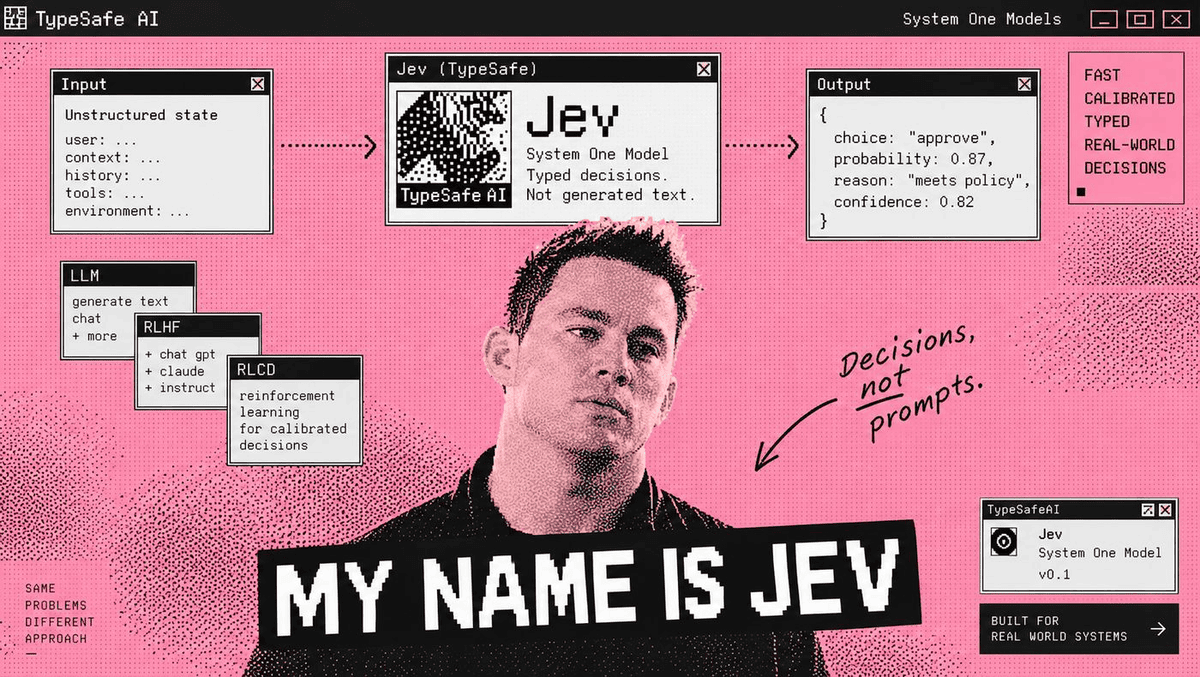
Jev operates on a similar foundational principle but introduces an architectural refinement termed "System One" modeling. Drawing inspiration from psychologist Daniel Kahneman’s dual-process theory of cognition, TypeSafe AI distinguishes Jev from the "System Two" nature of frontier LLMs. While models like GPT-4 or Claude excel at deep reasoning, planning, and long-form content generation—processes that require multiple tokens of computation—Jev is architected for immediate, instinctive classification. By bypassing the generation of verbose prose in favor of direct probability distribution outputs, Jev achieves a level of computational efficiency that general-purpose models cannot replicate.
Chronology and Development Trajectory
The discourse surrounding Jev gained momentum in late 2024 as TypeSafe AI began demonstrating its capabilities in production-like environments. Unlike traditional LLMs that rely on auto-regressive decoding—where each token is predicted sequentially—Jev employs a parallel sampler. This technical shift is significant because it addresses one of the primary bottlenecks in enterprise AI integration: latency.
In traditional deployments, developers often force a general-purpose LLM to perform classification by providing complex prompts, which necessitates a high number of input/output tokens. This approach is not only expensive but also prone to "drift," where the model’s performance varies based on the prompt’s framing. TypeSafe AI’s approach involves training a model specifically to output structured, calibrated probabilities, effectively turning the "reasoning" task into a streamlined mathematical mapping.
The Role of RLCD in Model Reliability
A central component of Jev’s architecture is Reinforcement Learning for Calibrated Decisions (RLCD). The objective of RLCD is to ensure that the model’s internal certainty matches the actual empirical accuracy of its outputs. In standard neural networks, a model might return a high-confidence prediction that is factually incorrect. This "overconfidence" is a major hurdle in deploying AI for high-stakes routing, such as financial transaction categorization or emergency service dispatching.
By optimizing for calibration, Jev provides developers with a reliable "confidence score" alongside its classification. This metadata allows downstream software to implement automated logic: if the confidence score exceeds a 90% threshold, the system may proceed with an automated action; if the score drops below 60%, the system can flag the request for human intervention. This shift from "black-box" decision-making to transparent, probability-aware logic is a critical step toward the enterprise-grade adoption of AI.

Clarifying the Hallucination Myth
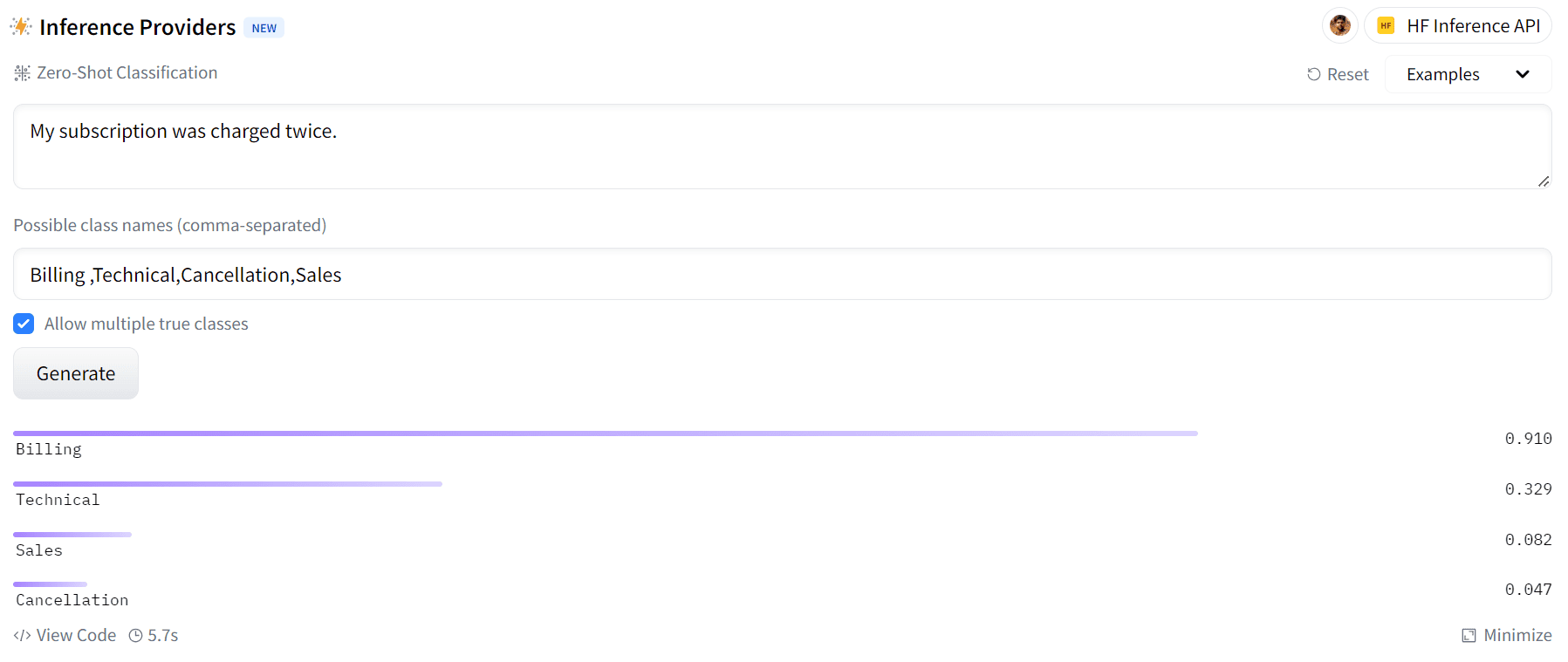
One of the most persistent misconceptions regarding Jev is the claim that it is immune to hallucinations. In technical terms, Jev prevents "out-of-schema" hallucinations—it cannot generate a classification label that was not provided in the prompt’s defined choices. However, it is essential to distinguish between a structural error and a semantic error.
If a user provides the labels "Billing," "Technical," and "Sales," Jev is physically incapable of outputting "Legal." Yet, it can still assign the highest probability to the wrong category. Therefore, while Jev eliminates the risk of the model inventing data points (hallucination in the traditional sense), it remains subject to classification errors. Journalists and industry observers must distinguish between the model’s structural integrity and its logical accuracy.
Comparative Analysis: Jev vs. Frontier LLMs
The debate over whether Jev is "revolutionary" hinges on the definition of innovation. If the metric is the invention of new AI principles, Jev falls short; it builds upon established research in NLI and probabilistic machine learning. If the metric is productization, however, the argument for Jev becomes stronger.
Frontier LLMs are designed for versatility. Their training involves billions of parameters and vast datasets to handle everything from Python debugging to creative writing. Using such a model to classify a customer support ticket is, in many cases, a misuse of resources. It is akin to using a supercomputer to perform basic arithmetic. Jev’s efficiency stems from its narrow focus. By narrowing the scope of the task, TypeSafe AI has enabled a model that is significantly faster, more cost-effective, and easier to integrate into existing CI/CD (Continuous Integration/Continuous Deployment) pipelines.
Implications for the Enterprise AI Sector
The industry is currently witnessing a transition from the "LLM Hype Cycle" to an era of "Specialized Utility." As enterprises move beyond initial experimentation, the demand for "System One" models like Jev is likely to increase. The ability to route thousands of customer interactions per second with a high degree of calibration is a tangible business value that general-purpose chatbots struggle to provide at scale.
Data from early tests, while limited, suggest that Jev performs competitively against larger models in narrow tasks. In a recent internal assessment, the model demonstrated a 96.3% accuracy rate in specific fact-checking benchmarks, though independent, peer-reviewed verification remains pending. As more developers integrate Jev into production environments, a clearer picture of its real-world performance will emerge.
Conclusion: A Pragmatic Tool for a Maturing Market
TypeSafe AI has effectively identified a gap in the current AI ecosystem: the need for high-speed, structured, and reliable decision-making tools. While it is inaccurate to label Jev as a new "kind" of AI, it represents a sophisticated optimization of existing machine learning research. Its strength lies not in replacing frontier LLMs, but in augmenting them. By offloading classification, routing, and intent detection to a specialized "System One" layer, organizations can reduce costs and latency, allowing their general-purpose LLMs to focus on the complex, high-reasoning tasks for which they were originally designed.
Ultimately, the development of Jev serves as a reminder that the most impactful advancements in artificial intelligence are often not the most "magical" ones. Rather, they are the ones that provide the reliability, speed, and precision necessary to bridge the gap between experimental research and robust, enterprise-scale software engineering. As the market matures, the integration of such specialized architectures will likely become the standard for any organization looking to deploy AI in a production environment.