Architectural Breakthrough: Cutting Token Costs and Latency by Up to 80% in Enterprise AI Agents Processing Large JSON Workloads

Enterprise adoption of generative artificial intelligence has rapidly evolved past simple single-turn text generation into complex, multi-turn agentic workflows. Organizations are deploying sophisticated production agents equipped with dozens of operational tools and massive, structured data inputs. However, as these systems scale to handle real-world enterprise operations involving megabyte-scale payloads, technical teams face a severe bottleneck: runaway token consumption and compounding response latency.
When autonomous agents process extensive JavaScript Object Notation (JSON) payloads—such as airline operational schedules, financial ledgers, or global supply chain metrics—every additional tool invocation typically injects the entire dataset directly into the large language model (LLM) context window. In extended multi-turn conversations, this architectural pressure compounds rapidly, inflating operational costs and severely degrading response times.
To address this challenge, engineering teams building production systems on platforms like Amazon Bedrock AgentCore and LangGraph have increasingly focused on context-window optimization. Recently, developers working on Flightscape, a prominent airline operations platform, implemented a suite of composable memory-management and payload-compaction strategies. By decoupling heavy data artifacts from conversational states, on-demand result paging, and dictionary compaction, the engineering team achieved remarkable performance improvements: cutting total token consumption by up to 71% and reducing average trace latency by up to 80% on benchmark runs involving multi-megabyte datasets.
The Scaling Challenge in Enterprise Agent Architectures
Flightscape provides mission-critical software solutions designed to help commercial airlines efficiently plan, coordinate, and manage crews, flight paths, and day-of-operations logistics. Within its crew management suite, developers constructed a specialized Training Schedule Optimization agent. Powered by more than 40 distinct operational tools and ingesting multi-megabyte JSON configurations, the agent was engineered to evaluate complex queries spanning crew assignments, regulatory compliance, scheduling constraints, and resource allocation.
Despite successfully delivering the required functional capabilities, the initial architecture encountered severe performance roadblocks. Average request latencies consistently exceeded 15 seconds per call. Because every tool invocation dumped its complete raw payload straight into the model’s context window, token counts escalated exponentially. On particularly dense datasets, the LLM’s context window filled to capacity before the reasoning engine could even formulate a complete, accurate response.
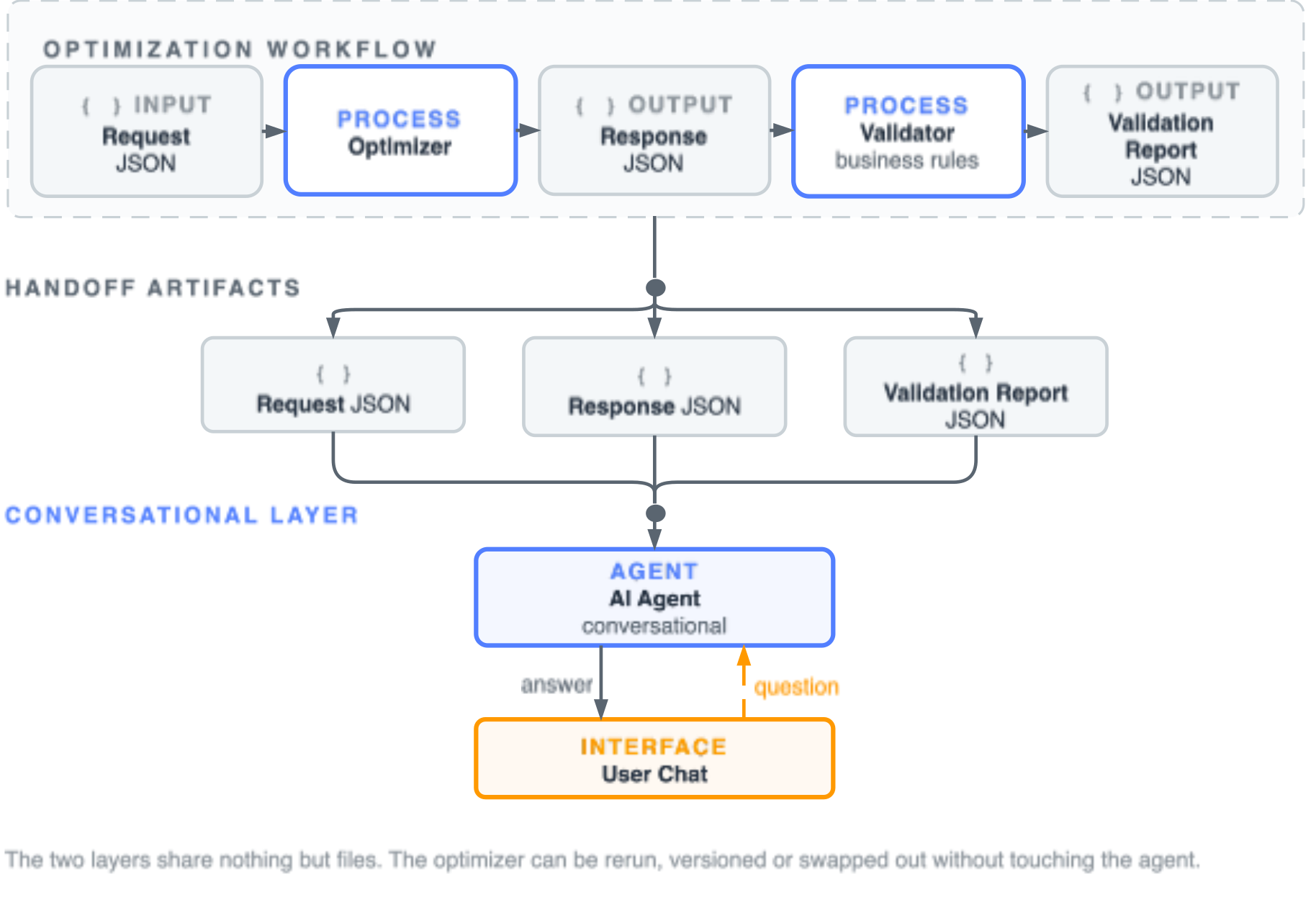
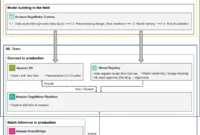
The system architecture relied on an Optimizer node processing an initial Request JSON to generate a Response JSON, which was subsequently verified by a Business Rules Validator to produce a Validation Report JSON. All three heavyweight documents were ingested directly by an AI Agent built via LangGraph and deployed on Amazon Bedrock AgentCore. While this setup provided robust conversational query capabilities—further secured through Amazon Bedrock Guardrails for responsible AI governance—the inline storage of massive data structures threatened the viability of the deployment.
Implementing Composable Optimization Strategies
To resolve these token inflation and latency issues without compromising the agent’s core reasoning depth, engineers designed three composable optimization strategies. Rather than passing raw multi-megabyte objects back and forth across every conversational turn, the system transitioned to a demand-driven, reference-based data architecture.
class GraphState(TypedDict):
    messages: Annotated[List[BaseMessage], add_messages]
    request_ref: Optional[str]
    responses_ref: Optional[str]
    validation_report_ref: Optional[str]
    basic_stats_ref: Optional[str]
    cache_data_ref: Optional[str]
Strategy 1: Lightweight Session States and S3 Artifact Offloading
The foundational optimization involved altering how session states persist across conversational turns. Initially, large JSON structures lived dangerously close to the dialogue history within memory stores. Under the new architecture, heavy data artifacts—including raw request files, response outputs, and validation reports—are offloaded directly to Amazon Simple Storage Service (Amazon S3).
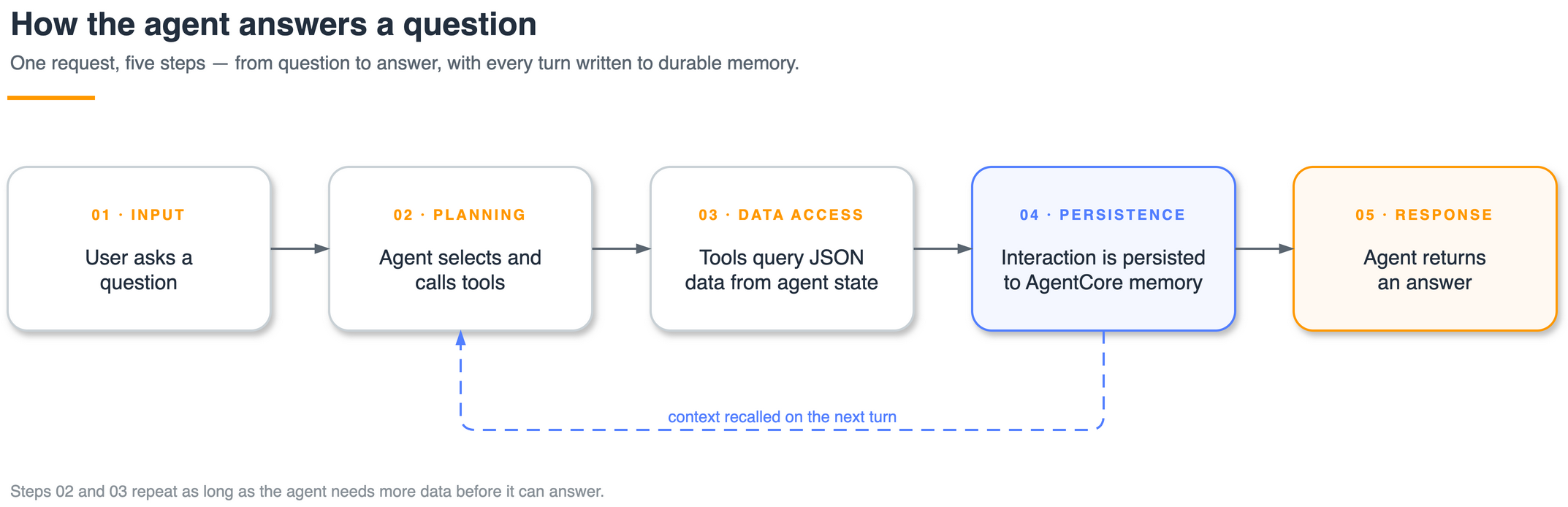
Amazon Bedrock AgentCore memory is utilized strictly to persist lightweight, stable references rather than bulky data bodies. To maintain idempotency and efficiency, the system utilizes content-addressable storage. Payloads are serialized using sorted keys and compact separators, generating a SHA-256 cryptographic digest of the byte stream to serve as the unique object reference key. If an identical payload is re-submitted during a subsequent turn, the system bypasses redundant upload operations entirely.
Strategy 2: On-Demand Result Paging for Large Lists
Even after offloading baseline files to S3, tool responses containing extensive data arrays remained a primary token drain. Certain tool outputs previously exceeded 80,000 tokens per invocation. To eliminate this bottleneck, engineers introduced dynamic list paging.
When a tool output exceeds a predefined sample-size threshold, the complete list is securely written to S3, and the model receives a compact summary containing a total item count, an abbreviated sample, and a unique result handle. When the agent specifically requires deeper insights, it invokes a dedicated paging utility function (get_result_page_tool()), passing the handle along with specific offset and limit parameters to retrieve precisely the targeted data slice.
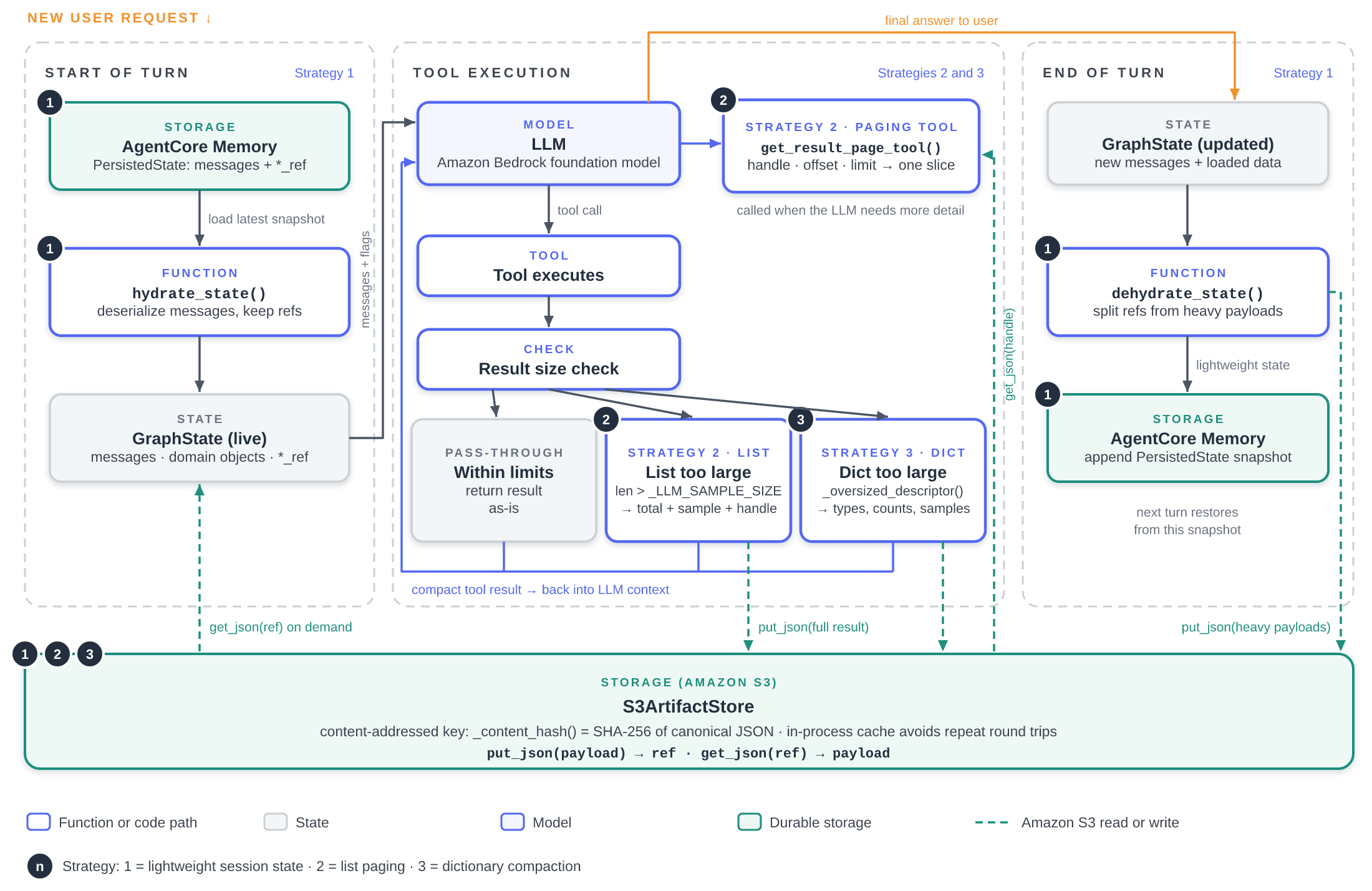
Strategy 3: Structural Compaction for Oversized Dictionaries
While lists can be effectively sliced via pagination, dictionary outputs frequently contain deeply nested, highly structured attributes vital for analytical reasoning. Returning these dictionaries verbatim remains prohibitively expensive in terms of token expenditure.
To resolve this, the system implements descriptor-based compaction. Instead of transmitting an expansive dictionary, tools return a structured summary object detailing field types, key counts, and representative scalar values or sample items, accompanied by an S3 artifact handle. The model retains full structural awareness of the dataset while consuming a fraction of the historical token volume.
Empirical Benchmarks and Performance Impact
To validate the efficacy of these combined methodologies, development teams conducted rigorous benchmark testing by running
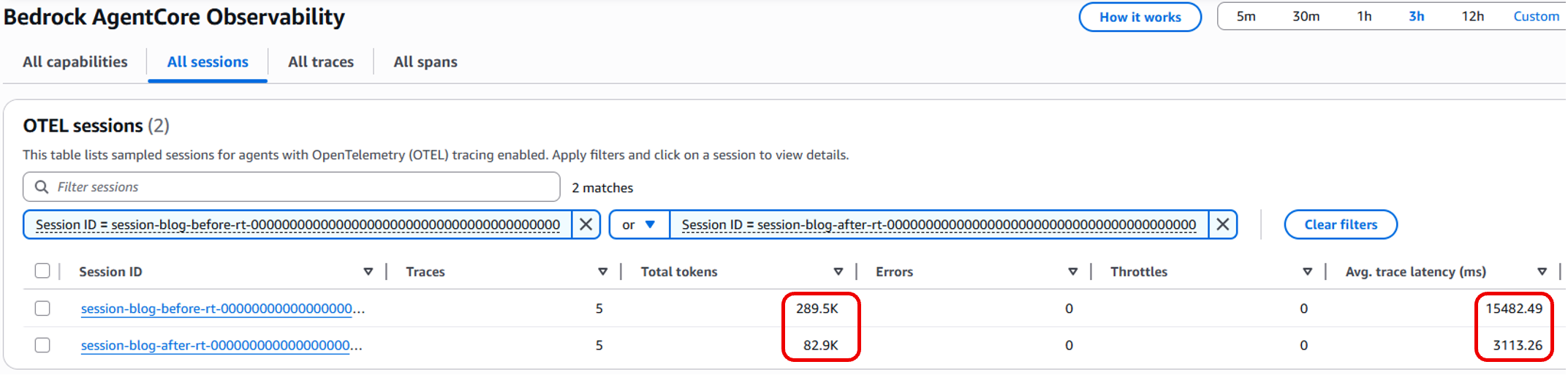
identical conversational test suites against both the unoptimized and optimized versions of the Flightscape agent. Performance metrics were systematically tracked and evaluated using Amazon Bedrock AgentCore Observability tools.
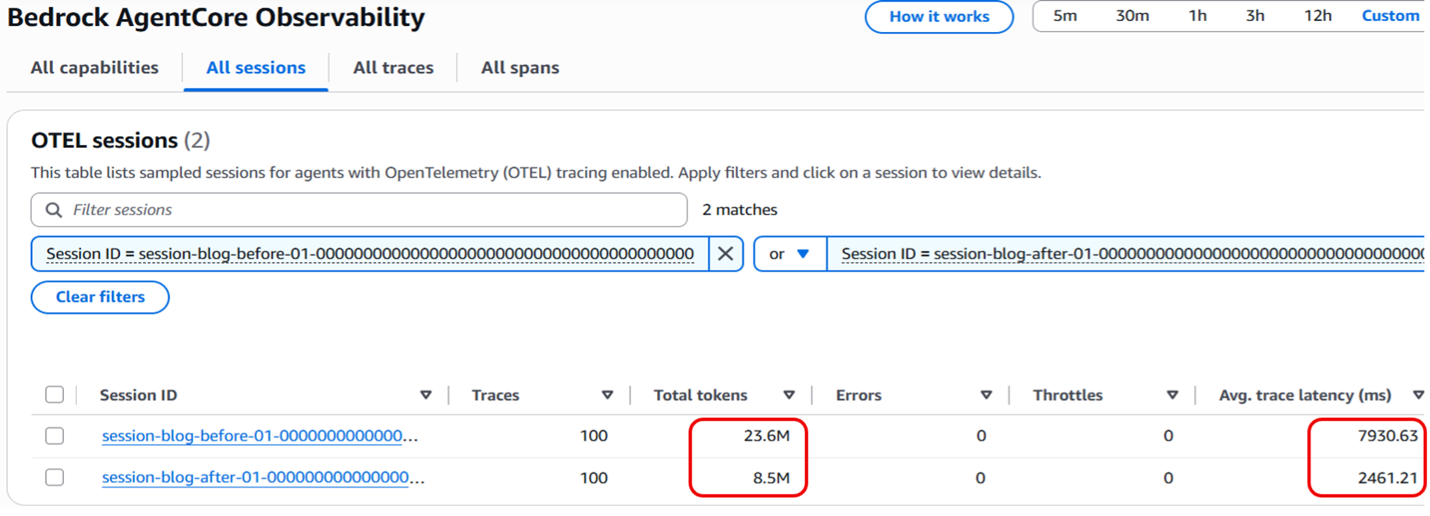
Across a standard five-question evaluation sequence, total token consumption plummeted by approximately 71%, dropping from roughly 289,500 tokens down to 82,900 tokens. Concurrently, average trace latency fell by nearly 80%, moving from 15.4 seconds down to 3.1 seconds per session. Broader evaluations encompassing 100 diverse sample queries demonstrated similarly dramatic efficiencies: aggregate token usage decreased by 64% (from 23.6 million to 8.5 million tokens), while average trace latency dropped by 69%, shifting from 7,930 milliseconds to 2,461 milliseconds.
| Metric Performance | Pre-Optimization | Post-Optimization | Net Improvement |
|---|---|---|---|
| Input Tokens (Single Heavy Query) | ~32,000 | ~8,000 | 75% Reduction |
| Output Tokens (Single Heavy Query) | ~2,800 | 477 | 83% Reduction |
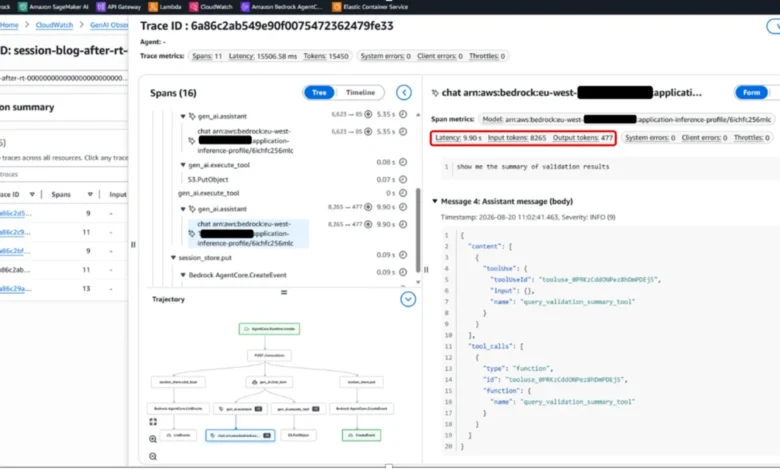
| Single Turn Latency | ~165 seconds | 9.9 seconds | 94% Reduction |
| Aggregate Tokens (5-Question Run) | ~289,500 | ~82,900 | 71% Reduction |
| Average Latency (5-Question Run) | 15.4 seconds | 3.1 seconds | 80% Reduction |
The most pronounced performance gains materialized during heavy single-turn operations, such as querying valid crew assignments across every regulatory compliance category. In these extreme scenarios, turn execution times collapsed from nearly three minutes down to under 10 seconds, while input token overhead dropped by 75% and output tokens fell by 83%.
Broader Implications for Enterprise AI Deployments
The successful deployment of these optimization patterns highlights a critical maturation phase in enterprise artificial intelligence engineering. As businesses increasingly transition agentic applications from experimental sandboxes into high-volume production environments, raw compute power and expanding LLM context windows alone cannot overcome inefficient data management practices.
Unchecked context inflation introduces unacceptable operational costs, risks hitting strict model rate limits, and degrades user experience through unpredictable latency spikes. By enforcing a demand-driven access pattern—where large JSON payloads are externalized into secure cloud storage and selectively queried via programmatic handles—organizations can scale sophisticated AI agents without compromising their analytical reasoning capabilities.
For industries characterized by immense, highly structured operational data streams, such as commercial aviation, logistics, healthcare, and financial services, this methodology provides a reliable blueprint. It bridges the gap between the complex data requirements of legacy enterprise software and the distinct technical constraints of modern generative AI frameworks, ensuring that conversational automation remains both economically viable and operationally responsive at enterprise scale.