Simplifying Real-Time Data Architectures with Amazon MSK Express Brokers and Native S3 Integration

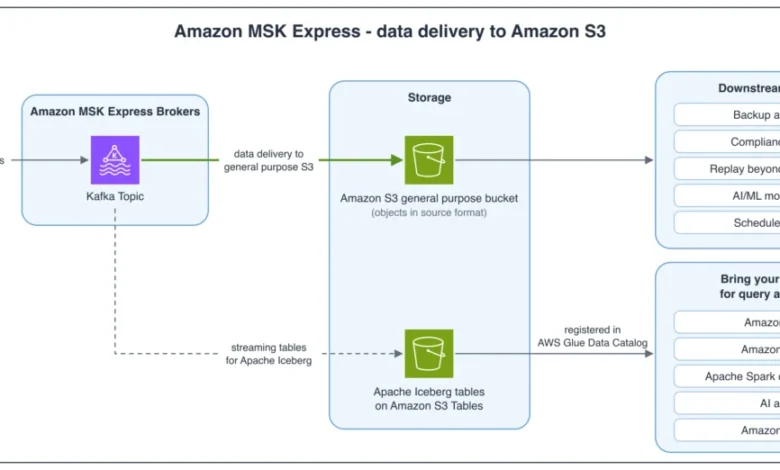
The landscape of real-time data processing has undergone a significant transformation with the introduction of native data delivery capabilities for Amazon Managed Streaming for Apache Kafka (MSK) Express brokers. This advancement allows organizations to stream Apache Kafka topic data directly into Amazon Simple Storage Service (S3) buckets and Apache Iceberg tables without the traditional requirement of Kafka Connect or supplementary infrastructure. By eliminating the need for separate connector clusters, enterprises can achieve up to a 60% reduction in ingestion and delivery costs, fundamentally changing how streaming architectures are provisioned, monitored, and scaled.
The Evolution of Kafka Data Archiving
For years, the standard architecture for persisting Kafka data for long-term storage, auditing, and analytical processing involved the deployment of Kafka Connect. While this approach provided a functional bridge between event streams and data lakes, it introduced significant operational overhead. Organizations were tasked with managing not only the Kafka brokers themselves but also the lifecycle of the connectors, which required their own compute resources, scaling policies, and monitoring frameworks.
As data volumes grew, the "double-management" problem became acute. Engineers had to size Kafka clusters to handle both producer traffic and the additional overhead of consumer groups tasked with writing data to S3. This often led to over-provisioning to account for potential traffic spikes, resulting in idle compute costs during periods of low activity. Compliance mandates—which frequently require raw event retention for multi-year audit windows—further pressured these systems, as managing storage growth on traditional Kafka clusters often became a bottleneck for performance and cost management.
The Technical Shift: How Express Brokers Redefine Ingestion
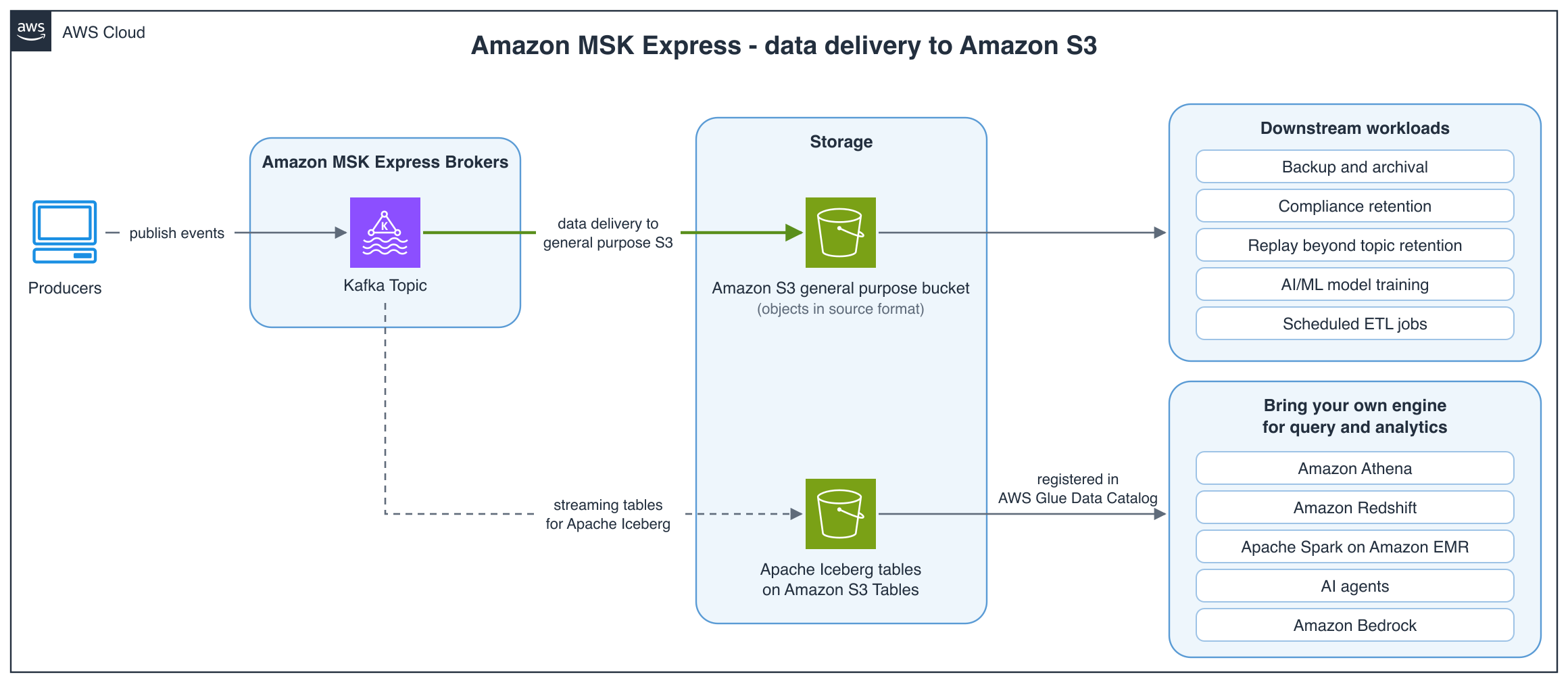
The transition to MSK Express brokers addresses these structural inefficiencies by integrating the delivery pipeline directly into the broker layer. Unlike the legacy model where a separate connector service reads from a topic and writes to S3, Express brokers handle the delivery process internally.
Because this delivery mechanism operates as a native function, it does not consume the primary broker throughput that real-time consumers rely on. This separation of concerns ensures that the act of archiving data does not interfere with the performance of low-latency applications, a common point of contention in traditional self-managed Kafka environments.
The economic implications are significant. By utilizing a pay-as-you-go storage model that scales dynamically with workload demands, organizations no longer need to provision storage upfront. When a workload decreases, storage costs scale down automatically. Furthermore, the removal of the Kafka Connect layer eliminates the "hidden" costs of maintaining that compute infrastructure, including patching, security hardening, and managing the uptime of connector instances.
Architectural Advantages for Modern Analytics
Beyond simple archival, the integration facilitates the creation of streaming tables. Through support for Apache Iceberg on Amazon S3 Tables, MSK can automatically register incoming data in the AWS Glue Data Catalog. This integration is critical for modern data engineering teams because it renders the data immediately queryable through engines such as Amazon Athena, Amazon Redshift, and Apache Spark.
Previously, achieving this level of interoperability required a complex pipeline involving Kafka connectors, Apache Flink jobs, and custom consumer logic. The current architecture automates this flow. By providing inline compaction, the system reduces the number of small files typical in streaming writes, which in turn optimizes downstream query performance and can decrease costs by up to 30% for analytical workloads.
Overcoming Operational Hurdles
The challenges of the legacy "self-managed" approach were primarily threefold: broker management, pipeline complexity, and scaling friction.
1. Broker Management:
In traditional environments, administrators were forced to manually provision storage, monitor disk utilization, and manage partition rebalancing. Any increase in traffic required a time-consuming process of adding brokers and rebalancing data, often taking hours or days. Express brokers automate this; capacity expansion occurs in minutes, and the system manages the rebalancing, allowing for a more agile response to unexpected data surges.
2. Pipeline Complexity:
Kafka Connect clusters often suffered from "config drift," where the configuration of the connector would fall out of sync with the cluster version or the schema requirements of the destination S3 bucket. By removing the connector, MSK eliminates the need for managing connector-specific plugins, IAM roles for those plugins, and the associated runtime errors that occur during transient network failures between the connector and the broker.
3. Data Reliability and Compliance:
The native delivery mechanism includes built-in validation for JSON and String records. Should a record fail validation, it is automatically routed to a Dead Letter Queue (DLQ) in S3. This ensures that the main pipeline remains unblocked while providing administrators with clear visibility into data quality issues, an essential requirement for regulated industries.
Integrating AI-Driven Automation
The integration of AI Agent Skills represents the next logical step in the maturity of this architecture. AWS has introduced open-source agent capabilities that allow developers to interface with their infrastructure using natural language. Rather than manually configuring IAM policies, output key templates, and DLQ settings, an engineer can instruct an AI agent to "Set up data delivery from the orders topic to the archive bucket."
This agent-led approach significantly lowers the barrier to entry for complex configurations. By leveraging the Agent Toolkit for AWS, the agent can inventory existing clusters, identify available S3 buckets, and perform the necessary provisioning steps. This not only reduces the risk of human error in security configurations—such as overly permissive IAM roles—but also ensures that best practices are followed consistently across disparate teams within a large organization.

Broader Implications and Future Outlook
The industry move toward serverless and native-integrated streaming services reflects a broader trend in cloud computing: the commoditization of infrastructure management. By shifting the responsibility of "plumbing" from the customer to the managed service provider, engineers are free to focus on data modeling, schema evolution, and the business logic of their analytical pipelines.
For businesses currently relying on self-managed Kafka or third-party managed alternatives, the migration process has been streamlined via the Amazon MSK Replicator. This tool allows for the seamless transfer of data and consumer group offsets to an Express cluster, minimizing downtime.
The impact of these changes is most profound in high-scale AI/ML environments. Training machine learning models requires massive, consistent streams of data. By having an automated, reliable, and performant pipeline that delivers data to S3 in a structured format (Iceberg/Parquet), companies can accelerate their model training cycles. Data scientists no longer have to wait for separate ETL processes to convert raw Kafka logs into usable datasets; the data is ready for analysis as soon as it arrives in the S3 bucket.
Conclusion
The evolution of Amazon MSK Express brokers underscores the importance of operational simplicity in high-throughput environments. By consolidating the delivery pipeline into the broker itself, AWS has effectively removed a layer of complexity that has plagued Kafka users for years.
As organizations continue to prioritize real-time data for decision-making, the ability to transition from raw event streams to queryable analytical tables without the "connectors" of the past will become a competitive advantage. With lower costs, automated scaling, and improved integration with modern AI development tools, this architecture provides a robust foundation for the next generation of data-intensive applications. Organizations looking to optimize their streaming investments should prioritize the evaluation of these native delivery channels as a means to reduce technical debt while enhancing the speed and reliability of their data lakes.