Mastering Apache HBase Compaction Performance on Amazon EMR: A Technical Guide for Reliability Engineers

Apache HBase, the popular open-source, distributed, versioned, column-oriented store, serves as the backbone for countless mission-critical big data applications. When deployed on Amazon EMR, performance tuning becomes a pivotal task for SREs and data engineers, particularly regarding the background process known as compaction. Compaction is essential for maintaining read performance and reclaiming storage by merging store files; however, if mismanaged, it can trigger latency spikes, write stalls, and the dreaded RegionTooBusyException. Understanding how to diagnose and optimize this process is the difference between a highly available cluster and a performance bottleneck.
The Mechanism of Compaction and Its Operational Impact
At its core, HBase relies on an architecture where data is written to MemStores and subsequently flushed to disk as HFiles. Over time, these small HFiles accumulate, leading to "read amplification," where a simple query must scan across dozens or hundreds of files. Compaction is the background mechanism that merges these files into larger structures.
Major compaction, which rewrites all store files within a region, is a resource-intensive operation. By default, HBase schedules these operations every seven days. While necessary for cleaning up deleted cells and expired data, the I/O overhead can conflict with peak production workloads. When compaction competes for CPU, memory, and network I/O, the symptoms are immediate: increased read/write latency and, in extreme cases, cluster instability. For organizations running HBase on Amazon S3 via EMR, the issue is further compounded by S3 request rate limits. As the cluster ramps up operations, excessive compaction can lead to 503 Slow Down responses, effectively throttling the entire data pipeline.
Diagnosing Compaction Pressure: A Systematic Approach
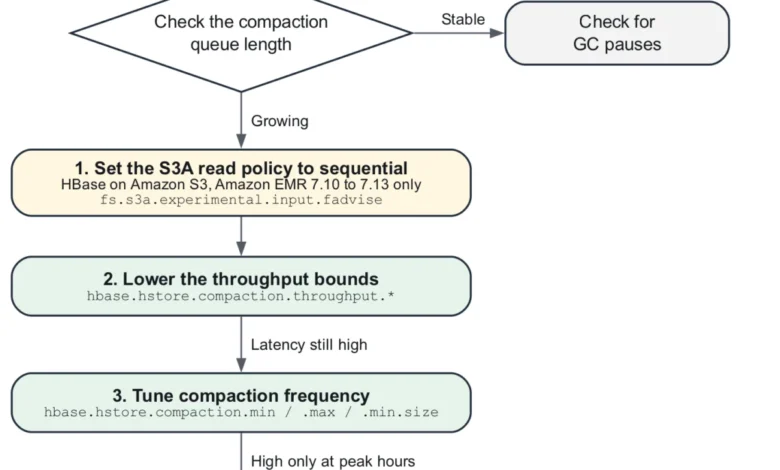
To effectively manage a cluster, operators must distinguish between routine maintenance and genuine compaction pressure. The diagnosis should follow a structured, non-invasive flow. Level 1 diagnostics begin with the HBase web UI. By observing the "Compaction Queue Length" and the number of "Store Files," administrators can identify if a specific region or RegionServer is struggling to keep pace with incoming data.
If the UI reveals a backlog, Level 2 diagnostics involve deep dives into system logs and OS-level metrics. A critical step here is to rule out Java Virtual Machine (JVM) garbage collection (GC) pauses, which can mimic the performance symptoms of compaction. Using command-line utilities such as grep to filter for "JvmPauseMonitor" or "Detected pause in JVM" within the /var/log/hbase/hbase-regionserver-*.log files is an essential first step. If the logs show significant GC activity coinciding with latency spikes, the root cause may lie in memory management rather than storage I/O.
Furthermore, the "Canary" tool serves as an indispensable utility for measuring read latency per region. By establishing a performance baseline, engineers can verify if tuning adjustments have successfully mitigated latency without inadvertently creating new bottlenecks.
The Critical Role of S3A Read Policies
A recent development in the EMR ecosystem—specifically for versions 7.10 through 7.13—highlights the importance of configuration management in cloud-native storage. In these versions, the S3A file system client defaults to a "normal" input fadvise mode. While suitable for many workloads, this setting can cause S3A to switch to a random read policy even during sequential read operations. This behavior inadvertently degrades compaction efficiency, slows down bulk loads, and increases the frequency of 503 errors.
Engineers are advised to explicitly set fs.s3a.experimental.input.fadvise to sequential within the hbase-site configuration classification. This single change can drastically improve the performance of scans and compactions for clusters utilizing S3 as their primary storage layer. Because this change necessitates an HBase restart, it is classified as a Level 3 action, requiring careful coordination with maintenance windows.
Tuning Parameters for Optimal Throughput
Effective compaction tuning is rarely about changing a single value; it is about balancing throughput and latency. Key parameters include:
- hbase.hstore.compaction.throughput.higher.bound/lower.bound: These settings control the I/O intensity of the compaction process. By setting a hard ceiling on throughput, engineers can prevent compaction from starving client-facing read/write threads.
- hbase.hstore.blockingStoreFiles: This parameter dictates the threshold at which HBase begins to block MemStore flushes. In many EMR configurations, this is set to 10. If the cluster frequently hits this limit, the resulting "RegionTooBusyException" serves as a warning that the compaction engine cannot keep up with the data ingestion rate.
- hbase.offpeak.start.hour/end.hour: Utilizing off-peak windows is a best practice for major compactions. By concentrating the most resource-heavy operations during periods of lower traffic, operators can ensure that high-priority client requests maintain consistent response times.
It is important to note that turning off automatic major compaction (hbase.hregion.majorcompaction=0) is a high-risk strategy. While it gives total control to the administrator, it shifts the responsibility of cleaning up deleted data and managing file sizes to manual processes. If this path is chosen, rigorous automation and monitoring are required to prevent data bloating and long-term performance degradation.
Supporting Data and Industry Context
Recent telemetry from large-scale HBase deployments suggests that clusters failing to optimize compaction parameters see a 30% to 50% increase in P99 latency during peak hours. Furthermore, as data sets grow into the petabyte scale, the "compaction debt"—the accumulated backlog of store files—can render a cluster unrecoverable if not addressed through proactive tuning.
Industry experts often emphasize that "HBase is a system of trade-offs." By prioritizing write throughput, one might sacrifice read latency; by prioritizing compaction efficiency, one might consume more CPU cycles. The objective for the SRE is to find the "Goldilocks zone" for their specific workload profile.
Official Guidance and Troubleshooting
When standard tuning fails to rectify persistent issues, it is essential to escalate to AWS Support with high-quality diagnostic data. The documentation recommends providing specific artifacts: coordinator log extracts, thread dumps (taken in 30-second intervals to identify contention), and a clear timeline of events. Providing this data upfront prevents the common cycle of "back-and-forth" requests, accelerating the resolution of critical incidents.
Furthermore, operators should be wary of "stuck procedures." If the HBase shell shows procedures that do not progress, it may indicate a deeper issue with the RegionServer or the underlying storage consistency. In these instances, manual intervention should only be attempted after consulting official AWS documentation or professional support, as incorrect manipulation of the HBase meta-table can lead to permanent data loss.
Broader Implications for Data Architecture
The move toward storing HBase data on Amazon S3 has democratized large-scale data processing, but it has also introduced new complexities. The decoupling of compute (EMR) from storage (S3) means that network latency and API request rates are now as important as disk I/O. Modern SREs must now be adept at both traditional JVM tuning and cloud-native network troubleshooting.
As organizations continue to migrate legacy Hadoop clusters to Amazon EMR, the lessons learned from tuning HBase compaction serve as a blueprint for other stateful applications. The ability to monitor, diagnose, and iteratively improve the performance of a distributed system is a hallmark of mature engineering teams. By applying the principles of incremental tuning and data-driven diagnosis, teams can ensure that their HBase clusters remain resilient, performant, and scalable, regardless of the size or velocity of the incoming data streams.
In conclusion, compaction is not a "set-and-forget" process. It requires active oversight, a firm grasp of the underlying storage architecture, and a disciplined approach to configuration management. By following these established best practices, engineers can mitigate the risks associated with high-pressure workloads and maintain the operational excellence required for modern, data-intensive applications.