Migrating Apache Hudi Data Lakes to Apache Iceberg: A Comprehensive Guide for Enterprise Data Architects

As the landscape of data engineering shifts toward more flexible, high-performance architectures, the transition from legacy data lake formats to modern, open-source table standards has become a priority for global enterprises. The cloud data lake, once a catch-all repository for disparate data, is evolving into a sophisticated transactional ecosystem. While Apache Hudi has long served as a standard for enterprise data lakes built on Amazon Simple Storage Service (Amazon S3), the industry is increasingly gravitating toward Apache Iceberg. This migration is driven by a desire for superior ACID transaction support, advanced partition evolution, and seamless multi-engine compatibility.
The evolution of data lakes can be traced back to the early reliance on Hive-style partitioning, which, while effective for initial storage, struggled with the complexities of modern analytics. Apache Hudi emerged as a solution to provide upsert and delete capabilities on top of S3. However, as organizations scale, the administrative burden of maintaining Hudi’s specific index structures and timeline metadata has prompted many to re-evaluate their storage layer. Apache Iceberg, with its focus on hidden partitioning and an open REST-based catalog specification, offers a more decoupled and modular architecture that aligns with the modern “Data Lakehouse” paradigm.
The Strategic Imperative for Migration
The shift from Hudi to Iceberg is not merely a technical upgrade; it is a strategic response to the changing requirements of data governance and performance. Organizations are increasingly managing petabyte-scale datasets where even minor inefficiencies in query planning can lead to significant cost spikes in compute resources.
Iceberg’s "hidden partitioning" is a key driver for this transition. Unlike traditional systems that require data engineers to maintain explicit partition columns—and require query writers to manually filter by those columns—Iceberg derives partitions from source data automatically. This eliminates the "partition drift" that often plagues large-scale analytics, where query performance degrades because users are unaware of the underlying physical layout.
Furthermore, the Iceberg REST Catalog provides a standardized interface for catalog operations. In a multi-engine architecture where teams might use Amazon Athena for ad-hoc SQL, Amazon Redshift for enterprise reporting, and Amazon EMR for heavy-duty Spark processing, this openness prevents vendor lock-in and simplifies the integration of third-party tools.
Methodologies for Transitioning Data
For organizations planning a migration, the choice between in-place migration and full table migration is the most critical decision. Each approach carries distinct trade-offs regarding cost, downtime, and operational complexity.
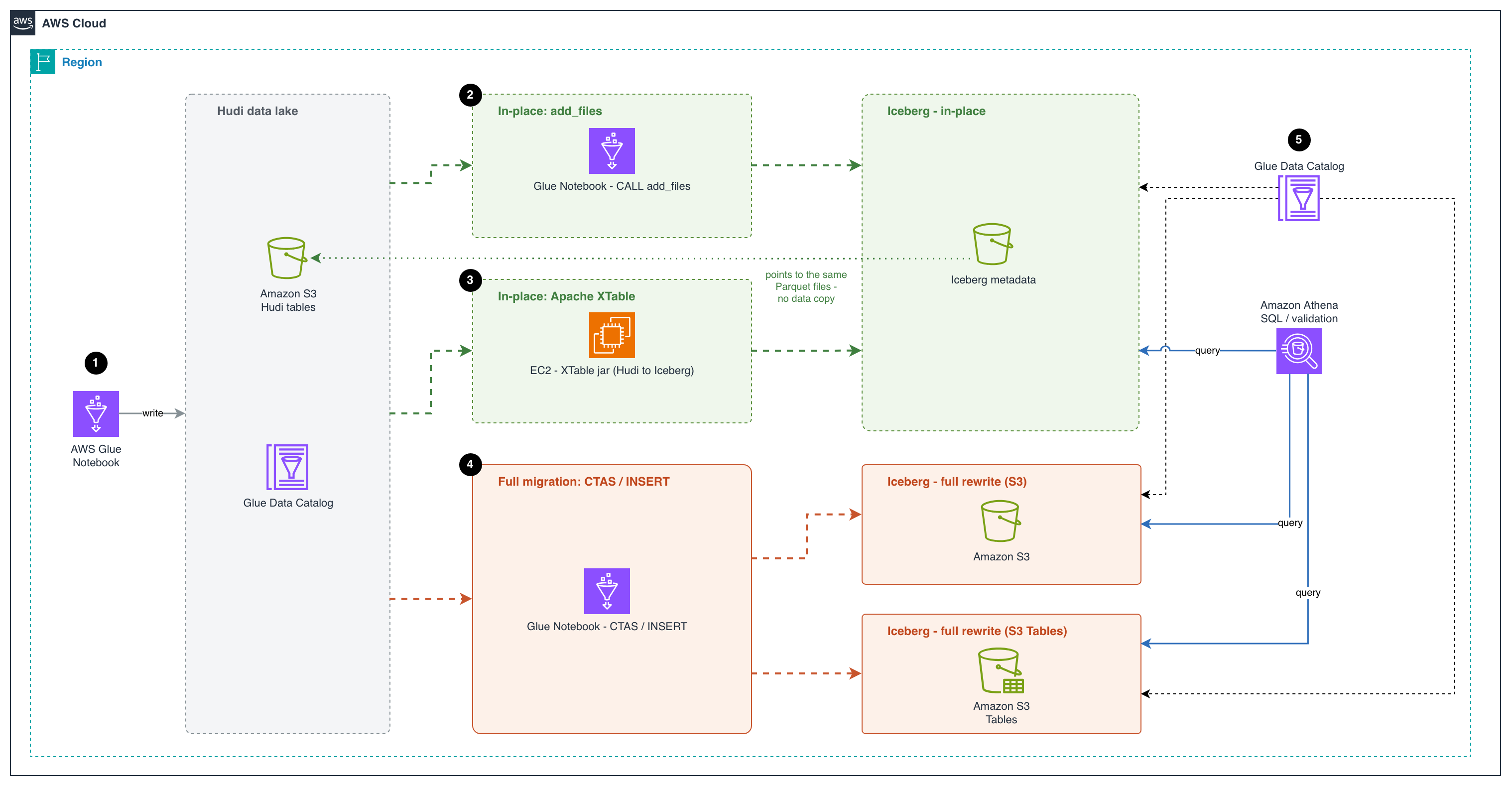
In-place migration leverages existing Parquet files, generating new Iceberg metadata pointers without moving the underlying data. This is the preferred route for massive datasets where the cost of rewriting data to S3 would be prohibitive. By using the Iceberg add_files procedure or the Apache XTable synchronization tool, data teams can effectively "wrap" their Hudi data in Iceberg metadata. This process is lightning-fast, but it does carry the limitation of inheriting the physical structure of the source table. If the Hudi table suffers from fragmented file sizes or inefficient sorting, those issues will persist in the new Iceberg environment.
Conversely, full table migration—often referred to as "shadow migration"—involves creating a brand-new Iceberg table and populating it via a CREATE TABLE AS SELECT (CTAS) or a series of INSERT INTO operations. While this approach is more compute-intensive and requires temporary double-storage, it offers the ultimate advantage of "reshaping" the data. During this rewrite, engineers can optimize file sizes, apply new partitioning schemes, and perform data quality cleanup that might have been neglected over years of Hudi operations.
Chronology of the Migration Workflow
Implementing a migration requires a structured, multi-phase execution plan. Data architects typically follow this timeline:
- Preparation and Assessment: Before any data movement occurs, teams must conduct a thorough audit of the source Hudi table. This includes identifying all schema versions, checking for column renames, and ensuring that no active long-running jobs are writing to the table.
- Environment Setup: Using AWS Glue 5.1 or later is highly recommended, as these environments include the necessary Spark extensions and libraries to handle both Hudi and Iceberg natively.
- The "Guardrail" Phase: If performing an in-place migration, it is vital to set the
gc.enabledtable property tofalsein Iceberg. This prevents automatic garbage collection processes from deleting Parquet files that are still technically owned by the legacy Hudi table. - Execution: Depending on the chosen methodology, the team either runs the
add_filesprocedure or begins the data-heavyINSERT INTOmigration. - Validation and Cutover: Validation is perhaps the most critical step. It is standard practice to run a "parallel" period where both the old and new tables are queried to ensure that results match down to the decimal point. Only after the validation runbook is passed on production traffic is the source Hudi table decommissioned.
The Role of Managed Infrastructure
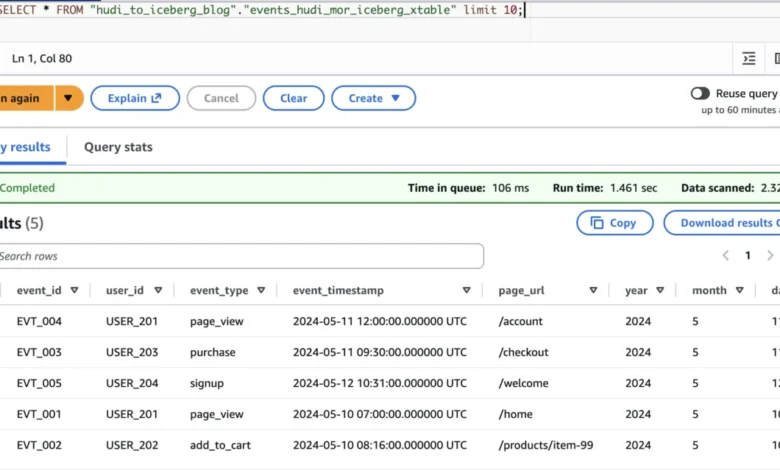
A significant portion of the success in migrating to Iceberg on AWS comes from the deep integration within the ecosystem. Amazon Athena, for instance, can query Iceberg tables directly using the metadata stored in the AWS Glue Data Catalog. This integration means that once the migration is complete, the transition for end-users is often invisible.
Moreover, the recent introduction of Amazon S3 Tables provides a high-performance, managed experience for Iceberg. By moving to S3 Tables, organizations can offload the operational overhead of managing Iceberg metadata files and snapshot retention, allowing data engineering teams to pivot their focus from infrastructure maintenance to value-added analytics.
Implications for Future-Proofing
The industry shift toward Iceberg is reflective of a broader trend: the commoditization of the data storage layer. As formats like Iceberg become the de facto standard, the power shifts from the file format to the ecosystem of tools that interact with it.
The move from Hudi to Iceberg also signals a maturation in how companies handle "late-arriving" data. While Hudi’s Merge-on-Read (MoR) capabilities were groundbreaking, the complexity of managing delta log files and the subsequent need for compaction often created a "compaction debt" that could stall pipelines. Iceberg’s handling of these operations, particularly when coupled with automated AWS managed features, offers a more predictable cost model for organizations operating at scale.
Recommendations for Success
To ensure a seamless transition, data teams should adhere to three core principles:
- Prioritize Non-Production Validation: Never migrate a production table without first testing the exact workflow against a mirror of the data. Use checksums and row-count verification scripts to ensure parity.
- Leverage Modern Tooling: Do not attempt to build custom conversion scripts if established tools like Apache XTable are available. The open-source community has invested heavily in making these utilities robust and reliable for enterprise use cases.
- Maintain Operational Discipline: During the migration period, treat the data as immutable. Avoid any manual file deletions or aggressive cleanup tasks until the cutover is finalized and the Hudi source has been retired.
As the data lakehouse continues to become the cornerstone of modern AI and machine learning initiatives, the agility afforded by Apache Iceberg will prove to be a significant competitive advantage. By moving away from proprietary or older, more rigid storage formats, organizations position themselves to integrate the next generation of data tools—whether they be vector databases, advanced feature stores, or real-time streaming engines—without the friction of architectural debt. The migration process, while demanding in its planning, is a necessary investment in the longevity and scalability of the enterprise data stack.