Apache Airflow has evolved from a niche scheduling tool into the fundamental orchestration layer for enterprise-grade data pipelines. As organizations scale their data operations, managing hundreds or thousands of directed acyclic graphs (DAGs) across heterogeneous environments—including AWS Glue, Amazon EMR, Amazon Athena, and Amazon Redshift—has created a significant operational bottleneck. When a complex pipeline fails, data engineers are frequently forced to engage in a time-consuming manual triage process: cross-referencing disparate log files, reviewing complex DAG configurations, and manually parsing thousands of lines of error messages. This "mean time to repair" (MTTR) latency often jeopardizes critical service level agreements (SLAs) and diverts engineering talent away from high-value development toward repetitive troubleshooting.
To address these challenges, a new integration has emerged that leverages Amazon Managed Workflows for Apache Airflow (MWAA) in tandem with Amazon Bedrock. By deploying a custom plugin, teams can now automate the diagnostic process, utilizing large language models (LLMs) to perform root cause analysis on demand. This shift represents a transition from reactive, human-led debugging to proactive, AI-assisted observability.
The Operational Challenge of Modern Orchestration
In a typical modern data stack, a single failure in a downstream task might be the result of a misconfigured Spark job in EMR, a syntax error in a SQL query sent to Redshift, or a permissions issue within an S3 bucket. Currently, the industry standard for debugging these issues is highly fragmented. Engineers must navigate the Airflow UI, jump into CloudWatch logs, and then inspect the underlying source code or SQL scripts.
Data industry benchmarks suggest that for complex ETL workflows, developers spend approximately 30% to 40% of their time on maintenance and debugging tasks. As the density of tasks within a single Airflow cluster increases, the cognitive load on engineers becomes a limiting factor for velocity. By automating the extraction of context—specifically, linking the failed task with its corresponding code, query, or bash script—this new plugin addresses the primary source of friction in the debugging lifecycle.
Technical Architecture and Implementation
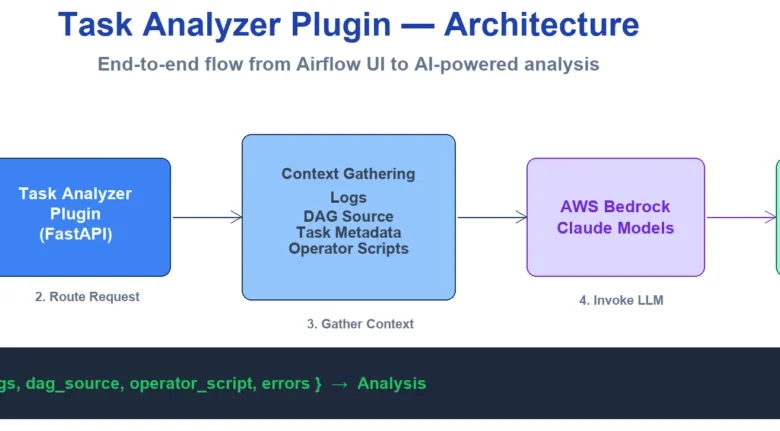
The solution functions as an Airflow plugin that embeds directly into the existing user interface. When an engineer identifies a failed task, they can trigger an "Analyze Task" action, which initiates a multi-stage data retrieval process.
The architecture relies on an operator-aware retrieval system. Unlike traditional log aggregators that only analyze the output stream, this plugin identifies the specific operator type—whether it is a GlueJobOperator, AthenaOperator, or BashOperator—and intelligently fetches the associated source code. For Glue jobs, it retrieves the PySpark script from S3; for Athena, it extracts the exact SQL statement executed at the time of failure.
Once the context is gathered, the plugin securely transmits the error logs and the associated logic to Amazon Bedrock. By utilizing a foundation model—such as the Claude family of models—the system generates a structured report. This report does not merely report the error; it identifies the probable root cause, suggests a remediation path, and offers preventative advice to avoid future occurrences.
The security architecture of this implementation is particularly notable for enterprise environments. Because the plugin runs within the context of the Amazon MWAA environment, it inherits the execution role’s permissions. This eliminates the need for managing static API keys or rotating credentials, as the authentication is handled natively through AWS Identity and Access Management (IAM). For organizations with strict compliance requirements, the integration allows for optional PII (personally identifiable information) redaction passes, ensuring that sensitive data points are masked before they are processed by the LLM.
Chronology and Deployment Workflow
The deployment of this diagnostic capability follows a standard CI/CD lifecycle for infrastructure as code. The process begins with cloning the source repository, which contains the FastAPI-based plugin structure. Developers package the code into a plugins.zip file, which is then pushed to an S3 bucket designated for the MWAA environment.
Once the S3 bucket is updated, the Amazon MWAA environment is instructed to refresh its plugins. This update is a non-destructive process that typically completes within 10 to 30 minutes, depending on the environment configuration. Upon completion, the "Analyze Task" button appears within the task instance view of the Airflow UI. Verification is performed by running a set of provided test DAGs designed to intentionally fail, thereby confirming the plugin’s ability to intercept errors and query the LLM.
Implications for Engineering Productivity
The move toward AI-powered observability in orchestrators has profound implications for the data engineering discipline. By reducing the time required to understand a failure from several minutes (or hours) to mere seconds, teams can maintain higher uptime for their data products.
Furthermore, the introduction of a caching layer within the plugin architecture ensures cost efficiency. By storing the results of previous analyses, the system avoids redundant calls to Amazon Bedrock for recurring failure patterns. This allows teams to balance the power of advanced LLM reasoning with the economic realities of production-scale infrastructure.
Expert Perspectives and Best Practices
Industry analysts have noted that the success of such tools depends heavily on the "quality of context." Providing an LLM with raw logs is often insufficient; however, providing the LLM with the exact lines of code that triggered the log makes the difference between a generic summary and an actionable fix.
For teams planning to adopt this framework, several best practices have been established:
- Model Selection: Teams should leverage inference profiles to ensure model availability across regions. Flexibility in model selection—swapping between higher-reasoning models like Claude Opus and cost-efficient models like Claude Sonnet—allows teams to optimize for different types of diagnostic tasks.
- Security-First Design: While the plugin utilizes IAM roles for authentication, organizations should still conduct an audit of the data being sent to Bedrock. For high-security environments, implementing an intermediate scrubbing layer using Amazon Comprehend is recommended to strip PII.
- Iterative Feedback: The system is most effective when engineers use the model’s output to improve the quality of their own code. The diagnostic reports should be treated as a collaborative tool, not a replacement for human oversight.
Future Trajectory
The potential to extend this architecture is significant. Future iterations could involve integrating the diagnostic engine with ticketing systems like Jira or ServiceNow, automatically opening tickets with the LLM-generated root cause analysis already populated. Additionally, as multi-modal models continue to advance, the system could eventually analyze visual diagrams of DAG structures to provide architectural recommendations, such as identifying potential bottlenecks or inefficient task dependencies.
As organizations continue to grapple with the increasing complexity of their data environments, the shift toward "intelligent orchestration" is becoming inevitable. By embedding generative AI directly into the tools where data engineers work, the barrier between problem detection and resolution is effectively dismantled. The ability to automatically diagnose failures across AWS services, from EMR to Redshift, marks a critical step forward in the maturity of DataOps, allowing teams to focus on innovation rather than the repetitive manual labor of troubleshooting.