Delivery Hero Revolutionizes Advertising Measurement with Real-Time Data Architecture

Delivery Hero, a global leader in local delivery services operating across 65 countries, has successfully completed a comprehensive overhaul of its advertising measurement pipeline, transitioning from an hourly batch-processing model to a fully real-time architecture. By implementing Amazon Managed Service for Apache Flink, the Berlin-based delivery giant has addressed long-standing inefficiencies, cut infrastructure costs by 57 percent, and achieved near-instantaneous data fidelity for its multi-billion-euro advertising ecosystem.
The scale of Delivery Hero’s operations, which serves millions of daily orders for food, groceries, and essential goods, necessitated a robust solution for tracking billions of ad events—impressions, clicks, and conversions. With advertising revenue reaching approximately EUR 1.5 billion in 2025, the ability to accurately attribute performance to specific vendors while providing immediate feedback to ad servers is no longer a technical convenience but a fundamental commercial imperative.
The Limitations of Legacy Batch Processing
Prior to this migration, Delivery Hero relied on a legacy measurement system that struggled to keep pace with the company’s explosive growth. The old architecture ingested event data from message queues, performed synchronous API calls for enrichment, and compiled metrics into hourly batches. This model proved increasingly untenable as the platform expanded to support tens of thousands of messages per second.
The most critical failure of the legacy system was the absence of event-time semantics. Because events were processed based on their ingestion time rather than their actual occurrence, any latency in the system skewed the data, introducing significant errors in Return on Ad Spend (ROAS) calculations. On average, the lag between an event occurring and being recorded was 61 minutes. For a modern advertising platform, an hour-long delay is a lifetime, rendering real-time budget pacing and adaptive ad serving impossible.
Furthermore, the reliance on synchronous enrichment—triggering blocking API calls for every event—created a cascading failure risk. During traffic spikes, such as major flash sales or seasonal surges, these connections would saturate, impacting not only the measurement pipeline but also critical billing and ad-serving infrastructure. Additionally, the system’s reliance on a NoSQL document database, designed for occasional retrieval rather than high-frequency stream mutation, led to extreme read/write amplification, resulting in frequent production outages during peak load times.
Architectural Evolution: The Path to Real-Time
To address these systemic vulnerabilities, the engineering team at Delivery Hero—working in collaboration with Amazon Web Services (AWS) architects—established three non-negotiable criteria for a replacement system: fault-tolerant data processing, stateful stream processing capable of maintaining multi-day interaction history, and a fully managed infrastructure to minimize operational overhead.
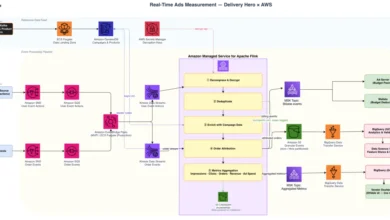
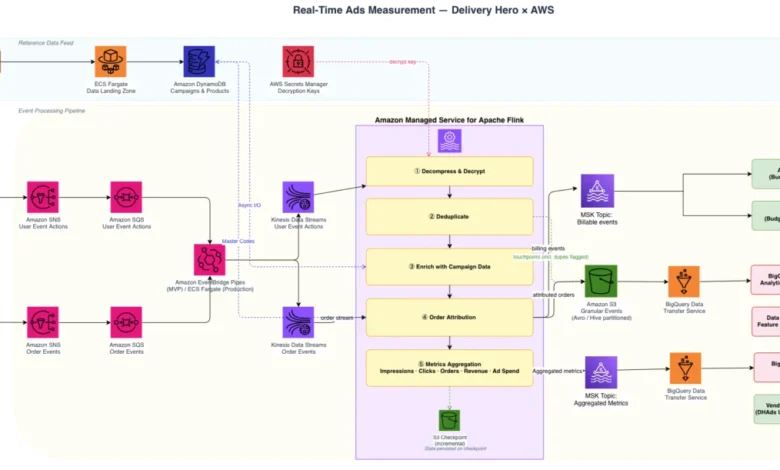
The team selected Apache Flink, managed via AWS, for its native ability to handle event-time watermarks and its RocksDB state backend. The new architecture moves away from synchronous bottlenecks by utilizing the Flink Async I/O API to query campaign and product reference data stored in Amazon DynamoDB. This allows for high-throughput enrichment without blocking the core processing pipeline.
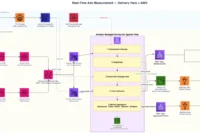
The pipeline now functions in five distinct stages:
- Ingestion and Decryption: Secure ingestion of user tokens via Amazon Kinesis Data Streams.
- Deduplication: Dropping duplicate events that occur during recovery phases to ensure billing accuracy.
- Enrichment: Retrieving campaign and product context via DynamoDB.
- Attribution and Aggregation: Calculating performance metrics in real-time.
- Egress: Delivering billing events and metrics to Apache Kafka for consumption by budget and ad-serving services.
This design enables a "checkpoint-to-S3" mechanism, which provides a resilient recovery path. If a failure occurs, the system resumes from the last incremental checkpoint rather than attempting to re-calculate hours of lost data.
Quantifiable Gains and Operational Impact
The shift to real-time measurement has produced measurable improvements in both data accuracy and operational cost. The processing latency has plummeted from 61 minutes to just 1.2 seconds, a reduction of over 98 percent. This shift allows the ad server to make decisions based on current user activity, rather than reconciling performance after the fact.
Beyond latency, the system’s data quality has reached unprecedented levels. The "missing session rate," which plagued the legacy system at 30 to 40 percent, has been effectively eliminated. Similarly, the rate of missing impression timestamps, which previously stood at 91 percent, has been reduced to 0.2 percent. These improvements provide a much cleaner data foundation for machine learning models that manage campaign ranking and conversion-rate estimation.
Financially, the move has been equally transformative. By decoupling enrichment from ingestion and eliminating the overhead of managing self-hosted infrastructure, the company has reduced monthly operational costs by 57 percent. This represents a significant optimization of the company’s capital expenditure, allowing resources to be redirected toward further innovation in personalization and AI-driven recommendations.
Implications for the Advertising Industry
The success of Delivery Hero’s migration highlights a broader trend in the digital advertising sector: the transition from batch-oriented reporting to streaming analytics. As advertising markets become more competitive, the accuracy of attribution and the speed of budget adjustment are becoming the primary differentiators for platforms.
The capability to perform "replayable history" is perhaps the most significant long-term improvement for the engineering team. By persisting raw events to Amazon S3 in Avro format immediately upon arrival, the team can deterministically reprocess data if a logic error is discovered. This replaces the previous, manual-heavy "reconciliation" process with a robust, automated workflow.
Industry analysts observe that this architecture serves as a blueprint for other high-traffic, transactional platforms. By utilizing managed cloud services to handle the complexities of distributed state management and back-pressure, companies can focus on business logic rather than infrastructure maintenance.
Looking Toward Future AI Integration
With the real-time measurement pipeline firmly in place, Delivery Hero is now positioned to leverage this data for more advanced applications. The company is currently exploring ways to feed these live interaction streams directly into personalization ranking models. Furthermore, the availability of real-time, high-fidelity data provides the necessary "grounding" for Large Language Models (LLMs) used in automated recommendations.
The success of this project demonstrates that for massive, distributed platforms, reliability and real-time processing are not competing interests—they are interdependent requirements. As Delivery Hero continues to scale its operations across Asia, Europe, and the Middle East, this new architecture provides the necessary agility to react to market changes in seconds, ensuring that every ad dollar is accounted for with precision.
The transition also signals a shift in the role of the data engineer at major delivery platforms. Rather than spending time on manual database maintenance and troubleshooting batch-job failures, the team is now empowered to build sophisticated, event-driven systems that contribute directly to the platform’s bottom line. For Delivery Hero, the measurement pipeline is no longer just a reporting tool—it is a critical engine driving the efficiency of their global advertising marketplace.