The Evolution of RAG and the Chunking Problem
Retrieval-augmented generation functions by pairing an LLM with an external vector database. When a user submits a query, the system searches the database for relevant "chunks" of text to provide the LLM with context. Historically, early RAG implementations relied on "naive" chunking, which simply sliced text into fixed-size segments. While efficient, this approach frequently ignored paragraph breaks, headers, and thematic shifts, often splitting a single concept across two disparate chunks.
The industry has since moved toward more nuanced strategies. Data scientists now recognize that the "semantic integrity" of a chunk is as important as the model’s ability to process it. Recent benchmarks from organizations like Pinecone and Weaviate suggest that optimizing chunk boundaries can improve retrieval accuracy by as much as 20% to 30% in complex, domain-specific corpora.
A Structured Decision-Tree Framework
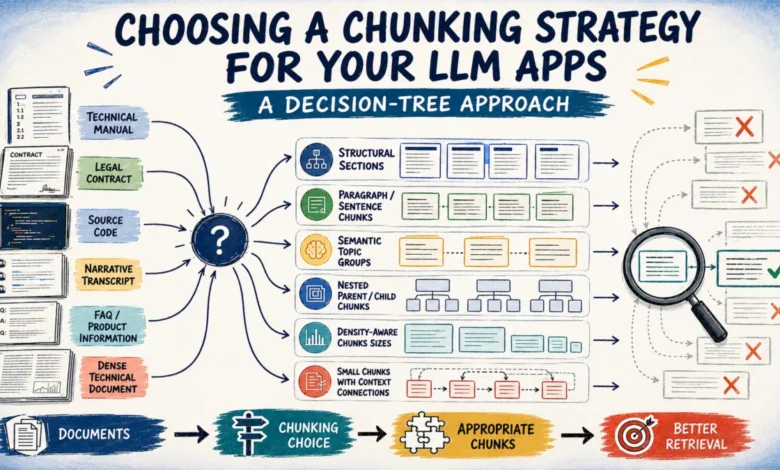
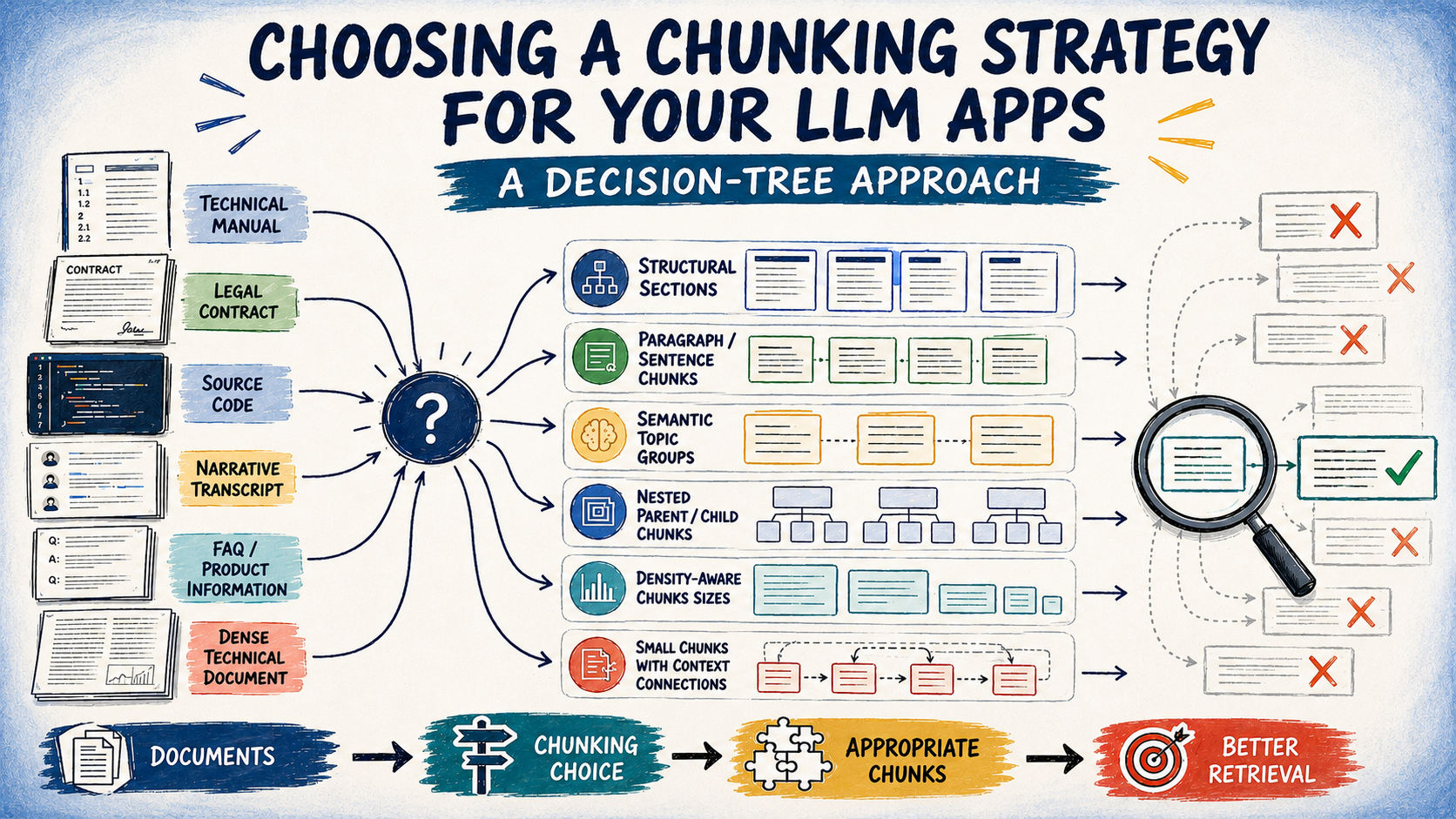
To eliminate the guesswork in preprocessing, engineers are increasingly adopting a six-stage decision-tree model. This systematic approach forces developers to evaluate the physical and logical properties of their data before committing to a technical architecture.
Phase 1: The Preliminary Assessment
The first step is to evaluate the necessity of chunking itself. Not all documents require segmentation. For FAQ databases, concise product descriptions, or granular configuration files, the content often fits entirely within a single embedding window. Splitting these items into smaller pieces can actually degrade performance by removing the document’s inherent context, forcing the system to re-assemble disparate segments during the generation phase.
Phase 2: Evaluating Document Architecture
If a document exceeds the context window, the next inquiry concerns its structural integrity. Does the document utilize Markdown, HTML, or structured schema? Document-based chunking is the preferred method here, as it preserves the logical boundaries established by the author. By treating headings and sub-sections as natural breaking points, the retrieval system maintains the hierarchical intent of the original text.
Phase 3: Contextual Dependencies and Global Meaning
A significant challenge in legal and technical documentation is the presence of "cross-document dependencies." For instance, a contract might define a specific liability clause on page one that is referenced via shorthand throughout the remaining fifty pages. In these scenarios, traditional chunking fails because the individual chunks lack the necessary definitions. The emerging solution is "late chunking," where the entire document is processed through a long-context model to capture global meaning before it is partitioned into smaller, context-aware segments.
Phase 4: Density and Granularity
Information density is rarely uniform across large datasets. A technical manual, for example, may alternate between high-density procedural instructions and low-density introductory text. Adaptive chunking strategies allow systems to adjust the size of the partition based on the density of the information. Similarly, hierarchical chunking—which creates both large, summary-level chunks and small, detail-level chunks—ensures that the retrieval system can effectively answer both broad, thematic questions and narrow, fact-specific queries.
Strategic Trade-offs: The Cost of Precision
Choosing a chunking strategy is fundamentally a exercise in resource allocation. Every added layer of sophistication—such as LLM-based chunking, where an AI is tasked with determining the most logical breakpoints—incurs significant computational costs.
| Strategy | Computational Cost | Retrieval Quality | Implementation Difficulty |
|---|---|---|---|
| Fixed-Size | Negligible | Low | Low |
| Recursive | Low | Moderate | Low |
| Semantic | Moderate | High | Moderate |
| LLM-Based | High | Very High | High |
| Agentic | High | Very High | High |
The current industry standard for large-scale, uniform corpora remains recursive chunking. It offers a reliable balance, splitting content at paragraph and sentence boundaries until the target size is reached. However, for heterogeneous datasets—collections containing a mix of code, narrative reports, and tabular data—the trend is shifting toward "agentic chunking." In this paradigm, an autonomous agent inspects each document upon ingestion and dynamically selects the most appropriate strategy for that specific file type.
Addressing Common Failure Points
Field reports from early RAG adopters indicate that even well-designed strategies face common failure modes. A frequent issue is the "cut-sentence" phenomenon, where a system consistently divides sentences in half, rendering the embedding vector incoherent. The most common correction is the implementation of a recursive strategy that prioritizes sentence endings over arbitrary token counts.
Another common pitfall is the miscalibration of semantic thresholds. In semantic chunking, systems calculate the "distance" between embeddings to determine when a topic has shifted. If the threshold is too high, the system may group unrelated topics into a single, massive chunk. If too low, it may over-fragment a single, coherent thought. Regular audit cycles—where human operators review the retrieved chunks—are essential for fine-tuning these thresholds.
Broader Implications for AI Infrastructure
The emphasis on intelligent chunking reflects a maturation of the AI sector. As organizations move beyond initial proofs-of-concept, the focus is shifting from "getting the LLM to talk" to "ensuring the LLM talks accurately." The quality of the retrieval system is now recognized as a limiting factor in AI performance, often more so than the underlying generative model itself.
Future advancements are expected to focus on automated, self-correcting chunking pipelines. By integrating feedback loops, systems may eventually be able to "learn" which chunking strategies result in the highest downstream accuracy, automatically adjusting parameters without human intervention.
For now, the most effective path for engineers is to start with a standard recursive approach and introduce complexity only when data quality issues necessitate it. By treating chunking as a foundational architectural decision rather than an afterthought, developers can build RAG systems that are not only more accurate but also more resilient to the complexities of real-world documentation. As the volume of enterprise data continues to grow, the ability to effectively parse and contextualize that information will remain the defining feature of successful AI implementation.