Getting Reliable Structured Outputs from LLMs: Validation, Retries and Constrained Decoding

The industry currently faces a "semantic gap" in automated data extraction. While tools like OpenAI’s Responses API, vLLM’s xgrammar, and various Python SDKs provide mechanisms to force a model to output a specific structure, these tools operate primarily at the syntactic level. They ensure the parentheses close and the data types align, but they cannot inherently verify the factual integrity of the data against the source document. For example, in automated invoice processing, a model might correctly generate a JSON object with an integer field for "total_cents." If the model misinterprets the currency formatting or performs a calculation error, the resulting JSON will be perfectly valid according to a schema, yet factually disastrous for an accounting system.
The Anatomy of a Modern Data Extraction Failure
In the current landscape of AI integration, a common failure point occurs when developers treat a successful JSON parse as the final step. Consider an invoice processed for Northwind Traders, where the document states: "Total due: EUR 1,250.00." A model might parse this and return a JSON object containing the ID, currency, and total. If the model incorrectly calculates the total as 12,500 cents (125 EUR) instead of the actual 125,000 cents (1,250 EUR), the application will ingest this data as "valid." Because the JSON schema only cares that the field is an integer, it will not flag the error.
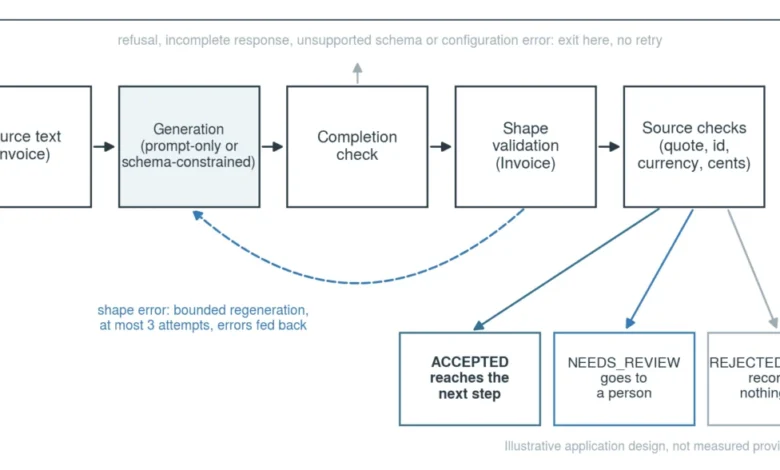
To mitigate this, robust systems are now implementing a multi-layered defense strategy: structural validation, logical cross-referencing with source text, and intelligent, budget-constrained retries. This approach ensures that data is not just "well-formed," but also "grounded."
Establishing a Triple-Layered Validation Framework
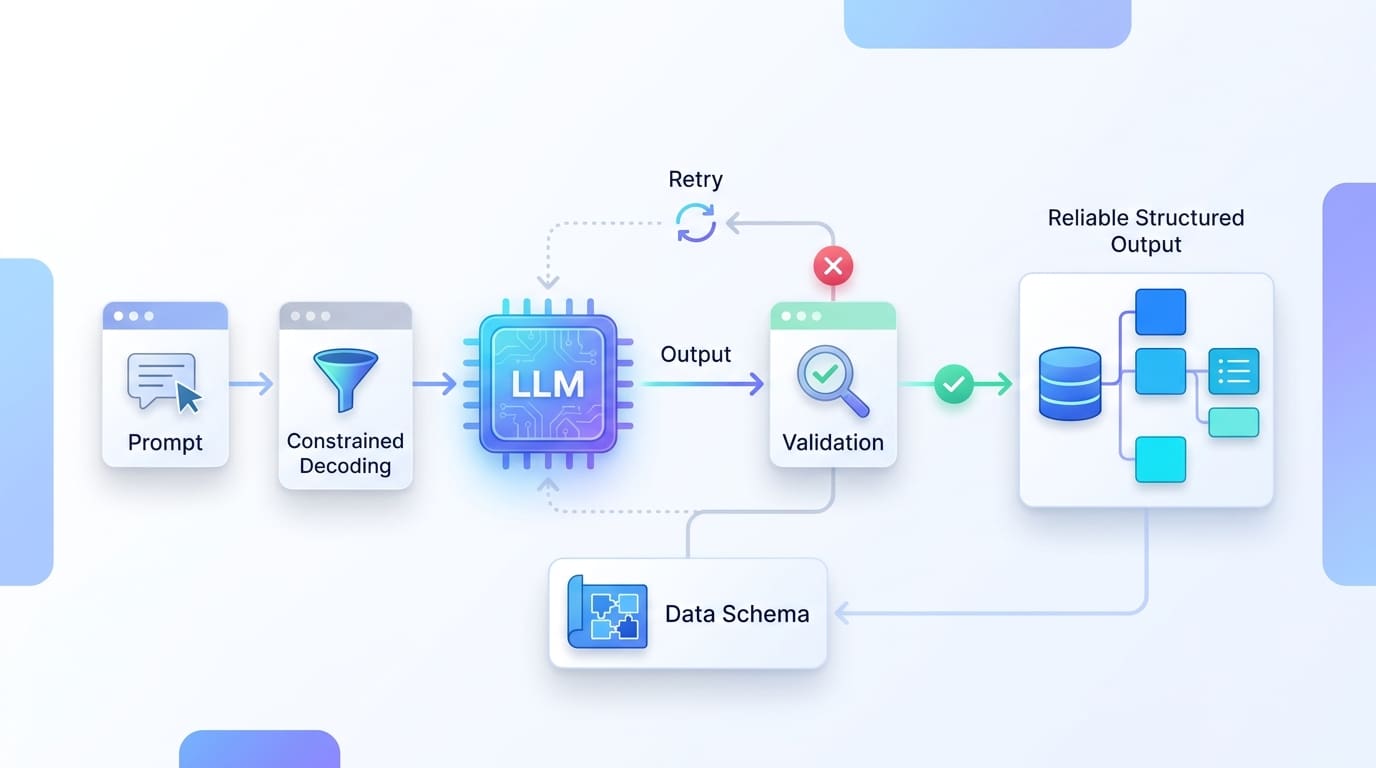
The framework for high-reliability extraction consists of three distinct tiers of operation.
First, structural validation serves as the "gatekeeper." By using tools like Pydantic in strict mode, developers can enforce that incoming data conforms to a defined contract. Setting strict=True in Pydantic is a vital configuration, as it prevents the model from coercing data types—such as converting a string "125000" into an integer—which can mask underlying generation issues. Furthermore, using extra="forbid" ensures that the model does not hallucinate extraneous fields that might confuse downstream logic.
Second, logical validation—or cross-referencing—is where the system checks the model’s output against the source document. This requires an "Acceptance Layer" that operates after the parser. This layer verifies that the extracted total_quote string actually exists in the original source text. It performs a calculation check: if the invoice shows 1,250.00, the system manually calculates the cents from the source text and compares it against the model’s integer output. If they diverge, the result is rejected immediately, regardless of whether the JSON is syntactically perfect.
Third, constrained decoding acts as the final guardrail. Unlike prompt-based instructions, which are suggestions to the model, constrained decoding masks the model’s token-selection process during generation. By restricting the model to only select tokens that maintain structural validity, the system mathematically prevents the generation of malformed JSON, thus reducing the need for costly and time-consuming retries.
The Logic of Controlled Retries
A frequent mistake in implementing LLM pipelines is the use of infinite loops or excessive retry budgets. Research into production latency suggests that if a model cannot produce a valid structure after three attempts, it is likely encountering a fundamental ambiguity in the source text or a failure in its internal logic that a fourth or fifth attempt will not resolve.
The current recommended industry policy for retry logic is as follows:
- Shape Errors: Only these should trigger a retry, as they indicate the model failed to follow the structural schema.
- Logical/Validation Errors: These should be treated as terminal "rejected" states. If the model extracts a value that contradicts the source text, asking it to "try again" without providing the specific evidence of why it failed is ineffective.
- Refusals: If a model refuses to generate output, or if the API returns a configuration error, the pipeline must stop to prevent cascading failures.
By limiting the retry budget to three attempts, developers can manage latency and prevent "zombie" processes that consume excessive API costs without providing actionable data.
Broader Implications for Enterprise AI
The shift toward these rigorous validation frameworks reflects a maturing understanding of AI’s role in enterprise workflows. In the early 2020s, the focus was on the capability of the model to understand context. Today, the focus has shifted to "AI determinism"—the ability to make non-deterministic models perform in deterministic environments like ERP, CRM, and accounting systems.
The financial sector, in particular, is leading this charge. With regulations requiring strict audit trails for automated financial processing, the ability to trace an extracted value back to a specific segment of the source text is no longer optional. The use of "Needs Review" states for ambiguous or missing data is a critical component of human-in-the-loop (HITL) systems, ensuring that when an LLM cannot definitively identify a value, it does not "guess," but rather escalates the task to a human agent.
Technical Recommendations for Future-Proofing
For organizations currently building these pipelines, the consensus among machine learning architects is to decouple the contract from the prompt. The schema should be owned by the application, not the LLM. When using modern SDKs like the OpenAI Python SDK, developers should move toward client.responses.parse methods, which integrate the Pydantic model directly into the decoding process.
However, even with these advances, the "human-in-the-loop" component remains essential. As models continue to improve in their reasoning capabilities, the role of the validation layer will not disappear; instead, it will evolve to handle more complex cross-document dependencies. Developers should prioritize observability—logging every stage of the validation process, including the specific loc, type, and msg of Pydantic errors—to create a feedback loop that informs future prompt engineering.
In conclusion, the path to reliable structured output from LLMs is not found in a single prompting technique, but in a disciplined engineering architecture. By combining schema enforcement, source-text cross-referencing, and controlled, state-aware retry policies, developers can bridge the gap between the probabilistic nature of generative AI and the deterministic requirements of enterprise-grade software. The goal is a system that treats every output as a candidate to be proven, rather than a fact to be blindly trusted.