The Evolution of Agentic AI Architecture: From Monolithic Orchestration to Specialized Swarms by Mid-2026.

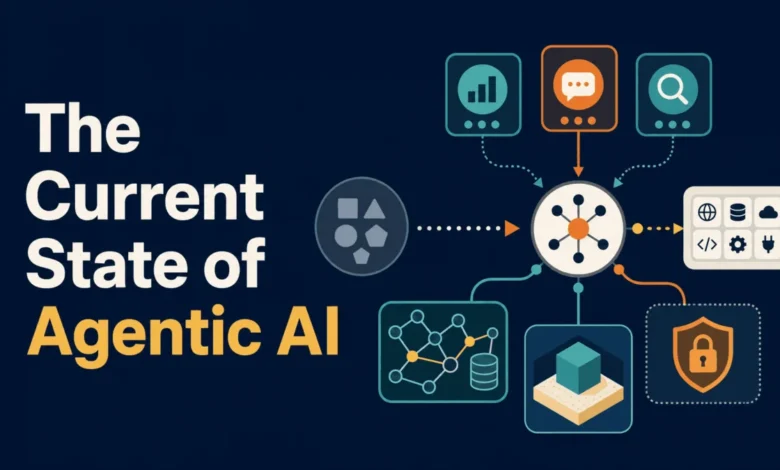
By mid-2026, the landscape of agentic AI architecture has undergone a profound transformation, moving decisively away from the brute-force orchestration paradigms that dominated just a year prior. This shift marks a maturation of AI engineering, characterized by the rise of highly specialized multi-agent swarms, the standardization of critical tool protocols, and the integration of native reasoning capabilities directly into foundation models. The era of the monolithic, all-encompassing agent is rapidly fading, replaced by an ecosystem of interconnected, intelligent microservices designed for efficiency, scalability, and enhanced security.
The Paradigm Shift: Native Reasoning and Decentralized Intelligence
Historically, AI engineers in early 2025 dedicated considerable effort to hand-crafting complex Reasoning and Acting (ReAct) loops. These intricate prompt chains were designed to compel single, massive language models to juggle multiple cognitive tasks simultaneously: planning, executing tools, and managing extensive context. This approach, while effective in demonstrating early agentic capabilities, proved inherently brittle, resource-intensive, and prone to latency issues, particularly in production environments.
A pivotal change has been the integration of "System 2" thinking directly into the architecture of modern foundation models. These advanced models now natively handle test-time computation, generating hidden reasoning tokens, exploring multiple solution branches, and self-correcting internally before producing a final output. This fundamental architectural upgrade renders much of the external scaffolding previously built to simulate reflection or multi-step planning redundant. Industry reports from Q1 2026 indicated a 30-40% reduction in external orchestration code for complex agent tasks in systems leveraging these new native reasoning models, alongside a 20% average improvement in inference latency for equivalent tasks. This internal cognitive processing has liberated AI engineers from the burden of designing elaborate, external cognitive loops, allowing them to redirect their focus to higher-level system design, such as routing, state management, and environment execution within a multi-agent framework.
The Rise of Agent Swarms: A Microservices Approach to AI
With the cognitive overhead largely absorbed by the models themselves, engineering efforts have pivoted towards decomposing complex problems across multiple specialized agents. This has given birth to the "agent swarm" paradigm, akin to a microservices architecture for AI. Instead of a single, overburdened agent attempting to manage dozens of tools and responsibilities, swarms consist of collections of smaller, highly specialized agents communicating via standardized protocols.
This approach offers significant advantages in modularity, testability, and resilience. For instance, a complex data analysis request might no longer be handled by one giant agent. Instead, a ‘Triage Agent’ would route the initial request, passing it to a ‘Data Fetcher Agent’ specialized in SQL queries. Once raw data is retrieved, the ‘Data Fetcher’ would transfer the context to a ‘Data Analyst Agent’ equipped with Python pandas capabilities for insight generation. This modularity not only makes each component easier to develop and debug but also allows for the use of more cost-effective and faster models (like current-generation small language models or specialized domain models) for individual nodes, reserving larger, more capable models primarily for complex routing, synthesis, or high-stakes decision-making. Preliminary data from early adopters in enterprise settings suggests that agent swarms can reduce overall operational costs by up to 25% for certain workflows by optimizing model usage and improving processing parallelism. Leading AI platform providers, such as OpenAI and LangChain, have rapidly developed SDKs and frameworks like the OpenAI Agents SDK and LangGraph Swarm to facilitate the creation and management of these multi-agent systems, signaling broad industry endorsement of this architectural shift.
Standardizing Interoperability: The Model Context Protocol (MCP)
The burgeoning complexity of connecting multiple agents to real-world systems necessitated a standardized approach to tool integration. Historically, connecting an AI agent to an external API was a tedious process, demanding custom JSON schemas, bespoke HTTP request handling, and error-prone parsing logic for every new integration. This "reinventing the wheel" for each API connection became a major bottleneck for rapid development and scalability.
The Model Context Protocol (MCP) has emerged as the definitive open standard addressing this challenge. MCP functions as a universal adapter, creating a unified interface between AI models and diverse local or remote data sources and services. Rather than embedding API keys directly into agent environments or writing custom wrappers for every tool, agents now connect to an isolated MCP server. This server automatically exposes available tools and resources in a standardized format, with execution occurring securely on the MCP server itself, thereby separating concerns and enhancing security.
The impact of MCP has been transformative. Development teams report a 50% acceleration in API integration times, as engineers can now "plug-and-play" pre-built MCP servers for common platforms like GitHub, Slack, or PostgreSQL into their agent swarms without writing extensive underlying API wrappers. While careful credential management on the server side remains crucial, the integration surface for developers has been drastically reduced, fostering greater interoperability and accelerating the deployment of agentic systems across diverse enterprise environments.
Continuous Learning through Memory Graphs: Beyond Per-Call Statelessness
A long-standing promise of agentic AI has been the ability for systems to learn and improve autonomously from their own execution history. By mid-2026, this vision is being realized through the widespread adoption of "memory graphs." This architectural pattern cleverly reconciles the need for lean, per-call statelessness in individual agents with the critical requirement for persistent, system-level memory.
Individual agents within a swarm continue to operate in a stateless manner per invocation, ensuring context windows remain efficient and manageable. However, the overall system maintains a persistent, evolving memory through a graph database, such as Neo4j or similar managed alternatives. This memory is not static; it is dynamically updated and injected into relevant agent context pipelines as needed.
The mechanism typically involves a specialized ‘Memory Agent’ operating asynchronously in the background. Its sole purpose is to observe the main swarm’s trajectory, analyze execution logs and outcomes, extract salient facts, and update the graph database with new knowledge, relationships, and successful patterns. When a new task arises, the graph is queried, and relevant information (e.g., prior successful strategies, user preferences, factual data points) is retrieved and fed into the appropriate agent’s context. This enables the system to learn from past interactions, adapt to evolving environments, and avoid repeating errors, effectively moving the focus from "prompt engineering" to "context engineering." Early benchmarks demonstrate that systems leveraging memory graphs can achieve a 15-20% improvement in task completion rates and efficiency over time, without requiring costly model fine-tuning. This continuous learning capability is a cornerstone for truly adaptive and intelligent autonomous systems.
Navigating the Security Landscape: The Swarm Attack Surface
The sophisticated, interconnected nature of multi-agent systems, particularly when coupled with universal protocols like MCP, has significantly expanded the attack surface for malicious actors. The threat of "AIjacking"—indirect prompt injections designed to hijack automated workflows—has become a primary concern for enterprise adoption. The swarm architecture, while offering immense utility, also presents a structurally more dangerous security profile than the monolithic models of the past.
The danger lies in the lateral pivot. If an ‘Email Processing Agent’ designed to read external communications can transfer context and control to a ‘Database Access Agent,’ a cleverly crafted malicious instruction embedded within an email could traverse the swarm laterally, mirroring traditional network intrusion patterns. The very handoff mechanisms that make swarms so powerful also render them susceptible to complex, multi-stage attacks.
In response, three critical defenses are rapidly converging as industry best practices:
- Granular Permission Models: Moving beyond simple API key management, these models implement sophisticated role-based access control (RBAC) specifically tailored for agents. Each agent is granted the minimum necessary permissions for its defined function, similar to the principle of least privilege in traditional software security. An ‘Email Agent’ would only have permissions to read and parse emails, not to access sensitive databases, even if it could theoretically transfer context to an agent that does.
- Context Sanitization and Validation: Implementing robust filtering and validation layers at every inter-agent communication point is crucial. This involves automatically scanning incoming context and instructions for known malicious patterns, anomalous requests, or attempts to bypass security directives before control or data is transferred. Advanced semantic analysis and even dedicated ‘Security Agents’ are being deployed to scrutinize communication payloads.
- Formal Verification and Behavioral Auditing: As swarms become more complex, formal methods are gaining traction to mathematically prove certain safety properties of agent interactions and workflows. This is complemented by continuous behavioral auditing, where AI-powered monitoring systems track agent actions, identify deviations from expected behavior, and flag potential compromises in real-time. These proactive measures aim to detect and mitigate threats before significant damage occurs.
While not yet universally standardized, these three pillars represent the active frontier of production agentic security. For any organization deploying swarms today, integrating at least one of these defense mechanisms is becoming a baseline requirement, as the cost of a compromised agent swarm could be substantial.
The Path Forward: Engineering for Resilience and Specialization
Agentic AI has transcended its origins as a research curiosity, evolving into a mature engineering discipline fraught with real constraints, identifiable failure modes, and critical design decisions at every layer. The foundational primitives—native reasoning, sophisticated tool calling, and intelligent routing—are maturing at an unprecedented pace. Consequently, the primary leverage for innovation and success now resides in the systems layer: how organizations design the swarm topology, architect persistent memory to foster compounding knowledge, and establish robust security boundaries that enable these systems to operate safely and effectively at scale.
The leading teams in this space are no longer fixated on developing incrementally "smarter" individual agents. Instead, their efforts are concentrated on constructing more resilient, specialized, and secure swarms. For newcomers, the recommended approach is to adopt one of the established architectural patterns, implement it at a manageable scale, and rigorously instrument its performance and security. The architectural intuitions gained from developing a three-agent swarm are directly transferable and scalable to a thirty-agent enterprise system, paving the way for the next generation of autonomous AI applications.