Scaling Enterprise AI Governance: Integrating Okta Cross App Access and Amazon Bedrock AgentCore Gateway

Enterprise artificial intelligence adoption has evolved past the phase of isolated proofs of concept and experimental task execution. Organizations are actively deploying autonomous agents at scale to interact with internal APIs, customer data, and legacy infrastructure. However, this proliferation creates significant security and architectural challenges, particularly regarding authentication, authorization, and centralized auditing. In Part 1 of this architectural series, developers explored how to implement a localized, single-agent topology using Amazon Bedrock AgentCore, Model Context Protocol (MCP) servers, and Okta Cross App Access (XAA). While effective for validating the core delegation mechanism, that setup relied on a tightly coupled wiring matrix that becomes untenable when managing hundreds of agents and thousands of downstream tools.
To address these enterprise scalability hurdles, security architects must transition from point-to-point connections to a centralized, policy-driven gateway architecture. By decoupling agent identities from tool-specific credentials and centralizing access decisions, organizations can maintain rigorous compliance without sacrificing operational agility. This report examines the technical transition to Amazon Bedrock AgentCore Gateway, the integration of Cedar policy engines, the incorporation of heterogeneous compute environments like Amazon Elastic Kubernetes Service (Amazon EKS), and the harmonization of distributed telemetry through Amazon CloudWatch Omni.
Architectural Limitations of Point-to-Point Agent Topologies
In early-stage AI deployments, configuring an agent to hold runtime Amazon Resource Names (ARNs) for every Model Context Protocol server works well. The agent calls each server directly, embedding authorization logic directly into the application code of each downstream service. However, as business units deploy multiple agents interacting with a vast library of microservices, this point-to-point model introduces severe scaling friction.
First, the complexity of the wiring matrix grows exponentially. Every newly introduced tool or microservice requires direct integration adjustments across every agent authorized to use it. Second, security risks increase when individual agent roles possess direct token-exchange permissions and read paths for provider secrets. In a large enterprise, granting every user-acting agent a direct credential path to every accessible resource expands the attack surface unnecessarily. Finally, replicating identical authorization logic—such as user group validation—across thousands of individual servers inevitably leads to policy drift. When authorization rules are duplicated in disparate codebases, auditing changes becomes virtually impossible, and compliance reporting suffers.
Transitioning to a Centralized Gateway and Policy Framework
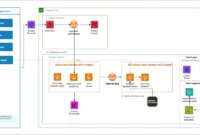
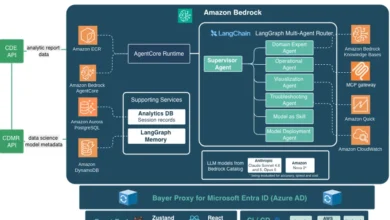
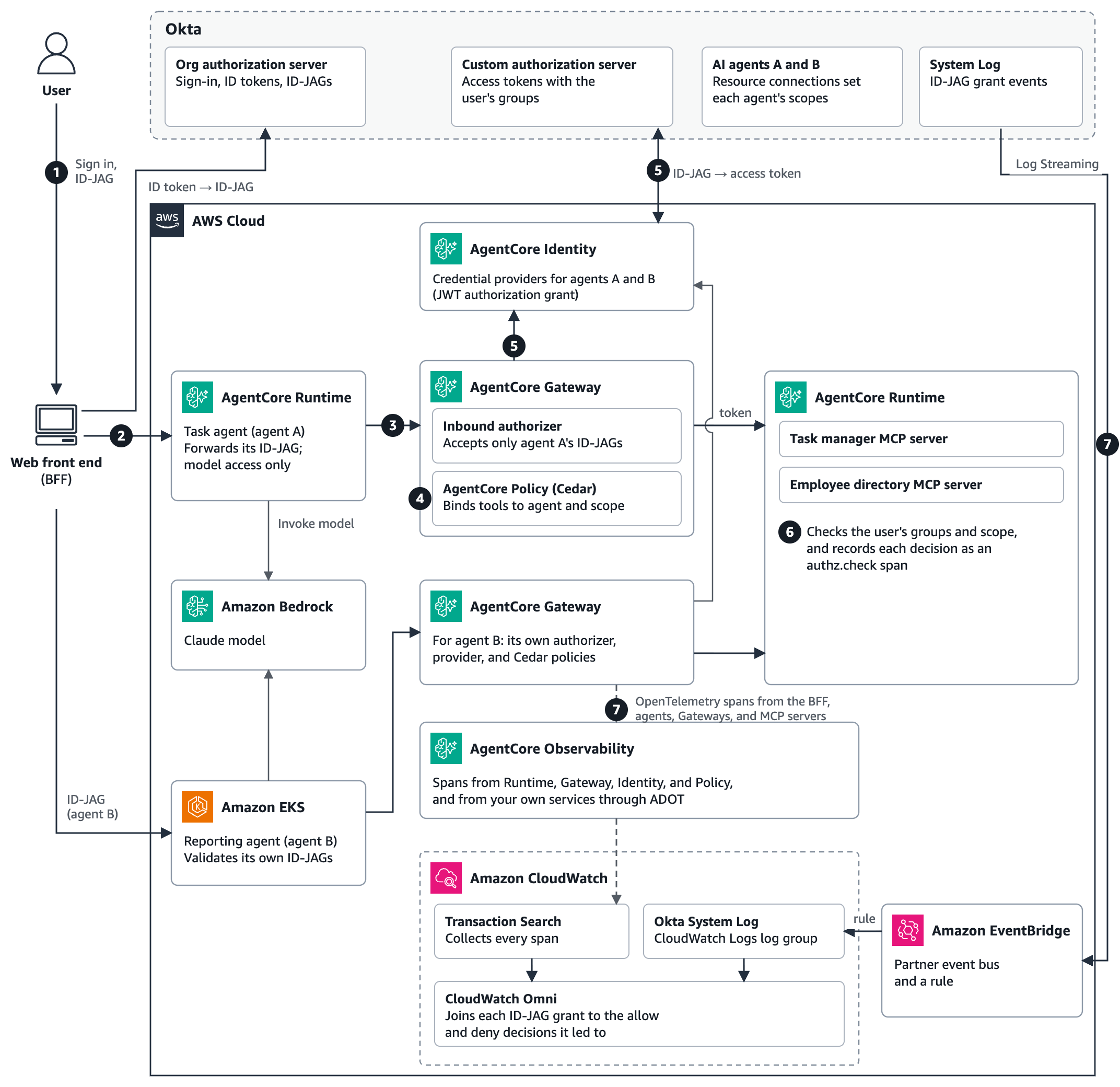
To resolve these enterprise bottlenecks, modern cloud architectures implement a centralized front door. Amazon Bedrock AgentCore Gateway replaces direct agent-to-server calls with a single managed endpoint that maintains an underlying target registry.
Under this advanced paradigm, the agent no longer manages individual server connections or holds token-exchange permissions. Instead, the agent forwards its inbound Identity Token-Exchange Grant (ID-JAG)—issued securely by Okta—directly to the Gateway. The Gateway assumes responsibility for redeeming the grant via centralized credential providers, completely shielding the agent from underlying resource secrets.
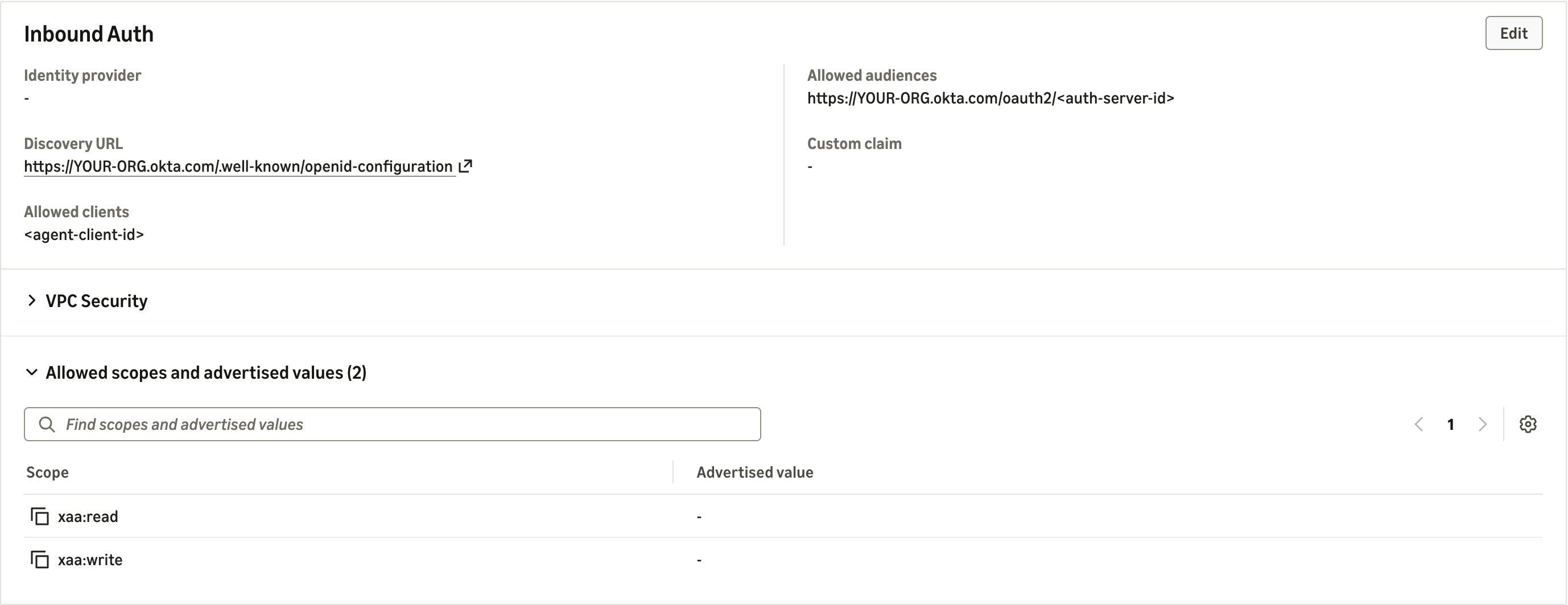
Furthermore, access control shifts from decentralized application code to centralized policy enforcement. By integrating Cedar, an open-source policy language designed for fine-grained authorization, security teams can define declarative, default-deny policy sets that bind specific tools to authorized agents and delegated scopes. These policies are evaluated at the Gateway level before any tool execution occurs. If a policy fails to explicitly permit an action, the system denies it by default, ensuring strict adherence to the principle of least privilege.
Expanding Deployment Topologies: Running Agents on Amazon EKS
Enterprise architectures rarely operate within a single, homogeneous runtime environment. Organizations frequently leverage hybrid deployments spanning managed serverless platforms and containerized orchestrators. To demonstrate that centralized governance mechanisms are runtime-agnostic, security engineers can deploy secondary agents on container orchestration platforms such as Amazon Elastic Kubernetes Service (Amazon EKS).
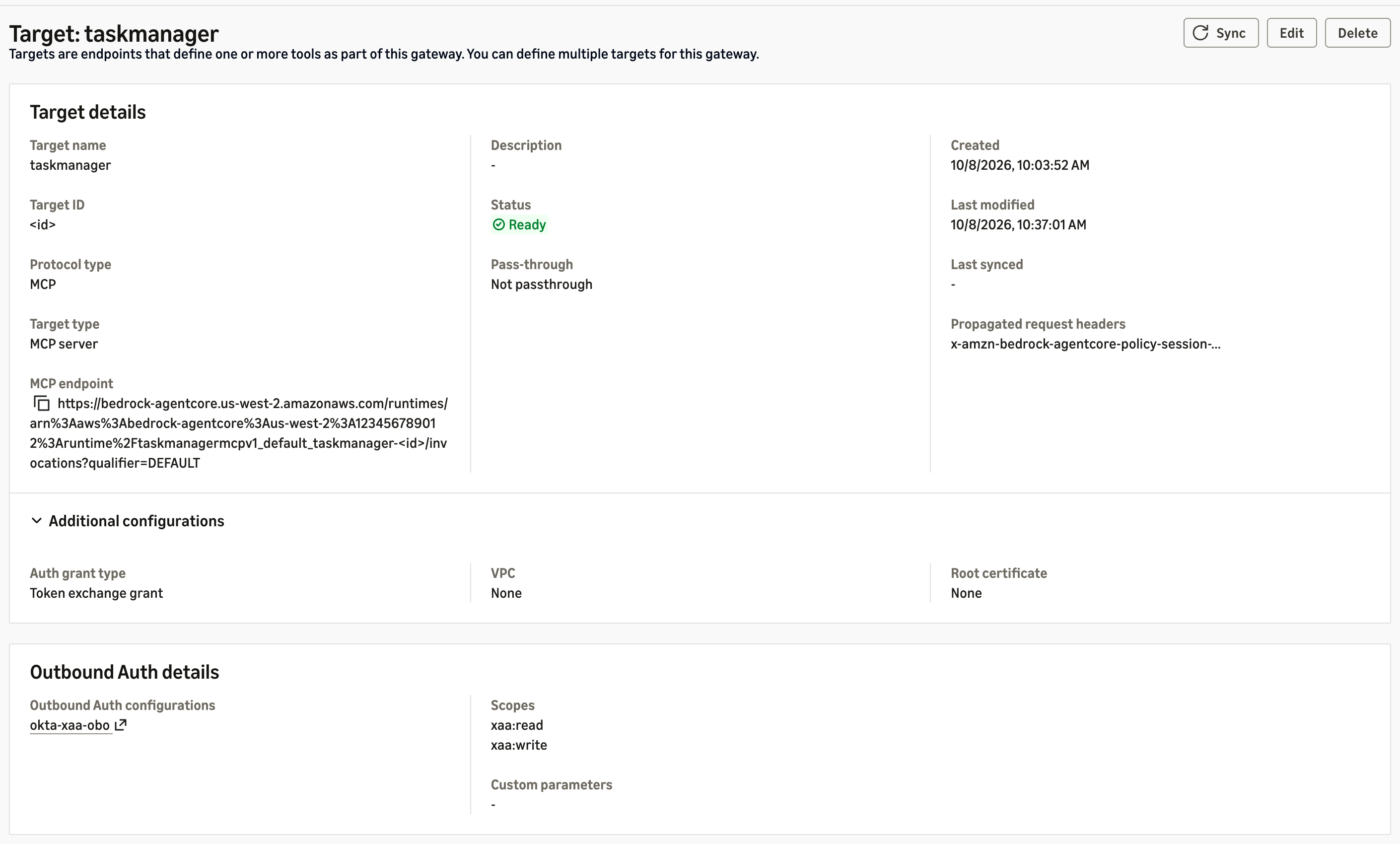
In this multi-environment configuration, a reporting agent hosted on Amazon EKS operates under its own distinct Okta registration while routing requests through its dedicated Gateway endpoint. Pod Identity features assign precise, scoped IAM roles to individual Kubernetes pods, granting only the necessary permissions to invoke models and export telemetry data via the AWS Distro for OpenTelemetry (ADOT). Because external runtimes lack built-in authorizers, these containerized agents independently validate incoming ID-JAG signatures, issuers, audiences, and client identifiers prior to executing model calls. This ensures uniform security enforcement whether an agent executes within serverless infrastructure or container clusters.
Comprehensive Observability and Unified Auditing
Regulatory compliance and operational transparency require end-to-end visibility into every AI-driven decision. Modern enterprise architectures synthesize telemetry data from multiple sources to provide a unified audit trail.
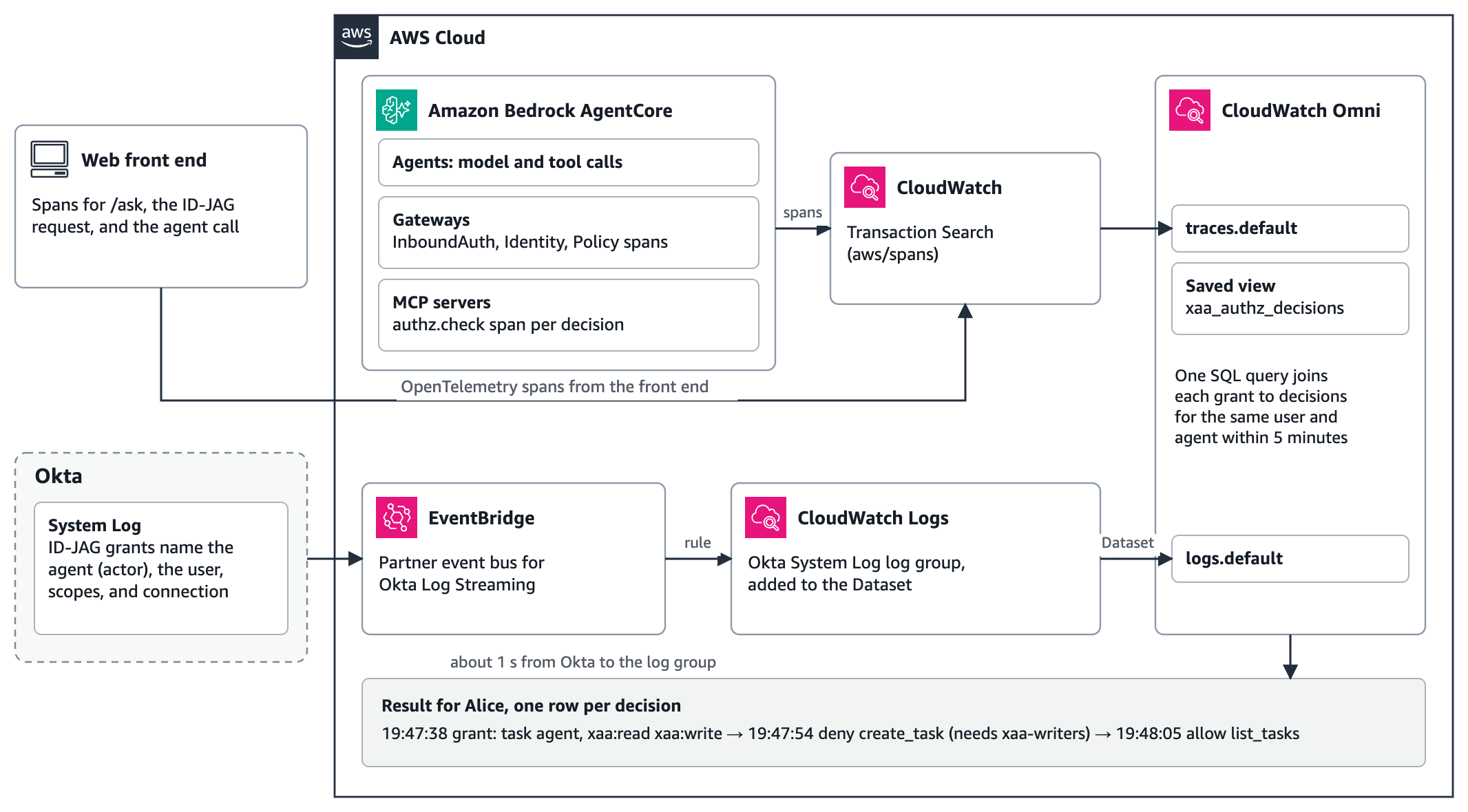
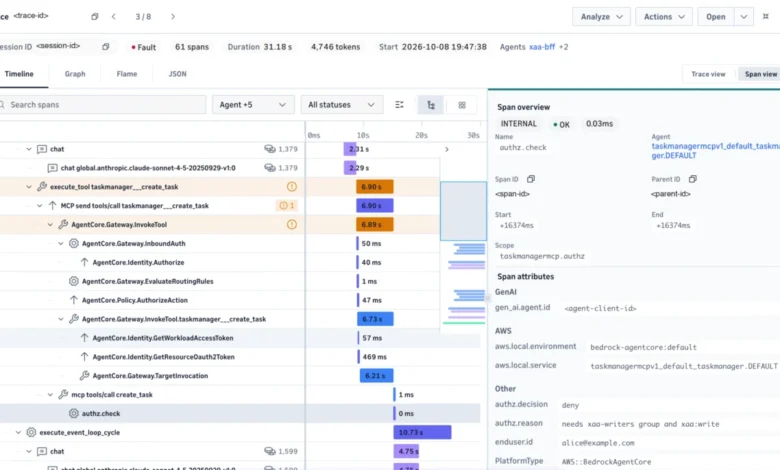
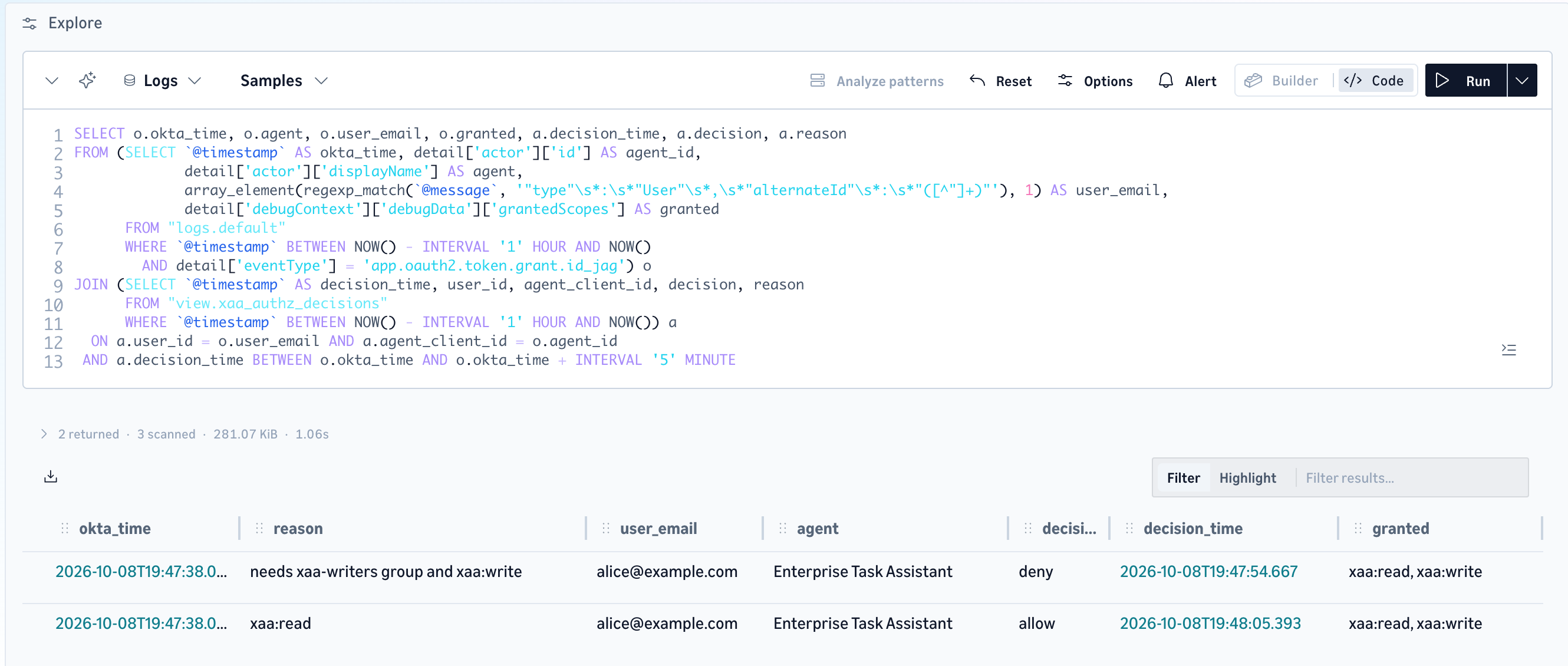
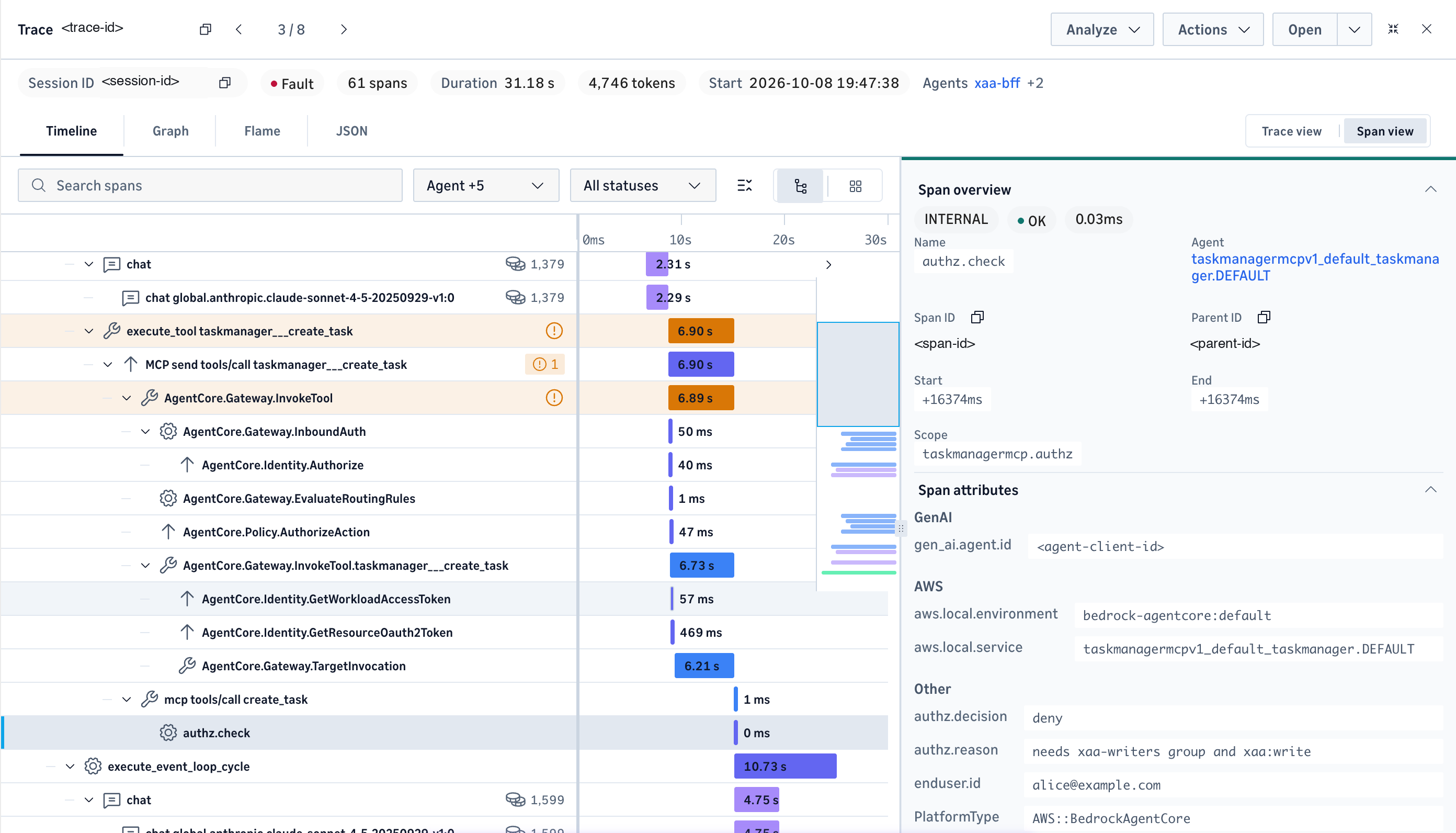
AgentCore Observability automatically captures OpenTelemetry spans across every architectural hop—including inbound authorization checks at the Gateway, Cedar policy evaluations, identity bindings, and tool executions. Concurrently, Okta’s System Log records external authentication and token grant events. By ingesting both AWS telemetry spans and Okta logs into Amazon CloudWatch Omni, security analysts can execute correlated queries that bridge identity provider actions with downstream application decisions.
For example, an enterprise compliance officer can execute a unified query to track a user session from the initial Okta ID-JAG issuance through subsequent policy evaluations and tool access determinations. If a tool execution results in an authorization denial, distributed tracing marks the request accordingly, allowing security teams to isolate the exact control plane component—whether an Okta access restriction, a Gateway identity check, a Cedar policy evaluation, or an MCP server group validation—that rendered the decision.
Comparative Analysis: Cross App Access versus Per-User OAuth Consent
When designing enterprise authentication flows for AI agents, architects must evaluate the operational trade-offs between Cross App Access (XAA) and traditional per-user OAuth consent models.
Cross App Access excels in environments where target applications and authorization servers natively accept ID-JAGs. In this model, enterprise administrators define which agents may act on behalf of specific user groups. End users experience seamless interactions without encountering repetitive consent prompts, while the identity provider evaluates fine-grained policies during each token request. Revocation is rapid; once Okta revokes a user’s privileges, issued tokens expire within a short window, halting subsequent ID-JAG minting.
Conversely, third-party applications or legacy services featuring independent authorization servers—such as GitHub—often rely on per-user OAuth consent frameworks. In these scenarios, individual users must explicitly authorize agent access via interactive consent portals. While necessary for external API integrations, the revocation lifecycle differs significantly. Stored grants in per-user consent workflows can outlive user session suspensions until explicitly terminated via administrative APIs or user disconnection actions. Consequently, security architects must select authentication mechanisms on a per-target basis rather than applying a monolithic policy across the entire enterprise.
Industry Implications and Future Outlook
The implementation of centralized AI governance patterns carries profound implications across highly regulated sectors, including financial services, healthcare, media, and the public sector. As organizations deploy larger fleets of autonomous agents handling sensitive enterprise workloads, the ability to maintain deterministic control, enforce fine-grained authorization, and produce verifiable audit logs is paramount.
By separating agent execution logic from credential management and policy enforcement, enterprises can scale their artificial intelligence initiatives securely. Future developments in this domain will likely focus on advanced online evaluations, automated behavioral scoring of agent outputs against compliance criteria, and real-time anomaly detection within distributed tracing pipelines. Ultimately, establishing robust foundational guardrails ensures that enterprise AI expansion remains secure, auditable, and fully aligned with corporate compliance mandates.