The landscape of enterprise artificial intelligence deployment is undergoing a fundamental economic shift, driven by rapid advancements in open-weight models that offer organizations unprecedented flexibility in balancing computational capability, operational speed, and financial expenditure. In alignment with this industry-wide transformation, Amazon Web Services (AWS) has officially announced the integration of Moonshot AI’s flagship Kimi K3 model into Amazon Bedrock. Representing a significant milestone in generative artificial intelligence infrastructure, Kimi K3 is recognized by its developers as their most capable system to date and the premier open-weight model to achieve a staggering 2.8 trillion parameters. This development expands the robust catalog of open-weight architectures available on the managed service, providing global enterprises with advanced capabilities designed to handle complex, long-horizon coding tasks and intricate knowledge management workflows.
Evolution of Open-Weight Integration on Amazon Bedrock
The introduction of Kimi K3 is the culmination of a sustained, multi-year strategic investment by AWS into open-weight artificial intelligence technologies. Beginning in earnest through 2025 and continuing into 2026, Amazon Bedrock systematically integrated a diverse array of open-weight models originating from prominent global artificial intelligence laboratories and technology providers, including DeepSeek, Google, MiniMax, Mistral AI, Moonshot AI, NVIDIA, OpenAI, and Qwen. This strategy addresses a core enterprise requirement: the need to match specific computational workloads with the precise balance of model intelligence, throughput latency, and cost-efficiency.
To support this expanding portfolio of third-party architectures, AWS concurrently modernized its foundational inference serving technology. Throughout 2026, the Amazon Bedrock platform rolled out native support for advanced operational paradigms, including automated tool calling, structured JSON outputs, chain-of-thought reasoning, real-time response streaming, and standardized application programming interfaces such as the Responses and Chat Completions APIs. Because these enhancements function as native platform capabilities rather than isolated, model-specific integrations, newly onboarded open-weight models immediately inherit these architectural advantages upon availability, significantly reducing the integration burden for enterprise engineering teams.
Technical Architecture and Performance Metrics of Kimi K3
Kimi K3 introduces a suite of advanced technical specifications tailored for intensive, multi-step enterprise operations. According to performance disclosures provided by Moonshot AI, the model achieves an approximate 2.5-fold improvement in scaling efficiency when compared directly to its predecessor, the Kimi K2. This heightened efficiency is paired with native multimodal capabilities, allowing the system to process both textual data and complex visual inputs seamlessly within a unified architecture.
A defining characteristic of Kimi K3 is its expansive 1-million-token context window. This massive capacity enables the model to ingest, analyze, and maintain coherent semantic continuity across extraordinarily large repositories of source code, extensive corporate documentation, and multi-page technical diagrams without losing contextual focus. Such capabilities render the architecture particularly advantageous for software engineering environments, legal analysis, financial auditing, and research-intensive knowledge work that demands sustained continuity over extended interaction horizons.
Furthermore, Kimi K3 distinguishes itself as the first open-weight model hosted on Amazon Bedrock to support explicit prompt caching. In enterprise workflows involving repetitive system instructions, extensive codebase references, or standardized compliance frameworks, applications frequently resend static context across multiple API calls. Explicit prompt caching allows developers to define precise cache breakpoints within prompt prefixes. When subsequent requests match these cached markers, Amazon Bedrock bypasses redundant token processing, yielding measurable reductions in input latency and operational expenditure.
Security Architecture and Data Governance Framework
For large-scale enterprises operating in heavily regulated sectors such as finance, healthcare, and government, the adoption of advanced artificial intelligence models is invariably predicated on stringent data security and privacy guarantees. AWS has structured the deployment of Kimi K3—and all other open-weight models on Amazon Bedrock—around a rigorous governance perimeter designed to protect corporate intellectual property.
All data processed during the inference of Kimi K3 remains strictly confined within the designated AWS data boundary. In accordance with platform security standards, user prompts and model completions are never shared with external model providers, nor are they utilized to train or fine-tune the underlying third-party models. Additionally, zero data retention is enforced by default for all inference requests, ensuring that transaction payloads are purged immediately upon generation. To mitigate internal risk vectors, zero operator access protocols prevent even AWS administrative personnel from inspecting prompts or completion outputs during execution. These layered protections allow organizations to leverage state-of-the-art open-weight models while retaining absolute sovereignty over their proprietary data assets.
Deployment Options, API Integration, and Global Inference Profiles
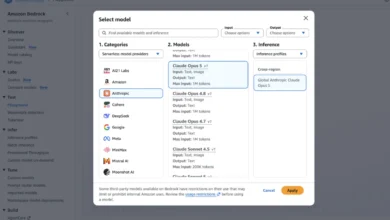
Enterprise developers can access and evaluate Kimi K3 immediately through multiple access points within the AWS ecosystem. For initial exploration, engineers can utilize the Amazon Bedrock console by navigating to the Test and Playground interface, selecting Kimi K3, and executing preliminary prompts in a sandboxed environment.
Programmatically, the model can be invoked via the bedrock-runtime endpoint. Amazon Bedrock supports standard OpenAI-compatible interfaces, including the Responses and Chat Completions APIs, alongside native Amazon Bedrock invocation methods such as the Invoke and Converse APIs. This multi-API compatibility ensures that organizations migrating existing applications from other hosting environments can transition with minimal code refactoring.
To optimize network routing and comply with data residency mandates, Kimi K3 is deployed via cross-Region inference profiles:
- Global Inference Profile (
global.moonshotai.kimi-k3): Recommended for workloads lacking strict geographic localization requirements, this profile dynamically routes requests to any operational commercial AWS Region worldwide. It offers an approximate 10 percent cost reduction compared to geographic profiles. - Geographic Inference Profile (
us.moonshotai.kimi-k3): Designed specifically for workloads subject to strict domestic data residency regulations, ensuring that all data processing remains strictly within the United States geography.
Implementing Explicit Prompt Caching via Python
The integration of explicit prompt caching can be implemented programmatically using standard software development kits. Below is a reference implementation utilizing the OpenAI Python SDK in conjunction with the aws-bedrock-token-generator library for short-term bearer token authentication against Amazon Bedrock:
from aws_bedrock_token_generator import provide_token
from openai import OpenAI

region = "us-west-2"
oai_client = OpenAI(
    api_key=provide_token(region=region),
    base_url=f"https://bedrock-runtime.region.amazonaws.com/openai/v1",
)

SYSTEM_PROMPT = "You are an expert systems architect analyzing large-scale codebases."
USER_INPUT = "Review the caching mechanism in module X and suggest optimizations."

resp = oai_client.responses.create(
    model="global.moonshotai.kimi-k3",
    extra_body="prompt_cache_options": "mode": "explicit",
    input=[

            "type": "message",
            "role": "system",
            "content": [

                    "type": "input_text",
                    "text": SYSTEM_PROMPT,
                    "prompt_cache_breakpoint": "mode": "explicit",
                ,
            ]
        ,

            "type": "message",
            "role": "user",
            "content": [

                    "type": "input_text",
                    "text": USER_INPUT,
                    "prompt_cache_breakpoint": "mode": "explicit",
                ,
            ],
        ,
    ],
)

if resp.usage.input_tokens_details.cached_tokens:
    print("Cache hit successfully registered.")
print(resp.output_text)
Integration with Developer Assistants and Agentic Frameworks
Beyond direct API consumption, Kimi K3 is designed to integrate smoothly into modern developer tooling, automated coding assistants, and multi-agent productivity frameworks that support Amazon Bedrock or OpenAI-compatible backends.
OpenCode Integration
OpenCode, an open-source, model-agnostic coding assistant, features native integration with Amazon Bedrock through its Converse API architecture. Developers can incorporate Kimi K3 by modifying their project or user-level configuration file (opencode.json):
    "$schema": "https://opencode.ai/config.json",
    "model": "amazon-bedrock/global.moonshotai.kimi-k3",
    "provider":
        "amazon-bedrock":
            "options":
                "region": "us-west-2",
                "profile": "default"
Once configured, engineers can utilize the /models command within the OpenCode interface to switch their active session to Kimi K3, enabling the assistant to tackle complex, multi-file software engineering tasks, architectural refactoring, and comprehensive script generation over extended operational windows.
Hermes Agent Integration
For general knowledge management and task automation, frameworks such as Hermes Agent provide native support for Amazon Bedrock models. By configuring the environment with appropriate AWS credentials—either via named CLI profiles or environment variables—users can deploy Kimi K3 to execute complex, autonomous research projects, draft structured institutional reports, and coordinate multi-step operational workflows across desktop and terminal environments.
Broader Industry Implications and Future Outlook
The introduction of a 2.8-trillion-parameter open-weight model with native multimodal capabilities and a 1-million-token context window marks a distinct shift in the economics of enterprise artificial intelligence deployment. Historically, models of this scale were restricted to proprietary, closed ecosystems managed exclusively by primary frontier labs. By making such high-capacity architectures available through managed enterprise infrastructure like Amazon Bedrock, AWS enables organizations of varying scales to harness frontier-class intelligence without forfeiting control over data governance, security posture, or infrastructure deployment topologies.
As enterprises increasingly transition from isolated generative chat applications to complex, multi-agent systems and autonomous coding workflows, the demand for high-context, low-latency infrastructure will continue to intensify. The convergence of expansive parameter scaling, explicit prompt caching, and robust cloud security boundaries establishes a new benchmark for enterprise-grade artificial intelligence readiness. Organizations seeking to evaluate Kimi K3 can access the model immediately through the Amazon Bedrock console across supported global and regional inference profiles, with comprehensive technical documentation and sample implementation repositories available via official AWS developer channels.