Financial institutions globally contend with an immense daily volume of complex documents, ranging from balance sheets and income statements to SEC filings, research reports, and audit materials. The integrity and accuracy of the data extracted from these documents are paramount, as even minor Optical Character Recognition (OCR) errors can propagate through intricate calculations, leading to systematic analytical inaccuracies and potentially significant financial repercussions for organizations. While a singular OCR mistake in a standard legal document might be rectified with a swift manual correction, the same error within financial datasets can trigger a cascade of interconnected miscalculations, severely impacting analytical precision and imposing substantial costs.
Traditional OCR technologies, largely designed to treat documents as static images, frequently prove inadequate for the sophisticated demands of financial data processing. These tools often fail to grasp the nuanced structural relationships, hierarchical data, merged cells, multi-column layouts with embedded references, and context-dependent information that define financial documents. Consequently, critical semantic understanding is lost, resulting in an arduous cycle of manual corrections, protracted data entry delays, and persistent analytical errors that undermine operational efficiency and data trustworthiness. The financial sector, which relies heavily on precision for regulatory compliance, risk management, and strategic decision-making, has long sought a more robust and intelligent solution.
The Evolution of Document Processing: From Basic OCR to Intelligent Automation
The journey of document processing has seen a significant evolution, driven by the ever-increasing need for speed and accuracy in data handling. Early OCR systems, emerging in the mid-20th century, focused primarily on converting scanned images of typewritten or printed text into machine-encoded text. While groundbreaking at the time, these systems struggled with variations in fonts, handwriting, and complex document layouts. The digital age brought advancements, yet even modern traditional OCR often falters when faced with the unstructured and semi-structured nature of contemporary financial documents.
The limitations of traditional OCR spurred the development of Intelligent Document Processing (IDP). IDP leverages artificial intelligence (AI), machine learning (ML), and natural language processing (NLP) to understand, interpret, and extract data from documents, moving beyond mere text recognition to semantic comprehension. This shift is particularly crucial for the financial industry, where the meaning of data elements is heavily dependent on their context within the document. Reports indicate that manual data entry and processing can account for up to 70% of operational costs in some financial departments, with human error rates ranging from 1% to 5% – figures that are unacceptable when dealing with multi-million or billion-dollar transactions.
Introducing a Next-Generation Solution: Pulse AI and Amazon Bedrock Synergy
Addressing these critical challenges head-on, a new paradigm in document understanding is emerging through the strategic integration of Pulse AI’s advanced document processing capabilities with the powerful AI services offered by Amazon Bedrock. This collaboration empowers organizations to achieve enterprise-grade accuracy and extract contextually relevant financial insights at unprecedented scale. Amazon Bedrock, a fully managed service, simplifies model customization with zero machine learning (ML) operations overhead, enables on-demand deployment without requiring extensive capacity planning, and features the Nova model family, renowned for its strong cost-to-performance characteristics. This robust infrastructure allows development teams to concentrate on innovation rather than infrastructure management.
Unlike traditional, monolithic OCR pipelines, Pulse AI ingeniously integrates vision language models (VLMs) with classical ML components specifically engineered for deep document understanding. This intelligent solution is designed to extract structured data with semantic awareness, generate highly improved supervised fine-tuning datasets tailored for financial domain models, and facilitate the deployment of custom large language models (LLMs) trained on an organization’s proprietary financial data. Pulse AI has already been deployed across a spectrum of global enterprises, including Samsung, Cloudera, Howard Hughes, and numerous Fortune 500 financial institutions and leading private equity firms, where it processes high volumes of financial and operational documents with remarkable efficiency.
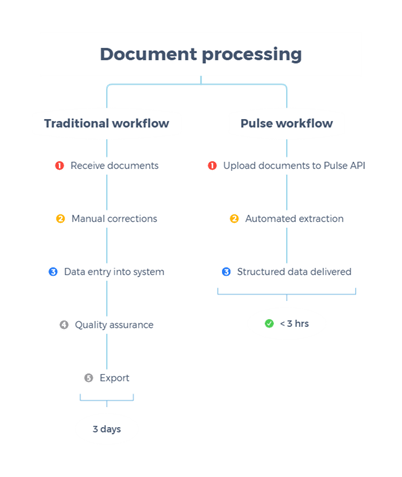
A notable deployment showcased the transformative power of this integrated approach: a batch of approximately 1,000 complex financial documents, which previously demanded a multi-day turnaround for manual processing, was fully processed in under three hours. The output consisted of structured, auditable data, immediately ready for downstream analytics and advanced AI applications. This dramatic improvement in processing speed and data quality underscores the solution’s potential to redefine operational benchmarks in financial services.
A Deeper Dive into the Integrated Workflow
The combined offering of Pulse AI and Amazon Bedrock provides a comprehensive suite of benefits, including enhanced accuracy in data extraction, significant acceleration of document processing workflows, and the ability to build highly specialized AI models tailored to specific financial contexts. The core workflow orchestrates a sophisticated series of steps, starting from raw financial documents and progressing through advanced processing, model fine-tuning, and deployment, culminating in a custom AI solution precisely tuned for financial data analysis and insights.
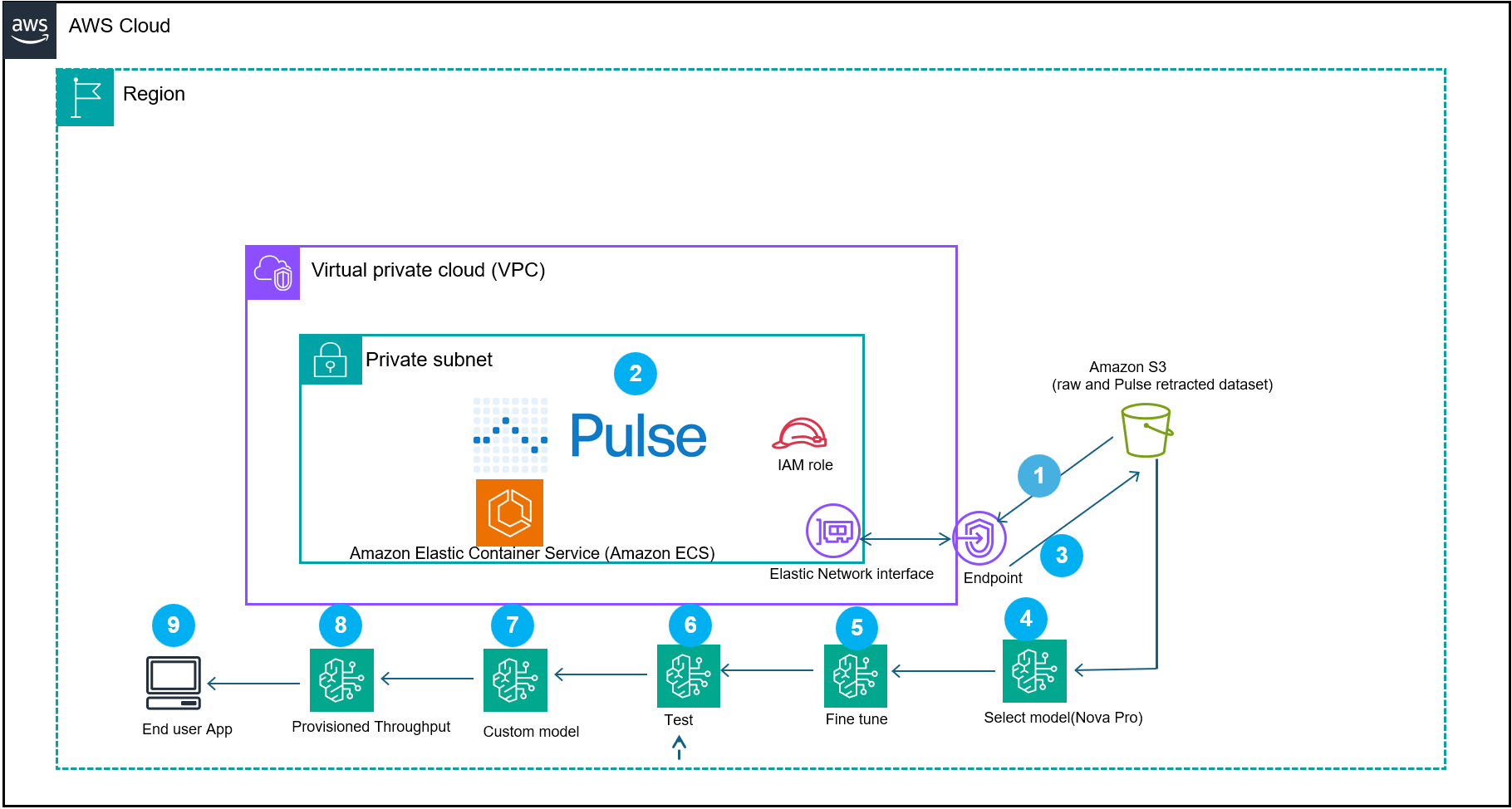
The process begins with the ingestion of financial documents into a Pulse container within the client’s Virtual Private Cloud (VPC) or via Pulse’s Software as a Service (SaaS) offering (Step 1). The Pulse model then intelligently processes these documents, leveraging its integrated vision language models and classical ML components to extract structured data (Step 2). The extracted data, now in a clean, structured format, is subsequently converted into the Amazon Bedrock Nova Micro supervised fine-tuning format and securely stored in an Amazon Simple Storage Service (Amazon S3) bucket (Step 3). This step is crucial, as it transforms raw extractions into a high-quality dataset suitable for training advanced AI models.
The workflow then extends into Amazon Bedrock’s powerful capabilities. A supervised fine-tuning job is initiated, utilizing Amazon Nova Micro (amazon.nova-micro-v1:0), a cost-efficient model specifically designed for text-based extraction tasks with a 128K context window (Steps 5 and 6). Nova Micro is chosen for its competitive price-performance ratio, making advanced customization accessible. Upon completion of the fine-tuning job, the resulting custom model is deployed for on-demand inference. For mission-critical workloads demanding consistent performance, Provisioned Throughput can be utilized. The Amazon Bedrock Playground offers an environment to evaluate and compare model responses. The custom model is then imported into Amazon Bedrock (Step 8) and deployed with provisioned throughput (Step 9) to power scalable end-user applications (Step 10). This meticulously designed architecture effectively merges domain-specific financial datasets with a custom supervised fine-tuned model, enabling organizations to develop production-ready AI applications that deeply understand financial context while maintaining optimal performance and cost efficiency.
The Nuances of Fine-Tuning for Financial Domain Expertise
The Python script convert_to_nova.py plays a pivotal role in preparing the training data, demonstrating how Pulse AI’s output is transformed into a format consumable by Amazon Bedrock Nova Micro. This conversion process teaches the model several critical domain-specific capabilities through pattern learning:

- Document Structure Recognition: The model learns to identify hierarchical relationships (headers, tables, text, page numbers), understand bounding box spatial information (coordinate systems and element positioning), and manage multi-page documents, including page number tracking and cross-page references.
- Financial Data Patterns: It internalizes table structure preservation, discerning row/column semantics and cell-level extraction. The model also learns to interpret confidence scores, differentiating between high-confidence fields (e.99+) and those requiring further scrutiny, and ensures data type consistency for account numbers, dates, monetary amounts, and check numbers.
- Structural Consistency: The training reinforces consistent field naming conventions ("content", "confidence", "page_number", "bounding_box"), recognizes nested object relationships (e.g., tables containing
cell_dataarrays with position metadata), and preserves metadata such asoriginal_contentalongside normalized values for audit trails. - Domain-Specific Conventions: The model becomes adept at identifying financial document sections (headers, footers, transaction tables, summary sections), detecting out-of-sequence items (often marked with an asterisk in check numbers), and extracting merchant data like terminal IDs, location information, and transaction references.
By exposing Nova Micro to hundreds of examples of Pulse AI’s high-quality structured extraction patterns, the model internalizes these complex financial document patterns. This approach is highly effective because Pulse AI consistently delivers structured, high-quality training data, the JSON schema is self-documenting, repetition reinforces structural patterns, and confidence scores guide the model on extraction reliability.
Demonstrated Performance and Domain Knowledge Superiority
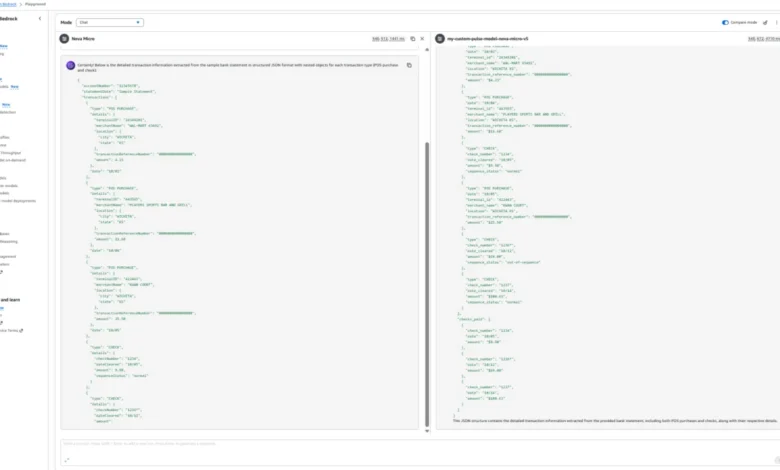
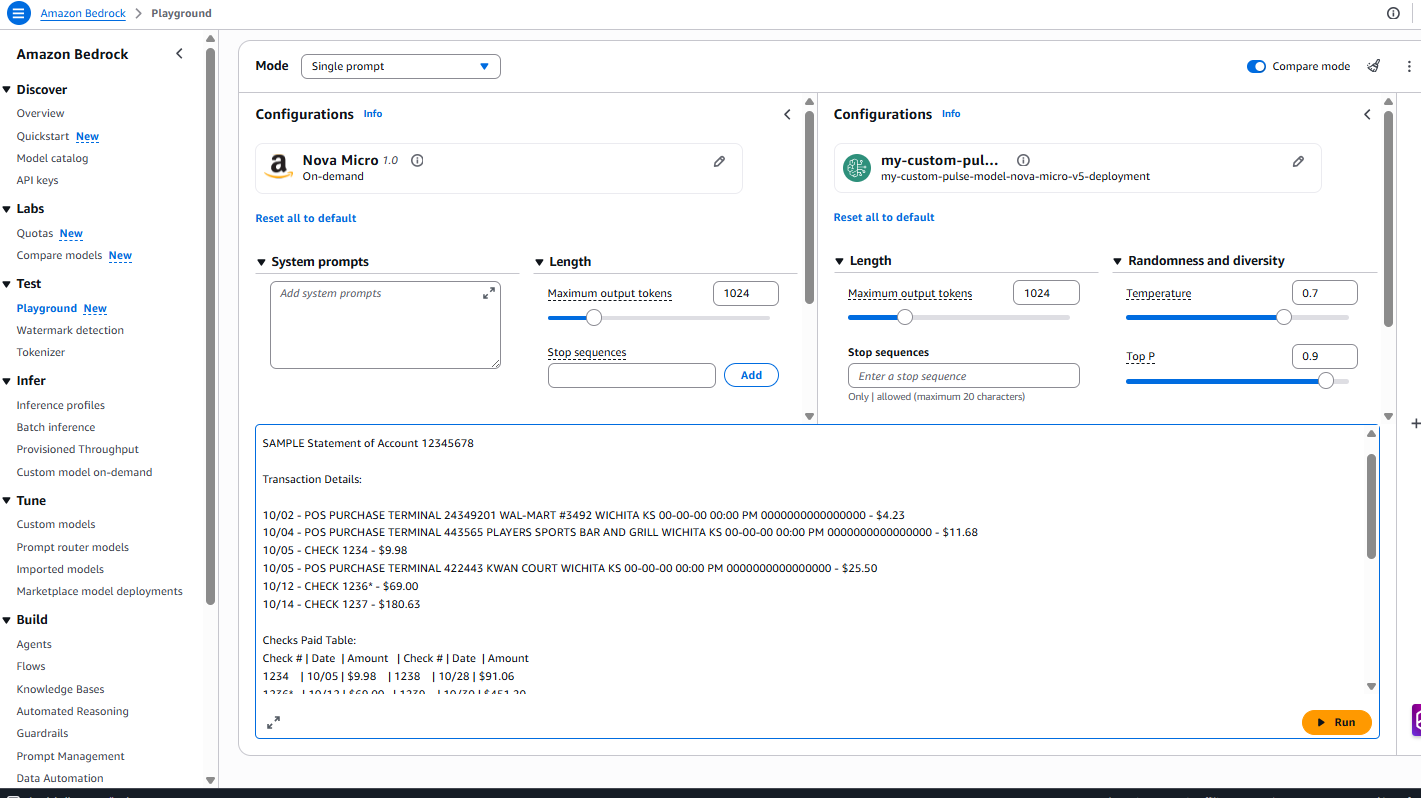
The efficacy of this integrated solution is vividly illustrated through a performance comparison between the base Nova Micro model and the custom fine-tuned model (my-custom-pulse-model-nova-micro-v5). While latency remained comparable (approximately 9 minutes for both), the custom model exhibited significant improvements in domain-specific extraction accuracy and completeness. The base model extracted only 3 out of 6 checks and organized transactions by type, leading to 50% completeness for check data and partial accuracy for sequence status. In stark contrast, the fine-tuned custom model successfully extracted all 6 checks, all 3 POS purchases, organized transactions in chronological order, achieved 100% completeness for check data, and accurately identified the sequence status for all checks. Furthermore, its JSON structure was a unified transaction list, demonstrating comprehensive document understanding beyond basic extraction. These metrics, while specific to the sample document dataset, underscore the profound impact of domain-specific fine-tuning.
Broader Implications for the Financial Sector

The implications of such advancements for financial institutions are far-reaching. Enhanced data accuracy directly translates into reduced operational risk, as errors in financial reporting, compliance filings, or internal analyses can be significantly mitigated. The dramatic acceleration of document processing cycles means faster time-to-insight, allowing financial professionals to make more informed decisions rapidly, especially in dynamic market conditions. This efficiency also frees up valuable human capital from tedious manual data entry tasks, enabling them to focus on higher-value activities such as strategic analysis, client engagement, and complex problem-solving.
Moreover, the ability to train models on proprietary documents, terminology, and business processes transforms AI from a general-purpose tool into a strategic asset. This specialization fosters competitive advantage by enabling institutions to unlock unique insights from their vast data repositories, optimize internal processes, and improve customer service through more efficient handling of inquiries and transactions. The inherent auditability of structured outputs also aids in regulatory compliance, a perennial challenge for financial entities.
Implementation and Continuous Improvement
Implementing this robust pipeline requires adherence to specific prerequisites, including an AWS account, configured AWS CLI, an EC2 instance, and necessary IAM roles and policies. Users are reminded of the AWS resource charges incurred during the tutorial. The process involves setting up AWS resources, configuring IAM roles for Bedrock fine-tuning, retrieving API keys securely from AWS Secrets Manager, making an API call to Pulse AI for document extraction, converting the Pulse output to Nova Micro’s JSONL format, creating and versioning an S3 bucket, uploading training data, initiating a model customization job on Amazon Bedrock, and finally deploying and testing the custom model.
The value of this architecture is not static; it supports iterative fine-tuning. This means organizations can continuously improve their models by building upon previously customized versions, incorporating new document types, edge cases, and evolving business processes. Pulse AI’s ability to convert unstructured documents into structured, schema-aligned outputs that are directly compatible with Amazon Bedrock’s fine-tuning requirements streamlines the creation of high-quality training datasets, offloading the heavy lifting of extraction and data quality to Pulse AI.
Conclusion: Unlocking the Full Potential of Domain-Specific AI
The synergistic combination of Pulse AI’s advanced document understanding and the robust ML capabilities of AWS, particularly Amazon Bedrock, offers financial institutions a pathway to build data processing systems that are not only faster and more accurate but also significantly more scalable than traditional approaches. This architecture provides a production-ready blueprint for intelligent financial document processing.
For organizations looking to embark on this transformative journey, Pulse AI offers a Standard account for immediate access to fine-tuned models for financial workflows, complemented by comprehensive Quickstart Documentation for configuring initial fine-tuning jobs and deploying custom models. The true power of fine-tuning is realized when foundation models are enriched with an organization’s unique financial datasets. By training models on proprietary documents, terminology, and business processes, financial institutions can cultivate specialized AI capabilities that generic models simply cannot replicate, turning AI into a strategic asset that deeply understands the nuances of their specific financial domain. Further technical guidance is available through the AWS Nova Fine-tuning Guide and documentation on customizing Amazon Nova Models, alongside the Pulse API Documentation for seamless integration into existing workflows.
Related posts: