Amazon Bedrock Prompt Caching Guide Optimizing Costs and Latency with the Converse API

Enterprise adoption of generative artificial intelligence has accelerated dramatically over recent years, but organizations increasingly grapple with the escalating operational expenses of processing massive context windows. When developers repeatedly transmit identical reference materials, extensive system instructions, or complex tool schemas alongside dynamic user queries, foundation models incur substantial redundancy. Every interaction reprocesses the entire payload from scratch, driving up input token bills and increasing latency before the model generates its first response. To mitigate these infrastructure hurdles, cloud providers have introduced automated memory management capabilities designed to intercept repetitive computational workloads at the architectural level.
Industry data indicates that prompt caching mechanisms can slash input token expenditures by up to 90 percent when applications repeatedly reference established contextual prefixes. Without such caching layers, transmitting a lengthy 10,000-token enterprise contract alongside 50 successive user inquiries forces the system to bill 500,000 input tokens at full standard rates. While developers historically attempted to resolve these financial inefficiencies by shortening prompts, shrinking context windows, or writing bespoke application-level caching logic, each alternative introduces severe functional trade-offs. Shortening prompts degrades response quality by stripping critical domain knowledge, whereas application-level caching adds substantial engineering complexity and maintenance overhead.
Infrastructure-Level Caching Mechanics and Request Flow
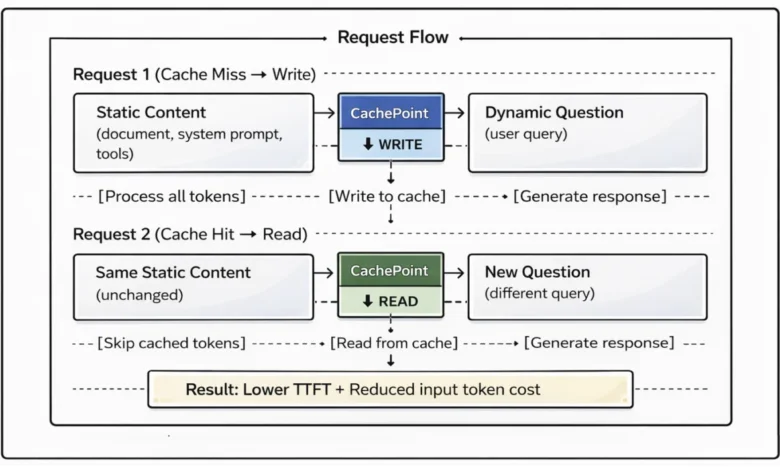
Amazon Bedrock addresses this operational dilemma by introducing prompt caching directly into its managed infrastructure. When engineers designate specific boundaries within a conversation context—encompassing system prompts, reference documents, or tool definitions—the platform captures a snapshot of the partially processed input. Subsequent requests sharing that exact contextual prefix bypass redundant computation entirely, yielding immediate reductions in time-to-first-token latency alongside massive cost savings on cache hits. Crucially, this infrastructure optimization occurs transparently without necessitating model modifications or degrading prompt output quality.
The underlying request flow relies on explicit checkpoint markers known as cache points. When a developer incorporates a cache marker into an API payload, Amazon Bedrock evaluates whether the preceding text matches an active cache entry. If the system detects an identical prefix, a cache hit occurs, allowing the foundation model to skip initial token processing and resume generation instantly from the stored state. Conversely, if no match is found, a cache miss registers, prompting the platform to process the full payload normally while simultaneously writing the resulting state to cache for prospective future utilization.
Four primary concepts dictate how caching behaves in operational environments, including token thresholds, Time-To-Live (TTL) expiration windows, prefix matching rules, and regional scope constraints. Models generally require a minimum input length—such as 1,024 or 2,048 tokens depending on the specific model family—before caching logic activates. Furthermore, because cache matching depends on strict prefix alignment, any modification to the text preceding a cache point invalidates the stored entry, triggering a cache write upon the next invocation.
Economic Implications and Token Pricing Structures
Integrating prompt caching introduces a nuanced financial structure that divides input tokens into distinct operational categories. Standard input tokens and output tokens retain their baseline pricing models, but caching introduces dedicated rates for write and read operations. Tokens written to cache during an initial request incur a surcharge, typically priced approximately 25 percent higher than standard input tokens, or up to 100 percent higher when utilizing extended one-hour Time-To-Live configurations. However, subsequent requests that successfully read from the cache benefit from a substantial 90 percent discount relative to standard input token costs.
To evaluate the economic impact, consider a scenario involving a 10,000-token legal document queried ten separate times within an active TTL window. The inaugural request triggers a cache write, absorbing the slight premium on token generation. The subsequent nine interactions each retrieve the document prefix directly from the cache at the heavily discounted read rate, yielding an aggregate net savings of approximately 75 percent on overall input token expenditures for that document context. Organizations managing high-frequency customer support bots, automated legal contract reviewers, and enterprise knowledge retrieval systems stand to realize immediate capital relief through these architectural efficiencies.
Practical Implementation Patterns Across Six Core Scenarios
Developers utilizing the Amazon Bedrock Converse API can implement prompt caching across diverse architectural patterns, scaling from foundational message caching to advanced multi-tenant isolation. The Converse API provides a model-agnostic syntax that abstracts away underlying provider differences, allowing engineering teams to deploy identical caching logic across supported foundation models including Anthropic Claude and Amazon Nova.
Message Content Caching for Retrieval-Augmented Generation
Retrieval-Augmented Generation architectures frequently force foundation models to ingest extensive reference documents before addressing specific user inquiries. By inserting a cache checkpoint directly between the static reference text and the dynamic query block, applications ensure that the heavy document payload is processed exactly once. In subsequent turns, users can pose varying questions against the same underlying document, leveraging rapid cache reads to accelerate response times and minimize token billing.
System Prompt Caching for Persona Consistency
Complex enterprise applications often rely on elaborate system prompts spanning thousands of tokens to enforce strict safety guidelines, formatting rules, and specialized domain expertise. Because these instructions remain constant across user sessions, placing a cache point at the conclusion of the system prompt ensures that the model’s persona definition is cached globally. Subsequent interactions from multiple users inherit the cached system state, eliminating repetitive computation and ensuring uniform adherence to organizational guardrails.
Tool Definition Caching for Autonomous Agents
Autonomous agentic workflows frequently provide foundation models with dozens of complex functional tools defined via extensive JSON schemas. These tool specifications can easily aggregate into thousands of tokens that remain completely static across execution loops. By appending a cache point at the termination of the tool configuration array, developers prevent the system from repeatedly parsing identical function signatures on every conversation turn, significantly optimizing agent response latency and operational budgets.
Mixed TTL Caching and Hierarchical Expiration Strategies
Enterprise data possesses varying velocities of change; core reference manuals and compliance policies remain stable for days, whereas session-specific user preferences update constantly. Amazon Bedrock supports mixed TTL caching, allowing developers to assign distinct expiration windows—such as one hour for static domain knowledge and five minutes for recent conversation context—within a single request payload. Developers must adhere to strict structural rules during implementation, ensuring that checkpoints with longer TTL durations appear prior to those with shorter durations within the request array.
Multi-Tenant Isolation via Cryptographic Prefixes
In shared multi-tenant SaaS platforms, safeguarding data privacy is paramount. To prevent one enterprise tenant from inadvertently accessing cached context belonging to another within the same regional infrastructure, developers can leverage a cryptographic hashing pattern. By prepending a SHA-256 hash derived from the tenant’s unique identifier to the cached instructional text, the system generates distinct prefix signatures for every organization. This forces Amazon Bedrock to maintain isolated cache partitions per tenant with negligible token overhead, satisfying stringent security mandates without requiring dedicated AWS accounts.
Ecosystem Integration Through LangChain Frameworks
Modern software development often relies on high-level orchestration frameworks to accelerate application delivery. LangChain integrates native support for prompt caching via specialized wrapper classes like ChatBedrockConverse. Developers can easily invoke native utility methods to generate cache points within standard message arrays and prompt templates, streamlining the transition to optimized infrastructure without disrupting existing codebases or application logic.
Strategic Recommendations for Production Deployments
Engineering teams preparing to deploy prompt caching in production environments should adhere to established industry best practices to maximize efficiency. First, audit existing application workloads to identify high-token, repetitive context prefixes that exceed minimum model activation thresholds. Second, structure prompt templates hierarchically, placing static reference materials, system instructions, and tool definitions at the beginning of the payload, followed explicitly by cache markers and dynamic user inputs.
Furthermore, monitor cache utilization metrics exposed in API response objects to calculate exact cache hit ratios and validate expected cost reductions. By systematically reviewing cache hit and miss distributions, teams can fine-tune Time-To-Live configurations to align precisely with user interaction patterns, preventing unnecessary cache expiration while minimizing storage overhead.
Conclusion and Future Outlook
The introduction of prompt caching within Amazon Bedrock represents a significant milestone for enterprise generative artificial intelligence deployments. By addressing the fundamental economic and latency penalties associated with repeated context processing, cloud infrastructure providers are enabling organizations to scale sophisticated AI applications sustainably. Through the model-agnostic Converse API, developers can implement robust caching patterns—ranging from basic document querying to advanced multi-tenant isolation and mixed TTL lifecycles—with minimal code modifications. As organizations continue to expand their reliance on large language models, prompt caching will transition from an optional optimization technique to an indispensable architectural pillar for cost-effective enterprise AI engineering.