Scaling Multimodal Reinforcement Learning Agents on Amazon SageMaker HyperPod Using SkyRL and GRPO


The rapid evolution of artificial intelligence has made reinforcement learning (RL) post-training a critical pillar for developing advanced language and vision-language model agents. As models increasingly need to reason, plan, and execute complex sequences of actions across multiple domains, traditional single-turn reinforcement techniques have proved insufficient. Instead, multi-turn RL requires generating expansive rollout trajectories, computing outcomes through specialized environments, and continuously updating underlying model policies. Executing these intensive pipelines at scale demands resilient, persistent cluster infrastructure capable of sustaining long multi-node training jobs, recovering seamlessly from hardware faults without regression, and providing real-time telemetry into training dynamics.
To address these architectural challenges, modern machine learning infrastructure platforms have begun integrating robust orchestration tools. Amazon SageMaker HyperPod, running on Amazon Elastic Kubernetes Service (Amazon EKS), has emerged as a premier foundation for large-scale distributed workloads. By offering advanced cluster resiliency features that actively monitor node health and automatically replace faulty hardware, HyperPod protects enterprise training runs from catastrophic interruptions. Paired with integrated checkpointing protocols and distributed file systems such as Amazon FSx for Lustre, multi-node reinforcement learning architectures can safely preserve ongoing states, allowing multi-day operations to resume smoothly following unexpected infrastructure hiccups.
Background and Evolution of Multi-Turn RL Frameworks
Historically, training vision-language models involved supervised fine-tuning (SFT) on static datasets, which often limited an agent’s ability to generalize to novel environments or dynamic interactive tasks. To overcome these limitations, researchers have turned to multi-turn reinforcement learning paradigms. Unlike standard single-turn setups that evaluate isolated model outputs against fixed rubrics, multi-turn RL requires an agent to observe an environmental state, execute an action, evaluate incoming feedback, and iteratively adapt its trajectory over prolonged episodes.
A classic benchmark for evaluating this capability is visual maze navigation, where an agent must interpret sequential image frames of a 2D grid, determine directional vectors, and reach a designated coordinate within a strict move limit. In such environments, reward signals are notoriously sparse—typically yielding a binary outcome only upon successful completion. Consequently, assigning credit to individual moves within a sequence requires sophisticated alignment algorithms.
Enter Group Relative Policy Optimization (GRPO), a training methodology implemented within modern open-source frameworks like SkyRL. GRPO eliminates the traditional requirement for a separate, resource-intensive critic or value model. Instead, for any given starting prompt, the agent generates multiple independent rollout trajectories under its current policy. The algorithm then evaluates and grades these trajectories relative to one another within the group, reinforcing paths that exceed the group average while suppressing underperforming sequences. This relative scoring mechanism provides a clean, stable optimization signal that drastically reduces memory overhead during distributed training.
Cluster Topology and Architectural Design
Executing a GRPO-driven training workflow for vision-language models—such as the 8-billion-parameter Qwen3-VL-8B architecture—requires a highly coordinated compute topology. A typical deployment on Amazon SageMaker HyperPod utilizes a hybrid cluster configuration comprising a dedicated CPU head node and multiple GPU worker nodes. Specifically, architectures often leverage a high-memory CPU head node, such as an ml.r5d.16xlarge instance equipped with extensive RAM, to efficiently coordinate cluster state, manage Ray object stores, and consolidate model checkpoints.
Meanwhile, GPU worker nodes—such as ml.g7e.12xlarge instances—handle the intensive computational burden of both inference rollouts and policy updates. A key engineering innovation in modern training pipelines is the colocation of inference and training on the same physical hardware. By utilizing vLLM engines for parallel rollout generation alongside Fully Sharded Data Parallel (FSDP) workers for gradient updates, compute resources are fully saturated.
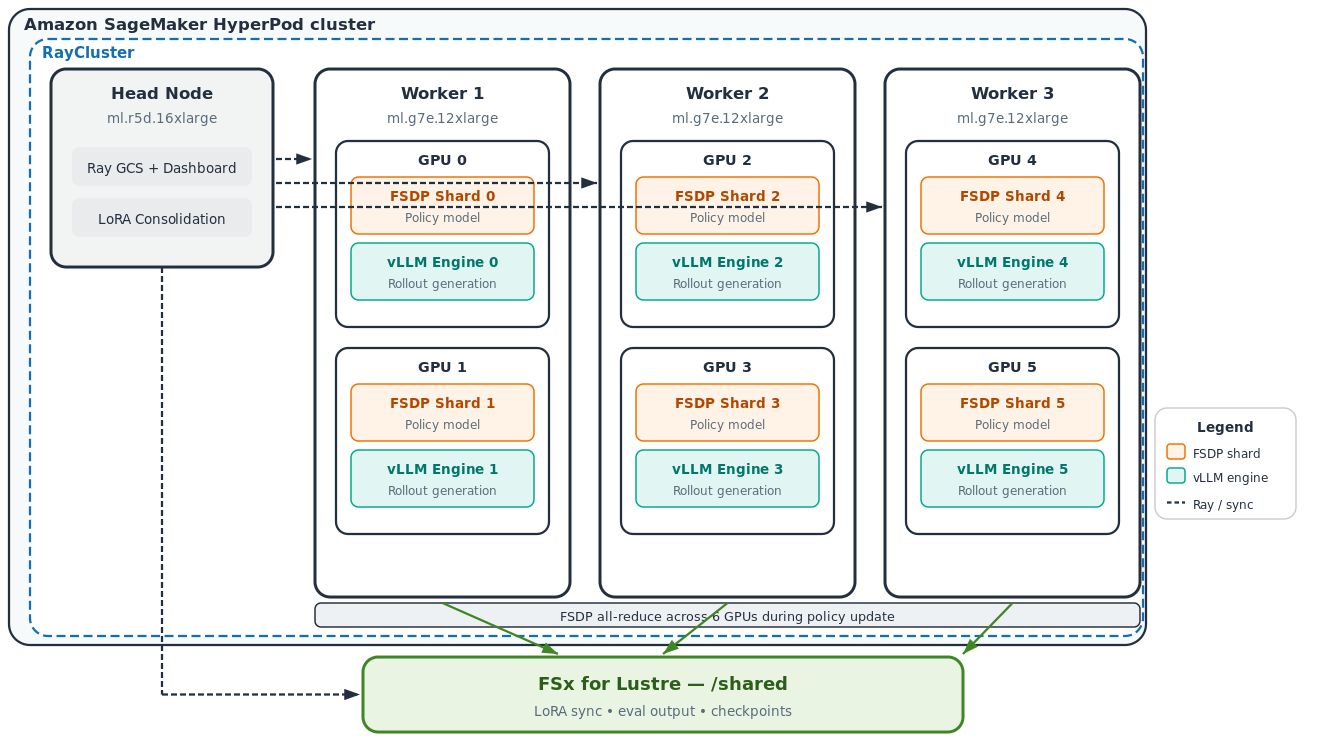
To prevent hardware starvation during this alternating cycle, memory utilization is carefully balanced, and low-rank adaptation (LoRA) weights are synchronized across nodes via shared Amazon FSx for Lustre file systems. After each optimizer step, updated adapter weights are written to the shared storage layer, immediately propagating to the inference engines without requiring costly network migrations or idling compute pools.
Step-by-Step Implementation and Workflow Execution
Implementing a production-grade multimodal RL pipeline on HyperPod involves a structured series of engineering phases, beginning with containerization and environment configuration.
Containerization and Dependency Management
To ensure absolute reproducibility across distributed nodes, developers construct customized container images incorporating foundational frameworks like SkyRL and the VisGym maze environment. These environments are pinned to specific GitHub commit hashes and built upon optimized base layers utilizing high-performance communication libraries like NVIDIA Collective Communications Library (NCCL) and Elastic Fabric Adapter (EFA) providers for low-latency inter-node networking. Once built, these images are pushed to Amazon Elastic Container Registry (Amazon ECR) repositories for cluster consumption.
Cluster Provisioning via SageMaker Studio
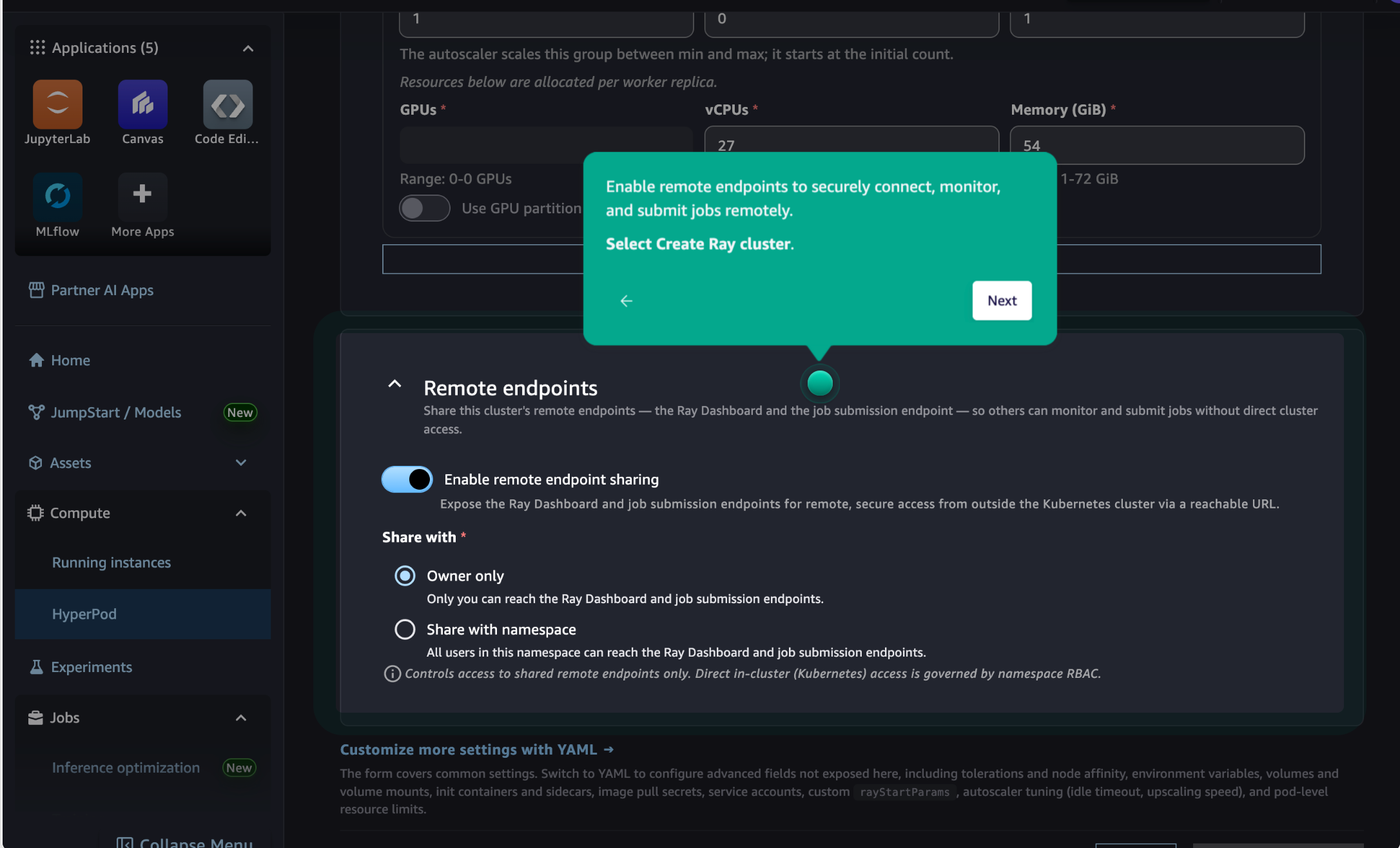
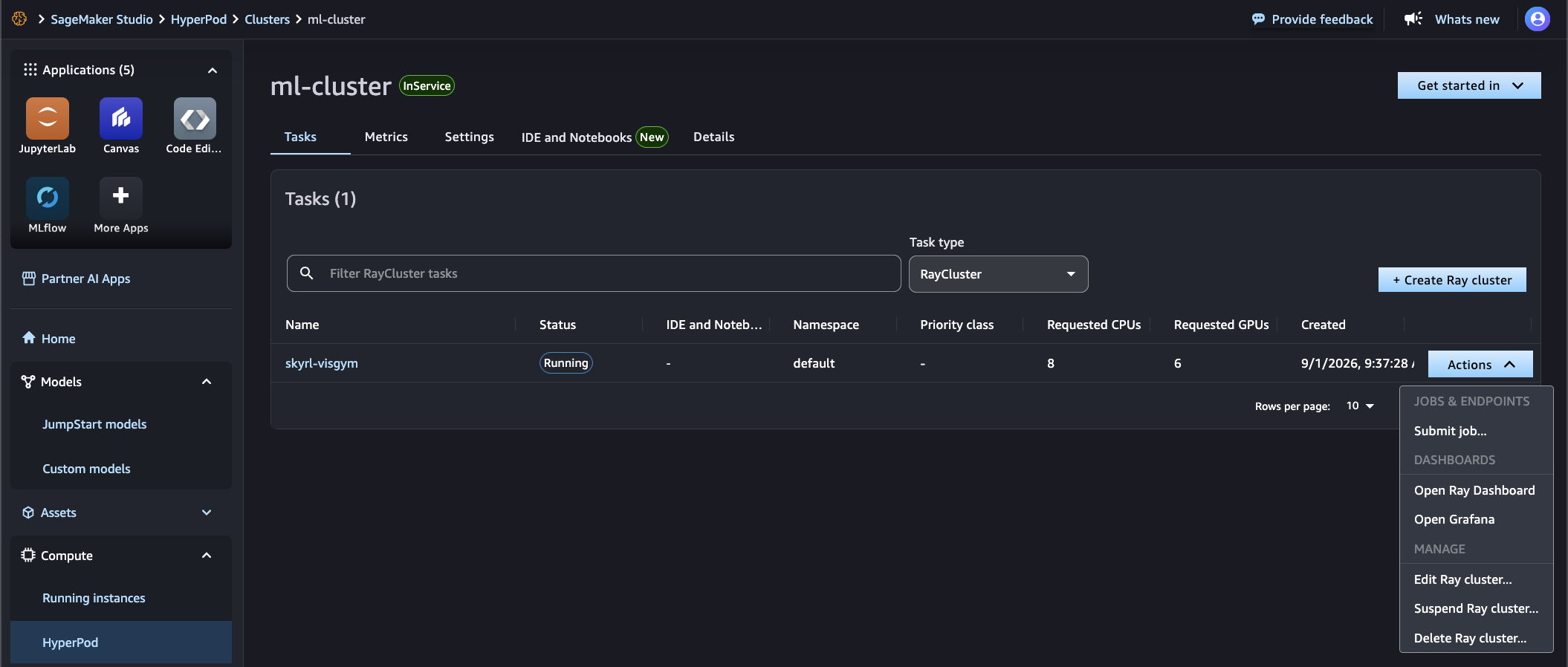
Machine learning engineers provision Ray clusters directly through the Amazon SageMaker Studio interface by navigating to the HyperPod console and configuring a RayCluster task. Administrators specify the desired instance counts, attach container URIs, and inject raw Kubernetes manifests to mount persistent volume claims backed by Amazon FSx for Lustre. Enabling remote endpoints eliminates the need for cumbersome manual port-forwarding, allowing developers to securely submit jobs and monitor clusters using IAM-authenticated URLs.
Job Submission and Distributed Orchestration
With the infrastructure operational, training jobs are dispatched remotely using the toolkit-for-ray-on-sagemaker-ai package. By leveraging the sagemaker_ray:// protocol, engineers can submit training scripts from local environments or automated CI/CD pipelines without maintaining direct network access to the underlying EKS cluster.
The training script itself orchestrates dataset generation, downloads supervised fine-tuning (SFT) starting checkpoints—such as the VisGym-adapted Qwen3-VL-8B model—and initiates the GRPO loop. Hyperparameters are meticulously tuned: sample sizes per prompt are set to generate sufficient group diversity, maximum turns are capped to prevent infinite loops, and evaluation intervals are established to gauge performance continuously against held-out benchmark sets.
Observability, Telemetry, and Performance Metrics
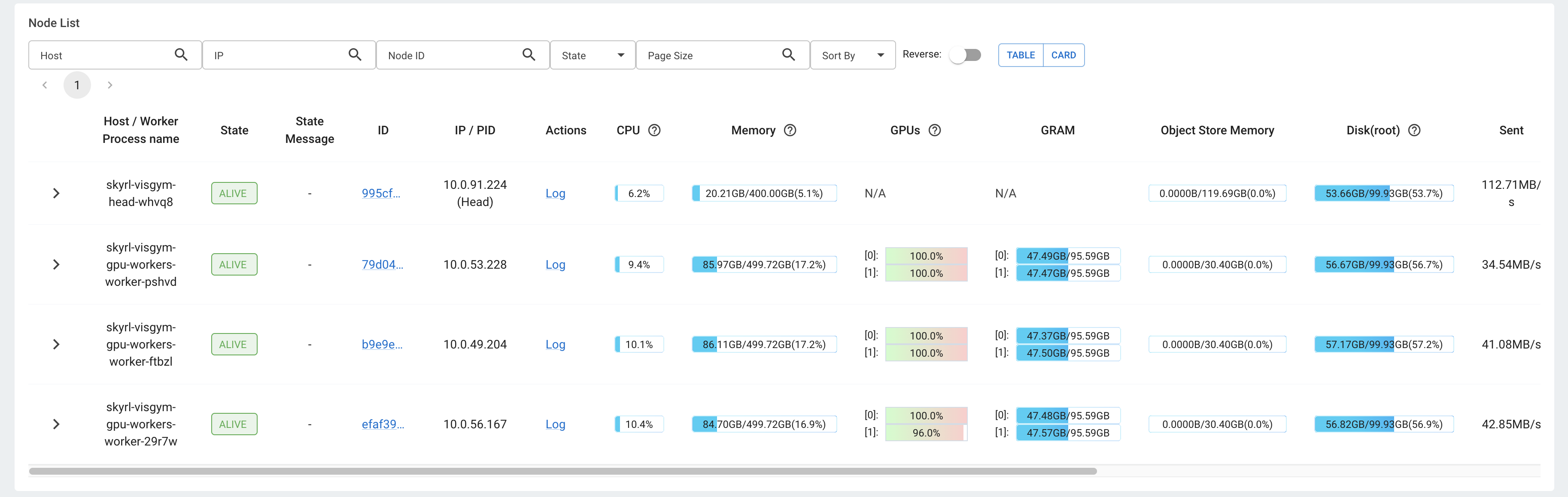
Maintaining visibility into multi-node distributed training runs is paramount for identifying bottlenecks and verifying convergence. Amazon SageMaker HyperPod integrates natively with Amazon Managed Grafana through the HyperPod Observability EKS add-on. This integration automatically provisions comprehensive dashboards—categorized into Ray Core, Ray Data, Ray Train, and Ray Serve—providing deep insights into CPU, GPU, and memory utilization metrics in real time.
Concurrently, the native Ray Dashboard offers job-level introspection, tracking active tasks, actor placement, and resource allocation across individual cluster nodes. During execution, evaluation passes run at regular step intervals against a fixed held-out set of 64 visual mazes, logging validation metrics such as pass rates directly to job consoles.
Empirical results from recent implementations highlight the potency of this approach. While baseline models starting from SFT checkpoints achieve modest maze-solving success rates—typically hovering around 43.75%—applying GRPO post-training on SageMaker HyperPod rapidly drives performance upward. Empirically, models cross 75% solve rates within the initial hundred training steps, eventually peaking at success rates exceeding 95% on identical evaluation sets. This dramatic improvement demonstrates the effectiveness of relative policy optimization when supported by reliable, self-healing infrastructure.
Inference, Model Hosting, and Dynamic LoRA Loading
Once training achieves target performance thresholds, the resulting model artifacts must be prepared for production inference. Rather than deploying monolithic, full-weight model copies for every iteration, modern architectures leverage lightweight LoRA adapters saved periodically during training checkpoints.
To host these models efficiently, engineers deploy Ray Serve clusters utilizing specialized Deep Learning Containers optimized for large language models. By configuring OpenAI-compatible endpoints with frameworks like ray.serve.llm, organizations can implement dynamic, per-request LoRA loading. In this setup, a single base model—cached in shared storage—remains resident in GPU memory, while dynamic loading pathways fetch specialized LoRA adapters from Amazon S3 on demand.
The first time an inference request references a specific adapter, Ray Serve downloads and caches the weight set locally on the replica, ensuring subsequent requests execute with minimal latency. This multi-LoRA serving strategy drastically reduces infrastructure costs and memory overhead, allowing multiple fine-tuned agent behaviors to share a unified serving endpoint securely managed via Amazon EKS Pod Identities.
Broader Implications and Industry Impact
The successful deployment of multimodal reinforcement learning workflows on Amazon SageMaker HyperPod underscores a broader shift in enterprise artificial intelligence development. As foundation models transition from static text generation to autonomous, goal-directed agents capable of complex visual and physical reasoning, the demand for resilient compute infrastructure will only intensify.
By combining the self-healing capabilities of HyperPod, the distributed orchestration power of Ray, and the algorithmic stability of GRPO, organizations can bypass the traditional infrastructure bottlenecks that have historically stymied reinforcement learning research. The ability to seamlessly transition from multi-node data generation and policy updates to production inference hosting within a unified ecosystem accelerates the deployment of safe, highly capable autonomous agents across diverse industrial sectors.
Ultimately, this integrated approach establishes a standardized blueprint for enterprise machine learning engineering, proving that complex, failure-sensitive post-training pipelines can be executed with high reliability, robust observability, and optimal cost efficiency. As frameworks continue to mature, these standardized infrastructure patterns will undoubtedly serve as the backbone for the next generation of artificial intelligence innovation.