The Limitations of Text-Only Retrieval
For years, the standard approach to document processing involved converting PDFs into plain text, effectively stripping away the spatial and visual context that often carries the most weight in technical reports, financial audits, and scientific papers. When a user queries a document about a specific downward trend in a sales graph, a text-only RAG pipeline typically fails, as it sees only the raw text surrounding the image, missing the visual data entirely.
Research indicates that up to 40% of information in high-value business documents is presented in non-textual formats, including tables, flowcharts, and infographics. The emergence of multi-modal architectures—systems that treat images as first-class, retrievable citizens—is no longer a luxury but a necessity for organizations operating in data-heavy sectors like finance, law, and engineering.
Architectural Evolution: The Four-Stage Pipeline
The transition to a multi-modal framework requires a fundamental shift in how data is ingested, processed, and stored. The modern approach, utilizing Python frameworks such as LangChain and the Unstructured library, moves beyond simple string extraction.
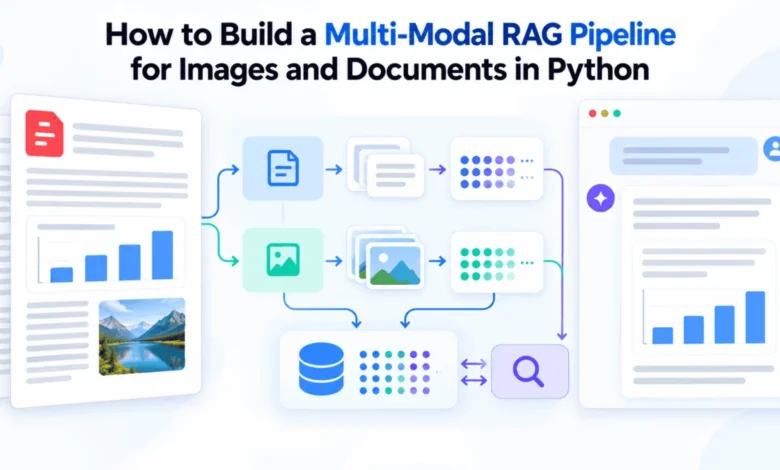
The architecture follows a rigorous, four-stage lifecycle:
- Intelligent Partitioning: Instead of a flat-stream extract, the system utilizes vision-capable partitioning to classify elements into distinct categories—text, tables, and image blocks.
- Semantic Summarization: Each visual asset is processed by a Vision-Language Model (VLM), such as GPT-4o, to generate a high-fidelity, text-based description that encapsulates the image’s content for vector indexing.
- Multi-Vector Indexing: The system maintains a dual-storage strategy where a vector store holds the semantic embeddings of both text chunks and image summaries, while a secondary document store maintains pointers to the raw source assets.
- Context-Aware Retrieval: The final query is executed against the vector database, with the system retrieving both the relevant textual context and the original visual files, which are then synthesized by the LLM into a comprehensive answer.
Technical Implementation and Infrastructure Requirements
Building this pipeline requires a robust environment. Beyond the core Python libraries, system-level dependencies like poppler-utils are essential for high-performance PDF rasterization. The following setup commands provide the foundation for developers to begin:
pip install langchain langchain-openai unstructured[pdf] chromadb pillow
apt-get install -y poppler-utils
Once configured, the process of parsing requires specific attention to the partition_pdf parameters. By setting infer_table_structure=True and defining specific extract_image_block_types, the developer ensures that the integrity of the document’s layout is preserved during the extraction phase.
The Role of Vision-Language Models in Indexing
A primary challenge in this pipeline is the "searchability gap." Because vector databases operate on numerical representations of text, raw images remain invisible to traditional search algorithms. By employing GPT-4o to generate detailed descriptions of these images during the indexing phase, developers create a bridge between visual information and queryable text.
For instance, an image of a complex supply chain flowchart is not merely stored as a file; it is indexed as a comprehensive description, such as: "A flowchart showing the logistics flow from Southeast Asian suppliers to regional warehouses, highlighting a bottleneck in the port of Singapore during Q3." This allows the RAG system to retrieve the relevant image even if the user’s query does not contain specific keywords, but rather explores the conceptual intent behind the request.
Financial and Operational Implications
The economic impact of deploying multi-modal RAG is significant. While the operational cost of using vision models for every image during indexing is higher than text-only pipelines, the reduction in human hours spent manually reviewing documentation provides a high return on investment.
Industry analysts observe that companies implementing these systems report a 30% to 50% increase in the speed of technical research tasks. However, developers are advised to implement filtering mechanisms to manage costs, such as excluding low-resolution icons or repetitive boilerplate images from the summarization process.
Strategic Advantages for Enterprise AI
The integration of visual reasoning into RAG has broader implications for corporate governance and compliance. In highly regulated environments, the ability to trace a decision back to a specific table or graph in an original PDF is essential for auditability. Unlike traditional "black box" AI, this multi-modal approach provides a clear path for verification: the system retrieves the specific evidence—be it a paragraph or an image—and presents it to the user.
Furthermore, this approach avoids the risks of hallucinations by grounding the LLM in specific, retrievable source files. When the model provides an answer, it does so based on the exact visual and textual data found within the document, rather than relying on internal parametric knowledge.
Future Outlook and Emerging Standards
As the field matures, the industry is moving toward more sophisticated retrieval methods, including re-ranking algorithms that prioritize results based on a hybrid score of text relevance and visual clarity. Innovations like ColPali, which allow for the embedding of document pages as images, signal a potential shift toward "vision-first" retrieval that may eventually render manual parsing unnecessary.
For organizations currently developing these pipelines, the focus should remain on scalability and security. Ensuring that the vector database is persisted to secure, high-performance storage and that the API calls are managed through secure key management services is paramount.
The adoption of multi-modal RAG is essentially a move toward the "document-agnostic" enterprise. By treating every element of a report as a piece of data capable of being queried, summarized, and reasoned over, businesses can unlock the latent knowledge trapped in millions of pages of legacy documents. The provided architecture is not merely a coding exercise; it is a blueprint for the next generation of business intelligence, where the barriers between text and imagery are permanently dismantled to provide a single, unified source of truth. As AI continues to evolve, the ability to synthesize these multi-modal inputs will define the competitive edge for organizations navigating the complexities of the modern information landscape.
Related posts: