Scaling PyTorch Model Training to Multi-Node Clusters Without Custom Container Builds Using AWS Ray Train DLC

The primary bottleneck in scaling distributed PyTorch training jobs out to large computing clusters has historically been rooted not in model code complexity, but in the complex orchestration of containerized environments. Engineers routinely face significant engineering overhead when attempting to manually align critical underlying software layers, including specific CUDA runtime versions, explicitly compiled PyTorch builds, the NVIDIA Collective Communications Library (NCCL), Elastic Fabric Adapter (EFA) userspace libraries, the AWS OFI NCCL networking plugin, and a compatible release of the Ray distributed framework. Rebuilding these monolithic container images every time a dependency shifts can consume weeks of engineering cycles completely detached from core machine learning model optimization. To resolve this persistent challenge, Amazon Web Services has introduced the Ray Train Deep Learning Container (DLC), a fully pre-assembled, thoroughly validated, and centrally maintained image published directly to the Amazon Elastic Container Registry (Amazon ECR) Public.
Background Context and Architecture of the Ray Train DLC
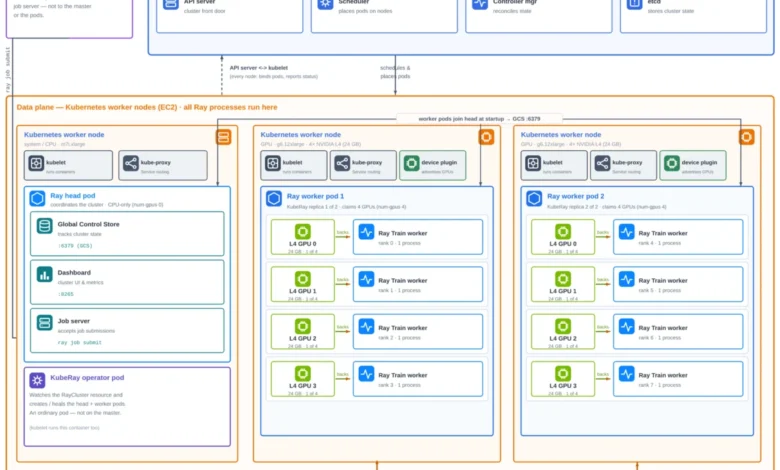
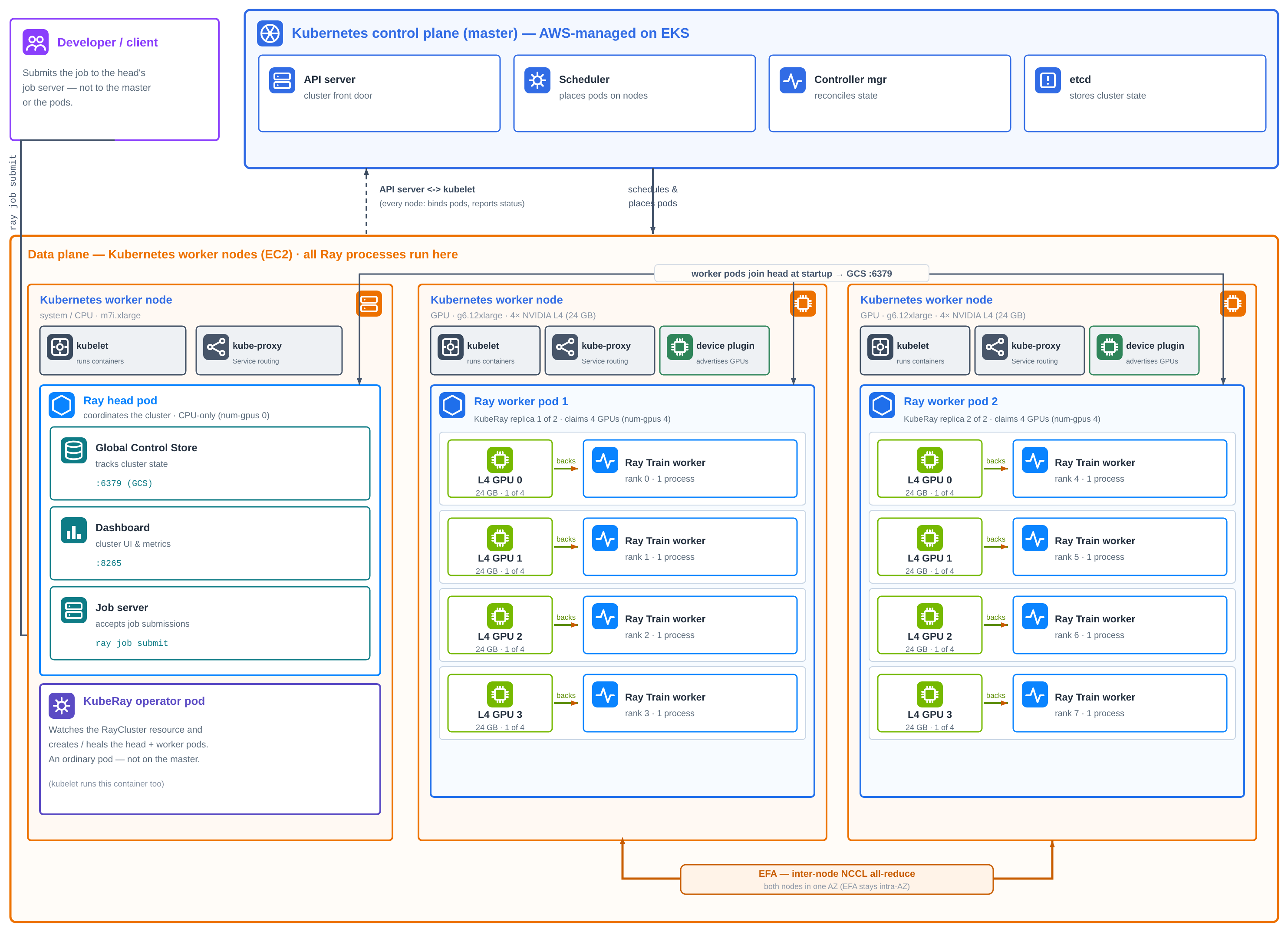
Distributed machine learning workloads require precise synchronization across multiple physical hosts to achieve linear scaling. In traditional enterprise workflows, setting up a multi-node Ray cluster involves deploying a Ray head node to manage state and coordinate tasks alongside multiple Ray worker nodes that provide the underlying hardware acceleration via graphical processing units. On modern cloud architectures utilizing Kubernetes, managing these distinct node roles requires external orchestration. KubeRay, an open-source Kubernetes operator, bridges this gap by introducing a custom RayCluster resource that enables administrators to define both head and worker groups within a single declarative YAML manifest.
Despite the flexibility of KubeRay, the underlying software dependencies within the container images have remained a persistent pain point. The AWS Ray Train DLC addresses this by pre-integrating the complete distributed stack. For instance, the public container image release (such as train-ml-cuda-v1.1) packages Ray 2.58.0 alongside PyTorch 2.13.0, CUDA 13.0.2, NCCL 2.29.7, and the latest AWS OFI NCCL plugin. Furthermore, the environment includes pre-configured performance libraries such as DeepSpeed, FlashAttention, and Transformer Engine. By pre-building and rigorous pre-testing of these components against multi-node EFA and KubeRay environments, AWS effectively eliminates the risk of silent networking degradation—a common failure mode where NCCL misconfigurations quietly default from high-speed EFA hardware transport down to standard TCP sockets, severely crippling training throughput.
Step-by-Step Technical Implementation and Infrastructure Layout
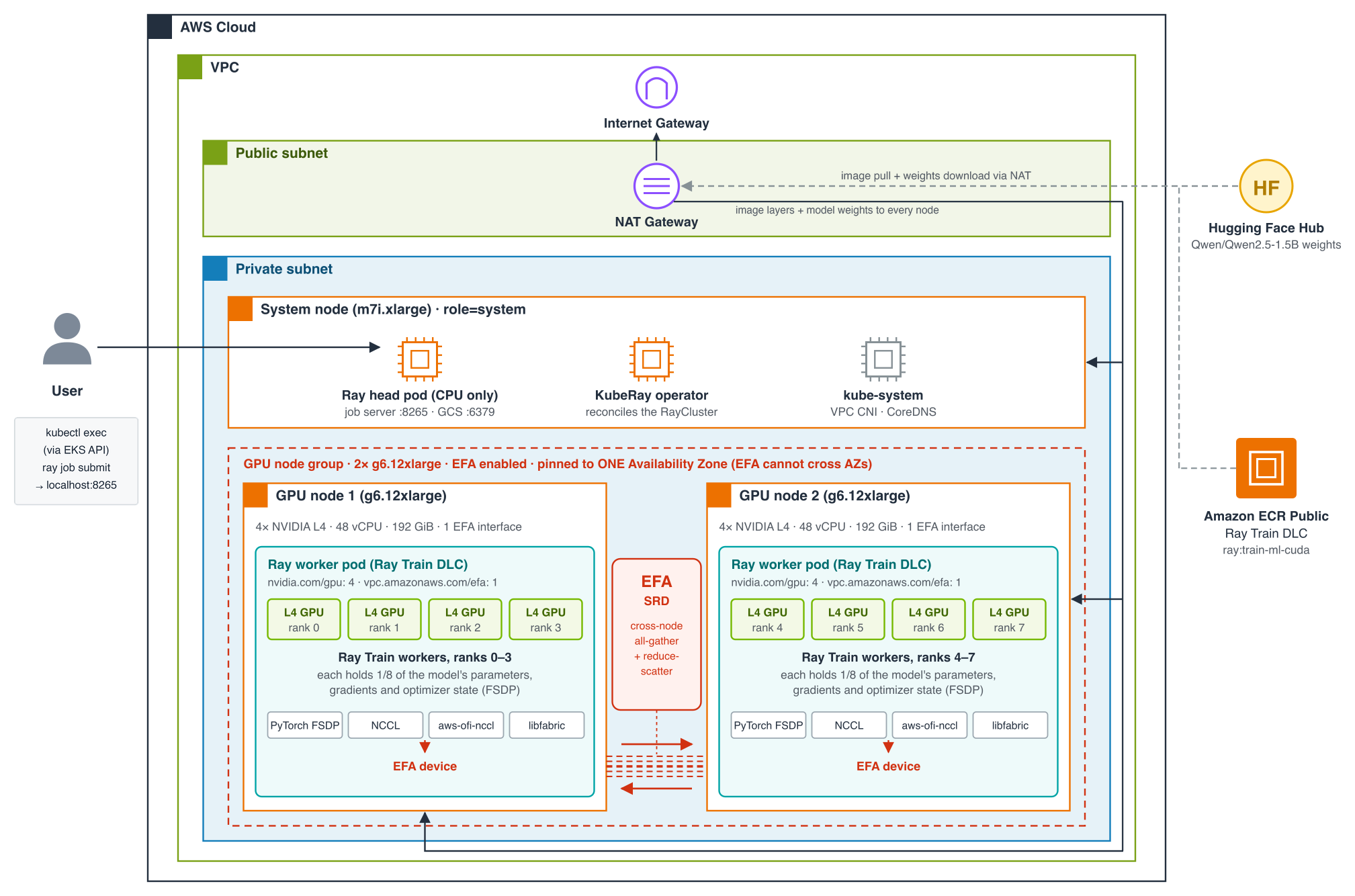
Deploying a production-grade distributed training job using the Ray Train DLC involves a systematic infrastructure setup combined with external configuration management rather than image modification. In a representative reference architecture deployed on Amazon Elastic Kubernetes Service (Amazon EKS), infrastructure engineers configure a dedicated Amazon Virtual Private Cloud (VPC) featuring private subnets connected to the internet exclusively via a NAT Gateway.
The control plane and supporting system components operate on an m7i.xlarge instance serving as the system node. This node hosts core Kubernetes add-ons, the KubeRay operator, and the Ray head node, which runs the cluster’s global control store on port 6379 and the job submission dashboard on port 8265. Critically, the Ray head node is explicitly configured without GPU allocation, ensuring that no active training workloads land on the orchestration server. Job submissions are securely handled via internal API calls using kubectl exec, keeping dashboard ports closed to external networks.
For the computational backbone, the architecture leverages two g6.12xlarge Amazon EC2 instances situated within a single Availability Zone to eliminate cross-zone network latency. Each g6.12xlarge instance is equipped with four NVIDIA L4 GPUs, 48 vCPUs, 192 GiB of system memory, 40 Gbps of network bandwidth, and a dedicated EFA interface. When KubeRay provisions the worker pods, each pod claims all four local GPUs and mounts the associated EFA device interface. Consequently, Ray Train initializes a total of eight parallel workers—ranks 0 through 3 on the first instance and ranks 4 through 7 on the second instance.
Configuring FSDP Workloads Without Rebuilding Containers
To maximize hardware efficiency during large language model fine-tuning, the reference architecture implements PyTorch Fully Sharded Data Parallel (FSDP). Unlike traditional data parallelism that replicates entire model weights across every available accelerator, FSDP intelligently partitions model parameters, gradients, and optimizer states across all eight NVIDIA L4 GPUs.
For example, fine-tuning the Qwen2.5-1.5B model in bfloat16 precision requires approximately 12 GB of memory for these core tensors. When sharded uniformly across eight GPUs, each individual L4 GPU holds a manageable footprint of roughly 1.5 GB. The operational trade-off of FSDP is communication overhead: the framework must gather layer weights prior to forward and backward execution, and subsequently perform reduce-scatter operations on gradients across the cluster during every training step. By relying on the pre-integrated EFA stack within the Ray Train DLC, inter-node communication bypasses standard network limitations and utilizes high-performance hardware paths.
Importantly, the training logic itself remains entirely decoupled from container infrastructure. Engineers write standard Python training functions utilizing native Ray Train APIs (TorchTrainer and ScalingConfig). At runtime, Ray automatically discovers the available cluster resources, initializes the torch.distributed process group, and executes the training loop across all designated ranks. Additional Python libraries required for specific experiments can be injected dynamically at submission time via Ray’s runtime_env configuration, ensuring that the foundational container image remains completely untouched across iterations.
Deployment Chronology and Infrastructure Automation
Automating the deployment of this multi-node training environment relies on idempotent shell scripts and environment configuration files (scripts/env.sh) that govern cluster naming, AWS Region selection, Kubernetes versions, node counts, and training parameters. The deployment chronology follows a rigorous sequence designed to verify capacity and validate hardware readiness prior to job execution:
- Capacity Discovery and Validation: Before provisioning infrastructure, automated probing scripts (
find_gpu_capacity.sh) query candidate Availability Zones to verify the physical availability of g6.12xlarge instance types, check regional On-Demand vCPU quotas, and analyze EC2 Spot placement scores. - Control Plane and Node Group Provisioning: Execution of
deploy_cluster.shestablishes the EKS control plane, core add-ons, and VPC subnets, followed bydeploy_node_group.sh, which provisions the GPU-accelerated worker instances with EFA enabled and appropriate Kubernetes node labels (role=gpu-worker). - Device Plugin and Operator Installation: Scripts verify and install essential Kubernetes device plugins (
install_gpu_plugins.sh) to ensure thatnvidia.com/gpuandvpc.amazonaws.com/efaresources are fully allocatable. Simultaneously, the KubeRay operator is deployed onto the system node viainstall_kuberay.sh. - Job Submission and Verification: Once pods reach a Ready state,
deploy_ray_train_job.shrenders the Kubernetes manifests, copies the training code to the head pod, and submits the job via the Ray CLI. Automated post-submission checks inspect NCCL telemetry to confirm that high-speed EFA networking was actively utilized during execution.
Industry Implications and Strategic Analysis
The adoption of pre-built, centrally maintained deep learning containers represents a significant maturation in cloud-native machine learning operations (MLOps). Historically, AI engineering teams dedicated substantial internal resources to maintaining infrastructure pipelines, debugging low-level driver incompatibilities, and troubleshooting silent networking fallbacks. By abstracting these infrastructure complexities into standardized, AWS-vetted containers like the Ray Train DLC, organizations can drastically accelerate iteration cycles for foundational model training and fine-tuning.
Industry analysts note that standardized DLC deployments directly address the growing demand for reproducible AI research and enterprise-grade operational efficiency. Because cluster definitions are managed entirely through external configuration variables and declarative manifests rather than custom Dockerfiles, reproducibility is significantly enhanced. Furthermore, ensuring that multi-node communication layers default to high-performance networking fabrics like EFA without manual intervention guarantees optimal utilization of expensive GPU hardware investments. As large language model architectures continue to scale across multi-node Kubernetes environments, reliance on pre-integrated, production-ready container ecosystems will likely become an industry standard for high-performance computing and enterprise AI deployment.
Related posts: