Scaling Reinforcement Learning for Mixture-of-Experts Models on AWS Using Amazon EKS, EFA, and DeepEP

Post-training large-scale Artificial Intelligence models has evolved into an exercise of extreme systems engineering, particularly when applied to Mixture-of-Experts (MoE) architectures running Reinforcement Learning from Human Feedback (RLHF) or Group Relative Policy Optimization (GRPO). As modern language models scale to hundreds of billions or trillions of parameters, developers increasingly rely on MoE designs to maintain computational efficiency during inference via sparsity. However, while sparsity reduces active parameter counts per token, it shifts the operational burden heavily onto infrastructure, creating profound communication and orchestration hurdles during the reinforcement learning phase.
Engineers tackling these workloads face a tripartite operational challenge: coordinating heterogeneous compute environments for concurrent rollout generation and policy training, sustaining ultra-high-throughput communication across hundreds of distributed accelerators, and dynamically balancing every underlying subsystem to prevent bottlenecks or idle capacity. Addressing these demands requires a tightly integrated stack combining Amazon Elastic Kubernetes Service (Amazon EKS), Elastic Fabric Adapter (EFA), and advanced communication libraries like DeepEP.
Background Context and Structural Realities of MoE Training
The standard machine learning pipeline for frontier large language models generally encompasses pre-training, mid-training, supervised fine-tuning (SFT), and reinforcement learning. Among these, large-scale RL places unique demands on underlying hardware architectures because it forces two fundamentally different workloads to operate in unison: elastic, throughput-heavy inference tasks for experience generation, and tightly coupled, lockstep model training updates. Reward models, verifiers, and frequent checkpoint synchronization compound the memory, networking, and orchestration pressures.
Unlike dense neural network models, post-training MoE structures introduce a distinct architectural constraint. As newer MoE configurations employ extreme sparsity to drive down inference costs, training efficiency becomes bound more strictly by inter-node communication than by raw floating-point compute capacity. The primary culprit is Expert Parallelism (EP), which introduces dynamic, fine-grained all-to-all token routing across network devices alongside the structured communication patterns typical of Tensor Parallelism, Data Parallelism, and Pipeline Parallelism.
In asynchronous RL loops—whether utilizing traditional Proximal Policy Optimization (PPO) with its separate value-estimating critic model or newer approaches like GRPO that eliminate the critic via group-based relative rewards—the infrastructure must perfectly balance generation and training. Sluggish training steps cause rollout workers to stall, while insufficient inference throughput leaves expensive training accelerators sitting idle.
Chronology and Evolution of Cloud-Native Infrastructure for AI
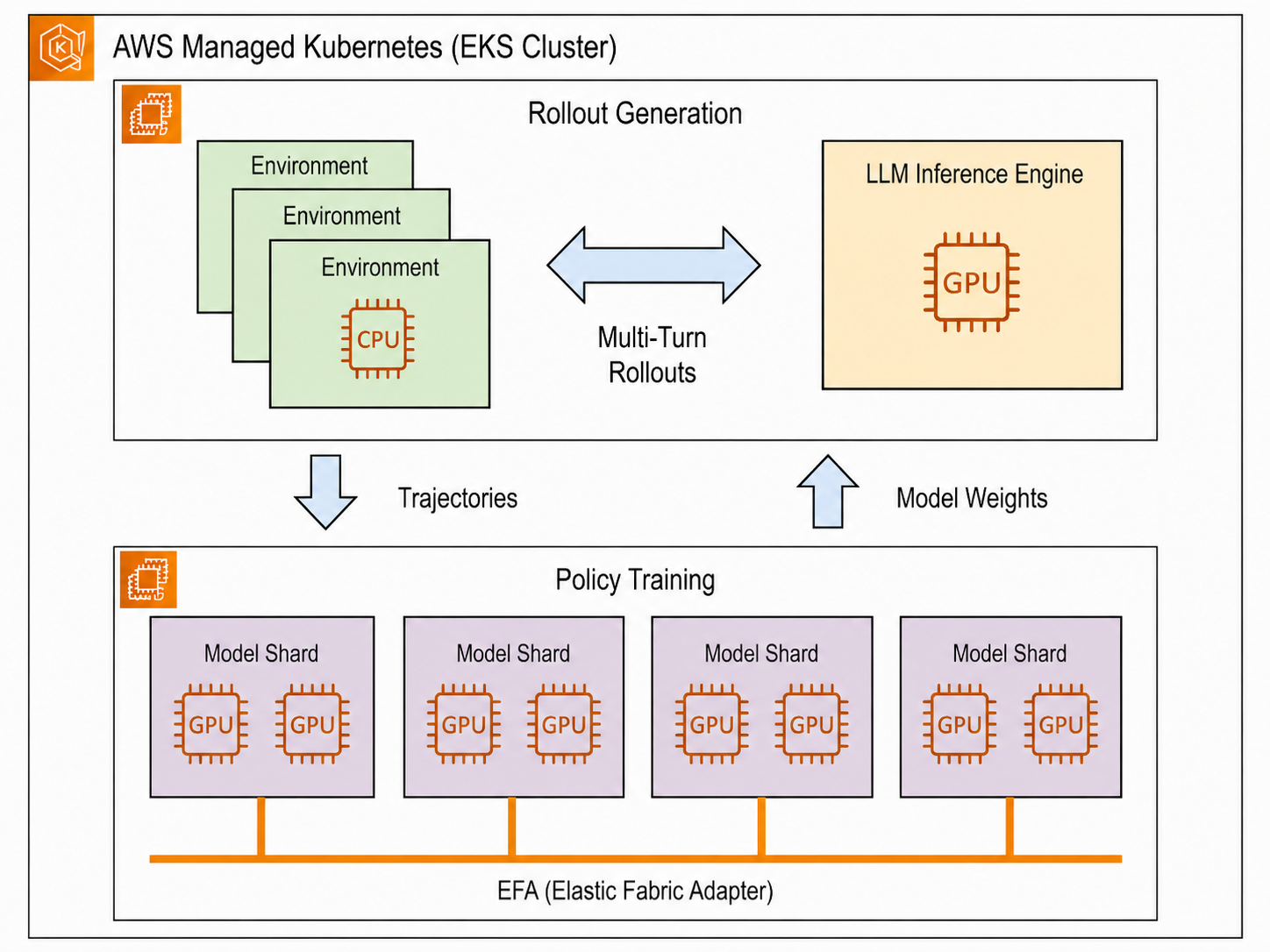
Historically, running massive distributed AI workloads required rigid, static bare-metal clusters that lacked the elasticity and automated failure recovery of modern container orchestration platforms. Over recent years, cloud providers and open-source communities have systematically bridged this gap.
In the early phases of large language model adoption, Kubernetes was primarily utilized for stateless microservices and lightweight batch jobs. However, the maturation of specialized device plugins, high-performance networking subsystems, and custom scheduler extensions transformed platforms like Amazon EKS into viable control planes for multi-node, accelerator-heavy distributed training.
The introduction of hardware innovations such as AWS Elastic Fabric Adapter (EFA)—which provides low-latency, high-bandwidth inter-node communication via OS bypass and NVIDIA GPUDirect RDMA—allowed cloud environments to match or exceed the performance profiles of traditional high-performance computing (HPC) supercomputers. More recently, the open-source release and community refinement of DeepEP (DeepSeek Expert Parallelism) introduced specialized GPU kernels designed to optimize sparse, imbalanced all-to-all communication patterns over modern network fabrics, setting the stage for highly scalable, cost-effective reinforcement learning pipelines.
Architectural Framework: Orchestration, Networking, and Storage
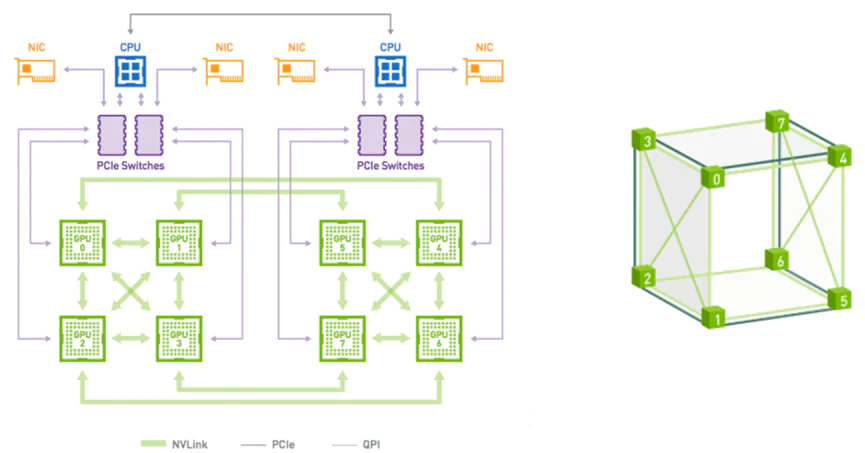
To deploy and scale complex RL workloads successfully, modern cloud architectures must decouple orchestration, communication, and storage layers so each can scale independently according to resource demands.
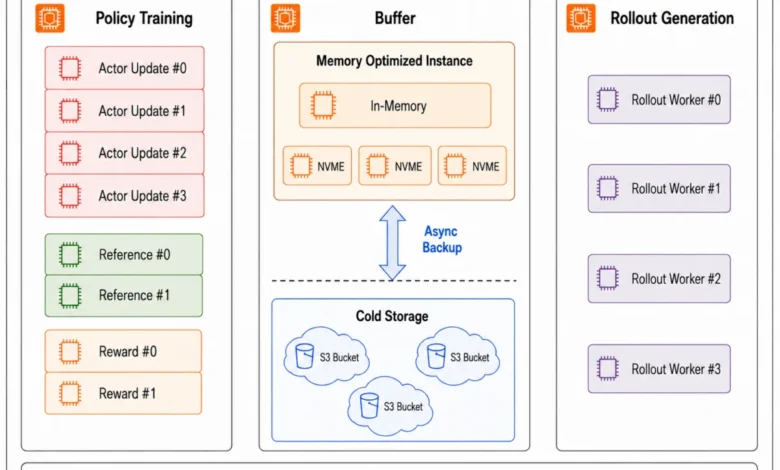
Within an Amazon EKS environment, cluster topology is organized into distinct node groups tailored to specific tasks. GPU-accelerated instances—such as AWS P5 and P6 instance families utilizing advanced NVIDIA accelerators—handle intensive rollout generation, reward-model inference, and policy training. Meanwhile, dedicated CPU node groups execute environment simulations and data preprocessing tasks. Memory-optimized instances are deployed to host experience buffers and checkpoint caches, allowing producers and consumers to exchange intermediate training data without introducing direct input/output bottlenecks on durable storage layers.
For high-performance communication, the architecture exploits two distinct domains. Intra-node traffic travels across high-bandwidth NVLink fabrics connected via NVSwitch. For inter-node communication, EFA provides the high-speed data path. By leveraging DeepEP over EFA, developers replace generic, dense all-to-all collectives with specialized dispatch and combine kernels. These kernels route tokens efficiently across instances, bypassing the host CPU and operating system to minimize per-message overhead during sparse Expert Parallelism operations.
Durable storage is handled via Amazon Simple Storage Service (Amazon S3), which maintains datasets, model checkpoints, and completed training artifacts. This decouples high-frequency experience sample exchanges from long-term persistence.
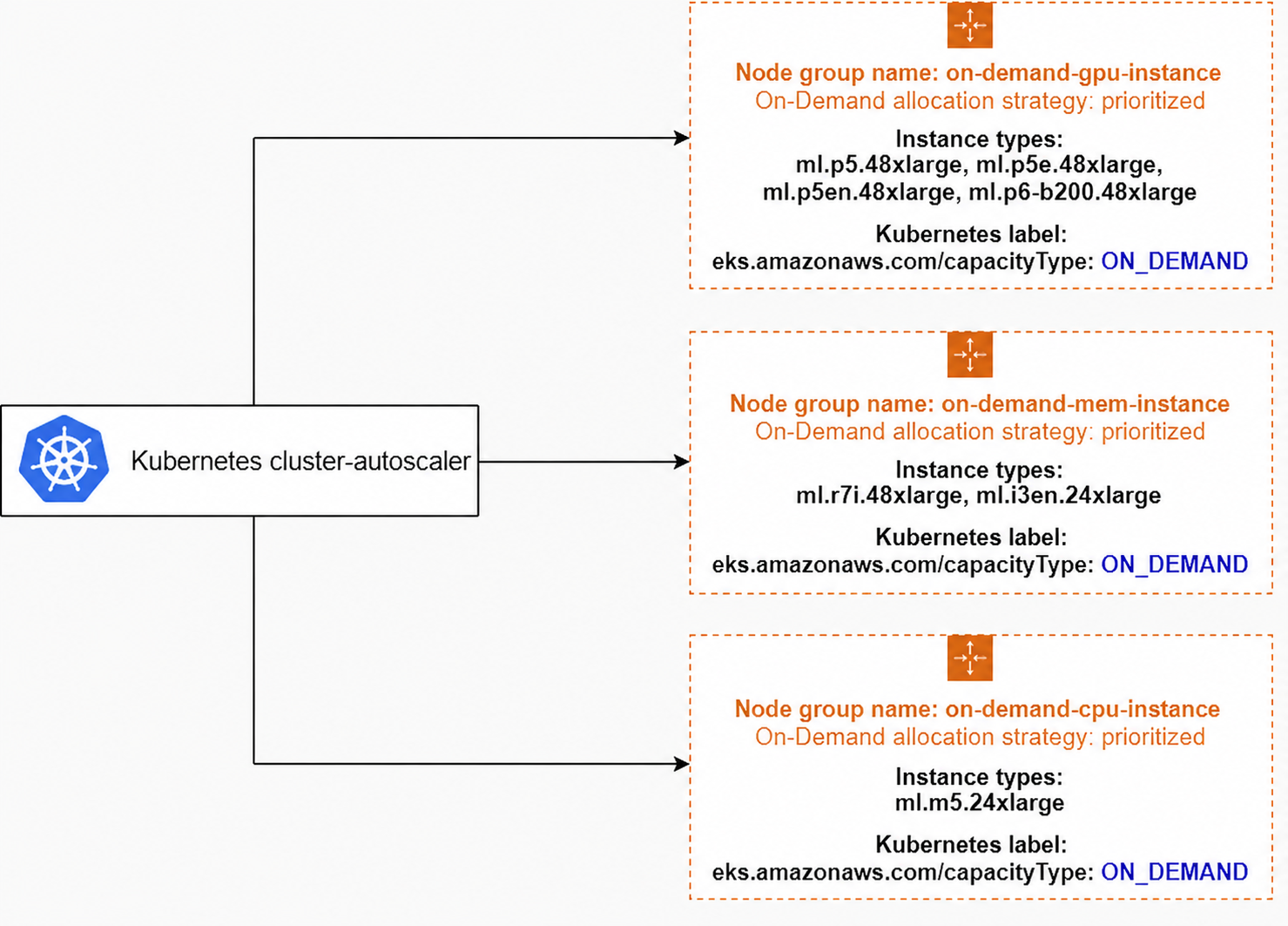
Performance Data and Comparative Analysis
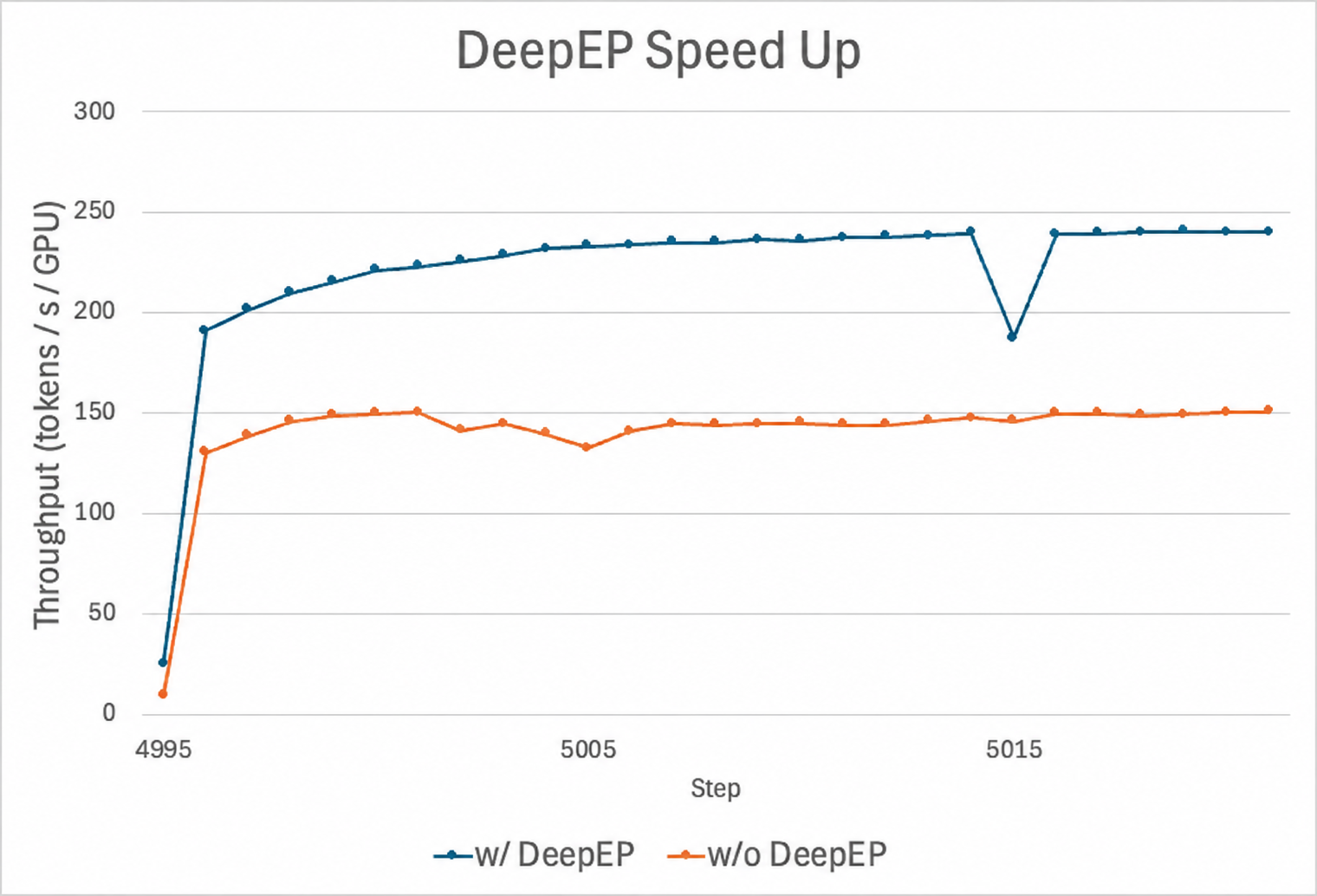
Recent benchmark evaluations highlight the tangible performance gains yielded by optimizing the communication layer for sparse MoE models. In comparative tests across 48 P5en instances—split evenly between 16 instances dedicated to policy training and 32 dedicated to rollout generation—running a super-sparse MoE model, integrating DeepEP over EFA delivered a dramatic 40 percent increase in aggregate RL rollout throughput.
This performance improvement stems directly from resolving the communication bottlenecks inherent in expert dispatch operations. Baseline configurations utilizing standard collective communication libraries frequently encountered synchronization delays and high per-message latency as the expert parallelism degree scaled across multiple network nodes. By migrating DeepEP’s communication primitives to libfabric and leveraging EFA’s native RDMA capabilities, the updated stack maintained high accelerator utilization, effectively eliminating starvation periods in the rollout-training feedback loop.
Furthermore, integrating Amazon EC2 Spot Instances into the rollout-generation tier provides substantial cost optimization. Because rollout generation consists of distributed inference tasks that can be partitioned across independent workers, the transient interruption of a single Spot worker does not invalidate the broader training job. Unfinished tasks return cleanly to the processing queue while stable, on-demand GPU capacity protects critical policy-training workloads from disruption or unexpected network timeouts.
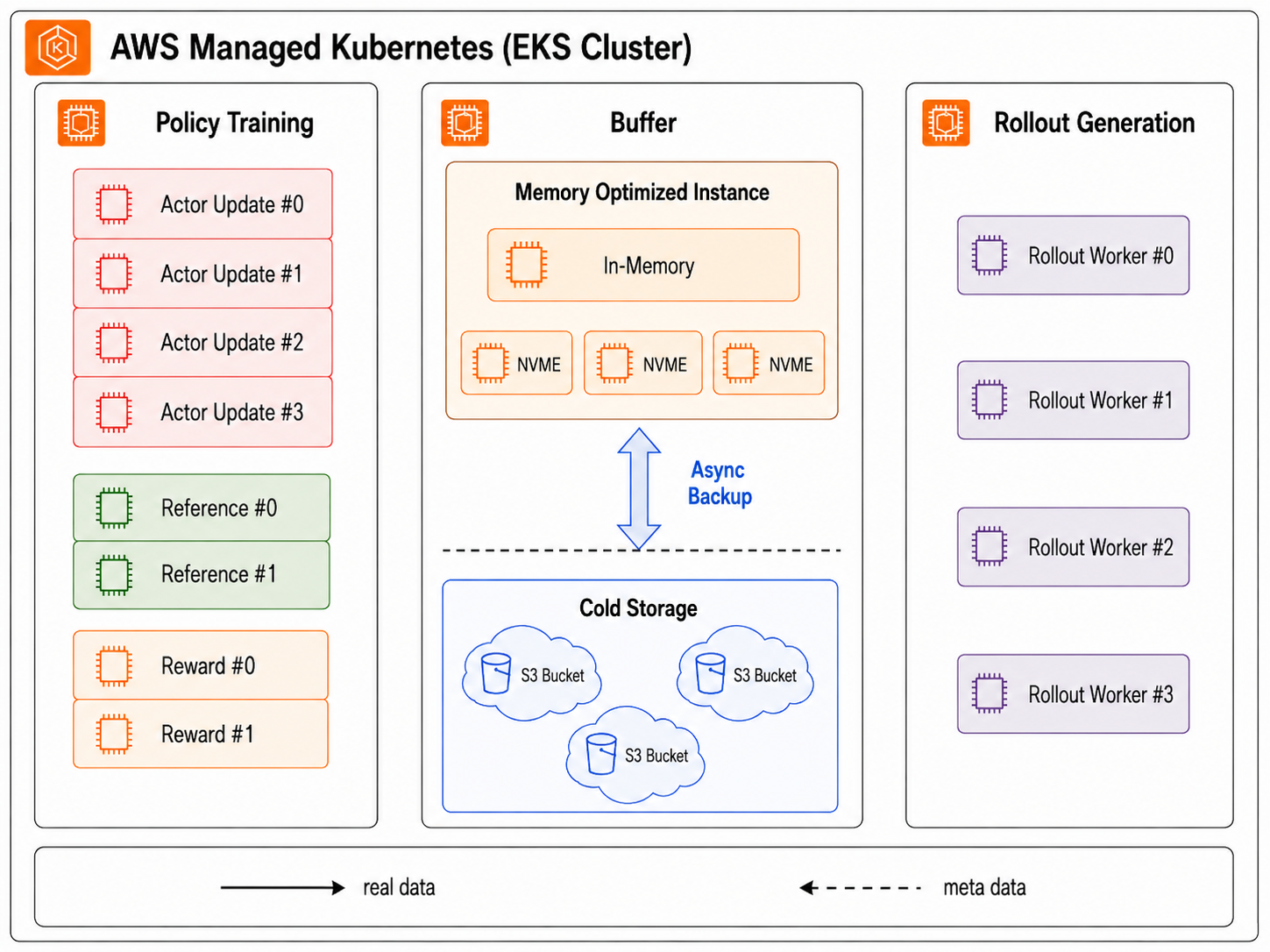
Deployment and Operational Workflow
Deploying this architecture in production relies on Infrastructure-as-Code and declarative configuration tools. Using utilities like eksctl, system administrators can provision multi-node EKS clusters featuring isolated node groups for general-purpose workloads and accelerated GPU tasks. Taints and tolerations ensure that general workloads do not encroach upon expensive accelerator capacity.
Cluster networking requires the deployment of the EFA Kubernetes device plugin via a DaemonSet to ensure that pods scheduled on accelerator node groups can natively access underlying network interfaces. Container image construction leverages optimized AWS Deep Learning Containers as base images, layering exact version pins for PyTorch, NCCL, NVSHMEM, and DeepEP to maintain binary compatibility across GPU kernels and network drivers.
Job submission and orchestration are streamlined through workflow frameworks like TorchX, which translates high-level reinforcement learning requirements into native Kubernetes resources. By separating application logic from infrastructure provisioning, engineering teams can adjust model hyperparameters, parallelism configurations, and worker counts without altering underlying cluster definitions.
Broader Implications and Industry Impact
The convergence of container orchestration, cloud-native high-performance networking, and advanced communication libraries signifies a major milestone for enterprise-scale artificial intelligence development. As organizations increasingly transition models beyond standard supervised fine-tuning into complex post-training reinforcement learning paradigms, infrastructure efficiency becomes a primary competitive differentiator.
The ability to scale Mixture-of-Experts models across hundreds of accelerators without hitting severe communication walls democratizes access to frontier-class model development. By leveraging elastic cloud resources—such as combining stable, on-demand GPU instances for synchronized policy training with spot-backed capacity for elastic rollout generation—enterprises can significantly compress iteration cycles while controlling operational expenditures.
As these architectural patterns mature, they establish a robust blueprint for future AI infrastructure deployments, proving that cloud-native environments can successfully manage the complex, heterogeneous demands of next-generation machine learning workloads.