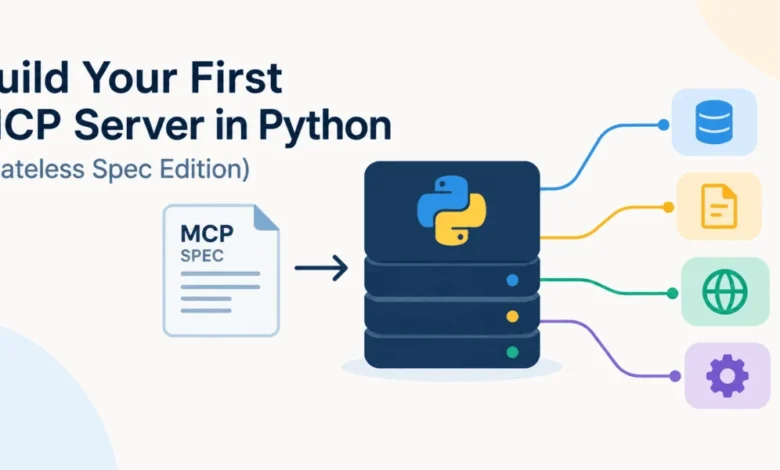
The landscape of AI-integrated software engineering underwent a foundational shift this summer with the release of the July 28, 2026, Model Context Protocol (MCP) specification. By moving the core of the protocol to a stateless architecture, the developers behind MCP have eliminated the traditional requirements for session management, allowing AI clients to interact with servers without the overhead of establishing stateful protocol sessions. This transition, which effectively decouples individual requests from specific server instances, represents a significant evolution in how large language models (LLMs) connect to local and remote data sources, making MCP servers considerably easier to deploy, scale, and maintain within standard HTTP infrastructure.
The Evolution of the Model Context Protocol
The Model Context Protocol was introduced to solve a pervasive problem in the AI ecosystem: the fragmentation of data access. Previously, connecting an LLM to a local database, a file system, or a proprietary knowledge base required custom integrations for every unique environment. MCP provided a universal, standardized language for these connections, utilizing tools, resources, and prompts as its primary primitives.
However, earlier versions of the protocol relied on session-based logic, often requiring the use of an Mcp-Session-Id to track the continuity of a conversation or a series of tool calls. While effective for simple, single-user applications, this approach created significant technical debt for enterprise developers. In a distributed environment, session-based protocols necessitate "sticky" load balancing, where a client must be routed back to the exact server instance that initiated the handshake. The July 2026 update removes this complexity. Under the new specification, every request is self-contained. The client sends a request, the server processes it, and the transaction is complete. This transition allows for horizontal scaling, where any incoming request can be handled by any available server node, drastically reducing the infrastructure requirements for deploying AI-driven tools.
Building a Stateless Knowledge-Base Server
To understand the practical application of this new standard, one must look at the implementation workflow using the updated Python SDK. The v2 release of the official Python SDK has introduced a high-level MCPServer API, which abstracts the complexities of JSON schema generation and protocol handshake negotiation. By utilizing this API, developers can define tools, resources, and prompts using standard Python functions, allowing the SDK to automatically infer the necessary schemas based on type hints and docstrings.
To construct a developer knowledge-base server, the project initiation begins with the installation of the necessary dependencies. Utilizing modern packaging tools such as uv or standard pip, developers can initialize a project that requires only the core mcp library. The server logic itself is remarkably compact, requiring no external framework boilerplate. By defining a server instance and decorating specific functions with @mcp.tool(), @mcp.resource(), and @mcp.prompt(), the developer defines an interface that is immediately accessible to any compatible LLM host.
Technical Deep Dive: The Role of Primitives
The power of the new stateless model lies in how these three primitives are utilized. An MCP tool is essentially a function that an LLM can trigger to perform a specific action, such as querying a database or executing a calculation. In the context of a knowledge-base server, a search_kb tool allows the LLM to perform semantic or keyword-based searches across internal documentation. Because the tool is stateless, the server does not need to remember what the user searched for previously; it simply receives a query and a limit parameter, processes the input, and returns the result.
Resources, by contrast, are static or semi-static data structures. By using the kb://articles URI scheme, the developer can expose a directory of information that the LLM host can read directly into its context window. Unlike tools, which represent an action, resources represent an information source. This distinction is critical for developers who need to balance the model’s ability to "act" versus its ability to "read."
Finally, prompts are predefined templates that ensure consistency in the LLM’s output. By exposing a draft_support_reply function, the server provides the model with a structured template for responding to customer inquiries. This ensures that the AI adheres to organizational policies and tone guidelines without requiring the user to manually craft a complex prompt every time a ticket is opened.
Development and Deployment Workflows
The current development lifecycle for MCP has been optimized for efficiency. The inclusion of an MCP Inspector—a built-in developer UI—allows engineers to test their servers in real-time. By running the mcp dev command, developers can inspect their tools, view generated schemas, and simulate tool calls without writing a single line of client-side code. This rapid feedback loop is essential for debugging and refining tool parameters.
Once the development phase is complete, the transition to production-ready HTTP is seamless. The SDK supports a streamable-http mode, which converts the MCP server into a standard ASGI application. This allows it to be deployed using high-performance servers like Uvicorn or integrated into larger frameworks such as FastAPI or Starlette. For organizations that require high availability, this architecture means they can spin up multiple workers behind a standard load balancer. Because no protocol session ties a request to a specific worker, the system can scale linearly with traffic, a feat that was notoriously difficult under the older, stateful versions of the protocol.
Addressing Application-Level State
A common point of confusion among developers is the distinction between a "stateless protocol" and an "application that requires state." The fact that the MCP protocol is stateless does not prevent developers from building stateful applications; it merely shifts the responsibility of state management to the application layer.
For instance, if a developer is building a shopping cart application, they should not rely on an MCP session ID to identify the user’s cart. Instead, the application should generate a basket_id as a piece of data. This identifier is then passed between the client and the server explicitly. When the model needs to add an item to the cart, it includes the basket_id in its tool call. This pattern, often referred to as an "explicit-handle" approach, is the recommended standard for modern MCP development. It ensures that the state remains persistent in the database rather than ephemeral in the memory of a specific server instance.
The Broader Impact on the AI Ecosystem
The transition to a stateless specification is expected to have a profound impact on the modularity of AI applications. By standardizing the communication layer in a way that aligns with existing web infrastructure, the MCP team has effectively lowered the barrier to entry for enterprises to connect their proprietary data to generative AI models.
Industry analysts note that this shift mirrors the evolution of microservices. Just as the industry moved from monolithic, session-heavy architectures to stateless RESTful services, the AI-data integration layer is maturing into a more resilient and scalable ecosystem. The ability to deploy MCP servers as lightweight, containerized microservices that can be orchestrated by Kubernetes or other cloud-native tools makes this technology viable for mission-critical enterprise environments.
Furthermore, the emphasis on the Python SDK’s ability to derive schemas from existing code suggests that the future of AI integration lies in developer experience. By minimizing the "glue code" required to make internal tools accessible to AI, organizations can iterate faster and integrate new data sources into their AI pipelines with minimal friction.
Conclusion
The July 2026 update to the Model Context Protocol marks a definitive step forward for AI-native software development. By prioritizing a stateless architecture, the protocol has become more robust, easier to scale, and better aligned with the standards of modern web engineering. For developers, the message is clear: the underlying complexities of the protocol are being abstracted away, leaving them to focus on the business logic of their tools and the quality of their data. As the ecosystem continues to embrace this stateless model, the integration of LLMs into professional workflows will become less about custom, fragile infrastructure and more about standardized, scalable, and predictable software engineering.