Streamlining Data Pipelines with Amazon Managed Workflows for Apache Airflow and DuckDB

The integration of high-performance analytical engines into managed orchestration services represents a significant shift in how engineering teams handle bounded data workloads. By combining Amazon Managed Workflows for Apache Airflow (Amazon MWAA) with DuckDB, organizations can now execute complex SQL transformations directly within the workflow environment, eliminating the operational overhead traditionally associated with deploying and maintaining separate distributed query clusters. This architectural evolution is particularly beneficial for analytical tasks such as daily usage reporting, showback pipelines, and intermediate data rollups that operate on manageable, bounded datasets.
The Evolution of In-Process Analytics
For years, the standard approach to large-scale data transformation involved spinning up transient clusters—such as Amazon EMR or Amazon Redshift—to handle even modest analytical tasks. While robust, this model often introduces unnecessary infrastructure latency and management complexity for teams whose data volumes do not strictly require distributed compute. DuckDB, an open-source, in-process analytical database, addresses this by providing a columnar, vectorized execution engine that runs within the application process itself.
The recent release of DuckDB 2.0.0 has accelerated this adoption, introducing critical features such as native asynchronous I/O for object storage and first-class support for semi-structured data through VARIANT types. Furthermore, the inclusion of the Quack protocol allows for client-server interaction, though the primary value for Airflow users remains the ability to perform high-speed, self-contained transformations within the worker container.
Amazon MWAA and the Modern Orchestration Layer
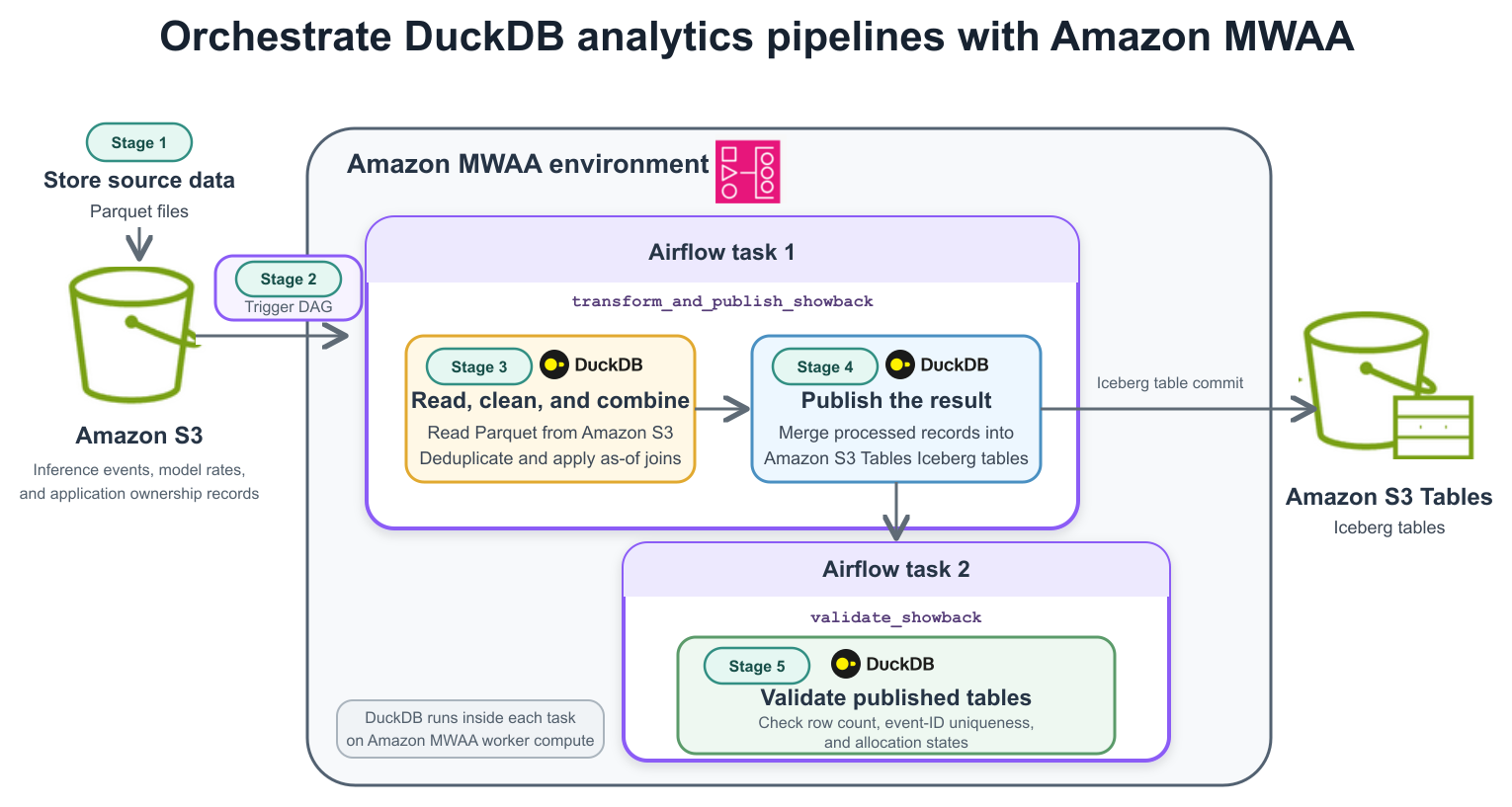
Amazon MWAA serves as the backbone of this paradigm, providing a managed environment for Apache Airflow that automates the scaling, patching, and monitoring of workflow infrastructure. In a typical implementation, an Amazon MWAA Provisioned environment schedules and triggers tasks, while the worker nodes utilize their local CPU and memory resources to execute DuckDB operations.
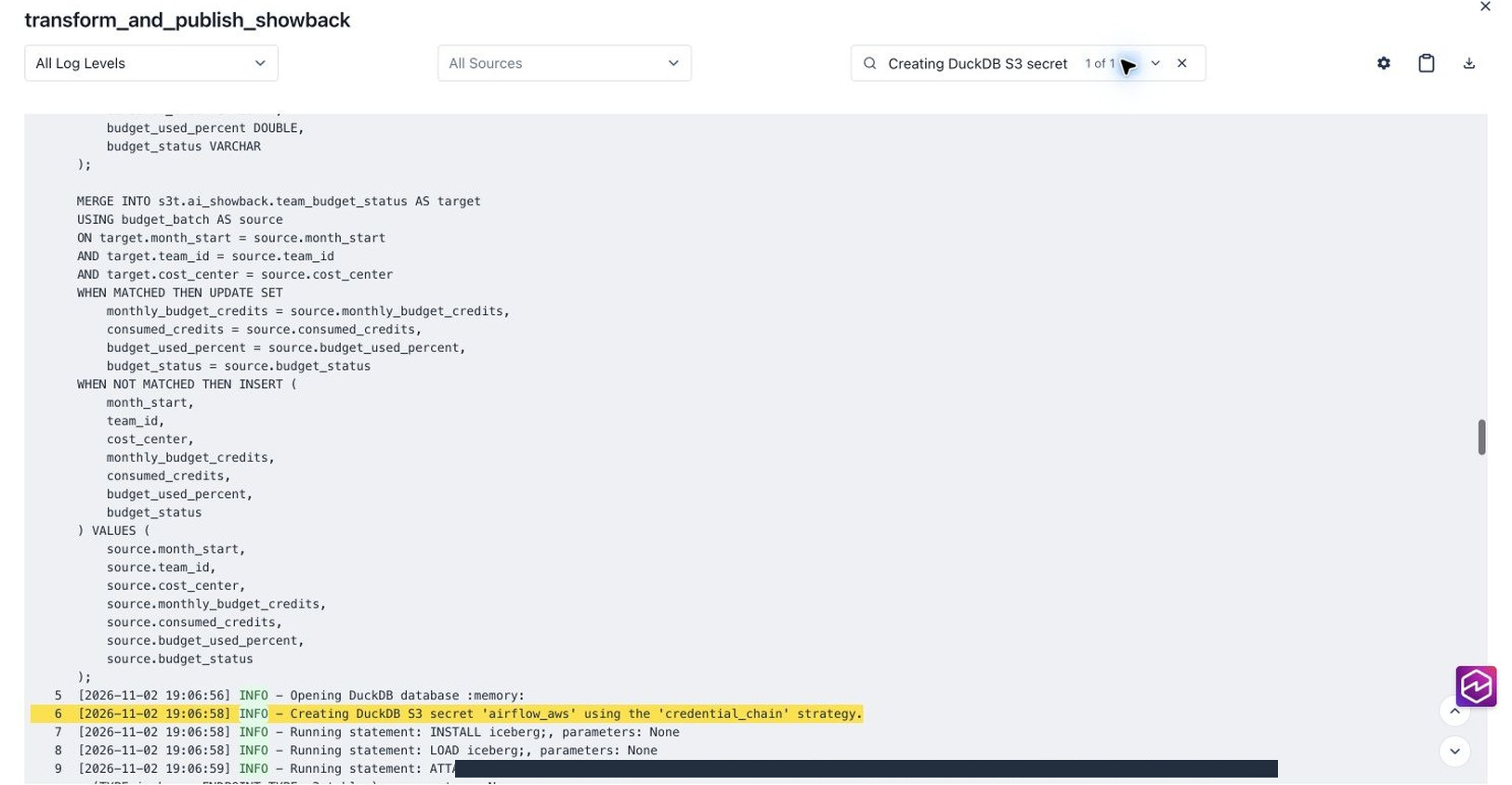
With the advent of the Apache Airflow DuckDB provider, specifically the DuckDBExecuteQueryOperator, developers have gained a standardized interface to execute SQL queries without the need for external database services. Amazon MWAA further simplifies this by pre-configuring the duckdb_default connection using the duckdb_aws connection type. This allows the Airflow task to automatically retrieve temporary security credentials, enabling secure, seamless access to data stored in Amazon Simple Storage Service (Amazon S3) without requiring hard-coded access keys or complex secret management.
Practical Application: AI Inference Showback
A primary use case for this architecture is the "showback" pipeline—a mechanism for engineering teams to track and attribute costs for shared services. As artificial intelligence inference services become ubiquitous, businesses must account for which specific applications or teams are driving consumption and, consequently, the associated costs.
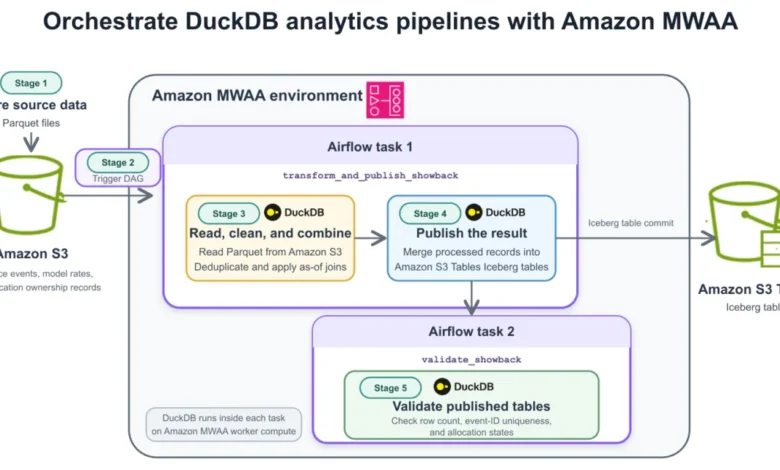
In a recent implementation, an engineering team utilized this combination to build a five-stage pipeline:
- Ingestion: Reading raw Parquet files from Amazon S3.
- Deduplication: Utilizing DuckDB’s window functions to remove redundant events based on ingestion timestamps.
- Attribution: Performing an ASOF LEFT JOIN to map event data to historical model rates and application ownership records.
- Transformation: Calculating credit costs based on token usage.
- Publication: Merging the results into Apache Iceberg tables hosted on Amazon S3 Tables.
This approach ensures that the data is not only processed efficiently but is also stored in an open-standard format that is easily queryable by downstream analytics services like Amazon Athena.
Technical Performance and Operational Efficiency
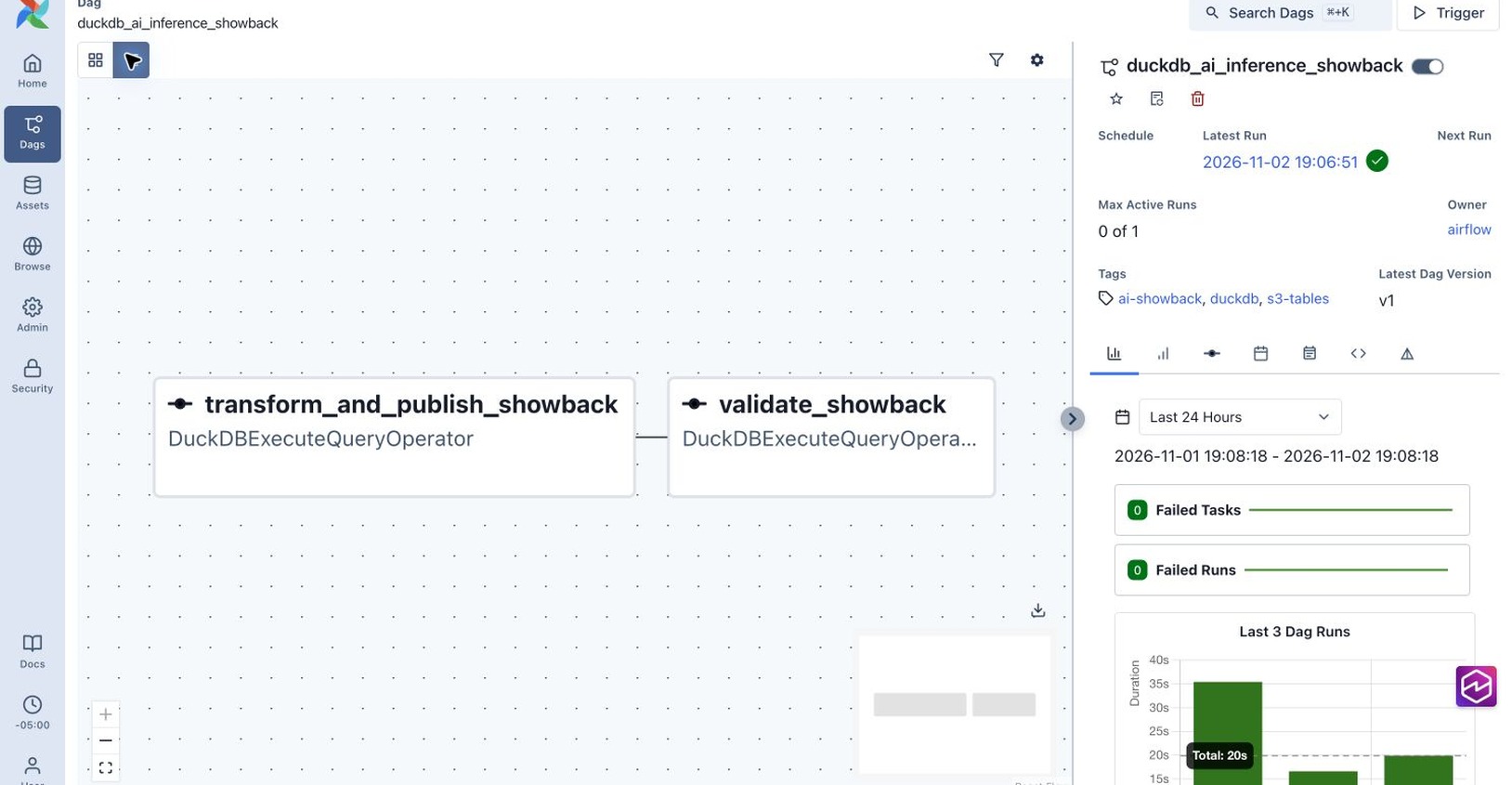
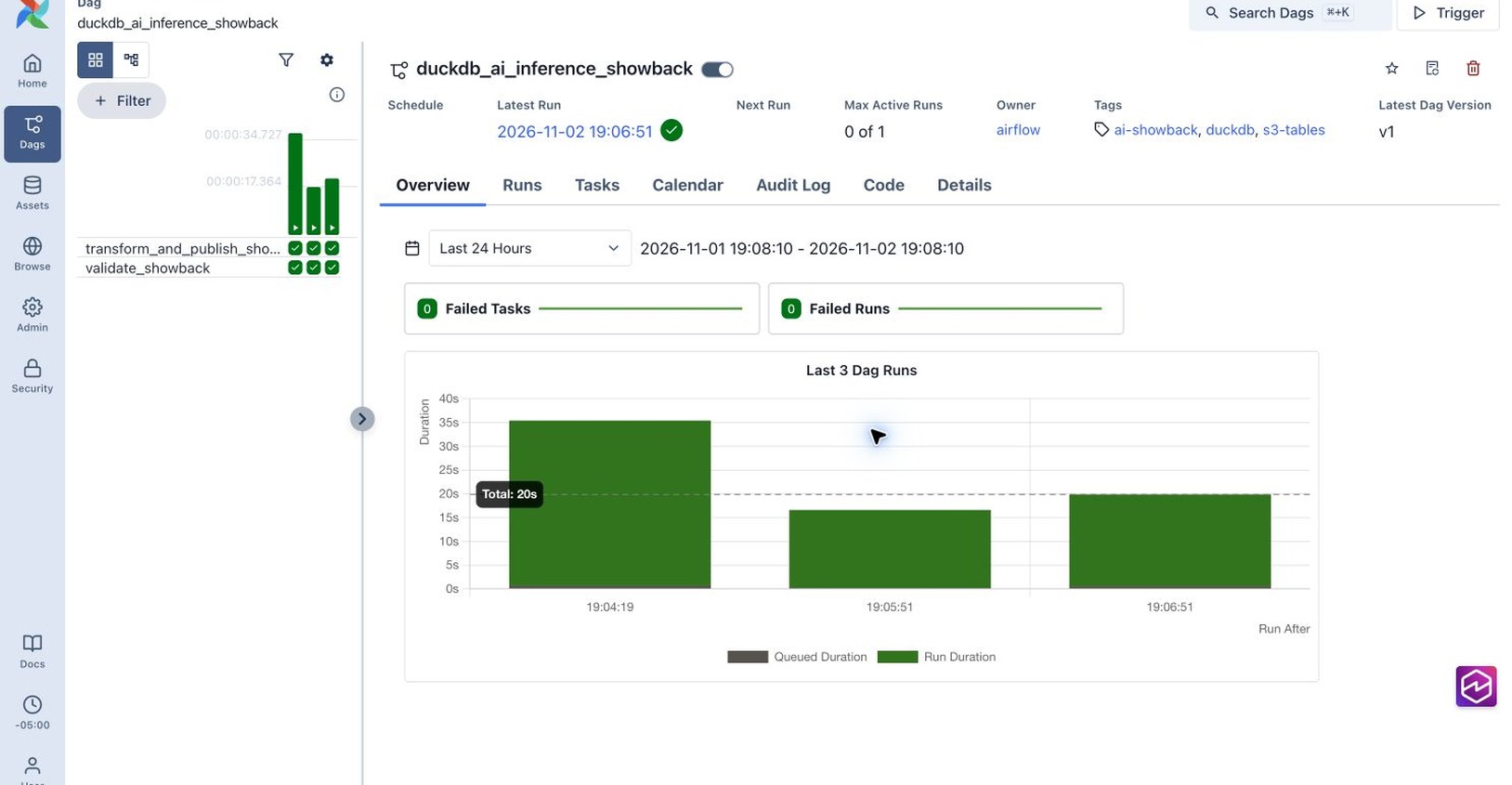
Performance data from test environments indicates that this integration is highly efficient for targeted workloads. In a representative test involving approximately 300,000 unique events, the pipeline completed the transformation and publication stages in roughly 11 seconds, with validation tasks concluding in 6 seconds. The use of DuckDB’s MERGE statement ensures that the pipeline remains idempotent; even if a task is retried due to a transient failure, the logic prevents the creation of duplicate records, maintaining data integrity.
The operational overhead is similarly minimized. Because the tasks run within the existing worker container, there is no need for external cluster initialization, which traditionally accounts for a significant portion of the "cold start" time in data pipelines. However, practitioners must remain mindful of resource constraints. Since Amazon MWAA workers have defined memory and CPU limits, excessive data loading or inefficient SQL joins can lead to resource exhaustion. Best practices dictate setting explicit memory limits within the operator and utilizing a local directory for spill-to-disk operations if the dataset size approaches the worker’s memory capacity.
Broader Implications for Data Engineering
The transition toward embedded, in-process analytics marks a broader trend in data engineering: the "unbundling" of the data warehouse. By using Apache Iceberg as the storage layer and DuckDB as the compute engine, organizations can achieve the performance of a traditional warehouse with the flexibility and cost-effectiveness of a decoupled storage architecture.
The ability to perform these operations within a managed orchestrator like Amazon MWAA allows teams to treat their SQL transformations as code, version-controlled within their DAG definitions. This increases the reproducibility of data pipelines and aligns with modern DevOps practices. Furthermore, because the output is stored in S3 Tables using the Iceberg format, the data remains accessible to a wide ecosystem of tools, preventing vendor lock-in and enabling future-proofing of the data stack.
Expert Perspectives and Strategic Guidance
Industry experts note that while this architecture is highly effective for bounded workloads, it should not be viewed as a universal replacement for all distributed compute. Kamen Sharlandjiev, a Principal Specialist Solutions Architect, emphasizes that the primary goal of this integration is to provide a "right-sized" solution. For massive, petabyte-scale datasets or workloads requiring complex, multi-node shuffle operations, distributed engines remain the appropriate choice.
However, for the vast majority of daily reporting, ETL, and data quality check tasks, the complexity of managing a distributed cluster is often unnecessary. By utilizing the built-in providers in Amazon MWAA, teams can significantly reduce their infrastructure footprint and simplify their maintenance burden. The focus for engineering teams should remain on rigorous testing—validating table schemas, handling partial failures, and ensuring that concurrent writes to Iceberg tables are managed according to the underlying storage configuration.
Conclusion and Future Outlook
The integration of DuckDB within Amazon MWAA provides a compelling blueprint for modern, efficient data engineering. It demonstrates that by leveraging lightweight, high-performance engines, organizations can achieve high-throughput data processing without the administrative weight of traditional distributed systems. As the data ecosystem continues to favor open standards like Apache Iceberg and high-speed local processing engines, the convergence of orchestration and compute will likely become a standard pattern for cloud-native analytics.
For organizations looking to implement this, the recommended path involves starting with representative sample data, establishing clear memory and thread boundaries within the DAG, and gradually transitioning existing legacy scripts to the DuckDBExecuteQueryOperator. As these pipelines mature, the combination of Amazon MWAA and DuckDB will continue to offer a scalable, resilient, and cost-effective method for managing the analytical demands of modern enterprise applications.