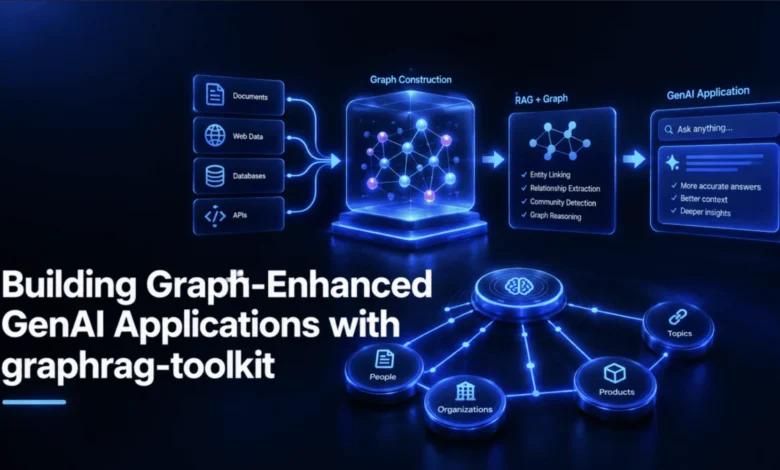
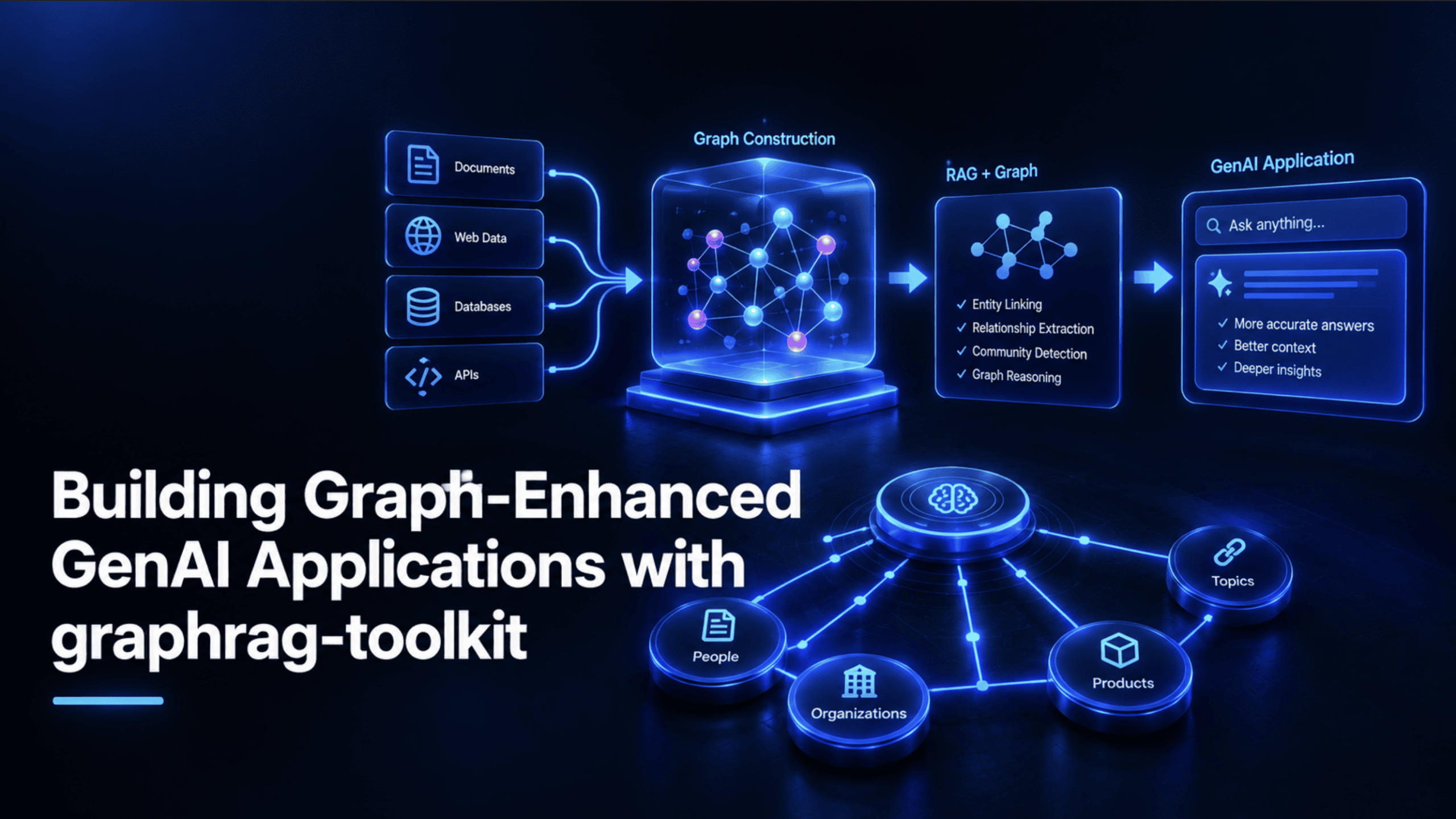
The landscape of Generative AI is currently undergoing a structural shift as developers move beyond the initial excitement of basic Retrieval-Augmented Generation (RAG) toward more robust, reasoning-capable architectures. While standard RAG systems—which rely exclusively on vector similarity—have revolutionized how chatbots interact with internal documents, they suffer from a fundamental limitation: they treat information as isolated, semantic "islands." When faced with complex queries that require connecting disparate facts across a large document corpus, these systems often fail to provide comprehensive answers. The emergence of the graphrag-toolkit, an open-source project from AWS Labs, marks a significant milestone in addressing these "multi-hop" retrieval challenges by integrating knowledge graph structures directly into the GenAI stack.
The Structural Limitation of Vector-Only RAG
To understand the necessity of GraphRAG, one must first analyze the mechanics of traditional vector search. In a standard setup, documents are segmented into chunks, transformed into numerical embeddings, and stored in a vector database. When a user asks a question, the system calculates the cosine similarity between the query embedding and the stored chunks, returning the "closest" matches.
This approach is highly effective for factoid-based retrieval—such as identifying a specific return policy or a product serial number. However, it fails when the information requested is implicit or distributed. For instance, a query regarding the intersection of international trade regulations and warranty liability requires the synthesis of information that may exist in two distinct, non-adjacent document sections. Because a vector index lacks an inherent understanding of relationships, it cannot "traverse" from one entity to another. The result is a fragmented response that lacks the contextual cohesion required for high-stakes enterprise research.
Chronology of the GraphRAG Evolution
The integration of graph databases with AI is not a sudden development but the result of several years of convergence between two traditionally separate data disciplines:
- 2020–2022: The rise of Large Language Models (LLMs) triggers a massive adoption of vector databases (Pinecone, Milvus, Weaviate) as the primary mechanism for adding external knowledge to LLMs.
- 2023: Early adopters realize that vector search struggles with complex, multi-hop reasoning. The term "GraphRAG" begins to circulate in technical circles as developers experiment with hybrid systems.
- 2024: Major database players, including Neo4j and Oracle, formalize their support for graph-enhanced retrieval, validating that the problem is a systemic bottleneck in AI development.
- 2025: AWS Labs officially releases the graphrag-toolkit, moving the concept from experimental research papers to production-ready open-source infrastructure. The release coincides with high-profile implementations, such as Deloitte’s usage of the system for GenAI-based security intelligence.
Technical Architecture: The Hierarchical Lexical Graph
The graphrag-toolkit distinguishes itself through its "lexical-graph" model, which categorizes information into a six-level hierarchy: source, chunk, topic, statement, fact, and entity. This hierarchy allows the system to perform a more sophisticated retrieval process than standard search.
When a query is submitted, the system does not simply pull chunks; it utilizes a traversal-based search mechanism. It identifies anchor points via traditional similarity search and then traverses the graph to extract related entities, statements, and facts connected to those anchors. This ensures that the context provided to the LLM is not just semantically similar, but logically connected to the query.
Furthermore, the toolkit’s emphasis on a two-stage extraction process—where raw text is first converted into clean, self-contained propositions before entity extraction—addresses the persistent "noise" issue found in unstructured document ingestion. By isolating the extraction (ingestion) phase from the building (indexing) phase, AWS has provided a scalable framework that allows for pause-and-resume data pipelines, a critical feature for enterprises dealing with terabytes of legacy documentation.
Comparative Analysis: Vector Search vs. Graph-Enhanced Retrieval
Industry benchmarks suggest that while vector search remains superior for speed and latency, GraphRAG provides a significant advantage in accuracy for complex reasoning.
| Feature | Standard Vector RAG | Graph-Enhanced RAG |
|---|---|---|
| Primary Strength | Semantic similarity | Relationship and entity reasoning |
| Multi-hop Capability | Low (relies on chunk overlap) | High (traverses connections) |
| Infrastructure Cost | Low | Moderate (requires graph/vector store) |
| Best Use Case | Simple Q&A, documentation lookups | Complex research, legal/regulatory analysis |
The implication of this shift is profound for developers. The reliance on Amazon Bedrock as the default model provider within the toolkit ensures tight integration with AWS’s security and compliance protocols, while the flexibility to use Neo4j or Postgres with pgvector allows teams to balance infrastructure costs according to their scale.
Practical Implementation and Deployment
Building a research assistant using the graphrag-toolkit involves a modular approach. The initial step of spinning up a Docker-based environment with Neo4j and Postgres allows developers to prototype without immediate cloud overhead.
The integration process requires three core dependencies: graphrag-lexical-graph, psycopg2-binary, and the relevant document readers. Once the environment is initialized, the extract_and_build method acts as the engine, utilizing LLMs to map the relationships between documents. For example, in an analysis of spaceflight programs, the system creates nodes for "Artemis," "International Space Station," and "Commercial Crew Program," effectively mapping the shared logistics and contractors across these entities. When a user asks how these programs intersect, the query engine traverses the graph, gathering the necessary context from all three articles to generate a unified, synthesized answer.
Broader Implications and Future Trajectory
The move toward graph-enhanced AI signals a maturation of the GenAI market. As organizations move past the "proof-of-concept" stage, they are finding that accuracy and reliability are non-negotiable. The ability of GraphRAG to provide "traceability"—showing exactly which facts were connected to form an answer—is a major step toward reducing hallucinations and increasing transparency in automated systems.
Looking ahead, the development of the Model Context Protocol (MCP) and the trend toward multi-tenant graph architectures suggest that we will soon see "agentic" systems capable of navigating vast, interconnected knowledge bases autonomously. The graphrag-toolkit provides the foundation for this evolution, offering a standardized way to bridge the gap between human-readable text and machine-processable knowledge.
As the industry moves forward, the consensus among database architects and AI engineers is clear: data without relationships is simply noise. By prioritizing the structural connection of information, the graphrag-toolkit provides the missing link that allows Generative AI to transition from a sophisticated search tool to a genuine reasoning engine. For organizations handling complex, interconnected domains—such as legal research, scientific discovery, and industrial engineering—this architectural shift represents not just a technical upgrade, but a fundamental change in how information is synthesized and consumed in the modern enterprise.