The rapid evolution of Large Language Model (LLM) agentic workflows has transitioned from simple, localized Python scripts to complex, multi-agent autonomous systems. As organizations move these agents from experimental sandboxes into production environments, they are encountering a significant "deployment gap." This chasm is defined by the inherent tension between the sequential nature of traditional software requests and the non-deterministic, high-latency characteristics of LLM-based reasoning. Bridging this gap requires a sophisticated understanding of two foundational architectural patterns: synchronous and asynchronous execution. Choosing the correct pattern is no longer a matter of preference; it is a critical infrastructure decision that dictates the scalability, reliability, and user experience of AI-driven applications.
The Evolution of Agentic Workflows
In the early stages of the generative AI boom, developers utilized high-level orchestration frameworks to build agents that could browse the web, execute code, and perform database lookups. These initial iterations were largely designed for single-user, local environments. However, as these agents began to handle enterprise-grade tasks—such as automated financial auditing, real-time code refactoring, or supply chain analysis—the limitations of standard request-response cycles became apparent.
In production, agents frequently require multi-step reasoning loops that may involve multiple API calls to foundation models, external search engines, and internal databases. Each of these steps introduces potential latency. When a system is architected to wait for every step to complete before returning a result to the user, it becomes highly susceptible to system timeouts, memory leaks, and a poor user experience. Industry data suggests that over 60% of enterprise AI projects face challenges in production deployment due to infrastructure bottlenecks, with latency-related timeouts being the primary culprit for service degradation.
Synchronous Execution: The Limitations of "Wait and See"
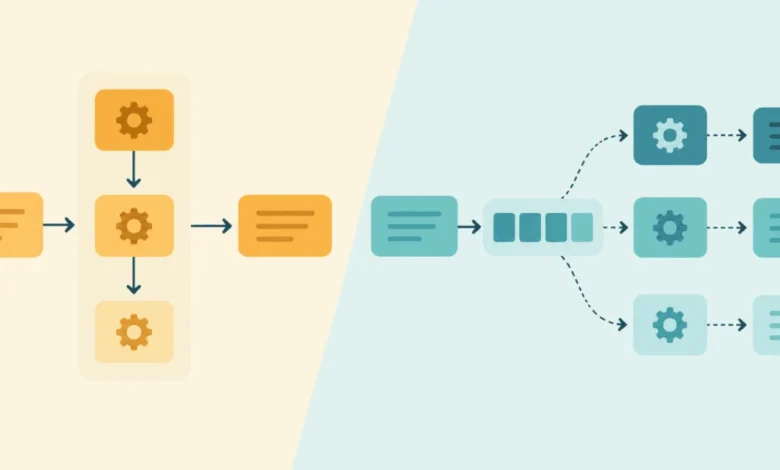
The synchronous execution pattern, often referred to as the "request-response" model, is the industry default for most web applications. In this architecture, an external caller transmits a prompt to the agent. The execution thread remains blocked, holding the connection open while the agent performs its chain-of-thought processing and tool execution.
This approach is highly intuitive and effective for low-latency tasks, such as simple RAG (Retrieval-Augmented Generation) pipelines where the data retrieval is fast and the LLM inference is minimal. However, the fragility of this pattern increases exponentially with the complexity of the agent. Most cloud infrastructure providers, including AWS API Gateway, enforce strict timeouts—typically 29 seconds. An agent tasked with a complex, multi-step query that takes 45 seconds to resolve will inevitably trigger a gateway timeout, resulting in a "504 Gateway Timeout" error. From the user’s perspective, the process fails entirely, despite the agent having technically performed the required labor. This leads to redundant token consumption, increased costs, and a breakdown in user trust.
To mitigate this, developers have historically attempted to shorten prompt lengths or utilize faster, smaller models, but these compromises often degrade the quality of the agent’s reasoning, limiting its utility for sophisticated enterprise tasks.
Asynchronous Execution: The Paradigm Shift
To address the shortcomings of the synchronous model, industry leaders are increasingly adopting asynchronous, event-driven architectures. This "fire-and-forget" pattern decouples task submission from task completion. When a client initiates a request, the system immediately returns a unique job identifier (job_id) and places the request into a persistent message queue, such as RabbitMQ, Amazon SQS, or Redis.
Under this architecture, background worker nodes—independently of the client request—poll the queue for new tasks. Once a task is retrieved, the worker processes the agent’s reasoning steps in the background. Because the worker is decoupled from the initial user request, the agent can operate for minutes or even hours without forcing a timeout on the client.
This model allows for high fault tolerance. Through frequent checkpointing, where the state of the agent is saved to a database (e.g., PostgreSQL or MongoDB) at each step, a system can recover from a node crash. If a worker process fails, a new worker can resume the task from the last saved state, ensuring that computational progress is not lost. While this introduces a higher degree of complexity—requiring the management of message brokers, databases, and worker fleets—the tradeoff is a significantly more robust system capable of handling high-concurrency, long-running agent workflows.
Comparative Analysis of Architectural Demands
The choice between synchronous and asynchronous patterns is fundamentally a choice between simplicity and scalability.
| Feature | Synchronous Pattern | Asynchronous Pattern |
|---|---|---|
| Complexity | Low; easy to implement | High; requires message brokers |
| Latency Tolerance | Very Low (Timeout prone) | High (Non-blocking) |
| User Experience | Instant feedback | Requires polling/webhooks |
| Fault Tolerance | Limited | High (Checkpointing) |
| Infrastructure | Minimal | Robust (Queue, DB, Workers) |
The industry consensus is shifting toward a hybrid model. Small, predictable tasks (e.g., chat interfaces, summarization) are served via synchronous APIs, while complex, non-deterministic tasks (e.g., data analysis, report generation, multi-agent debating) are offloaded to asynchronous background processes.
Broader Implications and Strategic Considerations
The move toward asynchronous agent architecture reflects a broader trend in distributed systems. As agents begin to function more like independent employees—performing long-running, recursive tasks—the "web request" becomes an insufficient vessel for communication. Modern AI platforms are increasingly adopting event-driven designs that treat agent "thoughts" as discrete events.
Official guidance from leading cloud providers emphasizes that developers must design for failure. In a production environment, assuming that a multi-step LLM task will complete without a hiccup is a strategy prone to failure. Asynchronous patterns enable "Human-In-The-Loop" (HITL) workflows, where the system can pause an agent’s execution, wait for a human to review or approve an intermediate output, and then resume the process. This capability is critical for sectors such as legal, healthcare, and finance, where agent autonomy must be constrained by oversight.
Furthermore, the data storage requirements for these patterns are distinct. A synchronous agent often relies on transient memory, while an asynchronous agent demands a persistent "memory store" to keep track of the context, state, and history of a job. This has led to the rise of specialized database solutions designed specifically for agentic state management, further professionalizing the AI deployment stack.
Conclusion: Designing for Resilience
For developers building the next generation of agentic AI, the architectural decision is clear: prioritize synchronous patterns only for tasks that are guaranteed to complete within the standard request-response window. For any workflow involving multi-step reasoning, external tool usage, or deep research, the transition to an asynchronous, queue-based architecture is essential.
While the infrastructure burden of message brokers and state databases is non-trivial, the long-term benefits—resilience against timeouts, high availability, and the ability to scale to thousands of concurrent agents—far outweigh the initial setup costs. As the field matures, the standard for a "production-ready" agent will be defined not by the sophistication of its prompt engineering, but by the robustness of its execution architecture. By decoupling task submission from processing, developers can ensure that their AI systems remain stable, reliable, and capable of executing the complex, long-running tasks that will ultimately define the future of the enterprise AI landscape.
Related posts: