Amazon Quick Revolutionizes Sales Productivity, Empowering Reps to Focus on Core Selling

The modern sales landscape is often characterized by a paradox: despite an arsenal of sophisticated tools designed to enhance efficiency, the average sales representative spends a mere 40% of their valuable time actively engaged in selling activities. The remaining 60% is consumed by a myriad of essential yet lower-value tasks, including diligent customer relationship management (CRM) updates, exhaustive prospect research, meticulous email drafting, and the constant, energy-draining context-switching between disparate software applications. This significant allocation of time away from direct customer engagement directly impacts an organization’s ability to close deals, cultivate deeper customer relationships, and ultimately, drive revenue growth. Addressing this pervasive challenge, Amazon has introduced Amazon Quick, an innovative AI assistant for work designed to transform questions into answers, answers into actionable insights, and actions into tangible business outcomes.
The Productivity Chasm: A Growing Concern for Sales Organizations

For years, the sales industry has grappled with declining "time-to-sell" metrics. A 2026 Salesforce State of Sales Report underscored this critical issue, revealing that the majority of a sales professional’s day is fragmented by administrative burdens. This fragmentation not only reduces the quantity of selling interactions but also diminishes the quality, as reps struggle to maintain focus and context across numerous tasks. The cumulative effect is often longer sales cycles, decreased win rates, and a lower return on investment from expensive sales talent. The rise of digital tools, while initially promising increased efficiency, has paradoxically contributed to this problem by expanding the number of platforms and data points sales reps must manage daily. This "tool fatigue" or "app overload" has become a significant barrier to maximizing sales team potential, diverting attention from strategic selling to tactical data entry and information retrieval.
Amazon’s Strategic Entry into AI-Powered Sales Enablement
Amazon Quick emerges from a broader trend within the tech giant to leverage its deep expertise in artificial intelligence and machine learning to solve complex enterprise challenges. Initially developed for internal use to enhance productivity across Amazon’s vast operational footprint, Quick represents a maturation of Amazon’s AI capabilities into a commercially available, robust enterprise solution. Its development is rooted in the understanding that AI can automate repetitive tasks, synthesize vast amounts of data, and provide proactive insights, thereby freeing human talent for higher-order thinking and relationship building.
Amazon Quick functions as a comprehensive AI assistant, seamlessly integrating into existing workflows whether reps are operating in a web browser, through a dedicated desktop application, or directly within ubiquitous platforms like Microsoft 365 and Outlook. This multi-platform accessibility is crucial for minimizing disruption and ensuring high adoption rates within diverse sales environments. By offloading administrative chores and streamlining information access, Quick aims to empower sales teams to expand their market reach, accelerate deal closures, and foster stronger, more enduring customer loyalty on a global scale.
Early Adopters Paving the Way
The efficacy of Amazon Quick is already being demonstrated by a cohort of prominent early adopters. Companies such as 3M, AWS Global Sales, and Amazon itself have deployed Quick to unlock previously untapped potential within their sales forces. These organizations are reporting significant improvements in efficiency and effectiveness. For instance, AWS Global Sales has showcased how Quick transforms insights delivery, enabling sales teams to quickly grasp complex data and tailor their approaches. Similarly, AWS sales teams leverage Quick to stay current on new product launches and service updates, ensuring they are always equipped with the latest information. Amazon’s internal journey deploying Quick Suite across thousands of its own users provides a compelling testament to its scalability and practical benefits, highlighting a tangible return on investment in enhanced productivity and strategic focus. These real-world applications underscore Quick’s capacity to deliver immediate, measurable improvements across the entire sales cycle.

Navigating the Sales Cycle with Amazon Quick: A Detailed Workflow
Amazon Quick is engineered to support the sales process from its nascent stages of lead identification to post-sale account management, meticulously protecting the sales professional’s most valuable asset: time.
1. Lead Scoring and Prospect Prioritization: Focusing on High-Value Opportunities
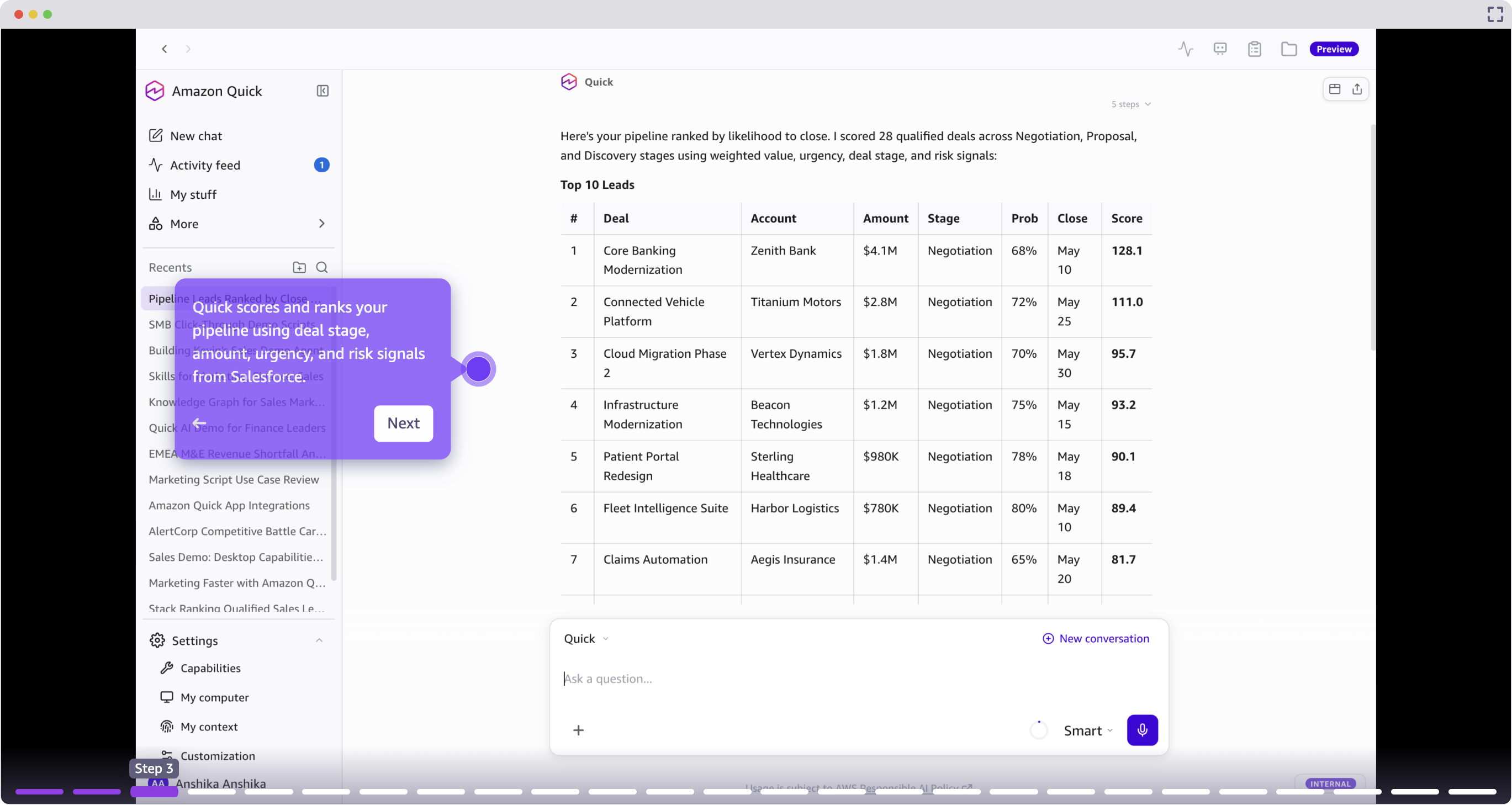
The initial challenge for many sales teams lies in sifting through an overwhelming volume of leads. A typical CRM might contain hundreds of prospects, ranging from those who briefly interacted six months ago to high-intent individuals who downloaded critical whitepapers last week. Without clear visibility into buying intent, sales reps often expend valuable resources on low-probability leads, missing out on more lucrative opportunities.
Amazon Quick addresses this by intelligently identifying and prioritizing high-intent prospects. It achieves this by connecting to an organization’s existing CRM, email systems, web analytics, and support platforms. Through advanced AI algorithms, Quick analyzes a multitude of engagement signals—such as website visits, email opens, content downloads, and support inquiries—to dynamically rank leads by their likelihood to convert. Furthermore, Quick’s custom chat agents can pull context from internal documents, historical opportunity details, and comprehensive account histories, providing reps with a holistic view of each prospect. This allows sales professionals to concentrate their efforts on those most ready to engage and purchase.
Integrating Quick with existing CRM systems is a straightforward process, with detailed instructions available for popular platforms like Salesforce, HubSpot, and ServiceNow, among others. Once integrated, users can leverage Amazon Quick Sight, the embedded business intelligence service, to create interactive dashboards. A natural language prompt, such as "rank my pipeline," can then trigger Quick to analyze the dashboard data, aggregating information across all connected systems to produce a prioritized view of urgent deals. This dynamic ranking highlights deals with stalled progression, overdue follow-ups, or competitive pressures, bringing them to the forefront of a rep’s daily focus.
2. Risk Detection and Proactive Next Steps
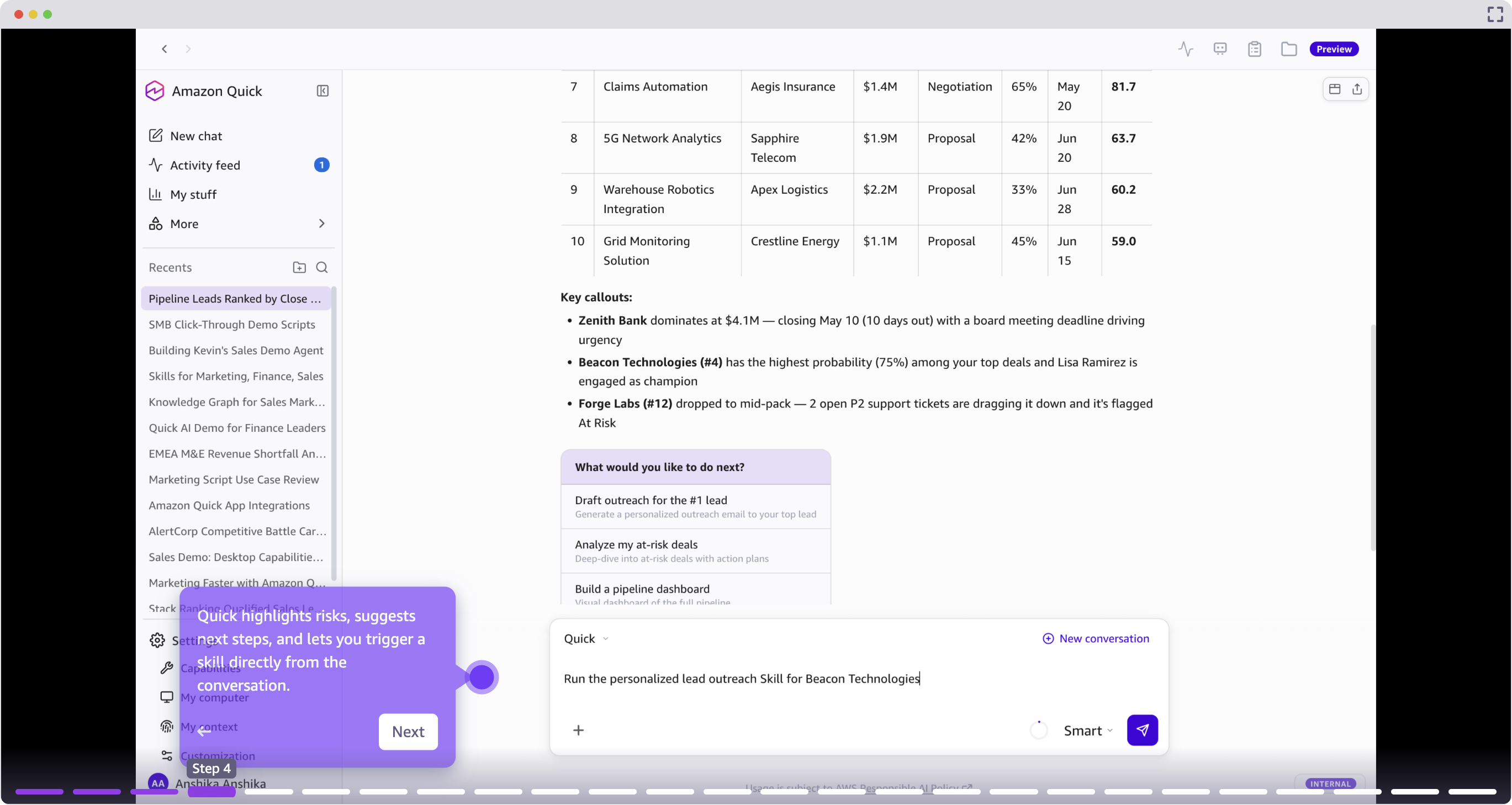
Beyond prioritization, Quick offers critical risk detection capabilities. For each identified deal, the system pinpoints specific risk signals, such as stagnating email threads, missed follow-ups, or mentions of competitors in communications. Crucially, it doesn’t just flag risks; it recommends concrete, actionable next steps. Sales professionals can then trigger a follow-up action directly from the conversation interface within Quick, eliminating the need to switch between multiple applications and maintaining workflow continuity. This proactive identification and remediation of risks are vital for preventing deals from falling through the cracks.
3. Personalized Outreach and Email Engagement: Crafting Messages That Resonate
Once a high-priority prospect is identified, crafting a compelling and personalized outreach message is paramount. Traditionally, this demands extensive manual research across CRM records, internal documentation, external sources like company websites and press releases, and individual prospect LinkedIn profiles. The alternative – sending a generic message – almost guarantees it will be ignored in today’s crowded inboxes.
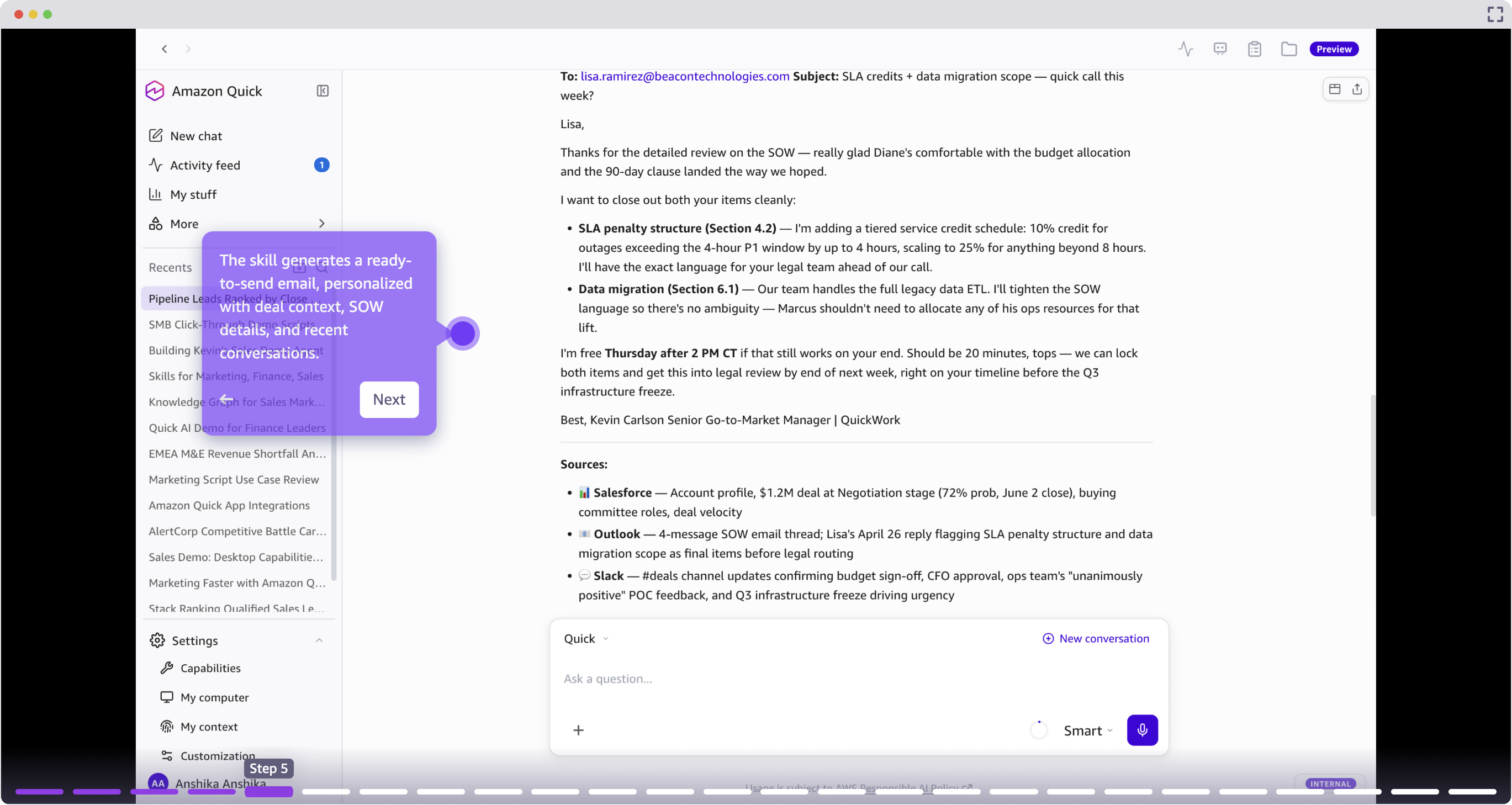
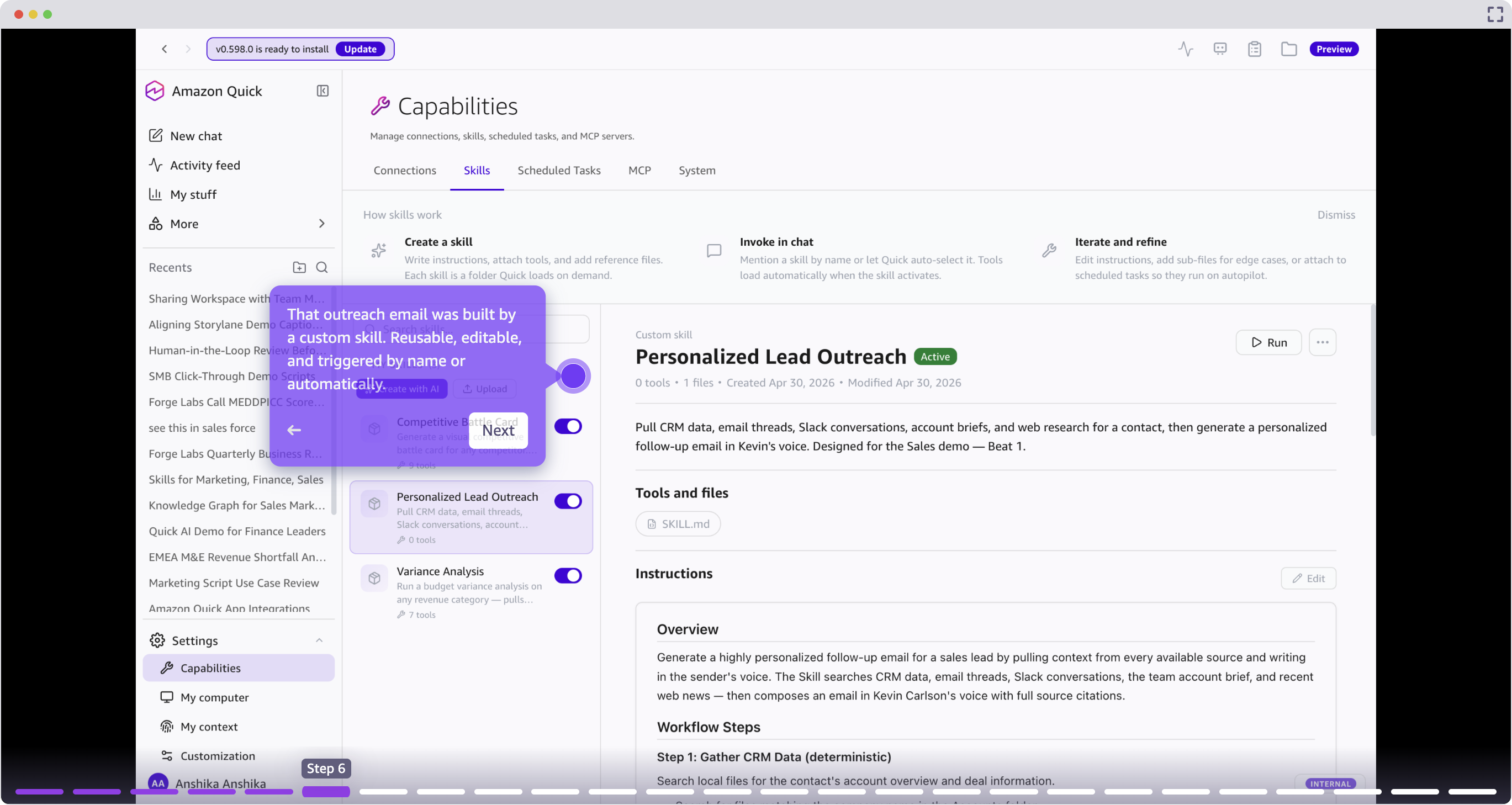
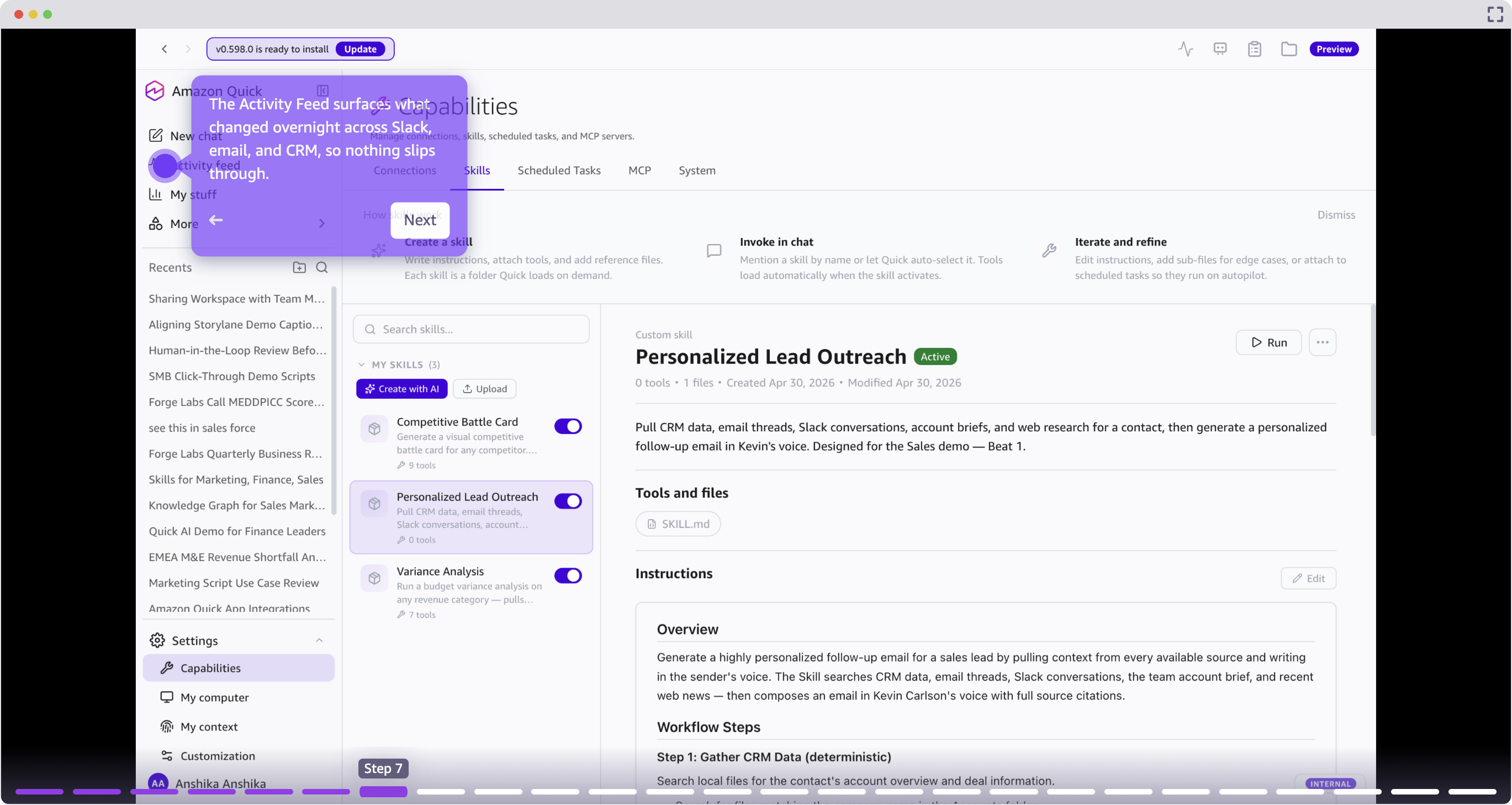
Quick eliminates this arduous tradeoff. It empowers reps to craft highly tailored outreach messages that incorporate specific context, such as recent company news, identified pain points from past interactions, and relevant use cases, all without requiring hours of manual research. This capability is powered by custom "skills" within Amazon Quick – reusable, automated workflows. A skill can be configured to "research a prospect by pulling data from multiple sources (CRM, email threads, Slack conversations, account briefs, and web research), then generate a personalized outreach message." This skill can be applied to the current prospect and then repurposed across all accounts, standardizing and accelerating personalized communication.
With seamless integration with Microsoft Outlook and other email clients, Quick surfaces as a side panel within the email client itself. This allows sales professionals to generate personalized outreach, pull pertinent account context, and refine messaging without ever leaving their email application, ensuring a fluid and efficient communication process.
4. Activity Monitoring: Starting Every Day with Clarity
The "Activity Feed" in Amazon Quick provides a consolidated, prioritized view of overnight changes across all connected systems, including Slack, email, and CRM. This feature replaces the often chaotic and time-consuming manual morning triage across multiple tools with a single, intelligent summary. Sales reps can quickly grasp critical updates relevant to their active deals, ensuring they begin their day with a clear understanding of their priorities and any immediate actions required. This consolidated feed significantly reduces information overload and enhances daily productivity.
5. Account Intelligence: Preparing to Close with Confidence
Securing a meeting with a prospect is a significant step, but it ushers in the intensive preparation phase. Traditionally, this involves toggling between Salesforce for deal history, ServiceNow for support tickets, an email client for past conversations, and a search engine for industry context. This manual assembly of a comprehensive account picture can easily consume an hour or more.
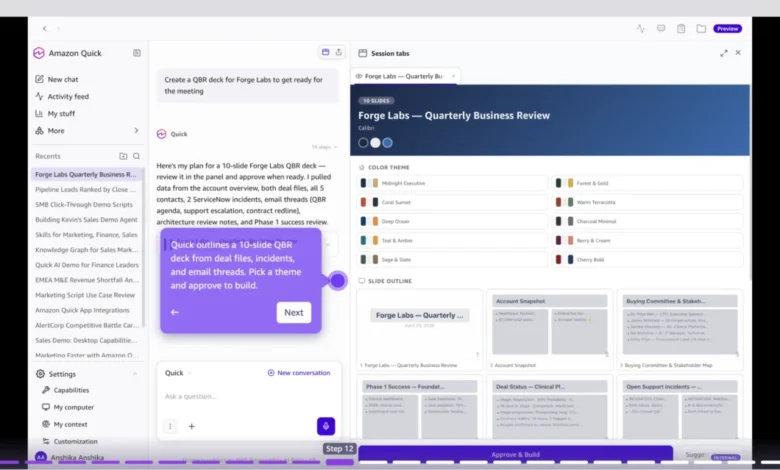
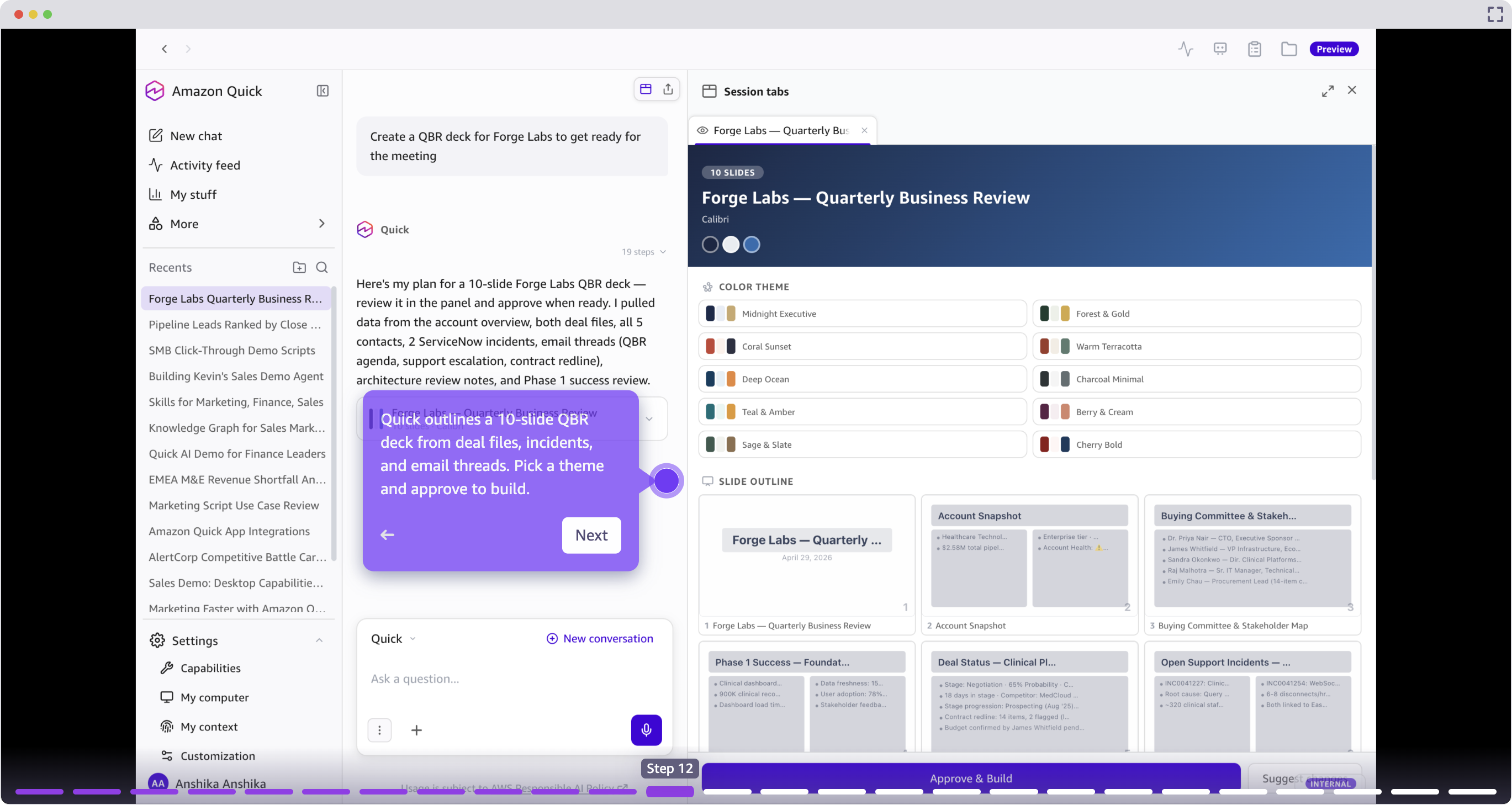
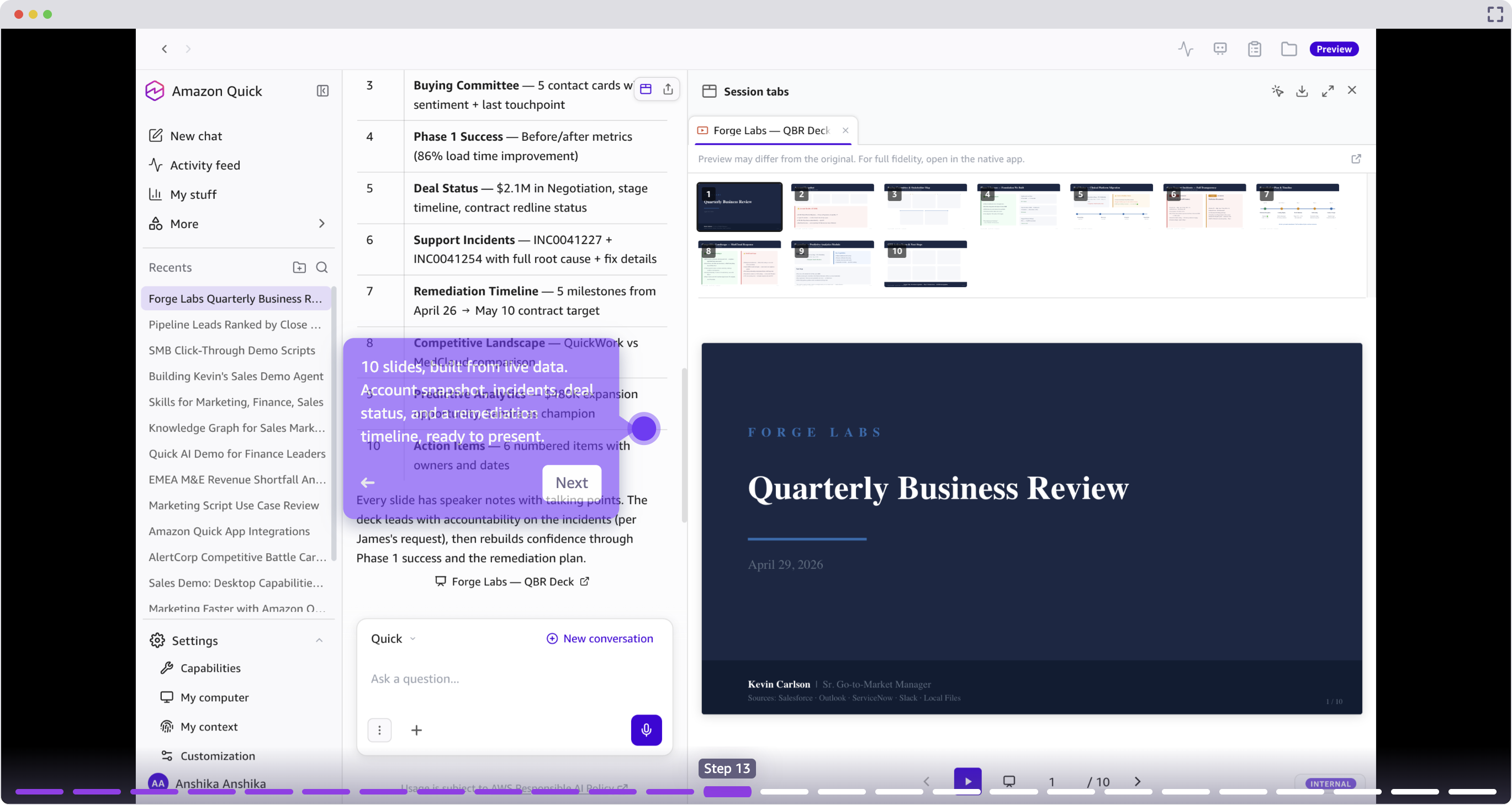
Amazon Quick streamlines this critical preparation. Sales professionals can simply ask Quick to generate a one-page meeting prep document that includes an account snapshot, attendee biographies, key questions to ask, and identified risks. By linking Quick Chat to a "Quick Space" – a centralized knowledge repository for organizing documents, data sources, and files – Quick can instantly reference all relevant information. For more extensive preparations, such as a Quarterly Business Review (QBR), Quick can outline and even build an entire presentation deck from deal files, support incidents, and email threads. The seller reviews the proposed outline, selects a theme, and approves the build, drastically reducing preparation time from hours to mere minutes. The resulting deck is dynamic, built from current data, and ensures accuracy and relevance.
6. Call Transcript Scoring: Evaluating Every Conversation
Post-meeting analysis is crucial for continuous improvement. Sales professionals can upload call transcripts into Quick for automated scoring against their organization’s established sales methodology, be it MEDDPICC, BANT, or a custom framework. Quick analyzes the conversation, identifying what topics were covered, what gaps remain, and provides a structured assessment of the deal’s health based on the interaction. This objective evaluation offers invaluable insights for coaching, refining sales strategies, and ensuring adherence to best practices.
7. CRM Automation and Activity Logging: Maintaining Data Accuracy
One of the most significant time sinks for sales reps is the consistent updating of CRM systems after every interaction. Each meeting or call can necessitate 15-20 minutes of data entry, a task often deferred or rushed due to other pressing customer engagements. This delay often leads to lost context and overlooked details, compromising the accuracy of the system of record.

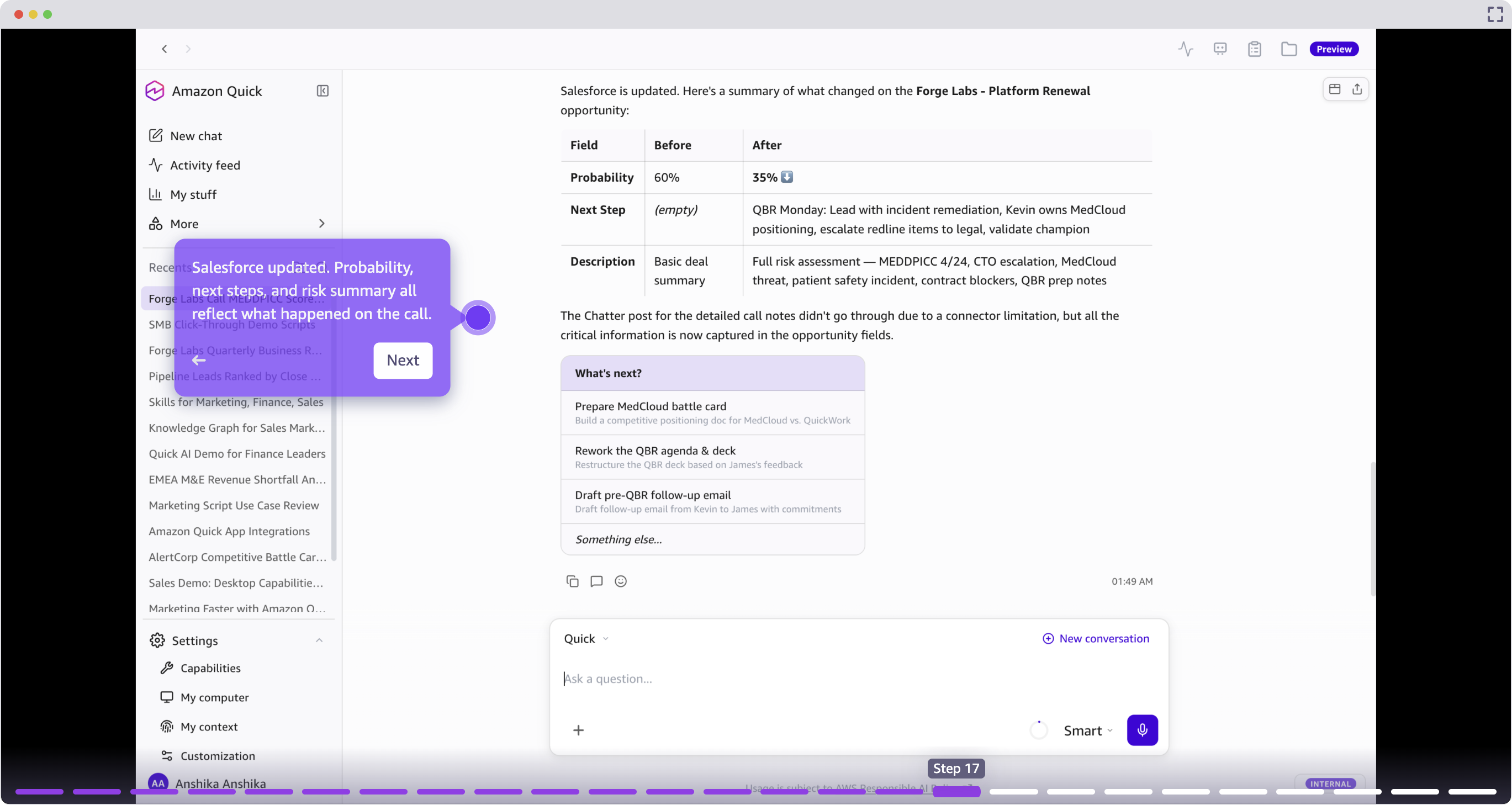
Following its comprehensive call analysis, Quick automatically pushes structured updates to Salesforce and other CRMs. This includes critical information such as updated deal probability, defined next steps, flagged risks, and a concise conversation summary. This automation ensures the CRM remains accurate and up-to-date without requiring manual data entry, freeing reps to focus on selling rather than administration. The implications of this are far-reaching, improving forecast accuracy, sales pipeline visibility, and overall operational efficiency.
8. Custom Applications from Natural Language: Building Tools Without Code
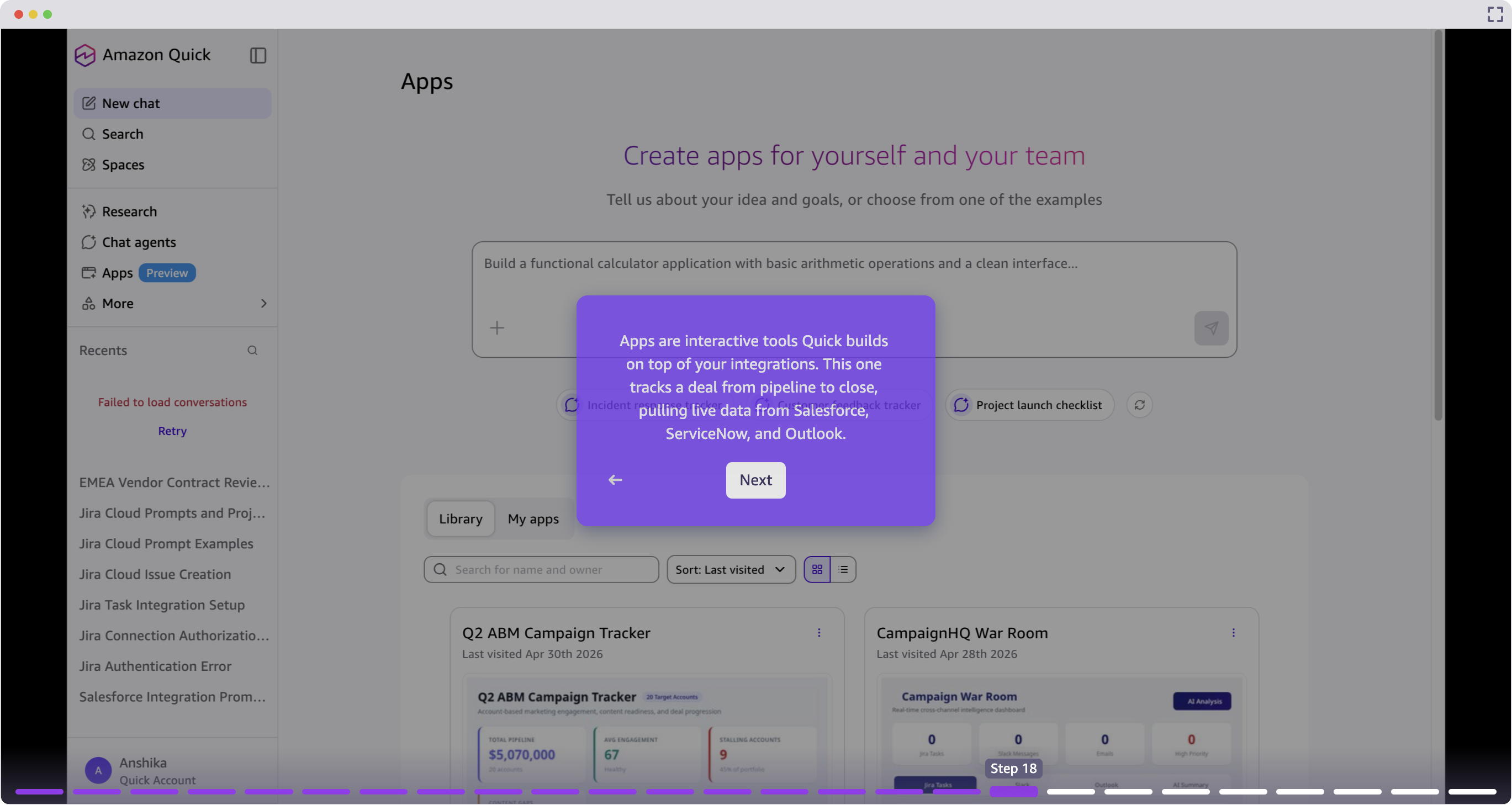
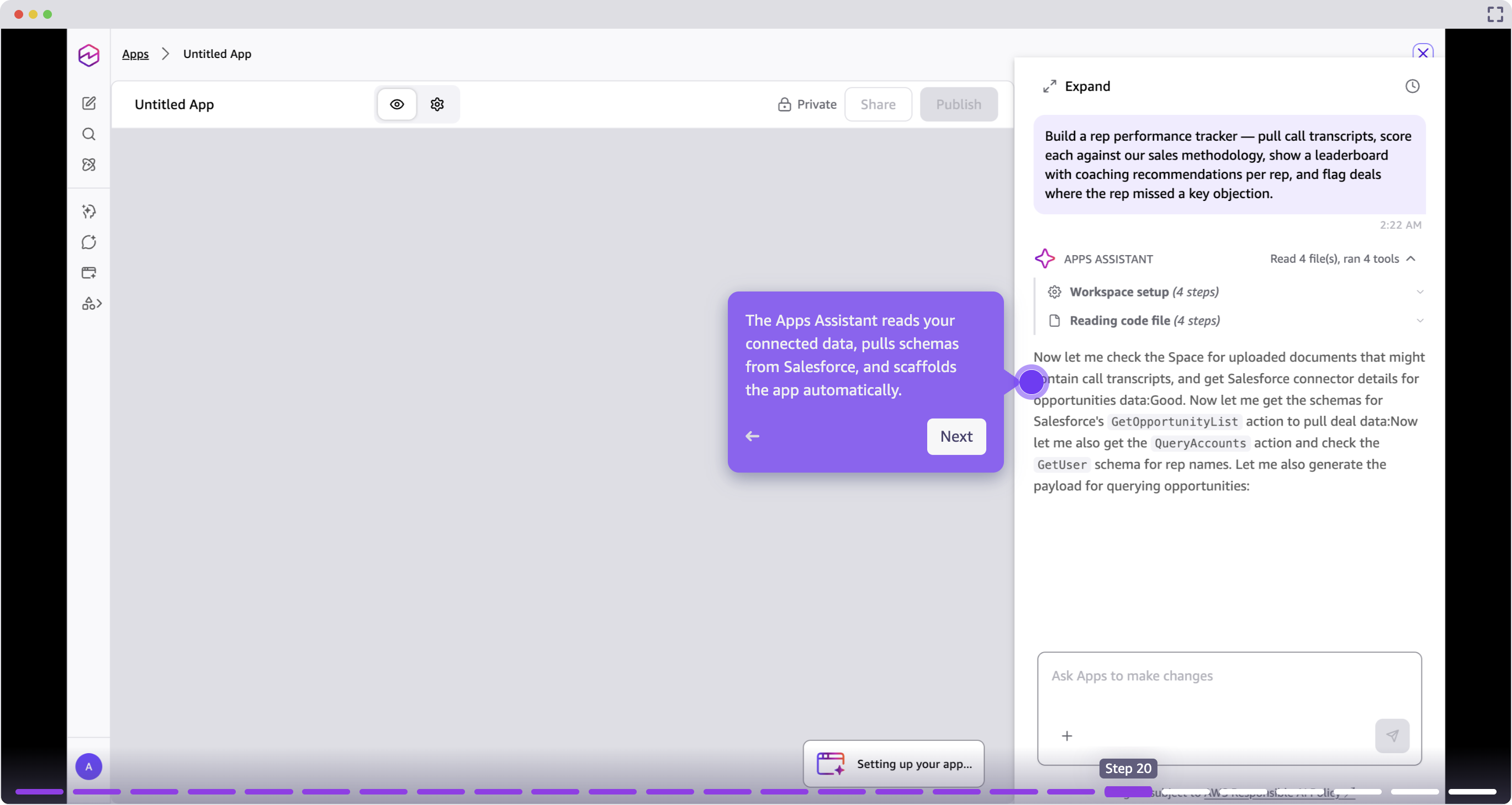
Amazon Quick empowers sales professionals and sales operations teams to build interactive applications directly from natural language prompts. The system automatically reads connected data schemas and scaffolds a live application without requiring any coding knowledge. This "no-code" or "low-code" capability democratizes tool creation, allowing teams to quickly develop tailored solutions for specific needs, such as a custom pipeline tracker or a specialized reporting dashboard. The resulting applications are live, shareable, and iterative, allowing for continuous refinement and feature additions through subsequent natural language prompts. This accelerates the development of bespoke tools that precisely meet evolving business requirements.
9. Knowledge Graph: Mapping Relationships Across the Book of Business
A cornerstone of effective sales is understanding the intricate web of relationships within and between client organizations. Amazon Quick’s Knowledge Graph visualizes these relationships, mapping connections between people, accounts, deals, and historical interactions. This intelligence is gleaned from all connected tools and data sources. Sales professionals can query relationship history, identify potential warm introduction paths, and gain a profound understanding of complex account structures without manual research. This comprehensive relationship intelligence is invaluable for strategic account planning and navigating complex sales environments.
Broader Impact and Future Implications
Amazon Quick’s integrated approach signifies a pivotal shift in sales technology, moving beyond mere automation to intelligent augmentation. By consolidating disparate tasks and providing proactive insights, Quick not only boosts individual rep productivity but also fosters a more data-driven sales culture. The ability to quickly analyze call transcripts, generate personalized outreach, and automate CRM updates means sales leaders can gain unprecedented visibility into team performance and deal health.
This technological advancement also has implications for the sales role itself. As AI handles more routine and analytical tasks, sales professionals can evolve into strategic consultants, focusing on complex problem-solving, deep relationship building, and innovative solution design. This could lead to a redefinition of sales skills, emphasizing emotional intelligence, strategic thinking, and collaborative capabilities over purely transactional selling. The market for AI in sales is projected to grow exponentially, with solutions like Quick setting a new standard for intelligent sales enablement.
Getting Started with Amazon Quick
The comprehensive capabilities demonstrated by Amazon Quick across the entire sales workflow – from initial pipeline review and personalized outreach to meticulous meeting preparation, call scoring, CRM automation, custom application creation, and sophisticated relationship mapping – underscore its transformative potential. Each feature seamlessly integrates with the next, creating a continuous, fluid workflow that keeps sales professionals engaged and productive, rather than constantly switching between applications.
Organizations can begin their journey with Amazon Quick by focusing on a single, high-impact workflow, such as lead scoring, streamlined meeting preparation, or automated CRM updates. Experiencing the tangible difference in one area can serve as a powerful catalyst for broader adoption. Further information, including detailed demonstrations and use cases, is available on the Amazon Quick for Sales page and through various online resources. By embracing AI-powered assistance, sales teams can move beyond administrative overhead and reclaim their primary mission: building relationships, creating value, and driving growth.