Talk Python and Python Bytes Host Special Crossover to Detail Essential Developer Tooling in a New Era of Collaborative Tech Media

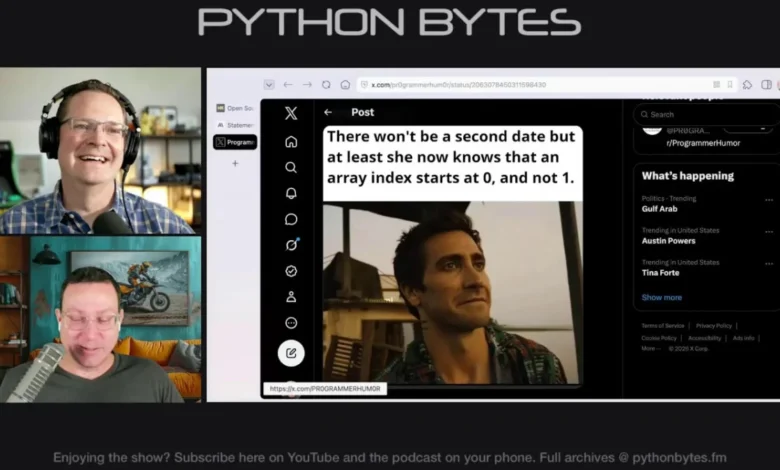
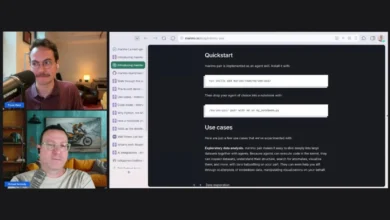
The landscape of Python-focused technical media underwent a significant structural shift as Michael Kennedy, host of the long-running "Talk Python To Me" podcast, joined forces with Calvin Hendryx-Parker for a comprehensive crossover event. The collaboration, recorded as episode 553 of "Talk Python To Me" and episode 484 of "Python Bytes" on June 16, 2026, marks the beginning of a new era for the "Python Bytes" program. This transition follows the departure of long-time co-host Brian Okken and the formal introduction of Hendryx-Parker, a Python Software Foundation (PSF) fellow and prominent figure in the Python community, as the new permanent co-host.
The episode, titled "All Our Tools," diverged from the standard news-summary format to provide an in-depth analysis of the modern developer’s workstation. By examining the intersection of agentic artificial intelligence, high-performance terminal environments, and secure overlay networking, Kennedy and Hendryx-Parker offered a blueprint for high-efficiency software engineering in the late 2020s.
The Evolution of Python Tech Media and Host Transitions
For over a decade, "Talk Python To Me" has served as the primary audio resource for Python developers and data scientists globally. The program has documented the language’s rise from a niche scripting tool to the dominant force in artificial intelligence and data science. Its sister show, "Python Bytes," was designed to deliver short, headline-driven updates. The recent departure of Brian Okken, who co-hosted the show for several years, necessitated a search for a successor who could maintain the show’s technical depth while adapting to the rapid pace of AI-driven development.
Calvin Hendryx-Parker’s appointment is viewed by industry observers as a strategic move to align the podcast with the "agentic" era of programming. Hendryx-Parker brings an "opinionated" terminal-first philosophy, which he noted during the broadcast was forged through decades of experience, beginning with early exposure to the vi editor. The crossover episode served as a "personal check-in" on the tools that define their daily workflows, ranging from niche open-source projects to high-powered commercial AI harnesses.
The Rise of Agentic Engineering: Pi and superpowers
A central theme of the discussion was the shift from "copilot" style AI—which suggests line completions—to "agentic" AI, which can plan, execute, and verify complex tasks across a codebase. Hendryx-Parker highlighted "Pi," an open-source orchestrating agentic harness, as his primary tool for this new workflow. Unlike integrated development environment (IDE) wrappers that place "guardrails" around the user, Pi is designed as a terminal-first tool that provides the developer with full control over the AI’s actions.
A critical feature of Pi discussed was its session management capability, which allows developers to "rewind" and branch off from specific points in a development timeline. This prevents the "token trap," where a model becomes stuck in a recursive error loop, consuming expensive computational resources without resolving the underlying bug.
Complementing Pi is "superpowers," a spec-driven development tool. This workflow emphasizes brainstorming, planning, and verification before code execution. By utilizing a stack of Markdown-based "skills" on the file system, superpowers allows developers to maintain a "test-driven development" (TDD) cycle—moving from red to green—within an AI-mediated environment. Industry data suggests that such spec-driven approaches can reduce technical debt by ensuring that AI-generated code adheres to pre-defined architectural requirements rather than merely chasing immediate functionality.
Reimagining the Terminal: Warp, Kitty, and OhMyZsh
The terminal remains the primary interface for the professional developer, yet the crossover episode revealed two distinct philosophies regarding its evolution. Michael Kennedy advocated for "Warp," a modern terminal built on the warp.dev platform. Warp integrates AI-line completion and team collaboration features directly into the terminal buffer. It treats individual commands as "blocks," allowing for easier navigation of historical output and integrated predictive capabilities that suggest commands based on recent user behavior.
Conversely, Hendryx-Parker defended the "raw power" of "Kitty," a GPU-accelerated terminal. The use of the Graphics Processing Unit (GPU) for text rendering allows for ultra-low latency scrolling and high-performance multiplexing. This is particularly relevant when running "tmux" (terminal multiplexer) or Kitty’s built-in window management system, which allows a single terminal window to be tiled into dozens of active sessions—monitoring test suites, file diffs, and AI agents simultaneously.
The hosts also emphasized the importance of shell customization through "OhMyZsh" and "Starship." Kennedy noted that "defaults are usually not good" in development environments. By using OhMyZsh, developers can integrate Git branch status, Python virtual environment indicators, and language versioning directly into the prompt. Starship, a Rust-based cross-shell prompt, was highlighted as a high-performance alternative to older, unmaintained prompt engines like Powerlevel10k.
Connectivity and the Mobile Developer: Mosh and Blink Shell
The discussion addressed the perennial challenge of maintaining productivity while mobile. Hendryx-Parker detailed a "remote compute" workflow involving "Mosh" (Mobile Shell) and "Blink Shell" on iOS. Mosh improves upon the standard SSH protocol by handling unreliable connections and roaming; a developer can close their laptop at a coffee shop and reopen it on a different network with their session perfectly intact.
Blink Shell serves as a professional-grade terminal for the iPad, even embedding a version of VS Code. This allows developers to utilize "remote compute" from a powerful home workstation or a GitHub Codespace while carrying only a tablet. This shift toward "thin client" development is a growing trend as the hardware requirements for running local LLMs (Large Language Models) exceed the capabilities of standard laptops.
Security and Networking via Tailscale
Security remains a paramount concern when accessing remote development environments. Kennedy described "Tailscale" as his "new religion" for networking. Tailscale is an overlay network built on the WireGuard protocol that creates a secure mesh VPN without the need for complex port forwarding or exposing sensitive ports (like SSH port 22) to the public internet.
By using Tailscale "exit nodes," a developer can ensure that their traffic appears to originate from a secure home or office IP address, regardless of their physical location. This allows for the secure use of local AI models via "LM Studio" or database servers running on dedicated hardware (such as a Mac Studio or a Linux server) from anywhere in the world.
The Geopolitical Tension in AI: The Mythos and Fable Controversy
One of the more provocative segments of the episode involved the sudden disappearance of "Fable" and "Mythos," high-powered security-focused AI models developed by Anthropic. Kennedy recounted how Mythos had gained notoriety for discovering critical vulnerabilities (CVEs) in major browsers like Firefox.
According to reports discussed in the episode, the U.S. government intervened, requesting that Anthropic restrict access to these models to U.S. citizens only, citing their potential as "weapons of mass destruction" in the context of cyber warfare. Anthropic, unable or unwilling to implement such granular geopolitical restrictions, opted to shutter the project entirely. This incident serves as a significant case study in the tension between open-source security research and national security interests, highlighting the "dual-use" nature of advanced LLMs.
Productivity and Physical Health: Voice and Documentation
The episode concluded with a look at tools that address developer health and documentation standards. Kennedy shared his personal struggle with Repetitive Strain Injury (RSI), which led him to adopt "MacWhisper" and "Handy" for voice-to-code dictation. By using OpenAI’s Whisper models locally, these tools allow for high-accuracy transcription without compromising privacy. Kennedy noted a unique "agentic" twist: passing his dictated text through "Claude Haiku" to format it into professional emails or structured code comments in real-time.
Finally, the hosts discussed "Great Docs," a new documentation framework built on Quarto. Kennedy emphasized that a library’s utility is often capped by the quality of its documentation. Great Docs allows for the creation of API references that include integrated LLM "skills," teaching AI agents how to use a specific library correctly. This "documentation for agents" is expected to become a standard requirement for open-source projects in the coming years.
Analysis of Implications for the Python Community
The "All Our Tools" crossover highlights a fundamental shift in the software engineering profession. The transition from Brian Okken to Calvin Hendryx-Parker at "Python Bytes" mirrors a broader industry transition from manual coding to "agentic engineering." The tools discussed—Tailscale for security, Pi for AI orchestration, and Warp for interface—suggest that the modern developer is no longer just a writer of code, but an orchestrator of complex, automated systems.
As Python continues to dominate the AI space, the infrastructure used to write it is becoming increasingly specialized. The reliance on GPU-accelerated terminals and secure mesh networks indicates that the developer’s "workstation" is now a distributed environment, spanning local hardware, remote servers, and cloud-based AI models. This episode of "Talk Python To Me" provides a critical snapshot of this evolution, offering a roadmap for professionals looking to maintain their edge in an increasingly automated landscape.