Iterators and Generators for Memory-Efficient Processing: Mastering Pythonic Data Pipelines

Data processing pipelines represent the backbone of modern software architecture, yet they often encounter a critical failure point when faced with exponential data growth. In many production environments, scripts that function flawlessly for months suddenly crash when log rotation policies change or traffic spikes occur, resulting in a sudden, massive influx of data that exhausts system RAM. This phenomenon, often manifested as a MemoryError, is rarely a failure of logic but rather a failure of data handling architecture. By transitioning from eager loading—where datasets are materialized in memory—to lazy evaluation through Python’s iterators and generators, developers can build robust, scalable pipelines capable of processing gigabytes of data on systems with limited memory resources.
The Anatomy of the Memory Crisis
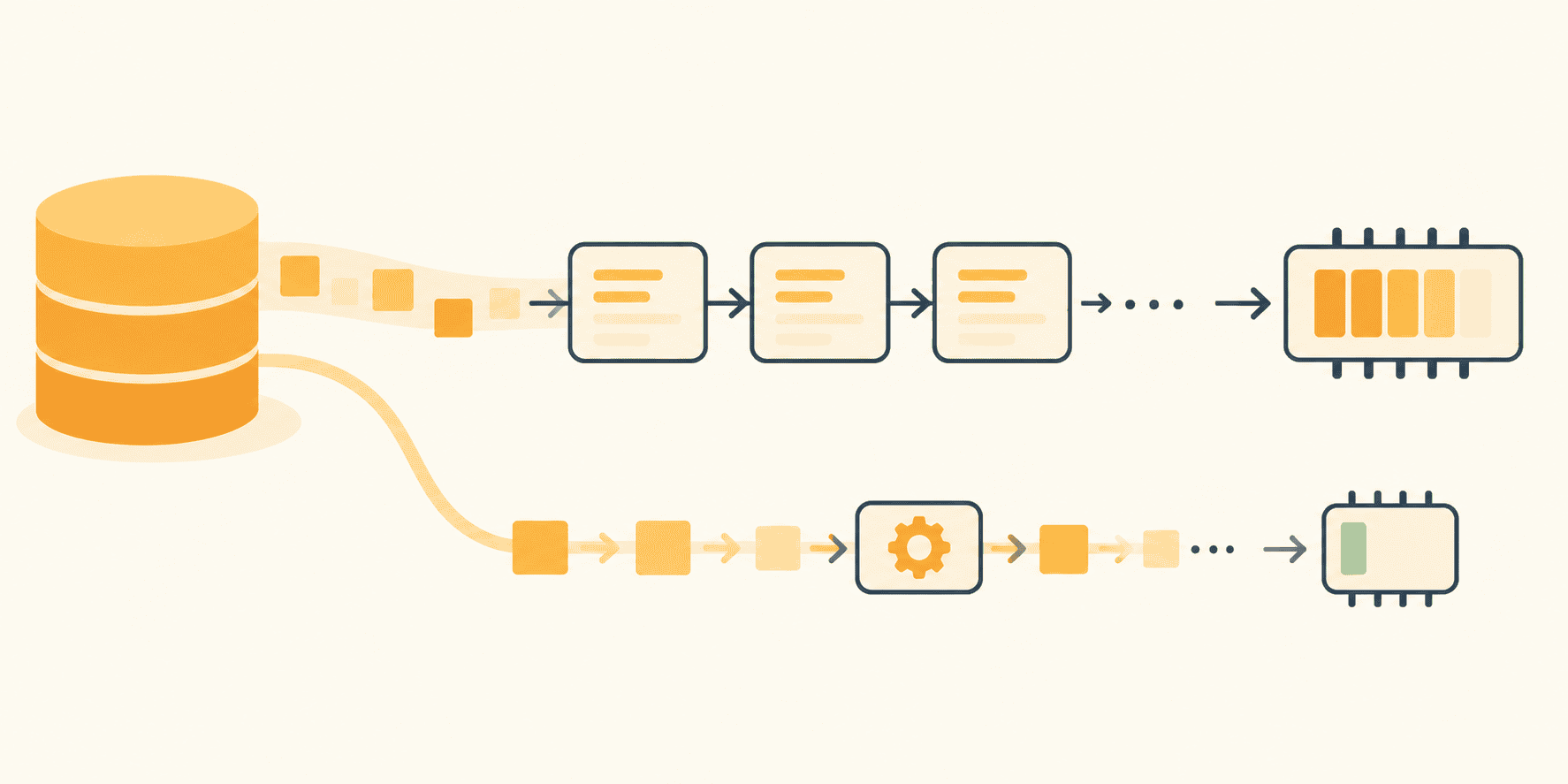
The typical "eager" approach to data processing involves reading an entire file into a list, filtering that list, and then performing operations on the result. Consider a scenario involving a 9 GB payments log. If a developer uses a list comprehension to parse this file, Python attempts to store every record as an object in the system’s RAM simultaneously. With modern log files containing millions of entries, the memory requirement quickly exceeds the available heap space.
This architecture is problematic because it assumes that the entire dataset must exist in an active state to be processed. In reality, most data processing tasks are serial in nature: we read a line, we parse it, we filter it, and we output the result. By treating these steps as a continuous stream rather than a batch operation, the memory footprint remains constant regardless of whether the input file is 10 MB or 100 GB.
Chronology of the Iterator Protocol
Python’s solution to this challenge is rooted in the iterator protocol, a concept that has been part of the language for over two decades. An iterable—such as a file, list, or string—is an object that can return an iterator. The iterator itself acts as a stateful cursor. When a for loop iterates over a file, Python calls iter() on the object and subsequently triggers next() to pull individual records.
This protocol relies on the StopIteration exception to signal the end of a stream. While simple, this mechanism is the foundation of streaming. Because the cursor only moves forward, the system does not need to hold previous records in memory. This "forward-only" design is the primary constraint that enables efficiency; however, it also serves as a common pitfall for developers who attempt to rewind or re-examine exhausted iterators. Once the stream has been consumed, it cannot be traversed again without re-initializing the generator or re-opening the file source.
Strategic Implementation: File Objects and Beyond
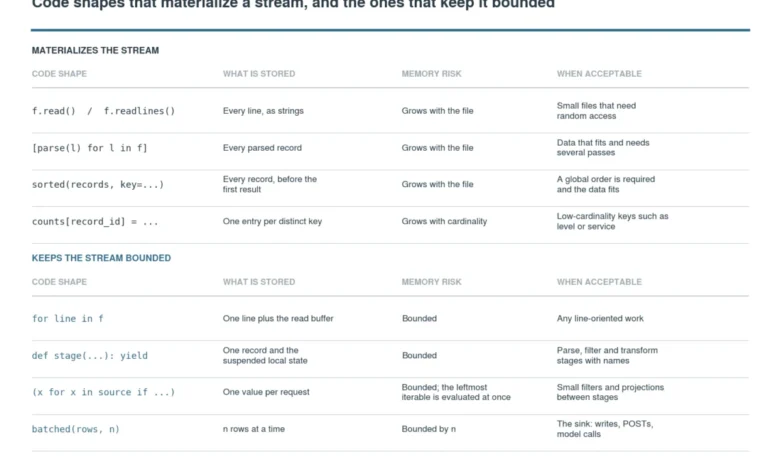
Before implementing custom generator functions, developers should leverage the inherent efficiency of Python file objects. Using f.readlines() is a common mistake that forces the entire file into memory as a list of strings. Conversely, simply looping over the file object (for line in f:) utilizes a buffered approach, reading only small, manageable chunks at a time.
For complex tasks, developers must move beyond basic loops and embrace generator functions defined by the yield keyword. Unlike standard functions that return a value and terminate, generator functions suspend their state. When a generator hits a yield expression, it pauses, saves its local variables, and returns the yielded value to the caller. When the caller requests the next item, the function resumes precisely where it left off. This creates a chain of "lazy" processing where each stage of the pipeline—parsing, filtering, and transformation—only processes a single record at a time.
Analyzing the Pipeline Architecture
To construct an effective pipeline, the architecture should be viewed as a series of connected stages:
- The Source: A file iterator or similar stream that provides raw input.
- The Transformation Stages: Generator functions that parse strings into structured dictionaries or objects.
- The Filtering/Projection Stage: Generator expressions that perform minor transformations or conditional filtering.
- The Sink: A boundary, such as
itertools.batched(), where data is finally materialized into a fixed-size group for output.
This staged approach is highly testable. Because each component is a generator, developers can unit test individual stages with a small subset of data, ensuring that parsing logic is sound without needing to load production-scale datasets into a testing environment.

Data-Driven Performance Gains
Measurements using tracemalloc demonstrate the stark contrast between eager and lazy processing. In an analysis of a 200,000-line log file (approximately 17 MB), an eager script that loaded the data into a list peaked at 198 MB of RAM usage. A streaming implementation, by contrast, peaked at just 0.4 MB. Crucially, the memory usage of the lazy implementation remained nearly flat as the input size increased, whereas the eager approach scaled linearly with the file size.
Implications and Professional Best Practices
The broader implication of this architectural shift is the ability to handle "big data" problems on commodity hardware. Whether processing JSONL files for machine learning preprocessing, handling large-scale CSV exports, or managing real-time event streams from message queues, the principles of lazy evaluation apply universally.
However, developers must exercise caution. Laziness is not a panacea. Algorithms that require global knowledge of the dataset—such as sorting the entire file by latency, calculating the median value of an entire stream, or performing exact deduplication across millions of rows—will inherently require memory proportional to the size of the data. In these instances, one must either employ external sorting tools (like disk-based merge sorts) or accept that the memory footprint cannot be reduced without compromising the algorithm’s requirements.
Conclusion: Maintaining the Chain
The ultimate goal of a memory-efficient pipeline is to keep the path "lazy" from the file object at the top to the batch output at the bottom. The most common cause of pipeline failure is a "leaky" step in the middle: a stray list() call, an accidental sorted() operation, or a third-party library function that insists on receiving a full sequence rather than an iterator.
By maintaining a clear, readable pipeline where every stage is either a file iterator, a generator function, or a generator expression, developers ensure that their applications are resilient. When someone opens the module, they should be able to identify exactly where data enters, where it is refined, and the specific location where the stream is finally materialized. If this clarity is missing, the application remains vulnerable to the next large file it encounters. Professional software engineering requires that we treat memory as a finite resource, and in the Python ecosystem, the iterator protocol remains the most effective tool for managing that constraint.