Stateful vs. Stateless Agent Design: Navigating the Architectural Tradeoffs for Scalable AI Systems

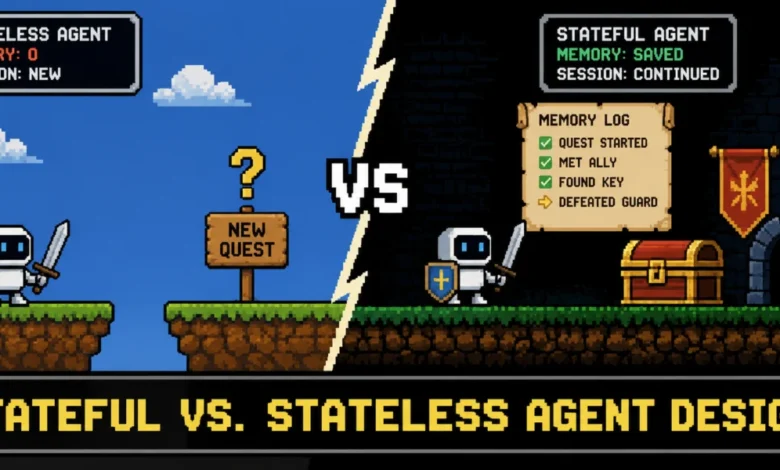
The architectural approach an artificial intelligence agent takes to managing its internal state—whether it operates as a stateless or stateful entity—profoundly influences both its implementation and the underlying deployment infrastructure. This fundamental decision dictates how an AI agent retains context, handles conversational history, and ultimately impacts scalability, cost, and user experience in production environments.
The Evolution of Conversational AI and Agent State
In the rapidly evolving landscape of artificial intelligence, particularly with the advent of sophisticated large language models (LLMs), AI agents have moved beyond simple, single-turn query-response systems. Modern AI agents are designed to engage in multi-turn conversations, perform complex tasks requiring sequential steps, and even orchestrate various tools and services. This increased sophistication necessitates a robust mechanism for memory and context retention, a concept broadly referred to as "state management."
Historically, early conversational AI systems often defaulted to stateless designs due to their simplicity and ease of scaling. However, as user expectations for natural, continuous interactions grew, the limitations of forgetting previous turns became apparent. The challenge lies in enabling an agent to remember details from earlier interactions without incurring prohibitive costs or introducing insurmountable architectural complexities. This article delves into the two primary paradigms for handling an agent’s state: stateless and stateful design, examining their respective tradeoffs through practical considerations relevant to real-world AI agent deployments.
Stateless Agents: The "Fire and Forget" Paradigm
Stateless agents are characterized by their complete independence from past interactions. Each request sent to a stateless agent is treated as an entirely new and isolated event. The agent processes the current user prompt, invokes its underlying LLM inference engine, and delivers an output. Crucially, once this execution cycle concludes, the agent discards all information pertaining to that specific interaction. It retains no memory of the user, the conversation history, or any context gathered.
- Implementation: In a stateless architecture, if conversational continuity is desired, the client application (e.g., a web frontend, a mobile app) bears the responsibility of maintaining and transmitting the entire conversation history with every new request. The agent merely appends the current prompt to the provided history before sending it to the LLM.
- Key Advantages:
- Exceptional Scalability: Stateless agents offer remarkable ease of horizontal scaling. Since no user-specific memory is stored on the backend server, incoming requests can be routed to any available instance via a simple load balancer. This makes them ideal for high-throughput scenarios where individual request processing is independent.
- Enhanced Resilience: The absence of persistent state on the agent itself simplifies fault tolerance. If an agent instance fails, new requests can simply be directed to another instance without any loss of conversational context, as the context resides entirely with the client.
- Simplified Server-Side Architecture: The backend logic for a stateless agent is inherently simpler, as it doesn’t need to manage database connections for state, implement caching strategies, or handle complex session management.
- Key Disadvantages:
- Context Window Bloat and Increased Token Usage: The most significant drawback in multi-turn conversations is the "snowballing" effect on the context window. With every new request, the client must re-send the full conversation history, leading to larger input payloads for the LLM. This directly translates to higher token usage and, consequently, increased operational costs, especially with LLMs where pricing is often based on input and output tokens.
- Higher Network Latency and Bandwidth: Larger request payloads consume more network bandwidth and can introduce additional latency, particularly for users with slower connections or in geographically distributed systems.
- Client-Side Burden: Shifting the memory burden to the client can complicate frontend development. Clients must implement robust mechanisms for storing, retrieving, and serializing/deserializing conversation history, which can be resource-intensive for certain client environments.
- Limited Asynchronous Workflows: Stateless agents are less suited for complex, asynchronous workflows where an agent might need to pause execution, await external tool responses, or seek human approval, and then resume while retaining its prior context.
Illustrative Principle of Statelessness:
Consider a basic interaction with an LLM, such as the llama-3.1-8b-instant model served via Groq’s API, which is known for its efficiency and generous free-tier support. If a user, "Alice," introduces herself and her learning topic in a first turn, a stateless agent would respond. In a subsequent turn, if Alice asks, "What is my name and what am I learning about?" without the client resending the initial context, the stateless agent would correctly state that it has no memory of her. Only when the client injects the full conversation history (Alice’s initial prompt and the agent’s first response) into the second request can the agent accurately recall the information. This clearly demonstrates the client’s critical role in maintaining context for stateless interactions.
Stateful Agents: Context-Driven Continuity
In contrast, stateful agents are designed to retain memory and context across multiple interactions. The agent itself takes on the burden of managing its state, allowing for a more natural and continuous conversational experience from the client’s perspective.
- Implementation: When a client sends a new user prompt, it typically includes a unique session identifier. The stateful agent uses this ID to retrieve the existing conversation history or context from a persistent storage layer (e.g., a database, a caching system). It then appends the new message, processes the LLM inference, and, crucially, updates the stored context with the agent’s response before sending the output back to the client.
- Key Advantages:
- Enhanced User Experience: Stateful agents provide a seamless and natural conversational flow, as they "remember" previous turns, allowing for more intuitive and human-like interactions. Users don’t need to rephrase or repeat information.
- Reduced Client Burden: The client application only needs to send the new user prompt and a session ID, significantly simplifying client-side implementation and reducing payload sizes.
- Enabling Complex Workflows: Stateful designs are essential for agents that engage in multi-step processes, long-running tasks, or asynchronous operations. The agent can maintain its internal state while waiting for external events or human input, then resume its process with full context.
- Optimized Client Payloads: Smaller client requests result in lower network bandwidth usage and potentially reduced latency from the client’s perspective.
- Key Disadvantages:
- Significant Scaling Challenges: Scaling stateful agents horizontally is considerably more complex. It necessitates a robust, distributed persistent database layer (e.g., PostgreSQL, MongoDB, Cassandra) or a centralized memory caching system (e.g., Redis, Memcached) to ensure that any agent instance can access the correct session history. Without careful design, systems can suffer from "localized amnesia," where a session’s history is stranded on a single instance that served earlier turns.
- Increased Infrastructure Complexity and Cost: Implementing stateful agents requires additional infrastructure components, such as databases, caching layers, and potentially message queues for asynchronous operations. This adds to architectural complexity, operational overhead, and overall infrastructure costs.
- Performance Overhead: Retrieving and updating state from a database or cache introduces additional latency into each request-response cycle compared to a purely stateless operation.
- Data Consistency and Durability: Ensuring data consistency and durability across distributed state management systems presents its own set of challenges, requiring careful design around transactions, eventual consistency, and backup strategies.
- Security and Privacy Concerns: Storing sensitive conversation history requires robust security measures to protect user data, including encryption at rest and in transit, access controls, and compliance with data privacy regulations (e.g., GDPR, CCPA).
Illustrative Principle of Stateful Design:
Using the same Groq/Llama 3.1 example, a stateful agent would implement a "persistent" database layer (e.g., a lightweight SQLite database for demonstration, or more robust solutions like PostgreSQL or Redis in production). When a user, "Bob," introduces himself and his interest in scaling an AI app, the agent would store this information associated with Bob’s unique session_id. In a subsequent turn, if Bob asks, "What was my name again?" the agent, upon receiving the session_id, would query its internal database, retrieve the stored history, and correctly answer, "Your name is Bob." The client’s role here is significantly simpler, only providing the session_id and the new prompt, as the agent autonomously manages the conversational context.
Architectural Implications and Strategic Decisions: The Tradeoffs
The choice between a stateful and a stateless architectural design for AI agents is a critical strategic decision that must align with the specific requirements, constraints, and long-term vision of the application. It fundamentally boils down to balancing user experience with operational efficiency and infrastructure complexity.
- Performance vs. Cost:
- Stateless: Potentially higher token costs due to redundant history transmission, but lower infrastructure costs for state management. Network latency might increase with larger payloads.
- Stateful: Lower token costs per turn (only new prompt sent), but higher infrastructure costs for databases/caches and potential latency from state lookups/updates.
- Scalability vs. Complexity:
- Stateless: Excellent horizontal scalability, simpler deployment architecture.
- Stateful: More challenging horizontal scalability, requiring sophisticated distributed state management solutions, increasing architectural complexity.
- User Experience vs. Developer Burden:
- Stateless: Can lead to a disjointed user experience if the client fails to manage context effectively; places the burden of history management on the client-side developer.
- Stateful: Provides a superior, continuous user experience; simplifies client-side development by abstracting state management to the agent’s backend.
- Reliability and Resilience:
- Stateless: Inherently more resilient to individual agent instance failures, as state is client-managed.
- Stateful: Requires robust database/cache fault tolerance and data recovery strategies to prevent loss of conversational state.
- Security and Compliance:
- Stateless: Client-side storage of history might raise concerns if not handled securely, but no central server-side repository of conversational data.
- Stateful: Centralized storage of conversational history demands stringent security measures (encryption, access control) and strict adherence to data privacy regulations.
Hybrid Approaches and Emerging Trends
In practice, many advanced AI agent systems adopt hybrid approaches to leverage the benefits of both paradigms. For instance, an agent might maintain a short-term, in-memory state for immediate conversational turns (acting statefully for a limited duration) while offloading long-term memory or broader knowledge to external, persistent storage.
The rise of Retrieval Augmented Generation (RAG) architectures and vector databases plays a crucial role in enhancing state management for both stateful and "stateless-leaning" agents. Vector databases can store vast amounts of past interactions, domain-specific knowledge, or user profiles as embeddings. When a new prompt arrives, relevant context can be retrieved from the vector database and injected into the LLM’s prompt, effectively providing a form of "externalized memory" without making the core agent strictly stateful in every request. This allows for dynamic context retrieval, mitigating the context window bloat of purely stateless systems and the scaling challenges of fully stateful, session-bound memory.
Conclusion
The decision between a stateless and stateful design for AI agents is not trivial. It requires a thorough understanding of the application’s specific needs, expected user interaction patterns, performance targets, and cost constraints. Stateless agents offer unparalleled scalability and simplicity for independent requests, making them suitable for transactional or single-turn interactions. Stateful agents, conversely, provide a richer, more natural user experience for complex, multi-turn conversations but introduce significant architectural and operational overheads. As AI agents become more sophisticated and integral to various applications, developers and architects must carefully weigh these tradeoffs, often exploring hybrid models and leveraging emerging technologies like vector databases to strike the optimal balance between user experience, operational efficiency, and scalable infrastructure.