Anthropic’s Claude Opus 5 Now Available on Amazon Bedrock and Claude Platform on AWS, Ushering in a New Era of Enterprise AI Capabilities

Seattle, WA – Amazon Web Services (AWS) and Anthropic, a leading AI safety and research company, today announced the immediate availability of Claude Opus 5 on Amazon Bedrock and through the Claude Platform on AWS. This significant development marks the debut of Anthropic’s most advanced large language model (LLM) to date, Claude Opus 5, representing the first in its fifth generation of models. The integration promises a substantial leap forward in enterprise AI, offering unparalleled intelligence, enhanced security features, and expanded capabilities across critical business workflows such as agentic coding, sophisticated knowledge work, advanced visual understanding, and complex, long-running tasks. According to Anthropic, Claude Opus 5 achieves top-tier intelligence, often matching or exceeding the capabilities of its highly regarded predecessor, Claude Fable 5, while maintaining Opus-tier pricing, positioning it as a powerful yet economically viable solution for demanding enterprise applications.
The launch of Claude Opus 5 on Amazon Bedrock is particularly noteworthy for its inherent enterprise-grade security and data governance features. By default, Amazon Bedrock provides zero data retention (ZDR) for models like Claude Opus 5. This crucial feature ensures that customer data used for inference is not stored or utilized for model training, directly addressing one of the most significant concerns for organizations deploying AI: data privacy and compliance. This commitment to data security is further bolstered by Bedrock’s next-generation inference engine, which allows enterprises to build and deploy AI solutions within their existing AWS environment, maintaining stringent enterprise security protocols, ensuring regional data residency, and scaling inference workloads seamlessly without requiring operator access to sensitive data.
Beyond Amazon Bedrock, Claude Opus 5 is also accessible via the Claude Platform on AWS. This alternative pathway provides enterprises with direct access to Anthropic’s native platform experience and capabilities, all unified within the AWS Console. This option, which supports zero data retention upon request, offers the same APIs, features, and console experience as working directly with Anthropic, but with the added convenience of integrated AWS billing and authentication. This dual availability strategy underscores AWS’s commitment to offering flexibility and choice, catering to diverse enterprise needs and existing infrastructure preferences. The current announcement builds upon a strategic partnership between AWS and Anthropic that has steadily evolved, seeing previous Claude models made available on Bedrock, and deepening the collaboration in AI research and deployment.
A New Benchmark in AI Capabilities: What Sets Claude Opus 5 Apart
Anthropic positions Claude Opus 5 as a transformative model, delivering a "step-change" in several critical domains. Foremost among these is its prowess in coding. The model is engineered to understand and navigate complex codebases with the proficiency of an experienced human engineer. It can generate production-quality code, dynamically adapting its strategy and approach as it works through problems. This capability is particularly impactful for software development teams seeking to accelerate their development cycles, improve code quality, and automate routine coding tasks. The model’s ability to power dependable, long-running agents that can operate for hours or even overnight, adeptly finding solutions around obstacles, recovering from errors, and consistently achieving predefined objectives, marks a significant advance in autonomous workflow automation.
For professional knowledge work, Claude Opus 5 brings deeper reasoning capabilities to the analysis of lengthy documents and higher accuracy to complex analytical tasks. Enterprises dealing with vast amounts of textual data – from legal contracts and research papers to financial reports and customer feedback – stand to benefit immensely. The model exhibits its largest gains on document-heavy enterprise tasks, where its ability to synthesize information, identify critical insights, and perform nuanced analysis can dramatically improve efficiency and decision-making accuracy. This combination of frontier capabilities, delivered at Opus-tier economics, positions Claude Opus 5 as a powerful tool for organizations aiming to harness AI for advanced problem-solving and operational excellence.
Expansive Use Cases Across Industries
The enhanced precision, reliability, and deep reasoning of Claude Opus 5 make it an ideal fit for industries where accuracy and robustness are paramount.
- Financial Services: For financial institutions, Claude Opus 5 can power complex financial workflows with deeper reasoning and an end-to-end understanding of context. This includes tasks such as market analysis, risk assessment, fraud detection, and compliance monitoring. Its ability to handle compliance-sensitive work with greater clarity and focus can help firms navigate intricate regulatory landscapes, reducing manual effort and potential errors. Given the high stakes and regulatory scrutiny in finance, the model’s reliability and enhanced reasoning capabilities are particularly valuable.
- Agent and Workflow Automation: Claude Opus 5 pushes the boundaries of agent and workflow automation. It can intelligently push back on flawed instructions, dissect complex jobs into manageable sub-agents, and execute tasks with minimal oversight. This translates into more resilient and effective automation solutions across a myriad of business processes, from customer service chatbots that can handle more complex queries to automated supply chain management systems. The ability to recover from errors and adapt to unforeseen circumstances is a critical differentiator for long-running autonomous agents.
- Productivity and Business Operations: In general productivity work, Claude Opus 5 excels at tasks such as report building and auditing, document drafting, and structured analysis. Its high consistency in generating professional-grade outputs makes it suitable for running multi-day projects that require sustained intellectual effort. This could include generating detailed market research reports, drafting legal briefs, summarizing extensive meeting minutes, or performing data analysis on large datasets to inform strategic decisions.
- Cybersecurity: Claude Opus 5 also demonstrates significant improvements over its predecessor, Claude Opus 4.8, across all cyber capabilities, ranging from advanced coding tasks to sophisticated cybersecurity operations. This includes threat detection, vulnerability analysis, incident response planning, and secure code generation. In higher-risk cybersecurity scenarios, Anthropic has implemented a safeguard where Opus 5 may fall back to Opus 4.8 if the system deems it safer. Users are notified when such a fallback occurs, and these fallback behaviors can be configured via the APIs, providing an additional layer of control and safety for critical applications.
The Strategic Imperative: Data Security and Enterprise Trust
The emphasis on zero data retention (ZDR) by default on Amazon Bedrock, and on request for Claude Platform on AWS, is a cornerstone of this announcement. In an era where data breaches and privacy concerns are paramount, enterprises are increasingly cautious about adopting cloud-based AI solutions if their proprietary data is used to train third-party models. AWS’s commitment to ZDR directly addresses this, fostering greater trust and accelerating the adoption of advanced AI within highly regulated industries. This approach ensures that intellectual property and sensitive customer information remain within the customer’s control, a critical factor for legal, healthcare, finance, and government sectors. The ability to maintain enterprise security and regional data residency within existing AWS environments further simplifies compliance and governance for global organizations.
Technical Pathways for AI Engineers
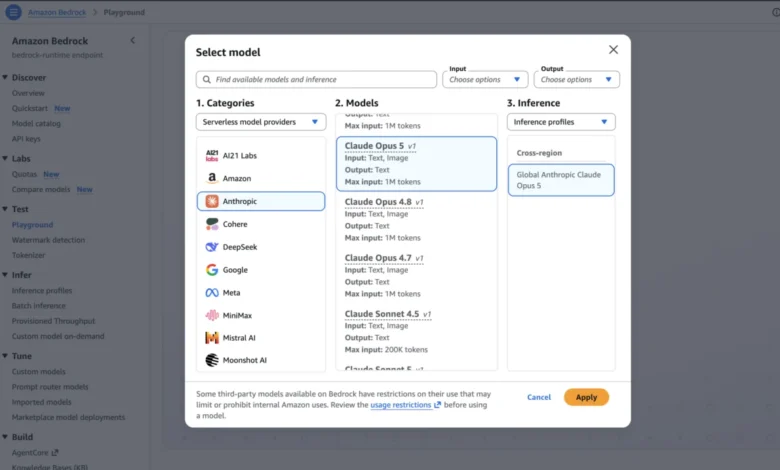
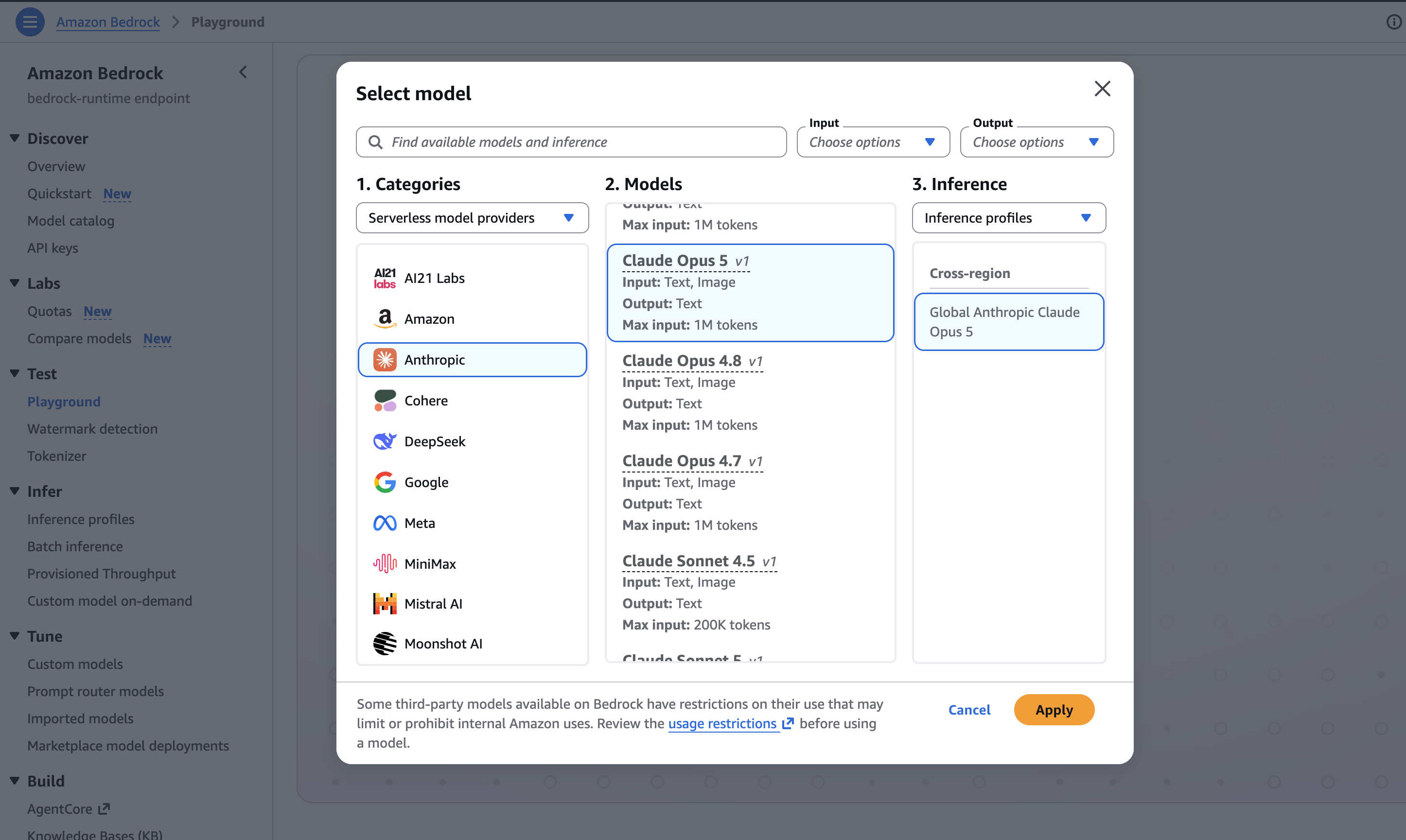
For AI engineers looking to integrate Claude Opus 5 into their systems, AWS provides multiple programmatic avenues. Developers can access the model via the Amazon Bedrock console, where a dedicated Playground environment allows for interactive testing of prompts, particularly complex coding challenges.
Programmatic access is facilitated through the Anthropic Messages API, enabling calls to bedrock-runtime via the Anthropic SDK or bedrock-mantle endpoints. Alternatively, developers can continue utilizing the familiar Invoke and Converse API on bedrock-runtime through the AWS Command Line Interface (AWS CLI) and AWS SDKs.
The article provides practical code examples in Python using boto3 for invoking the model directly and using the converse API for a unified multi-model experience. A streamlined experience is also offered through the anthropic[bedrock] SDK package, leveraging AnthropicBedrockMantle for automatic SigV4 authentication.
A notable technical enhancement in Claude Opus 5 is its support for dynamic tool management. The model now allows for adding and removing tools mid-conversation through tool_addition and tool_removal content blocks on role: "system" messages. This eliminates the need to resend the full top-level tools array, simplifying agentic system design and improving conversational efficiency, especially for long-running and complex interactions.
Availability and Future Outlook
Claude Opus 5 is available today on Amazon Bedrock in key AWS Regions, including US East (N. Virginia), Asia Pacific (Melbourne), Europe (Ireland), and Europe (Stockholm), with additional regions to be rolled out. A comprehensive list of supported regions is provided in the Bedrock documentation. For those opting for the Claude Platform on AWS, the model is accessible across North America, South America, Europe, and Asia Pacific.
This widespread availability ensures that enterprises globally can begin leveraging the advanced capabilities of Claude Opus 5 without significant geographical constraints. AWS is actively encouraging developers and organizations to explore the model through the Amazon Bedrock console, the Claude Platform on AWS console, and the "Getting Started" notebooks on GitHub. Furthermore, AWS highlights the potential to unlock the full capabilities of Opus 5 through Amazon Bedrock’s Advanced Prompt Optimization feature, which benchmarks existing prompts against evaluation criteria and generates production-ready rewrites, streamlining the deployment process for optimal performance.
Broader Implications for the AI Landscape
The introduction of Claude Opus 5 signifies a critical juncture in the rapidly evolving artificial intelligence landscape. Its release underscores the intense competition among leading AI developers like Anthropic, OpenAI (with its GPT series), and Google (with Gemini), all striving to push the boundaries of what LLMs can achieve. For AWS, this integration reinforces its position as a leading cloud provider for enterprise AI, offering a comprehensive suite of foundation models through Bedrock, enabling customers to choose the best model for their specific needs without managing underlying infrastructure.
The emphasis on "Opus-tier economics" suggests a strategic effort to make cutting-edge AI more accessible and cost-effective for a broader range of enterprise applications. As AI models become more powerful and capable, the focus shifts not just to raw performance but also to deployability, security, and cost-efficiency in real-world business environments. Anthropic’s commitment to AI safety, exemplified by its "Constitutional AI" approach and the fallback mechanisms for high-risk cyber scenarios, is also a crucial aspect. As AI becomes more deeply embedded in critical systems, the debate around responsible AI development and deployment will only intensify, making safety features a key differentiator.
This launch is poised to accelerate the adoption of advanced AI agents and sophisticated automation across diverse sectors. By providing a model capable of deeper reasoning, robust error recovery, and complex task execution, AWS and Anthropic are empowering organizations to automate more intricate processes, augment human capabilities in knowledge work, and develop more intelligent applications. The long-term impact could be a significant boost in productivity, innovation, and competitive advantage for enterprises that strategically integrate these advanced AI capabilities into their core operations. The continuous evolution of these models, coupled with secure and scalable cloud platforms, sets the stage for an era where AI plays an even more foundational role in shaping the future of business and technology.