Amazon SageMaker AI Expands Enterprise Generative AI Capabilities With 13 Major Inference Launches in 2026

The enterprise artificial intelligence landscape faces a persistent infrastructural paradox: while foundational models grow increasingly sophisticated, running them in production remains extraordinarily difficult. Generative AI inference imposes severe demands on computing environments. Models routinely span tens to hundreds of gigabytes, strict latency requirements are measured in tokens per second, cold starts can stretch across several minutes while massive containers and weights transfer, and GPU capacity frequently remains constrained. Furthermore, traditional monitoring tools have historically failed to capture the token-level telemetry necessary to diagnose performance bottlenecks in real time.
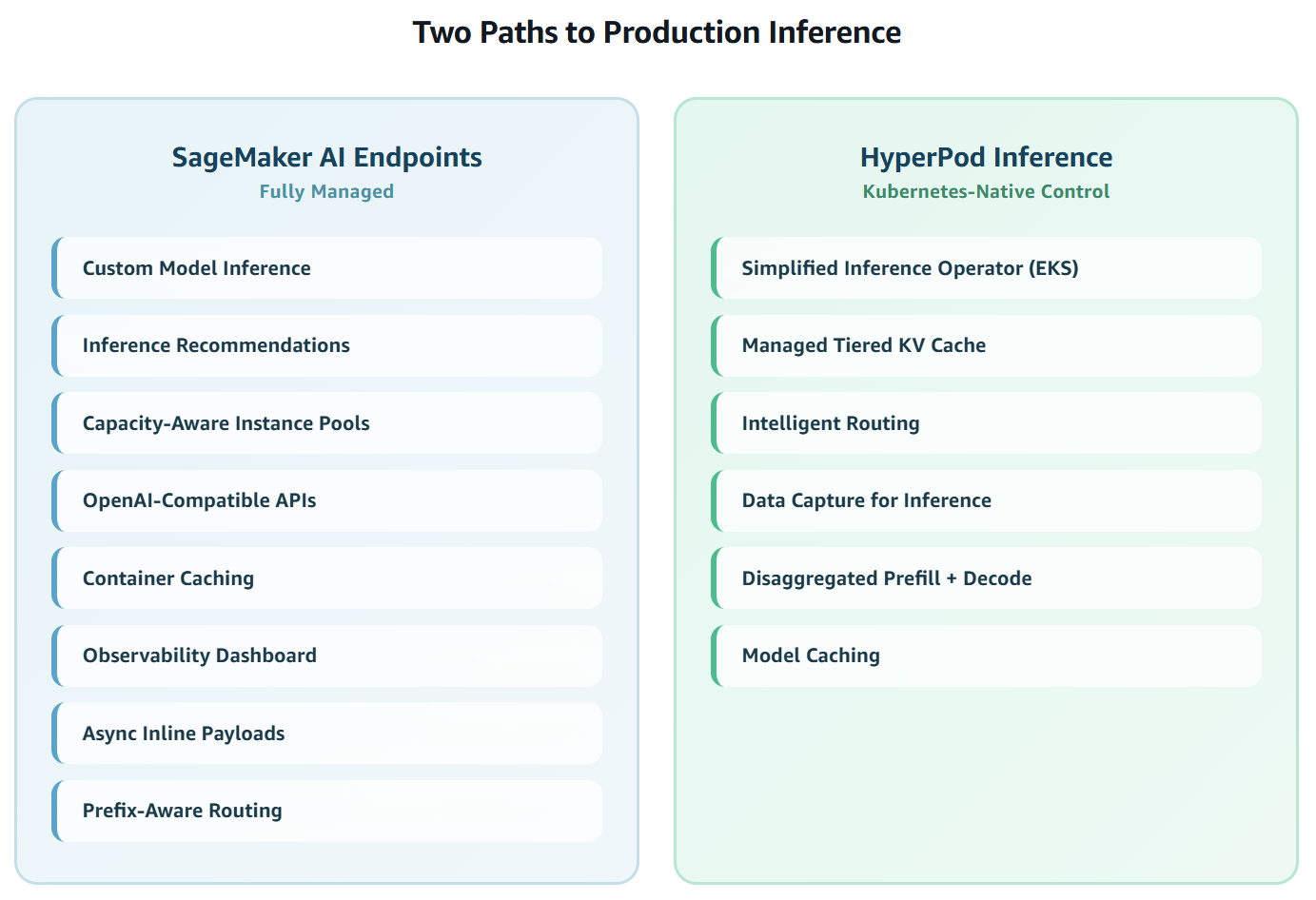
To address these compounding engineering hurdles, Amazon Web Services (AWS) has rolled out a comprehensive suite of 13 major capabilities for Amazon SageMaker AI throughout the year 2026. Designed to streamline operations for enterprises, startups, and public sector organizations alike, these updates span both primary deployment models offered by the platform: fully managed endpoints for teams seeking minimal operational overhead, and Amazon SageMaker HyperPod Inference for organizations requiring fine-grained, Kubernetes-native control over dedicated GPU clusters. By shifting the economic and operational paradigm from per-token billing to instance-based consumption, AWS aims to make high-performance generative AI deployment accessible without requiring dedicated internal research teams specialized in infrastructure.
The Dual Deployment Strategy: Managed Endpoints Versus HyperPod Inference
Modern AI workloads vary wildly in their operational requirements, prompting AWS to maintain a dual-path deployment architecture. Managed SageMaker AI endpoints appeal primarily to organizations aiming to minimize infrastructure management. In this model, AWS handles GPU provisioning, scaling, and operational monitoring directly, allowing developers to bring their own models and specify high-level performance targets.
Conversely, Amazon SageMaker HyperPod Inference caters to advanced engineering teams that require deep orchestration capabilities. Utilizing a managed Kubernetes stack, HyperPod gives practitioners node-level access, custom Amazon Machine Images (AMIs), and granular control over frameworks. This pathway is heavily optimized for multi-cloud and hybrid-cloud deployments where train-to-serve workflows demand strict customizability.
A rigorous side-by-side comparison reveals distinct operational philosophies. While managed endpoints utilize native auto-scaling via Amazon CloudWatch and provide seamless OpenAI-compatible APIs, HyperPod leverages advanced Kubernetes tooling such as Karpenter and KEDA alongside standard kubectl and Terraform workflows. Both pathways, however, received substantial technological injections in 2026 to solve critical performance bottlenecks.
Streamlining Managed Endpoints: From Model to Production in Hours
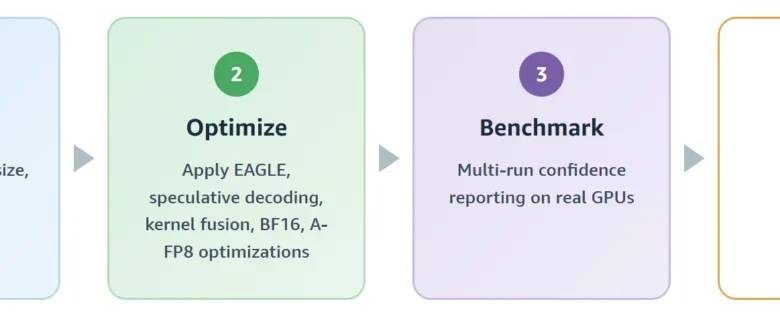
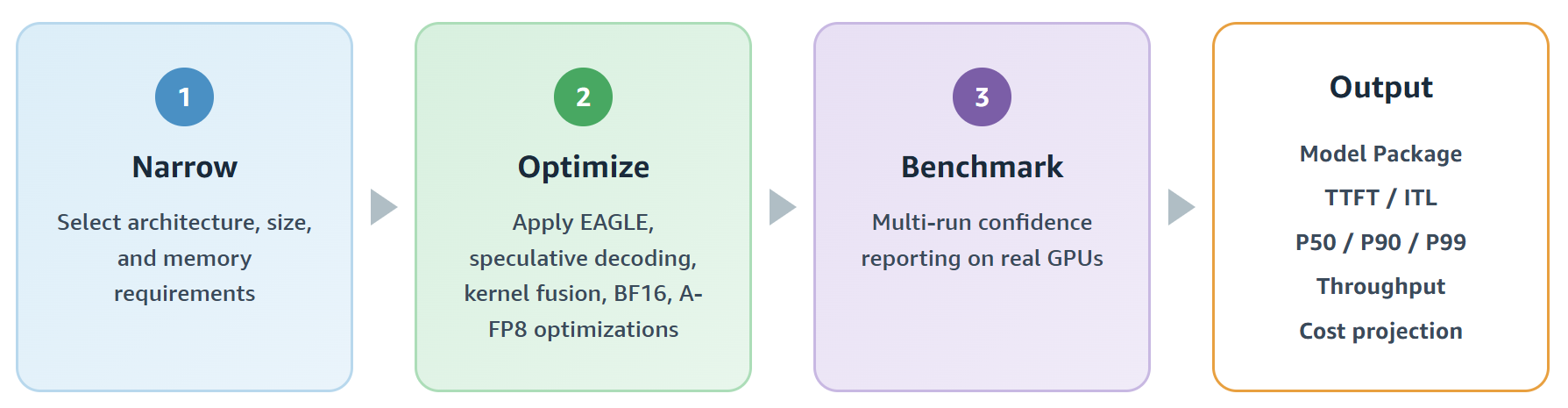
Deploying complex models onto managed endpoints traditionally required weeks of manual benchmarking across thousands of configuration permutations. To eliminate this friction, AWS introduced the Inference Recommendations and Benchmarking feature in April 2026. Instead of forcing engineers to manually test instance types, serving containers, and optimization settings, the system automates the process based on user-defined performance goals—such as cost, latency, or throughput. The platform outputs a deployment-ready SageMaker Model Package complete with validated metrics, including time to first token (TTFT), inter-token latency (ITL), P50/P90/P99 latency percentiles, and cost projections. For instance, throughput optimizations on the GPT-OSS-20B model demonstrated a twofold increase in tokens per second without increasing request latency.
To mitigate the risk of hardware shortages halting production pipelines, May 2026 brought Capacity-Aware Instance Pools. Previously, if a specified instance type lacked available capacity, an endpoint would fail to initialize. The new feature allows customers to define a prioritized fallback list of up to five instance types. SageMaker automatically cycles through this list during endpoint creation, scale-out, and scale-in events, ensuring high availability even during periods of tight GPU supply.
Integration barriers were simultaneously lowered with the rollout of OpenAI-compatible APIs in May 2026. Enterprises maintaining applications built on the OpenAI SDK, LangChain, or agentic frameworks can now target SageMaker endpoints simply by changing the endpoint URL. The service natively supports chat completions and streaming through the /openai/v1 path, utilizing bearer tokens generated from standard AWS credentials for authentication. This eliminates the complexity of SigV4 request signing and saves engineering teams from rewriting client-side adapters.
Accelerating Scale-Out Events Through Container Caching
Scaling inference fleets dynamically often introduces latency spikes due to the time required to pull massive container images from registries like Amazon Elastic Container Registry (ECR). For serving containers exceeding 10 GB, this transfer previously added several minutes of dead time to scale-out operations.
Introduced in June 2026, Container Caching addresses this by automatically pre-pulling images onto supported accelerator instances. With zero code changes required, new instances launch with the container already available locally. Benchmarks using the Qwen3-8B model on ml.g6.2xlarge instances with a 17.7 GB compressed LMI container showed end-to-end startup latency dropping from 525 seconds to 258 seconds—a 51 percent reduction. Combined with sub-minute CloudWatch metric detection and instance-store data caching, this three-part scaling optimization suite drastically curtails latency during sudden traffic surges.
Observability and Routing Innovations
Production troubleshooting for large language models historically suffered from a lack of unified telemetry. June 2026 updates introduced native OpenTelemetry emission for over 100 detailed inference metrics, coupled with a pre-built Insights dashboard in Amazon CloudWatch. Teams can monitor GPU memory trends, KV cache pressure, and token-level latencies instantly, or query metrics directly via PromQL-compatible tools like Amazon Managed Grafana.
Furthermore, asynchronous inference workloads received a boost with the introduction of inline payloads up to 128,000 bytes, removing the requirement to pre-stage prompt data in Amazon S3.
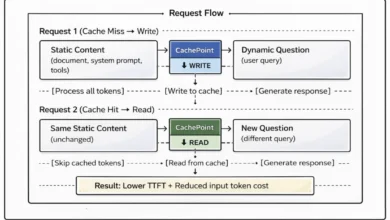
Perhaps the most impactful routing enhancement is Prefix-Aware Routing. In typical retrieval-augmented generation (RAG) and multi-turn conversational architectures, large portions of a prompt—such as system instructions and conversation histories—are repeated across requests. Prefix-aware routing uses the beginning of each prompt as a cryptographic fingerprint, directing similar requests to the same instance to maximize Key-Value (KV) cache reuse. Benchmarks on Llama 3.1 70B models handling long-context workloads revealed that P50 time to first token dropped by up to 77 percent, while KV cache hit rates surged from 25 percent to 82 percent with a negligible routing overhead of under two milliseconds.
Kubernetes-Native Control via HyperPod Inference
For organizations operating dedicated clusters, HyperPod Inference introduced transformative features in 2026, beginning with the Simplified Inference Operator on Amazon EKS in April. This add-on eliminates the need to manually manage low-level Kubernetes objects like Deployments, Services, and HorizontalPodAutoscalers, allowing administrators to deploy models via clean Custom Resource Definitions (CRDs).
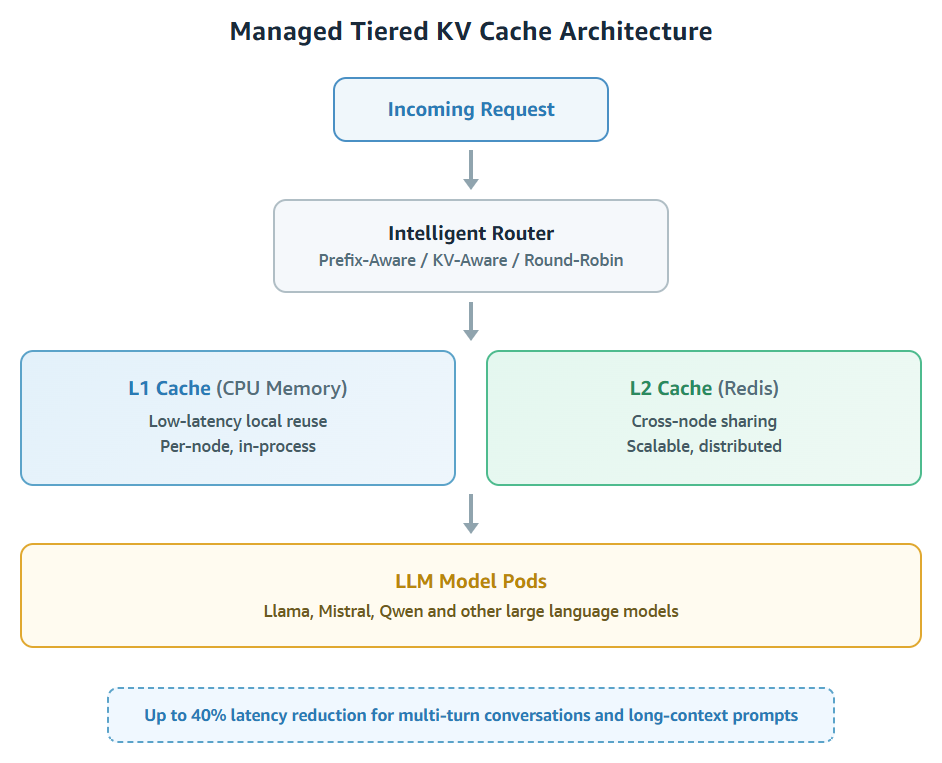
To further optimize long-context efficiency, HyperPod introduced a Managed Tiered KV Cache supported by intelligent routing. The architecture utilizes an L1 tier residing in node-level CPU memory for ultra-fast local retrieval, and an L2 tier backed by Redis for cross-node sharing. This system successfully reduces latency by up to 40 percent for complex multi-turn workflows.
Addressing enterprise compliance requirements, May 2026 saw the release of Data Capture for HyperPod. Regulated entities can now effortlessly log inference activity at the application boundary, application load balancer, and container boundary, streaming tamper-evident logs directly to S3 for auditing and model drift evaluation.
Disaggregated Prefill and Decode and Advanced Caching
One of the most radical architectural shifts arrived in July 2026 with the introduction of Disaggregated Prefill and Decode (DPD) in Inference Operator v3.2. In traditional setups, processing a complex prompt’s prefill phase on the same GPU used for token generation blocks concurrent users, causing unpredictable latency distributions. DPD separates these phases onto distinct GPU pools. Once the prefill phase computes the KV cache, the data transfers instantly to the decode pool via Elastic Fabric Adapter (EFA) using GPU-Direct RDMA, bypassing the CPU entirely. Each pool scales independently, resulting in vastly more consistent latency profiles under heavy mixed enterprise traffic.
Complementing DPD, HyperPod model caching addresses cold-start delays by pre-downloading model weights directly to node-local NVMe storage—enabling read speeds of approximately 7 GB/s—while pre-pulling container images via DaemonSets. Benchmarks indicate scale-out speeds improve by approximately 60 percent for models ranging from 57 GB to 145 GB.
Broader Implications and Industry Impact
The cumulative effect of these 13 feature launches signals a maturation phase in the generative AI market. Enterprises are shifting focus from experimental model selection to operational efficiency, unit economics, and deterministic reliability. By lowering the technical barriers associated with high-performance inference, AWS has positioned SageMaker AI to capture a broader spectrum of commercial workloads.
To bridge the gap for organizations lacking specialized machine learning infrastructure teams, AWS continues to deploy its Experience-Based Acceleration program. This initiative pairs enterprise customers with cloud architects to benchmark workloads, configure instance-based inference stacks, and align performance targets with strict budgetary constraints. As artificial intelligence solidifies its role as a core enterprise utility, the ability to operate efficient, scalable, and observable inference pipelines will ultimately determine commercial success in the AI era.