Building a Conversational Claims Assistant Using Amazon Bedrock Knowledge Bases and Agentic Retrieval

Insurance claims management has long suffered from information fragmentation, with critical data points scattered across diverse formats such as adjuster diary entries, repair estimates, police reports, payment ledgers, and scanned attachments rather than centralized, searchable database fields. When a policyholder contacts an insurance provider to inquire whether a claim has been approved, or when a senior claims adjuster needs to review every open auto claim exceeding $10,000 from the previous month, both workflows demand the rapid and accurate synthesis of complex evidence. Addressing this challenge requires robust artificial intelligence architectures that can transcend simple keyword searches to deliver precise, grounded, and fully cited insights.
To solve these systemic lookup hurdles, modern enterprise engineering teams are increasingly turning to Retrieval-Augmented Generation (RAG). By grounding large language model responses in verified source documents, RAG systems eliminate hallucinations and provide verifiable audit trails. Using fully managed RAG capabilities like Amazon Bedrock Knowledge Bases, organizations can streamline the ingestion, parsing, chunking, embedding, and vector storage of unstructured files, enabling conversational interfaces that return accurate answers accompanied by direct citations from native claim files.
The Claims Lookup Challenge and Operational Bottlenecks
The fundamental friction in claims administration stems from the diverse nature of incoming inquiries and the unstructured storage formats of historical files. Policyholders, contact center customer service representatives, and seasoned insurance adjusters all approach the data repositories with distinctly different requirements. A policyholder typically asks narrow, status-oriented questions about their specific incident, whereas a customer service agent requires rapid verification of policy limits and current payment statuses during live calls. Adjusters and fraud investigators, conversely, execute complex aggregations, sorting through multi-variable parameters across hundreds of active files.
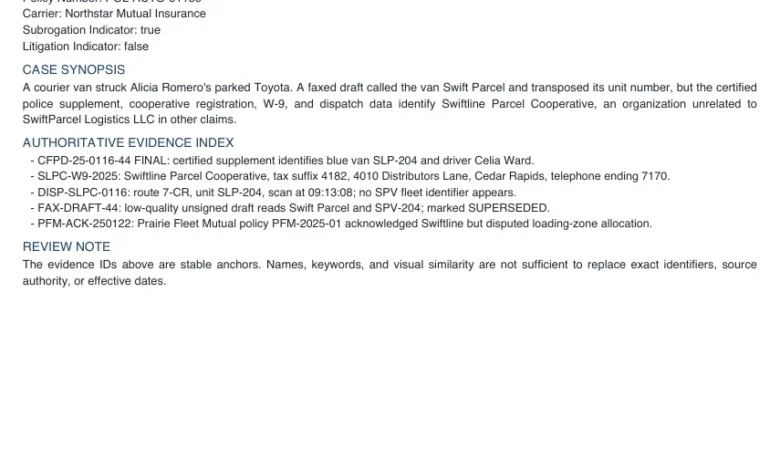
Compounding this complexity, these answers rarely reside in neat database columns. Instead, they are locked within PDF adjuster reports, Microsoft Word correspondence, and unstructured text notes. Furthermore, claim records are inherently dynamic; documents frequently conflict or supersede earlier iterations. A revised repair estimate can replace a provisional draft, or an initial payment authorization can be formally reversed weeks later due to coverage disputes. An effective conversational assistant must therefore possess the contextual intelligence to evaluate which estimate, payment log, or status indicator legally controls the file at any given moment.
Because the insurance sector operates within a heavily regulated environment, regulatory compliance mandates that every automated answer be strictly grounded in underlying source documents and paired with transparent citations. This traceability allows contact center agents to independently verify a data source before communicating with a policyholder, while compliance supervisors and internal auditors can thoroughly review the exact logical pathway the assistant utilized to reach a specific conclusion.
Architectural Solution Overview: Ingestion and Retrieval Lanes
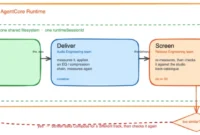
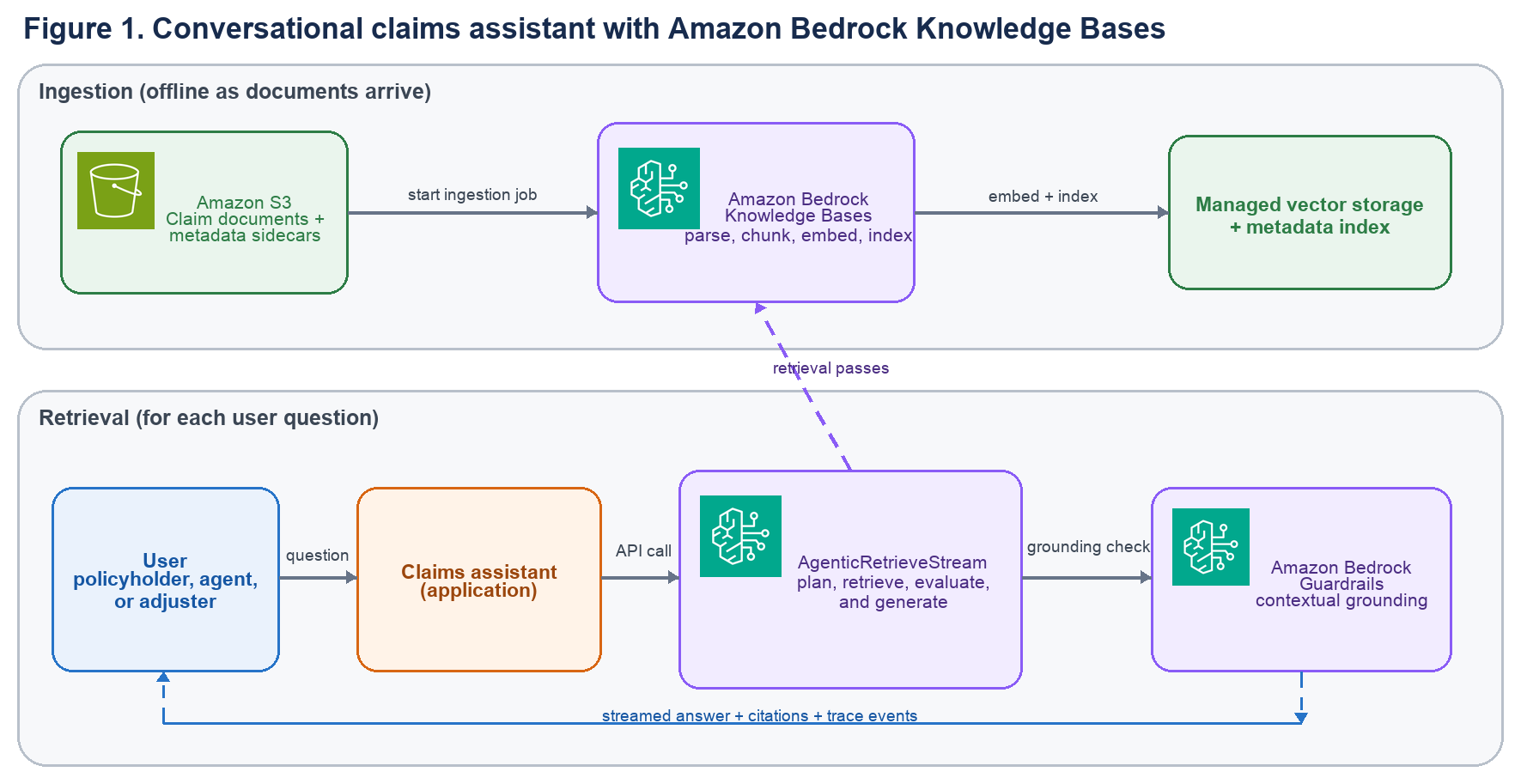
Implementing an enterprise-grade conversational claims assistant relies on a dual-lane architecture divided into a document ingestion lane and an advanced retrieval lane. The ingestion lane processes incoming insurance files as they arrive in an Amazon Simple Storage Service (Amazon S3) bucket, while the retrieval lane handles incoming natural-language queries by routing them through agentic workflows and safety guardrails.
Within the ingestion workflow, raw documents—including PDFs, Word documents, and plain-text files—are ingested directly into Amazon Bedrock Knowledge Bases alongside structured metadata sidecar files. The system automatically parses, chunks, and embeds the textual content, storing the resulting vector representations securely in managed storage without requiring manual vector database infrastructure provisioning.
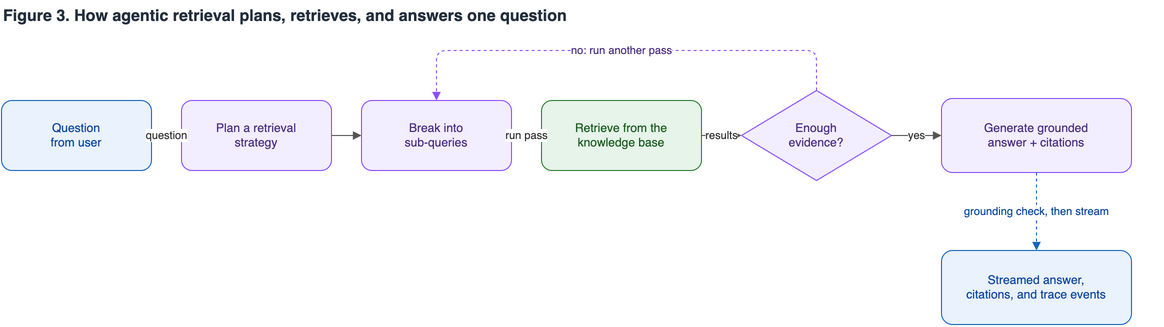
When a user submits a query through the conversational interface, the system initiates the retrieval lane by invoking the AgenticRetrieveStream API. Rather than executing a single, rigid vector search, agentic retrieval formulates a strategic plan, breaks multi-part natural-language questions down into discrete sub-queries, and executes multiple retrieval passes if initial evidence is deemed insufficient. This iterative refinement guarantees that complex requests are thoroughly researched before a response is synthesized.
Prior to delivering the final output to the user, the retrieval lane routes the generated text through Amazon Bedrock Guardrails, which enforce contextual grounding and relevance checks. The resulting application stream delivers real-time trace events, natural-language answer text, and precise document citations that map specific spans of the answer back to their originating source files in Amazon S3.
Data Modeling, Metadata Sidecars, and Filtering
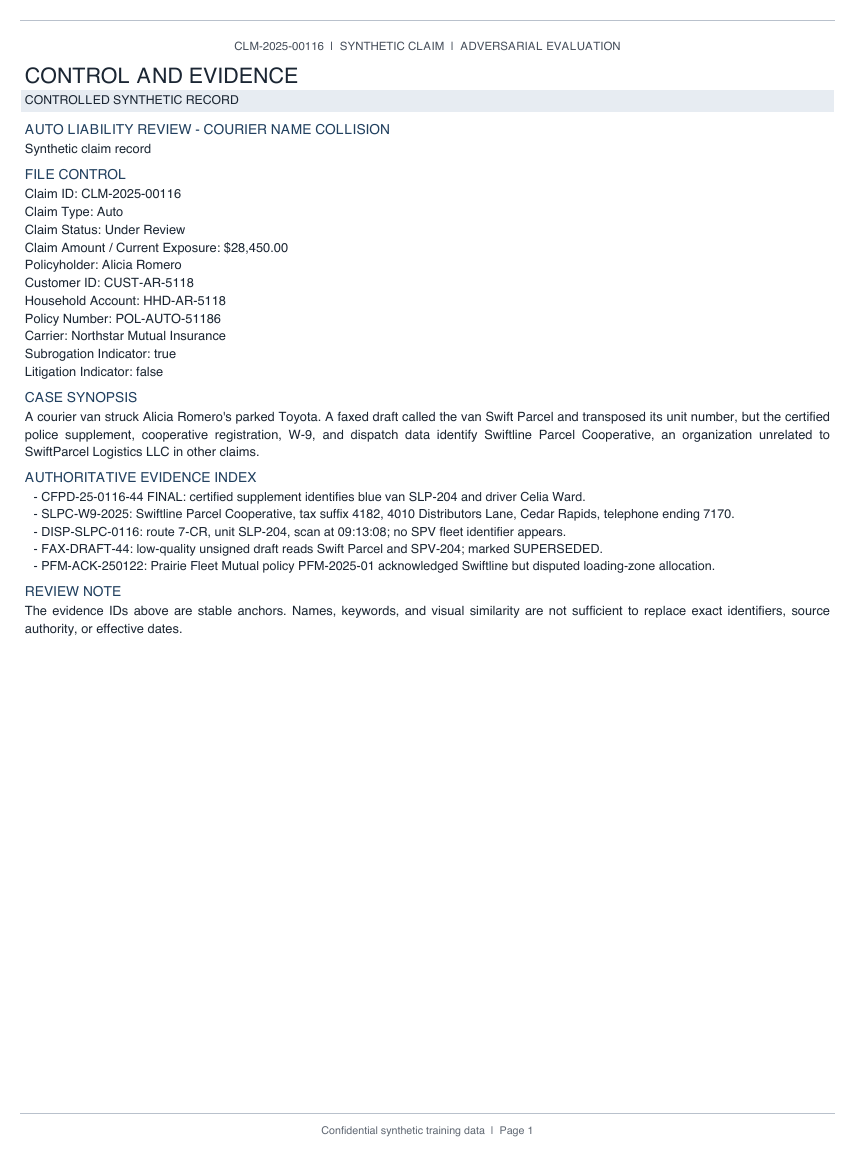
Effective metadata management is critical for narrowing semantic searches and enforcing strict access control boundaries. Organizations utilizing this architecture pair each native claim document stored in Amazon S3 with an accompanying JSON metadata sidecar file sharing the identical base filename with a .metadata.json extension. For example, a primary claim record named CLM-100482.pdf is accompanied by CLM-100482.pdf.metadata.json, which contains scalar string, numeric, and Boolean attributes.
These metadata fields empower developers to construct sophisticated query filters. Attributes such as claim_id, claim_type, status, amount, date_filed, region, customer_id, and has_subrogation allow the retrieval engine to execute precise Boolean and numeric filtering before semantic similarity scoring takes place. Notably, dates are systematically stored as YYYYMMDD integers rather than standard date strings, enabling accurate numeric range comparisons such as isolating claims filed within a specific calendar month.
To protect sensitive consumer data, synthetic data sets are typically employed during initial development and testing phases, ensuring compliance with data privacy standards before production deployment involving real personally identifiable information (PII) or protected health information (PHI). Access controls are further reinforced by programmatically deriving tenancy filters—such as region or customer_id—directly from the authenticated user session on the server side, ensuring that end users can never manipulate or expand their search boundaries via user-generated prompt text.
Deployment and Ingestion Execution Workflow
Deploying the knowledge base infrastructure involves programmatically establishing the foundational service client via software development kits such as AWS SDK for Python (Boto3). By configuring the knowledge base type and embedding model type as managed resources, administrators eliminate the operational overhead associated with managing custom vector database clusters and embedding pipelines.
Once the foundational knowledge base identifier is generated, administrators link the designated Amazon S3 data source bucket, applying inclusion prefixes to restrict ingestion boundaries to specific directory paths, such as the claims/ folder. Executing an initial ingestion job triggers the automated parsing, chunking, and indexing pipeline. Because insurance files are continuously updated as claims progress through their lifecycles, subsequent ingestion jobs are scheduled or triggered programmatically whenever new documentation is appended to the repository, maintaining absolute synchronization between the source bucket and the vector index.
Advanced Querying via AgenticRetrieveStream
Querying the ingested knowledge repository is executed via the agentic runtime client, passing natural-language user prompts alongside retriever configurations and agentic parameters. Setting the foundation model type to managed and defining maximum agent iterations allows the underlying large language model to intelligently decompose complex user intent.
During runtime execution, the application iterates over the streamed response object, handling three distinct event types: trace events, response events, and final result payloads. Trace events expose the underlying execution plan, detailing specific sub-queries, full-document expansions, and guardrail interventions. Response events stream natural-language text chunks token by token to the user interface, while final result payloads deliver structured citation mapping arrays.
Citations are rendered by correlating character spans within the generated response text against the specific supporting references contained in the result array, matching displayed assertions directly to their source URIs in Amazon S3. In multi-turn conversational scenarios, prior conversational history is systematically preserved and passed forward within the message payload, enabling the assistant to correctly resolve ambiguous pronouns—such as determining that the word "it" refers to a specific claim identifier established in an earlier turn.
Security, Governance, and Contextual Grounding
Securing an enterprise claims assistant requires a multi-layered security posture encompassing identity and access management (IAM), data encryption at rest and in transit, and real-time behavioral guardrails. IAM policies governing the application restrict execution permissions to explicit actions, granting access solely to required APIs such as AgenticRetrieveStream, Retrieve, GetDocumentContent, InvokeModelWithResponseStream, GetGuardrail, and ApplyGuardrail, while all administrative and operational activities are logged via AWS CloudTrail for comprehensive auditing.
Data encryption is enforced across all operational layers. Amazon S3 natively encrypts stored objects by default, and organizations can layer customer-managed AWS Key Management Service (AWS KMS) keys across both the storage buckets and managed vector indexes. Network traffic is similarly secured through the mandatory enforcement of Transport Layer Security (TLS).
To mitigate the risk of model hallucination or unsupported statements, organizations implement Amazon Bedrock Guardrails configured with strict contextual grounding checks. By establishing high numerical thresholds for grounding and relevance—such as requiring a grounding score of 0.85 or higher—the system automatically intercepts and blocks responses that fail to achieve sufficient alignment with the retrieved source documents. In high-stakes regulatory environments like insurance claims adjudication, configuring the system to decline an unsupported answer is substantially safer than generating speculative or erroneous content.
Empirical Performance and Evaluation Baselines
Rigorous evaluations of synthetic evaluation corpuses comprising dozens of diverse claim scenarios have demonstrated the operational viability of managed retrieval architectures. Testing suites incorporating direct lookups, comparative analyses, alias resolutions, superseded document handling, reversed payment validations, and adversarial edge cases consistently yield high retrieval and citation recall metrics.
Empirical benchmarks indicate that well-tuned retrieval pipelines achieve high expected-source retrieval recall percentages while maintaining zero instances of vector chunks contradicting requested metadata filters. Adversarial testing further confirms that advanced models successfully isolate similarly named corporate entities, preserve legal allegations strictly as unverified allegations rather than established facts, and ignore deceptive instruction-like text embedded maliciously within document attachments.
Nevertheless, empirical data highlights that narrow, claim-specific queries consistently outperform broad, unfiltered portfolio inventory requests. Consequently, engineering best practices dictate that broad inquiries incorporate strict result limits and pagination handling, and that organizations conduct thorough human-in-the-loop validation reviews before exposing automated assistants directly to policyholders.
Broader Industry Implications and Future Outlook
The successful deployment of agentic retrieval architectures for claims management signals a broader technological shift across the insurance and financial services sectors. By bridging the gap between unstructured document silos and structured metadata filtering, organizations can drastically reduce administrative cycle times, accelerate claims processing workflows, and empower contact center personnel with immediate, verifiable insights.
As financial institutions continue to mature their artificial intelligence strategies, the core patterns demonstrated through managed knowledge bases and agentic retrieval streams will increasingly expand into adjacent operational domains, including commercial underwriting, policy servicing, risk assessment, and regulatory compliance reporting. Ultimately, combining autonomous document synthesis with rigorous human oversight establishes a scalable, secure framework for modernizing enterprise data utilization while preserving absolute auditability and trust.