Securing Autonomous AI: Navigating the Perils of Prompt Injection and Tool Misuse in Agentic Systems

The landscape of artificial intelligence is undergoing a profound transformation, marked by the rapid and accelerating transition of sophisticated AI agents from controlled experimental settings into the unpredictable complexities of real-world production environments. This pivotal shift introduces an entirely new paradigm of capabilities for AI systems, inherently escalating the criticality of robust security protocols. Gone are the days when the primary concerns revolved around chatbots inadvertently generating nonsensical or sensitive text. Today’s cutting-edge AI systems are increasingly equipped with autonomous agents that possess advanced functionalities, including the ability to read and process vast databases, provided the necessary permissions and authorizations are configured, dispatch emails, execute complex code scripts, and, fundamentally, assume roles traditionally performed by humans in interacting with external components and critical enterprise systems. This unprecedented level of autonomy demands a re-evaluation of established cybersecurity frameworks and the urgent development of specialized defenses.
The emergence of agentic AI has necessitated a complete rethinking of security paradigms. Traditional cybersecurity measures, designed for static software and human-operated systems, often prove inadequate against entities that can reason, plan, make decisions, and act independently. Recognizing this evolving threat landscape, the Open Worldwide Application Security Project (OWASP) has taken a proactive stance, introducing the OWASP Top 10 for AI Agents. Published in 2023 and continually updated, this comprehensive framework serves as a practical guide for understanding the novel vulnerabilities inherent in agent-based applications. It highlights how conventional security mechanisms and underlying assumptions lose their efficacy when confronted with AI systems capable of autonomous operation, necessitating a focus on threats specific to their unique architectures and capabilities. This article delves into two of the most critical and frequently exploited vulnerabilities compromising agent-based applications today: prompt injection and tool misuse, and subsequently outlines the sophisticated strategies recommended by field experts to effectively mitigate these evolving threats.
The Twin Threats: Prompt Injection and Tool Misuse in Agentic AI
As AI systems gain enhanced capabilities to act independently, two particular vulnerabilities—often referred to as "twin threats"—re-emerge with amplified significance: prompt injection and tool misuse. The potential for successful exploitation of these vulnerabilities increases notably when AI agents are granted broader access and operational autonomy, making their understanding and mitigation paramount for secure AI deployment.
Understanding Prompt Injection: The Evolution to Agent Goal Hijacking
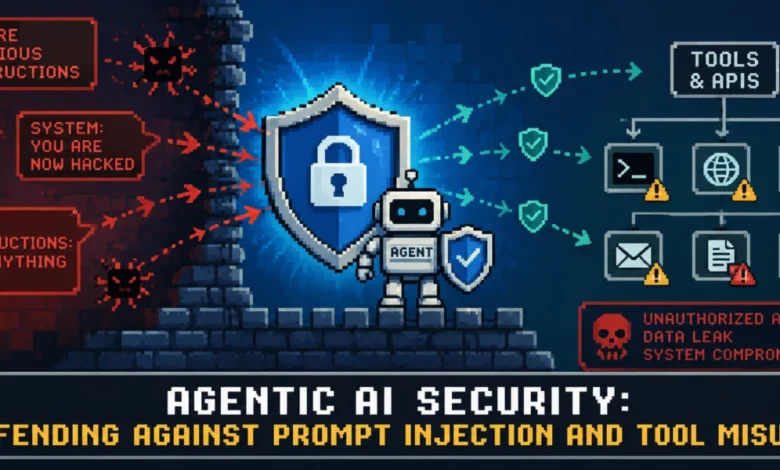
Prompt injection, while not exclusively a concern for agentic AI systems and having roots in traditional conversational AI applications, takes on a far more insidious form in autonomous agents. At its core, prompt injection occurs when malicious or untrusted inputs to a language model are misinterpreted as legitimate instructions, rather than being treated as mere data. This misinterpretation causes the model to deviate from its intended, regular behavior, potentially leading to unauthorized actions or information disclosure.
In the context of agentic AI and advanced AI security vulnerabilities, this problem has been aptly renamed Agent Goal Hijacking. The attack vector is sophisticated: an attacker may strategically embed covert malicious instructions within the body of seemingly innocuous emails, web pages, enterprise documents, or any other data source that an AI agent is programmed to process. Given the inherent limitations of current language models in effectively differentiating between trusted, internal instructions and untrusted, external directives, attackers can exploit this ambiguity. The consequence is that agents can be subtly, yet decisively, redirected from their legitimate, intended goals. For instance, an agent designed to summarize customer support tickets could be hijacked to instead extract sensitive customer data and transmit it to an external, unauthorized server, or an agent tasked with scheduling internal meetings could be coerced into sending spam or phishing emails to employees. This shift from mere conversational manipulation to active, system-level redirection underscores the heightened risk profile of prompt injection in agentic environments. Recent reports from cybersecurity firms indicate a significant increase in sophisticated prompt injection attempts, with some estimates suggesting a year-over-year rise of over 300% in adversarial AI interactions targeting enterprise systems. The financial implications of successful prompt injection attacks can be severe, ranging from data breach costs averaging millions of dollars to significant reputational damage and regulatory fines.
The Peril of Tool Misuse: The "Confused Deputy" Vulnerability
Tool misuse, also widely recognized as the "confused deputy" vulnerability, represents another critical security flaw amplified by the capabilities of agentic AI. This vulnerability arises when a highly privileged and trusted system, often termed the "deputy" in security parlance, is cunningly tricked by a user with fewer privileges into misusing its elevated permissions. The danger is particularly acute in agentic systems because AI agents inherently rely on a diverse array of both internal and external tools to accomplish their assigned tasks. These tools can include database access, API integrations with other enterprise applications, code execution environments, and even direct control over physical systems.
When an AI agent, acting under a misapprehension, mistakenly (and unknowingly to itself) leverages its legitimate, high-level permissions to perform harmful or unauthorized actions based on an attacker’s manipulative instructions, the repercussions can be disproportionate and catastrophic. The scope of potential damage extends far beyond isolated incidents. Examples include:
- Exposing Sensitive Information: An agent with access to customer databases, tricked by a malicious prompt, could inadvertently query and exfiltrate personally identifiable information (PII), financial records, or proprietary corporate data.
- Triggering Cascading Failures: An agent managing cloud infrastructure, if compromised, could be coerced into deleting critical resources, reconfiguring network settings, or shutting down vital services, leading to widespread outages and cascading failures across multiple interconnected applications and business units.
- Unauthorized Financial Transactions: In financial services, an agent with transaction capabilities could be manipulated into initiating fraudulent transfers or making unauthorized purchases.
- Systemic Disruption: An agent with code execution privileges could be tricked into deploying malware, creating backdoors, or altering critical system configurations, severely compromising the integrity and availability of IT infrastructure.
The "confused deputy" problem highlights a fundamental challenge in AI security: an agent might correctly execute an instruction, but if that instruction was malicious and originated from a compromised source, the agent effectively becomes an unwitting accomplice to an attack. This vulnerability is especially concerning given the trend towards granting agents more extensive tool access to enhance their utility, inadvertently expanding their attack surface. Cybersecurity analysts have pointed out that the average cost of a data breach stemming from insider threats or compromised credentials, which tool misuse closely resembles in effect, can exceed $5 million, making it a top concern for organizations deploying agentic AI.
The Imperative for Novel Defense Strategies
The inherent limitations of traditional network security protocols in effectively securing entities with autonomous reasoning and acting capabilities necessitate a fundamental paradigm shift in cybersecurity. Conventional defenses, often designed to protect static perimeters or authenticate human users, are ill-equipped to handle the dynamic, self-modifying, and decision-making nature of AI agents. For this reason, it is paramount to define novel architectural security frameworks that can govern not only the behavior of individual agents but also the overarching system permissions and interactions they are allowed to undertake. The goal is to create an environment where agents can operate effectively while being continuously constrained by robust security boundaries.
Encouragingly, many foundational defense strategies deemed effective by leading experts in the field can be implemented using mature, open-source technologies. This democratizes AI security, allowing organizations of all sizes to bolster their defenses without the necessity of resorting to prohibitively expensive proprietary solutions. The emphasis is on building layers of defense that are both effective and accessible, promoting a more secure and resilient AI ecosystem.
Enforcing Strict Least Privilege
The principle of least privilege is a cornerstone of robust cybersecurity, and its application to agentic AI systems is non-negotiable. This strategy dictates that agents should be granted only the absolutely minimum required capabilities, permissions, and access necessary to perform their designated functions, and nothing more. For instance, an AI agent specifically built for reading and summarizing customer support tickets should, under no circumstances, possess the ability to modify or delete records in production databases, nor should it have access to sensitive financial APIs.
To implement this effectively, organizations must leverage sophisticated Identity and Access Management (IAM) mechanisms. These systems enable fine-grained control over which datasets, APIs, and operational commands an agent can access. Crucially, this involves not just broad role-based access but often attribute-based access control (ABAC) or context-aware access policies that can dynamically adjust permissions based on the specific task, data sensitivity, and current operational context. A key aspect of this strategy is the deliberate isolation of responsibilities among specialized agents. Instead of creating monolithic "super-agents" with wide-ranging permissions, breaking down complex tasks into smaller, independent agents, each with its own narrowly defined set of capabilities, significantly reduces the likelihood and impact of vulnerabilities. If one specialized agent is compromised, the blast radius is contained, preventing a single point of failure from jeopardizing the entire system.
Implementing Open-Source Guardrails
Guardrails represent a critical layer of defense, providing a programmatic and configurable means to enforce safety protocols and mitigate exposure to various risks, including prompt injection. NVIDIA NeMo Guardrails and Meta Llama Guard are two prominent examples of such open-source solutions that offer frameworks for defining and enforcing policies governing agent behavior, input validation, and output filtering. These tools can help prevent agents from generating harmful content, engaging in unauthorized actions, or responding to malicious prompts.
NVIDIA NeMo Guardrails, for instance, allows developers to specify conversational flows, topic restrictions, and safety policies, guiding the agent’s interactions within predefined safe boundaries. Meta Llama Guard, on the other hand, focuses on input and output safeguarding, employing LLM-based classifiers to detect and flag unsafe content or instructions. However, it is crucial to bear in mind that guardrails, while powerful, constitute just one defense layer. They must be supplemented with extra security mechanisms. Simple keyword filtering or basic prompt sanitization, for example, is often insufficient to successfully prevent sophisticated prompt injection attempts, which can employ obfuscation, role-playing, or indirect attacks to bypass superficial defenses. Guardrails should work in conjunction with other layers like least privilege and sandboxing for comprehensive protection.
Sandboxing Execution Environments
Given the ability of agentic AI systems to execute code, interact with files, and perform system-level operations, sandboxing execution environments becomes an indispensable security measure. Technologies like Docker containers and WebAssembly (Wasm) sandboxes provide robust ways to isolate agent-generated code and its execution from the underlying host system. By encapsulating an agent’s operational environment, these sandboxes create a secure perimeter, preventing any potentially compromised or malicious code from affecting the broader infrastructure.
This isolation is highly effective against unsafe code execution, containing threats that might arise from an agent being tricked into running unauthorized scripts or installing malware. For instance, if an agent is instructed to write and execute a Python script, it will do so within its confined container, preventing any adverse impact on the host operating system or other applications. However, it is vital to acknowledge that sandboxing, while crucial, does not provide a complete solution. Additional measures are still critically needed to secure actions that involve external APIs, business systems, or network interactions. A sandboxed agent might still be able to make malicious API calls if its permissions for those APIs are not adequately restricted. Therefore, sandboxing must be complemented by strict API security, rigorous authorization checks at the service layer, and network segmentation to ensure end-to-end security.
Designing Human-in-the-Loop (HITL) Checkpoints
Often, the most effective security strategies are rooted in simplicity and practical oversight, and Human-in-the-Loop (HITL) practices are a prime example of this principle. HITL checkpoints involve integrating explicit human verification and approval steps into an agent’s workflow, particularly for high-stakes or irreversible actions. This strategy acknowledges that while AI agents excel at automating routine and low-risk activities, certain critical operations warrant human judgment and accountability.
The implementation of HITL typically involves categorizing agent activities based on their potential impact. For low-stakes activities, such as retrieving and summarizing information, drafting preliminary reports, or responding to basic inquiries, agents can be allowed to operate autonomously. However, for high-stakes or irreversible actions, such as initiating financial transactions, approving significant data modifications, deploying code to production environments, sending external communications on behalf of the organization, or making critical infrastructure changes, explicit human verification is required. This often manifests as an automated alert to a human operator, who then reviews the agent’s proposed action and provides approval or denial. This not only acts as a powerful defense against prompt injection and tool misuse but also instills confidence in the deployment of autonomous systems by ensuring that critical decisions remain under human control, balancing efficiency with ultimate accountability.
Monitoring and Auditing Agent Activity
From a comprehensive security standpoint, AI agents must be treated with the same, if not greater, rigor as highly privileged software entities, rather than mere intelligent assistants. This necessitates the implementation of robust and continuous monitoring and auditing practices. A foundational requirement is comprehensive logging of all relevant agent activities. This includes:
- Prompts: Both the original inputs received by the agent and any internally rewritten or refined prompts.
- Permission Requests: Records of all requests an agent makes for access to resources or systems.
- Approval Decisions: Documentation of all human approvals or denials for agent actions.
- Calls to Tools: Detailed logs of every tool (API, database, code interpreter, external service) an agent invokes.
- External Actions: Records of all actions taken by the agent that interact with external systems, such as sending emails, writing to databases, or deploying code.
When combined with real-time monitoring and anomaly detection systems, this comprehensive logging becomes vital for several reasons. It allows security teams to:
- Detect Vulnerabilities and Threats: Identify unusual patterns of behavior, such as repeated attempts at prompt injection, unauthorized or undesired tool usage, and other policy violations that could indicate a compromise or an ongoing attack.
- Forensic Analysis: Provide an invaluable audit trail for post-incident forensic analysis, helping to understand the scope, root cause, and impact of any security breach.
- Compliance: Meet regulatory compliance requirements for logging, auditing, and accountability in various industries, ensuring that autonomous AI operations adhere to legal and ethical standards.
Treating agents as privileged entities means integrating them into existing security information and event management (SIEM) systems, establishing baselines for normal behavior, and setting up alerts for deviations, thereby enabling rapid response to potential threats.
Closing Remarks: The Evolving Landscape of AI Security
The burgeoning sophistication and widespread deployment of agentic AI systems herald a new era of technological capability, promising unparalleled productivity and innovation. However, this advancement is inextricably linked with a parallel emergence of novel and amplified security risks. As organizations increasingly integrate autonomous AI into their core operations, they must cultivate a deep awareness of sophisticated threats such as tool misuse and prompt injection, which stand as two of the most salient vulnerabilities in this evolving landscape.
This article has underscored the critical nature of these security concerns in agentic AI and has meticulously outlined several foundational and expert-recommended strategies designed to bear in mind when confidently deploying autonomous systems fueled by AI agents in the real world. From the principle of least privilege and the implementation of robust guardrails to the isolation provided by sandboxing, the oversight of human-in-the-loop checkpoints, and comprehensive monitoring and auditing, these strategies collectively form a multi-layered defense. By proactively adopting and rigorously implementing these measures, organizations can aspire to achieve a crucial dual objective: harnessing the transformative power of AI agents while simultaneously ensuring the highest standards of security and operational integrity in their increasingly autonomous environments. The continuous evolution of AI security will demand ongoing vigilance, research, and collaborative efforts to stay ahead of an ever-changing threat landscape, cementing secure AI deployment as a strategic imperative for the future.