AWS Launches WhisperX Deep Learning Container on Amazon SageMaker AI to Solve Speech-to-Text Precision Gaps

For organizations utilizing spoken audio workflows—ranging from high-volume contact centers and enterprise boardrooms to legal depositions and broadcast media—generic automated speech recognition (ASR) systems have long presented a persistent operational bottleneck. Standard transcription models routinely falter in two critical dimensions: timestamp alignment and speaker attribution. Conventional systems typically map timestamps only at the broad utterance or segment level, frequently introducing margins of error spanning several seconds. Furthermore, they struggle to consistently and accurately answer the fundamental question of who uttered a specific phrase.
These architectural gaps severely limit the utility of large-scale text repositories. In compliance-heavy industries such as finance, healthcare, and legal services, a missing or misattributed speaker label can compromise compliance reviews, audits, and legal discovery processes. Simultaneously, in media production and e-learning ecosystems, imprecise timestamping breaks downstream video captioning pipelines and automated content redaction tools. To resolve these challenges, Amazon Web Services (AWS) has introduced the WhisperX Deep Learning Container (DLC), a GPU-ready, production-grade serving image designed to streamline the deployment of advanced speech recognition models on Amazon SageMaker AI.
Understanding the Technology and Its Architectural Evolution
OpenAI’s Whisper model family transformed the landscape of open-source automatic speech recognition by providing high-accuracy transcriptions across numerous languages. However, its native configuration focuses primarily on broad-phrase or segment-level time outputs. The WhisperX project builds upon this foundation, integrating specialized open-source components that bridge the gap between raw audio ingestion and structured, machine-readable data.
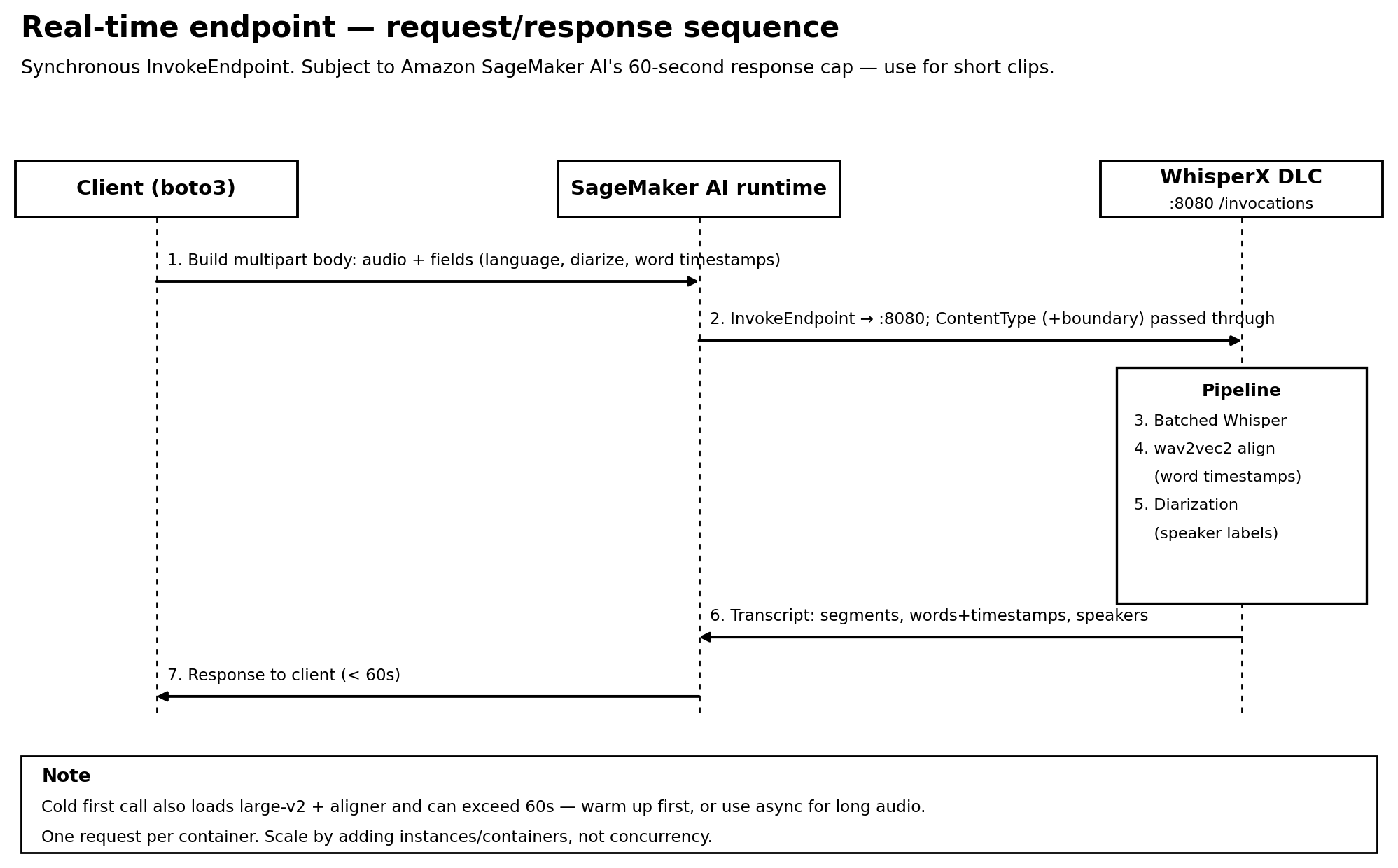
WhisperX operates by combining batched inference routines with wav2vec2 forced alignment models to generate exact, word-level timestamps. Additionally, it integrates advanced speaker diarization algorithms to accurately partition and label individual speakers within multi-party audio streams. By wrapping these capabilities into a single, cohesive architecture, the model transforms unstructured audio into a fully searchable, annotated data structure.
To deploy these capabilities at enterprise scale without requiring custom image compilation or complex dependency management, AWS engineered the WhisperX Deep Learning Container. The DLC packages Whisper, alignment weights, and diarization modules into an optimized, GPU-accelerated image. Crucially, the container operates natively within the standard Amazon SageMaker AI serving contract, eliminating the need for external Hugging Face tokens or cumbersome custom initialization scripts during deployment.
Deployment Topologies: Real-Time Versus Asynchronous Endpoints
Recognizing the diverse performance and latency profiles of enterprise workloads, AWS supports two distinct hosting patterns for the WhisperX DLC on Amazon SageMaker AI: real-time endpoints and asynchronous endpoints. Selecting the appropriate architecture depends primarily on audio clip duration, throughput volume, and interaction requirements.
For short, interactive audio clips that require immediate, synchronous feedback, the real-time endpoint provides an optimal solution. Clients submit audio payloads via a standard HTTP multipart/form-data request, receiving inline transcripts, word-level timestamps, and speaker labels within a single response cycle. Because real-time endpoints are bound by the Amazon SageMaker AI 60-second synchronous response cap, this configuration is best reserved for brief recordings, rapid query interactions, or low-latency monitoring applications.
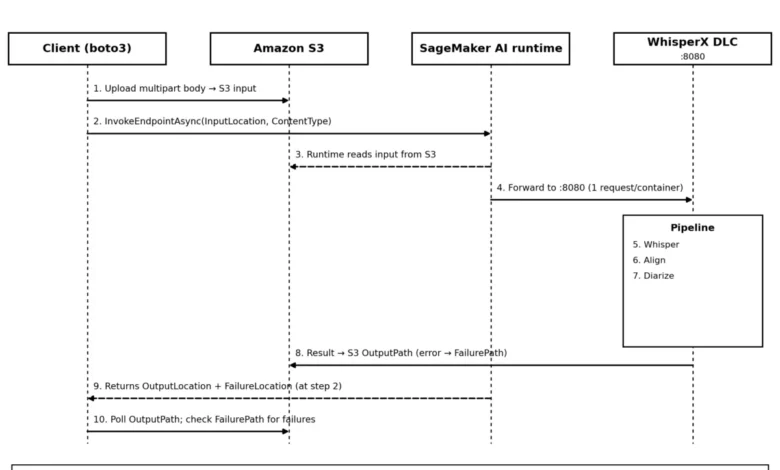
Conversely, long-form audio processing—such as multi-hour depositions, all-hands corporate meetings, or extensive broadcast archives—requires the asynchronous endpoint architecture. This pattern decouples request submission from processing, utilizing Amazon Simple Storage Service (Amazon S3) to broker large input files and resulting output documents. Clients invoke the endpoint asynchronously, receiving an immediate job reference while the backend processes the workload without time constraints. Asynchronous endpoints also support advanced cost-control mechanisms, including the ability to autoscale down to zero instances during idle periods, preventing continuous billing overhead.
Production Best Practices and Operational Considerations
Deploying advanced machine learning models in production environments demands rigorous adherence to infrastructure best practices. When provisioning endpoints for the WhisperX DLC on Amazon SageMaker AI, engineers must explicitly configure the inference AMI version to match the underlying CUDA and Python environment. Specifically, GPU variants require the al2-ami-sagemaker-inference-gpu-3-1 version pin; omitting this parameter leads to container initialization failures.
Instance selection plays a pivotal role in balancing cost and processing throughput. For cost-optimized deployments handling moderate workloads, ml.g4dn.xlarge instances provide an efficient baseline. For high-throughput environments or operations requiring additional computing headroom for intensive diarization and alignment tasks, ml.g5.2xlarge instances are recommended. Furthermore, because the container’s internal architecture processes requests sequentially per container worker, administrators must configure concurrency limits appropriately—setting maximum concurrent invocations to one per container instance to prevent memory contention.
Industry Implications and Broader Market Impact
The introduction of the WhisperX Deep Learning Container on Amazon SageMaker AI arrives at a time of accelerating demand for automated speech analytics across regulated and commercial sectors. Contact centers are increasingly leveraging sentiment analysis, talk-time metrics, and automated script adherence monitoring to drive customer experience improvements. In the legal and medical fields, automated transcription engines that guarantee strict speaker attribution and precise timestamping significantly reduce administrative overhead while supporting rigorous auditing standards.
By packaging these advanced capabilities into a standardized, GPU-ready Deep Learning Container, AWS lowers the technical barriers associated with deploying multimodal artificial intelligence models. Organizations can rapidly integrate sophisticated speech-to-text pipelines into existing enterprise architectures, transforming passive audio archives into dynamic, searchable intelligence assets. As enterprises continue to scale their generative AI and data analytics initiatives, purpose-built serving frameworks like the WhisperX DLC represent a critical step toward reliable, production-grade machine learning operations.