Building Resilient Streaming Data Pipelines with Dynamic Apache Iceberg Sinks on Amazon Managed Service for Apache Flink

In the modern data landscape, the agility of a streaming architecture is often tested by the inevitability of upstream schema evolution. Engineering teams managing data lakes frequently encounter a persistent operational bottleneck: when a source system modifies its data structure—adding fields, changing types, or introducing new event categories—the downstream ingestion pipeline often requires a complete shutdown. This necessity to halt, update, and redeploy not only results in significant downtime but also introduces risks of data loss, stale metrics, and increased toil. Recent advancements in the integration of Apache Flink 2.3 and Apache Iceberg 1.11.0 on Amazon Managed Service for Apache Flink have introduced a paradigm shift, enabling dynamic, per-record routing and automated schema evolution that allows pipelines to adapt in real-time without operator intervention.
The Operational Challenge of Static Pipelines
Historically, streaming pipelines were architected as static entities. A Flink job configured to ingest order_events was typically hard-coded to expect a specific schema. Should an upstream team decide on a Wednesday that an order_events stream should also include a loyalty_tier field or that an entirely new interaction_events stream should be processed, the conventional response was to pause the Flink job, modify the schema registry or local definitions, and perform a rolling deployment.
Industry data suggests that for high-volume streaming environments, these manual interventions account for nearly 30% of total pipeline maintenance time. Beyond the engineering hours consumed, the "stop-the-world" requirement creates an operational gap. While the pipeline is offline, in-flight data must either be buffered in intermediate storage or, in worst-case scenarios, discarded. If the data lake falls out of sync with the upstream source, downstream analytics dashboards and machine learning models relying on that data produce inaccurate results, leading to a loss of trust in the data platform.
A New Architecture: The Dynamic Sink
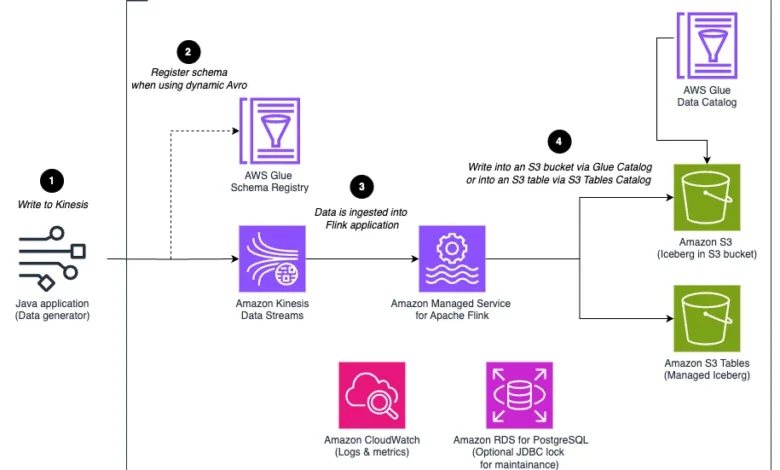
The introduction of the Dynamic Iceberg Sink represents a move away from rigid, per-pipeline configurations toward a more fluid, metadata-driven architecture. By leveraging the DataStream API in Apache Flink, developers can now resolve the destination table at the individual record level. This means a single Flink application can ingest a heterogeneous mix of events, analyze the metadata of each record, and route it to the appropriate Iceberg table in Amazon S3 automatically.
The underlying mechanism for this flexibility is the DynamicRecord class. Each DynamicRecord encapsulates the necessary metadata—including the target table ID, schema, partition specifications, and the row payload—ensuring that the sink has complete instructions for every item processed. If a table does not exist when a record arrives, the sink creates it on the fly. If an existing table receives a record containing new fields, the sink performs an immediate schema evolution, adding the new columns as optional fields. This ensures that historical data files remain valid while new data is captured according to the updated schema.
Technical Implementation and Schema Governance
The transition to dynamic sinks requires a robust approach to schema management. There are two primary methodologies for achieving this: schema inference from the data itself and integration with a centralized schema registry, such as the AWS Glue Schema Registry (GSR).
The Inference Model
For environments where schemas are semi-structured or evolving rapidly, runtime inference allows the pipeline to adapt without a pre-defined contract. The SchemaAgnosticRoutingGenerator processes incoming JSON, mapping fields to table names and inferring the appropriate Iceberg types. To prevent the loss of data precision, the system employs conservative type-widening rules. For instance, all integral values are mapped to LongType, and floating-point values are mapped to DoubleType. While highly convenient, this model is fundamentally "lossy" because JSON does not explicitly carry complex type information.
The Governed Model
For enterprise-grade environments that require strict data contracts, the integration with AWS Glue Schema Registry is the preferred solution. In this scenario, producers register schemas in the registry, and each record is tagged with a schema-version ID. The Flink consumer fetches the exact writer schema, ensuring that types are mapped with high precision—such as differentiating between timestamp-millis and timestamp-micros. This approach enforces governance; if a producer attempts to push a schema change that violates predefined compatibility rules (e.g., BACKWARD or FORWARD compatibility), the registry rejects the change, preventing corrupted data from reaching the data lake.
Chronology of Evolution: From Static to Fluid
The industry’s shift toward this model has occurred in three distinct phases:
- The Static Era (Pre-2020): Pipelines were strictly defined by fixed schemas. Any change required a full redeployment and potential downtime of several minutes to hours.
- The Metadata-Aware Era (2020–2023): Teams began utilizing external schema registries and custom code to handle schema drift, but the sink logic remained largely tied to static configurations, requiring custom wrappers to achieve "dynamic" behavior.
- The Dynamic Era (2024–Present): With native support for
DynamicIcebergSinkin Flink 2.3 and Iceberg 1.11.0, the "sink" itself has become a first-class citizen in handling schema evolution. The complexity has shifted from the infrastructure layer to the logic layer, where developers focus on defining routing rules rather than infrastructure management.
Impact on Data Reliability and Consistency
The core value proposition of this architecture lies in the combination of Apache Flink’s checkpointing mechanism and Apache Iceberg’s two-phase commit. This pairing provides end-to-end exactly-once processing guarantees. Because the dynamic sink handles schema updates as atomic operations—often using an "immediate table update" flag—there is no risk of a partial schema application where half a batch is written with an old schema and half with a new one.
From an analytical standpoint, this stability is critical. When a schema evolves, Iceberg tables handle the change by adding columns as optional, ensuring that queries against historical data do not fail. Queries scanning both old and new files will simply return null for the new columns in older partitions, maintaining backward compatibility for SQL engines like Amazon Athena or Amazon Redshift.
Broader Implications for Streaming Infrastructure
The ability to maintain a unified pipeline for multiple event types significantly reduces the cloud footprint of data engineering teams. By consolidating many small-to-medium event streams into a single, high-capacity Flink job, organizations can pool their compute resources. This reduces the number of idle Flink TaskManagers that would otherwise be required to maintain separate jobs for each event type.
However, architects must be cautious regarding the "noisy neighbor" effect. In a unioned pipeline, a sudden spike in volume for one event type could potentially cause backpressure that affects all other routed streams. Consequently, the recommendation is to reserve this unified approach for streams with similar SLAs, while isolating mission-critical, high-volume event sources into their own dedicated applications.
Future Outlook
As organizations move toward "Data Mesh" architectures, the ability to automate the lifecycle of tables becomes a foundational capability. The current trajectory in streaming technology points toward a future where "schema management" is an invisible background process, handled by intelligent sinks that negotiate contracts between producers and consumers in real-time. By removing the operational friction of schema changes, teams can pivot their focus from managing pipeline downtime to building more sophisticated data products, ultimately accelerating the time-to-insight for the entire organization. The integration of Managed Service for Apache Flink with Apache Iceberg provides the robust, scalable framework necessary to sustain this evolution in the years to come.