Migrating from Amazon CloudSearch to Amazon OpenSearch Serverless: A Comprehensive Strategic Guide for Modernizing Enterprise Search Infrastructure

The transition of enterprise search capabilities from legacy environments to modern, cloud-native architectures has reached a critical juncture with the strategic pivot toward Amazon OpenSearch Serverless. Organizations currently utilizing Amazon CloudSearch—a service that served as a foundational pillar for AWS-based search applications for over a decade—are now facing an industry-wide shift. Modern search requirements have evolved rapidly to encompass semantic search, hybrid retrieval, and Retrieval Augmented Generation (RAG) for generative AI applications. Consequently, Amazon Web Services (AWS) is actively encouraging users to migrate to Amazon OpenSearch Serverless, a platform that provides the operational simplicity of a managed service while introducing high-performance, scalable, and AI-ready search capabilities without the burden of manual infrastructure maintenance.
The Evolution of Managed Search
Amazon CloudSearch, which debuted in 2011 with a major 2013 API update, was designed for simplicity. It allowed developers to build search functionality into applications without managing complex hardware or cluster scaling. However, as the digital landscape shifted toward big data and machine learning-integrated search, the limitations of CloudSearch became apparent. It lacks native support for vector databases—the bedrock of modern AI search—and does not offer the granular query control required by complex, high-traffic applications.
OpenSearch Serverless, introduced as the next generation of managed search, aligns with the "serverless" trend that has defined cloud computing in recent years. By abstracting away the compute layer, it allows organizations to pay strictly for the resources utilized, ensuring that companies do not over-provision during low-traffic periods while maintaining the ability to handle massive bursts in demand automatically.
Strategic Planning and Assessment
The migration process is not a "lift-and-shift" operation; it requires a structured approach to ensure data integrity and query parity. The planning phase begins with a comprehensive audit of the existing CloudSearch domain. Engineers must document current configurations, including partition counts, replication factors, and specific field definitions.
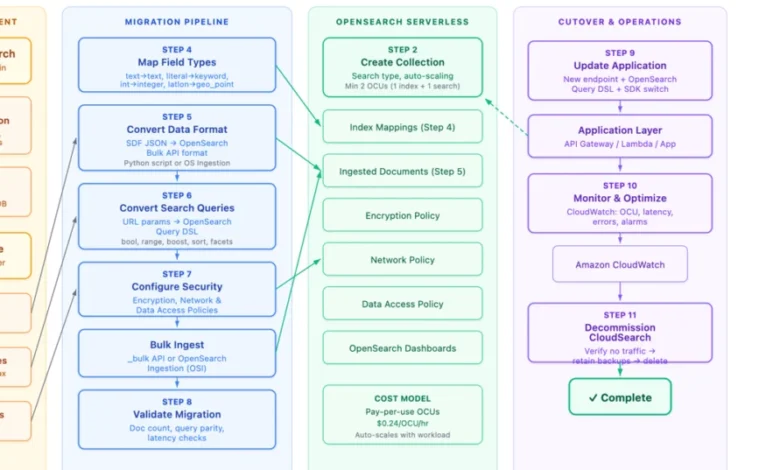
A critical step in this assessment is determining the compatibility of the source data. CloudSearch uses specific field types (text, literal, integer, etc.) that do not map directly to OpenSearch mappings in every instance. For example, while a CloudSearch "literal" maps effectively to an OpenSearch "keyword" type, developers must be wary of numeric types. CloudSearch defaults to 64-bit storage for integers, which is often unnecessary. Migrating to a more precise numeric type in OpenSearch—such as a 32-bit integer or a float—can significantly reduce index size and improve query performance, a secondary benefit of the migration process.
The Four-Phase Migration Workflow
Industry best practices suggest a four-phase migration cycle to mitigate risk:
- Assessment and Source Preparation: Identify the current architecture and verify the availability of source data in durable storage solutions like Amazon S3 or Amazon DynamoDB. Since CloudSearch lacks an automated export feature, data must be prepared for re-ingestion.
- Conversion and Mapping: This phase involves translating the source data format (SDF) into the JSON-based format required by OpenSearch. During this stage, schema drift must be managed by implementing strict index mappings to prevent the accidental creation of undefined fields.
- Data Ingestion: Utilizing Amazon OpenSearch Ingestion—a managed pipeline service—allows teams to move, filter, and transform data before it reaches the target collection. This method is preferred over direct API indexing because it provides an audit trail and the ability to restart ingestion if a network failure occurs.
- Validation and Cutover: Before redirecting production traffic, engineers must run parallel queries on both systems. This validation must go beyond simple string matches to include complex query DSL patterns, such as range queries, boolean logic, and relevance boosting.
Query Language Translation
One of the most significant challenges for development teams is the transition from URL-based query parameters used in CloudSearch to the robust REST API and query Domain-Specific Language (DSL) utilized by OpenSearch. In CloudSearch, complex queries are often appended to a URL string. In OpenSearch, these are structured as JSON request bodies.
For example, a standard search request for "Shakespeare" in CloudSearch is a simple parameter query. In OpenSearch, this is handled through a match query within a JSON object. This transition provides developers with significantly more power, allowing for compound queries that combine full-text search with filtering, sorting, and geospatial analysis. While the learning curve for Query DSL is steeper, it is a necessary investment for any organization looking to leverage modern AI-driven search features like K-Nearest Neighbors (KNN) for vector similarity.
Security and Access Control
Security in OpenSearch Serverless is more granular than in CloudSearch. While CloudSearch relies on AWS Identity and Access Management (IAM) for basic API access, OpenSearch Serverless introduces a multi-layered security model. This includes:
- Encryption Policies: Ensuring all data at rest is encrypted via AWS KMS.
- Network Policies: Defining which VPCs or public endpoints can access the collection.
- Data Access Policies: Providing role-based access control at the collection or index level, ensuring that specific user groups can only query or write to the indices relevant to their function.
This transition allows enterprises to move away from broad IAM policies toward a "least privilege" model, which is essential for compliance in industries like finance and healthcare.
Economic Implications: Cost Efficiency
From a cost perspective, the migration offers a transition from fixed-cost infrastructure to a pay-per-use model. In a traditional CloudSearch environment, companies paid for the instance types and uptime regardless of usage levels. In OpenSearch Serverless, the compute layer is decoupled from the storage layer. During periods of inactivity, the compute can scale to zero, leaving the organization to pay only for the stored data.
For high-volume, unpredictable workloads, this can result in substantial savings. However, for organizations with consistent, high-baseline traffic, a managed OpenSearch cluster—rather than the Serverless version—may occasionally prove more cost-effective. AWS advises that migration teams perform a workload profile analysis before committing to the Serverless architecture to ensure the cost model aligns with their specific operational patterns.
The Role of Generative AI
The primary driver for this migration is not just cost or scaling, but capability. By moving to OpenSearch, organizations gain the ability to integrate vector search, which is essential for Retrieval Augmented Generation (RAG). As AI agents become standard in enterprise search, the ability to store embeddings and perform semantic similarity searches becomes a competitive necessity. CloudSearch simply cannot support these workloads. Therefore, the migration is viewed by industry analysts as a prerequisite for any business intending to deploy modern, LLM-based search or chatbot interfaces.
Conclusion and Future Readiness
The decommissioning of Amazon CloudSearch is not merely a change in AWS service offerings; it represents the retirement of an era where search was a static, keyword-based utility. Today, search is an intelligent, dynamic interface. The migration to Amazon OpenSearch Serverless provides the stability and scalability of a managed service while opening the door to the next generation of search technology.
By following a methodical approach—assessing current configurations, mapping data with precision, converting query logic to DSL, and implementing robust security policies—organizations can ensure a seamless transition. As the industry continues to move toward more autonomous and AI-centric systems, the move to OpenSearch Serverless ensures that enterprise data remains accessible, searchable, and ready for the next wave of technological integration. Organizations are encouraged to begin the assessment phase immediately, utilizing AWS migration documentation and leveraging AI-powered coding assistants to expedite the translation of legacy query logic into modern OpenSearch DSL. Through careful planning, the transition serves as an opportunity to clean up legacy data models, optimize performance, and significantly reduce operational overhead.