Streamlining Governance: Amazon SageMaker Unified Studio Introduces Granular Designations for Multi-Role AI Projects

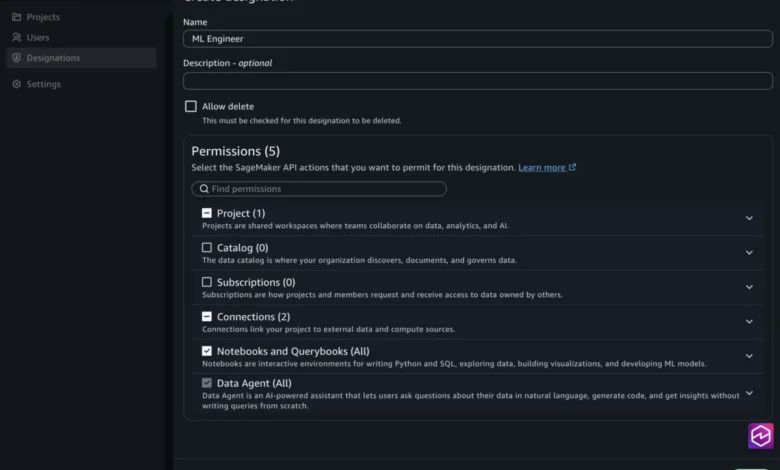
As organizations accelerate the integration of artificial intelligence and machine learning (ML) into their production environments, the challenge of managing access control within shared development spaces has reached a critical juncture. The complexity of modern data ecosystems—where data engineers, stewards, analysts, and ML scientists collaborate within singular project environments—has historically necessitated a trade-off between operational agility and strict security compliance. To address these evolving requirements, Amazon SageMaker Unified Studio has officially introduced "Designations," a sophisticated framework for granular permission management that allows administrators to define specific roles and responsibilities within a project, ensuring that users possess only the access required for their specific functions.
The Evolution of Access Control in AI Development
For years, the standard approach to managing shared AI workspaces relied heavily on broad, project-level permissions. In many cases, this led to "permission creep," where users were granted excessive access to ensure workflow continuity, or conversely, operational bottlenecks, where teams were forced to fragment their work into multiple, isolated projects to enforce security boundaries. The latter approach introduced significant overhead, leading to data silos, duplicate infrastructure costs, and fractured governance.
The introduction of Designations marks a shift toward a more nuanced, policy-driven model. By separating the definition of a permission set from the assignment of a user to a project, Amazon is enabling organizations to codify their security posture. This development follows a period of rapid growth in the SageMaker ecosystem, as enterprises shift from experimental ML workflows to high-stakes, production-grade applications that require robust auditing and strict adherence to the principle of least privilege.
Mechanics of the Designation Framework
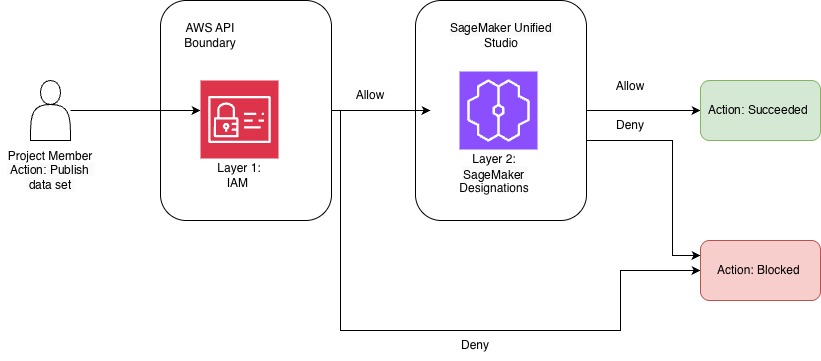
At its core, a Designation acts as an authorization layer that operates in tandem with existing AWS Identity and Access Management (IAM) protocols. When a user initiates a request—such as publishing a dataset or modifying a pipeline—the system evaluates the request against two distinct filters. First, the standard IAM framework checks if the user possesses the requisite broad permissions to interact with the AWS API. If the request clears this initial hurdle, the SageMaker Unified Studio Designation layer conducts a second check to verify if the specific action is permitted within the context of the user’s assigned role.
This dual-layer approach provides a crucial security safeguard. Because the system is designed to integrate with IAM roles, IAM users, and AWS IAM Identity Center (formerly AWS SSO), it offers a consistent authorization model across diverse user types. Importantly, the framework is designed for reusability; an administrator can create a "Data Steward" designation once and apply it across dozens of different projects, ensuring that security policies remain uniform across the entire organizational landscape.
Strategic Implications for Data Governance
The implications of this update for large-scale enterprises, particularly those in highly regulated sectors like financial services and healthcare, are significant. For institutions such as Swiss Life Germany, the ability to automate project setup while simultaneously enforcing granular permissions has been a long-standing requirement. By integrating Designations into the project lifecycle, organizations can ensure that the right access is enforced from the very first day of a project’s inception.
Industry analysts observe that this capability directly mitigates the operational risks associated with accidental infrastructure disruption. In a typical production environment, a misconfigured script or an unauthorized deletion of a data source can cause cascading failures. By limiting the "blast radius" of user actions through defined Designations, organizations can empower their teams to experiment and iterate without jeopardizing the stability of the broader production environment.
Implementation and Operational Workflow
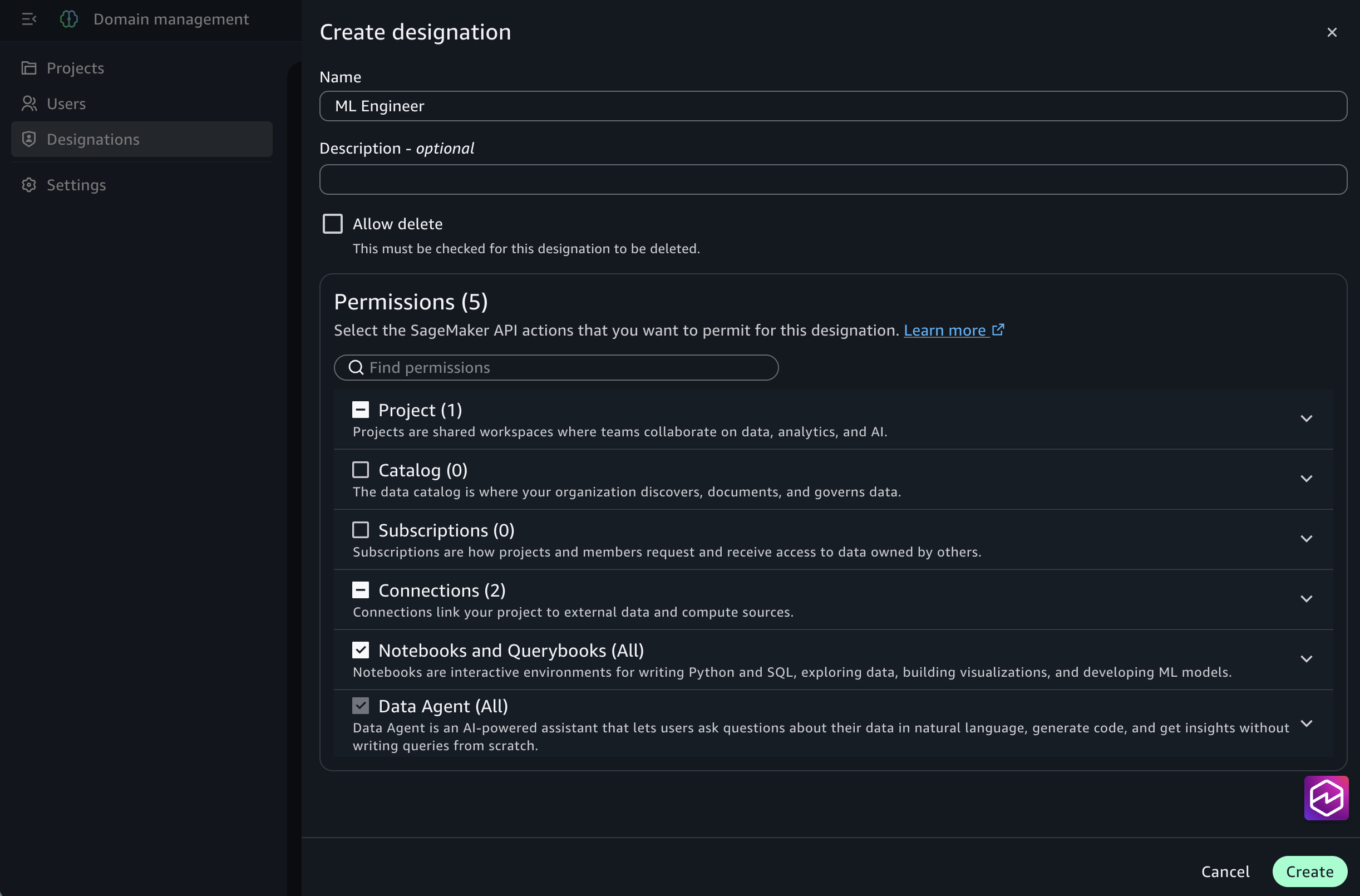
The implementation of Designations is designed to be seamless for existing SageMaker users. Administrators interact with the system via the domain management portal, which remains distinct from the primary workspace portal used by developers and analysts. Within this management interface, administrators can leverage a visual selector to define which actions—such as creating data sources, updating models, or managing asset publishing—are permissible for a given role.
Furthermore, the system includes two pre-configured managed designations, allowing teams to initiate security controls immediately without waiting for a custom policy build-out. For organizations that prefer a "configuration-as-code" approach, the integration with AWS CloudFormation and the AWS Command Line Interface (CLI) is a standout feature. This allows for the versioning of security policies within source control systems, enabling teams to treat access management with the same rigor as they treat software code deployments.
Analyzing the Shift Toward Automation
A key component of this release is the focus on the full lifecycle of project permissions. By allowing for the programmatic creation and assignment of Designations, AWS is enabling a "Governance-as-Code" model. This is particularly valuable for DevOps and Platform Engineering teams tasked with managing hundreds of concurrent AI projects.
When an organization scales, manual configuration becomes a liability. The ability to push updates to a Designation and have those changes reflect immediately across all assigned projects reduces the administrative burden of policy management. However, this level of automation requires a robust auditing strategy. AWS CloudTrail integration ensures that every change to a Designation, from creation to deletion, is captured in an immutable audit log. This is essential for meeting compliance standards such as SOC2, GDPR, and HIPAA, where proving "who had access to what and when" is a mandatory requirement.
Addressing the Risks of Deletion and Modification
Recognizing the potential for unintended disruption, the framework includes a specific "deletion protection" mechanism. By default, designations are protected from deletion to prevent scenarios where active users are suddenly stripped of their permissions. Administrators must explicitly toggle this protection off if they intend to retire a specific role, a design choice that reflects a "safety-first" philosophy.
Should a designation be deleted, the system is designed to maintain the user’s presence in the project but revoke their permissions, effectively putting the user in a "read-only" or "no-access" state until a new designation is assigned. This approach forces a controlled transition, preventing the common issue of "orphaned" users who retain access due to administrative oversight.
Broader Impact and Future Outlook
The introduction of Designations in Amazon SageMaker Unified Studio represents a maturity milestone for the platform. As AI becomes the backbone of enterprise decision-making, the tools supporting those AI workflows must shift from being purely productivity-focused to being security-first.
The data provided by industry benchmarks suggests that organizations with mature, granular access control frameworks reduce their security-related downtime by approximately 30% compared to those relying on legacy, role-based access models. By removing the need for duplicate project environments and providing a clear, audit-ready mechanism for permission management, Amazon is lowering the barrier to entry for secure, large-scale AI deployment.
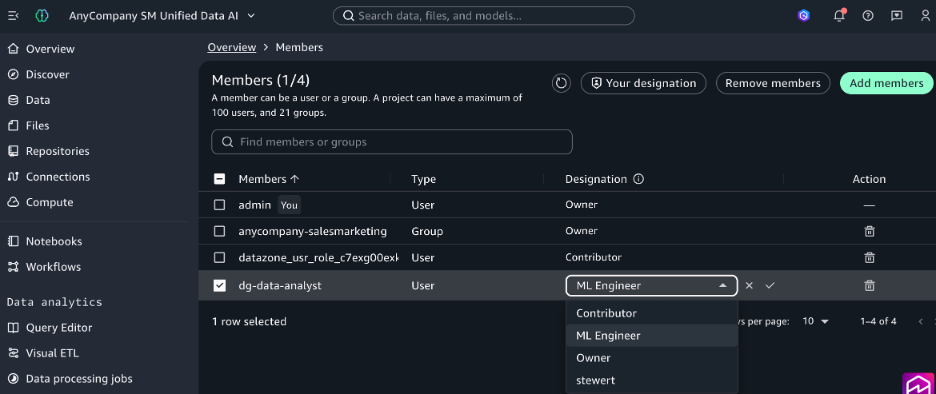
As organizations continue to integrate more advanced LLMs and predictive models into their operations, the demand for this level of precision will only grow. The ability to define exactly what an "ML Engineer" or a "Data Analyst" can do within a specific project, without the administrative weight of managing dozens of distinct IAM policies, is a vital step toward creating a self-sustaining, secure, and collaborative AI ecosystem. For administrators and architects, the path forward is clear: move away from broad, sweeping permissions and toward a model of precision-engineered access, where every action is a conscious, governed choice.
Conclusion: A New Standard for Collaboration
The shift toward granular, project-level permissions is not merely a feature update; it is a fundamental improvement in how enterprises govern data-driven innovation. By providing a mechanism that is both flexible enough for day-to-day operations and rigid enough for strict compliance, Amazon has addressed a critical gap in the MLOps lifecycle. As teams look to scale their AI efforts throughout 2026 and beyond, the adoption of structured Designation models will likely become the standard for any organization that treats its data and models as core business assets. With no additional cost for this feature, the path to improved security and streamlined governance is now accessible to every organization operating within the SageMaker Unified Studio ecosystem.
Related posts: