Balancing Autonomy And Oversight: Amazon Quick Introduces Smart Approvals To Streamline AI Agent Governance

As artificial intelligence agents transition from experimental tools into core enterprise systems, enterprise security leaders face a fundamental design paradox: how to preserve essential human oversight without burying end-users in an unsustainable avalanche of routine authorization prompts. When multi-step AI agents execute complex operational workflows, they frequently trigger dozens of checkpoint requests. This high-frequency interruption phenomenon often degrades user attention, inadvertently increasing the likelihood that operators will rubber-stamp critical security warnings without proper evaluation. To combat this operational fatigue, Amazon Quick has unveiled Smart Approvals, an intelligent governance mechanism designed to automate low-risk permissions while maintaining stringent policy boundaries for high-stakes actions.
The Challenge of Prompt Fatigue in Enterprise AI
Security governance has historically relied on granular permission structures to dictate the precise actions an automated system can execute. However, possessing technical permission to perform an action does not automatically mean the execution warrants human intervention at every intermediate step. Industry research examining human responses to continuous security warnings consistently demonstrates that attention spans and procedural adherence decline significantly when users are subjected to repetitive prompting.
In environments where AI agents handle multi-step tasks—such as pulling quarterly records, drafting summaries, and preparing communications—requiring manual verification for every trivial sub-task creates severe cognitive friction. Rather than enhancing security posture, relentless prompting encourages complacency. Users subjected to constant interruptions tend to approve pending items indiscriminately, neutralizing the protective value of human-in-the-loop safeguards. Smart Approvals seeks to resolve this vulnerability by dynamically filtering routine operations, allowing human operators to reserve their cognitive focus exclusively for decisions that genuinely require human judgment.
Policy Boundaries and Technical Architecture
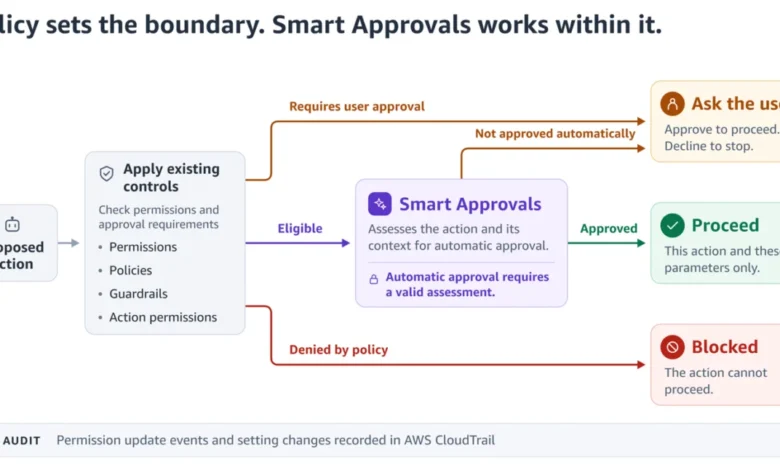
Smart Approvals operates firmly within pre-established organizational security frameworks rather than bypassing them. Before an action reaches the automated review tier, Amazon Quick evaluates the proposed operation against Custom Permissions, platform-specific Guardrails, connector action constraints, and individual user preferences.
The system enforces strict foundational boundaries. Any action explicitly denied by overarching security policies remains blocked, and mandatory human approval workflows dictated by regulatory or structural mandates cannot be overridden. For Smart Approvals to engage, an action must meet specific criteria: the user’s individual setting must be configured to the Ask Each Time parameter, and no secondary security control must mandate human intervention. Furthermore, connector action permissions—configured at the initial setup of enterprise integrations—retain the authority to enforce absolute human review for sensitive operations regardless of automated classification.
Administrators wield comprehensive administrative oversight through Custom Permissions. While Smart Approvals is enabled by default to streamline immediate deployment, high-security profiles utilizing a deny-by-default posture must explicitly opt in to the feature. Additionally, individual end-users retain the ultimate authority to disable Smart Approvals across all active conversations and scheduled runs. Once a user deactivates the feature, any action otherwise eligible for automated review instantly reverts to manual approval requirements, and account-level administrators cannot remotely re-enable it for that specific profile.
The Dual-Engine Review Process: Classifier Judgment and Permission Enforcement
When an action is deemed eligible for automated review, Smart Approvals deploys a dedicated classification model. This classifier assesses the proposed action by cross-referencing the original user request with a tightly bounded, contextual view of the ongoing conversation. The model analyzes the functional nature of the action, the designated data destination, and the potential impact radius.
To contextualize recipients accurately, the classifier can consult the user’s internal knowledge graph—a secure repository mapping professional relationships and reporting chains derived exclusively from connected corporate sources. This internal lookup ensures the system understands organizational hierarchies, such as whether a designated recipient sits within the user’s direct reporting line. Crucially, Amazon Quick maintains strict data privacy guarantees: the content reviewed by the classifier, including knowledge graph metadata, is never utilized to train foundational models or improve external services.
The system is explicitly engineered to recognize that an action matching a literal request may still demand human scrutiny. Operations that involve transmitting data outside the organization, routing information to senior leadership within reporting chains, modifying access privileges, deleting historical records, or initiating financial transactions are routinely flagged for human review.
Furthermore, this classification layer acts as an effective defense against indirect prompt injection attacks. If malicious instructions embedded within retrieved enterprise documents attempt to hijack the agent’s execution path, Amazon Quick instructs both the underlying agent and the classification model to treat retrieved text strictly as passive data rather than executable instructions. Nevertheless, recognizing that probabilistic models remain imperfect, high-risk operational categories must be hardcoded to mandate human intervention through connector permissions.
Once the classifier renders a judgment, the core permission service enforces the boundary. Each automated approval generated
by the system is strictly single-use, tied exclusively to the exact parameters evaluated, and grants no persistent authorization. Amazon Quick transparently labels these automated approvals within the chat interface. Actions failing classification, encountering system timeouts, or triggering review errors are automatically routed back to the user; under no circumstances do operational failures result in default automated approvals.
Operational Scenarios and Real-World Guardrails
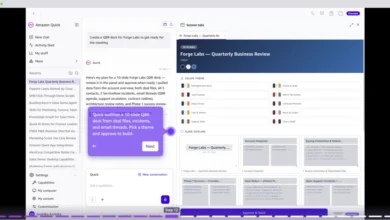
To understand how Smart Approvals functions in practical enterprise scenarios, consider an account manager who instructs Amazon Quick to compile a quarterly business review brief for a client using team account notes and recent email archives. Following the compilation, the user requests that the document be transmitted to two named colleagues.
If the transmission aligns with standard parameters, Smart Approvals evaluates the request against conversation context and approves the send automatically. However, if a background account note contains an incidental instruction indicating that the brief should also be distributed to a massive sales distribution list comprising thousands of recipients, the operational scope shifts dramatically. Because the intended audience expands far beyond the user’s explicit specification, Smart Approvals intercepts the discrepancy and routes the transmission back to the account manager for manual review and potential rejection. Crucially, an approval granted for the original two recipients cannot be repurposed or recycled to authorize transmission to the broader audience.
Comprehensive Audit Trails and Forensic Investigation
Enterprise compliance demands rigorous traceability, and Amazon Quick integrates deeply with AWS CloudTrail and Amazon CloudWatch Logs to provide an unalterable forensic record of every governance event. The permission service records all permission updates associated with Smart Approvals directly into CloudTrail. Each event captures the identity of the user, the specific connector involved, the executed action, the precise timestamp, and a distinct marker identifying the request as processed by Smart Approvals.
Security investigators can correlate these CloudTrail events with auxiliary log streams to reconstruct complete operational timelines. Chat logs capture the original user prompt, system responses, and conversational context, while agent metadata logs record structural modifications to autonomous agents. Finally, destination system logs—such as an email delivery confirmation or a modified ticketing record—verify whether an action successfully completed its lifecycle.
Because CloudTrail event history defaults to a 90-day retention window, enterprise security teams are strongly advised to configure persistent trails for extended forensic investigations. Furthermore, because chat logs inherently capture sensitive corporate communications, administrators must restrict access permissions and implement CloudWatch Logs data protection policies to mask confidential information.
Strategic Implementation Roadmap for Security Leaders
Deploying automated governance requires a methodical, phased strategy. Security leaders should initiate the rollout by verifying that high-consequence operations are properly restricted through connector-level permission settings. Concurrently, administrators must establish robust CloudTrail logging and CloudWatch log delivery pipelines before activating the feature broadly. Because historical chat logs cannot capture context retroactively, establishing logging infrastructure early is paramount.
Organizations should begin deployment by establishing a targeted pilot program utilizing Custom Permissions to restrict Smart Approvals to a single, well-defined operational team. Prior to launch, security teams must establish quantifiable success metrics: measuring a measurable reduction in routine prompt fatigue while verifying that consequential actions continue to trigger mandatory human review.
During the pilot phase, security administrators should audit a randomized sample of automated approvals and actively test high-impact scenarios—such as attempting to transmit data externally or introducing new recipients via unstructured documents—to ensure the safety classifiers function as intended. Only when pilot data confirms that operational efficiency is achieved without compromising oversight should organizations expand Smart Approvals across wider enterprise units.
Ultimately, the true benchmark of effective AI governance is not measured by how infrequently an autonomous agent prompts its human operator, but by whether human actors retain absolute control over high-consequence business decisions. By intelligently filtering routine operational noise, Smart Approvals allows security leaders to preserve cognitive focus, strengthening institutional accountability in an increasingly automated enterprise landscape.