HiFiMan HE1000 Stealth: A Critical Analysis of High-End Planar Magnetic Headphone Engineering


The landscape of personal audio has undergone a significant transformation since 2012, driven by the publication of landmark research by the Audio Engineering Society regarding target response curves. While budget and mid-range audio equipment have pivoted toward a standardized, neutral "Harman target" tuning—prioritizing accuracy and objective fidelity—the ultra-high-end headphone market remains a bastion of subjective, specialized sound signatures. At the center of this divergence is the HiFiMan HE1000 Stealth, a $949 planar magnetic headphone that represents the 2023 iteration of a lineage originating in 2015. Unlike entry-level gear that aims for mass-market neutrality, the HE1000 continues to embrace a signature "house sound" that prioritizes spatial presentation over clinical flatness, challenging the industry-wide push for objective uniformity.

The Evolution of the HE1000 Lineage
The original HiFiMan HE1000 was introduced in 2015 at a $3,000 price point, positioning it firmly within the flagship tier of audiophile equipment. At the time, it was lauded for its innovative use of nanometer-grade diaphragm technology and its unique aesthetic, which moved away from industrial utility toward a more refined, artisanal look. Throughout the subsequent eight years, HiFiMan iterated on the design, culminating in the "Stealth" version.
The 2023 Stealth iteration incorporates the company’s proprietary Stealth Magnet technology, a design feature engineered to reduce wave diffraction turbulence. By shaping the magnets in a way that allows sound waves to pass through without generating interference, the company claims a more transparent and detailed output. This technological shift reflects a broader trend in high-end audio engineering: moving beyond mere frequency response tuning to address the physical behavior of air and sound waves within the ear cup assembly.

Technical Specifications and Design Philosophy
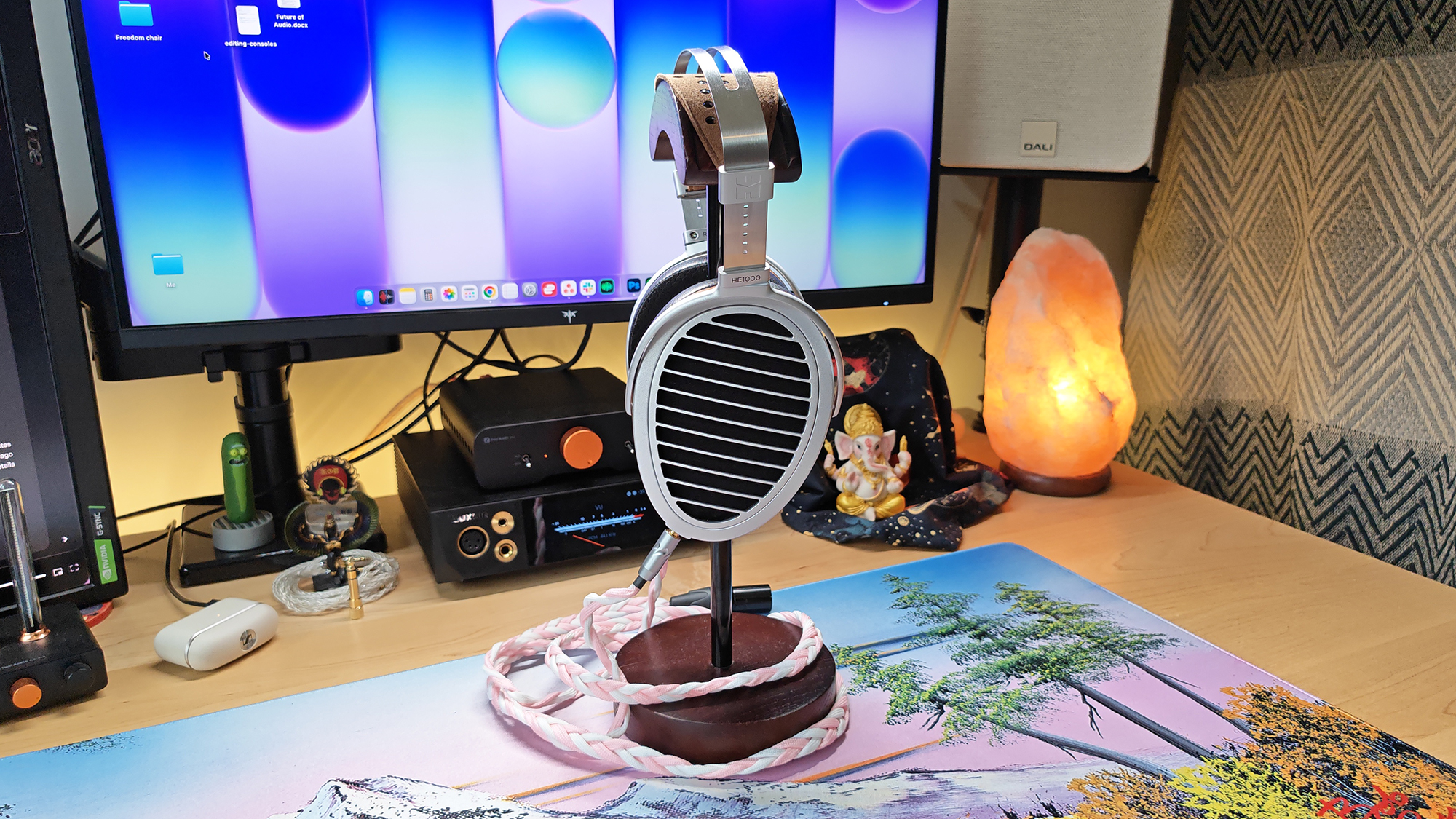
The HE1000 Stealth is built upon a 100mm planar magnetic driver, a size that provides significant surface area for air displacement, contributing to its reputation for expansive soundstage reproduction. The chassis is a sophisticated blend of materials: a CNC-machined aluminum frame and yokes provide structural integrity, while the ear cups are finished with a wood-veneer trim and a real leather headband strap.
Key technical specifications include:
- Driver Type: 100mm Planar Magnetic (Open-back)
- Impedance: 32 Ohms
- Sensitivity: 93dB/mW
- Weight: 458g
- Cable Connectivity: Dual 3.5mm ear cup connectors
While the build quality is high, industry analysts have noted that the use of wood-printed vinyl veneer rather than solid hardwood for the ear cups is a point of contention at the $949 price bracket. Nevertheless, the ergonomics—specifically the weight distribution of the suede-lined headband—have been consistently praised for allowing extended listening sessions, a critical requirement for professional studio environments and dedicated audiophile setups.
Comparative Tuning: Neutrality vs. Artistic Presentation
The divergence between the HE1000 and modern affordable alternatives is best understood through the lens of frequency response manipulation. Affordable reference-class headphones, such as the Sennheiser HD 480 Pro Plus, strive for a linear response that minimizes color. In contrast, the HE1000 utilizes a deliberate "scoop" in the upper midrange, specifically between 1.25kHz and 2.5kHz.

This psychoacoustic tuning pushes lead vocals and primary instrumentation slightly back in the mix, creating an illusion of depth and physical space. While this "HiFiMan house sound" is highly effective at separating complex musical layers, it contrasts sharply with the "vocal-forward" or intimate tuning found in professional monitor headphones. For the listener, this means the HE1000 is less a tool for surgical audio analysis and more an instrument for immersive, large-scale musical enjoyment.
Critics of this approach argue that such coloration sacrifices the natural timbre of instruments. However, proponents suggest that the "spaciousness" effect provides a more realistic representation of a live orchestral performance, where distance and room acoustics play a vital role in sound perception.

Market Context and Consumer Implications
The release of the HE1000 Stealth at a price point significantly lower than its predecessors suggests a strategic shift in HiFiMan’s market positioning. By bringing a flagship-level driver to the sub-$1,000 market, the company is competing with high-end monitor manufacturers like HEDD Audio, whose D1 headphones offer a more clinical, neutral perspective.
This price-to-performance calculation is a central theme in modern high-end audio. As supply chain efficiencies and manufacturing techniques for planar magnetic drivers have matured, the "barrier to entry" for premium sound has lowered. However, the decision to purchase such equipment remains heavily dependent on the individual user’s listening profile. For a sound engineer or a creator requiring absolute accuracy, the HE1000’s sculpted frequency response may be detrimental. For an enthusiast or a media professional seeking to experience the spatial nuances of a production, it remains a standout choice.

The Impact of Treble Peaks and User Experience
A notable aspect of the HE1000 Stealth is its treble behavior. The frequency response shows specific peaks between 6.5kHz and 7.3kHz, followed by a secondary peak near 9kHz. These regions are notorious in the audio community for causing listener fatigue. While these peaks provide the perceived "detail" and "air" that many users find appealing, they can also render certain recordings—particularly those with aggressive high-hat percussion or electronic synthesized textures—uncomfortable to hear at higher volumes.
Professional testing suggests that the HE1000 requires a high-quality Digital-to-Analog Converter (DAC) and amplifier pairing to perform at its peak. The low sensitivity of 93dB/mW means that underpowered sources, such as standard mobile devices or basic laptop headphone jacks, will fail to drive the planar magnetic drivers with sufficient authority, potentially leading to a lackluster, thin sound. Users are generally advised to utilize dedicated balanced amplification to achieve the full dynamic range the drivers are capable of producing.

Conclusion: The Future of High-End Personal Audio
The HE1000 Stealth stands as a testament to the enduring appeal of "character" in audio hardware. While the industry is clearly moving toward a data-driven, neutral future, there remains a substantial demand for headphones that offer a distinct, curated experience. The HE1000 succeeds not by being "correct" in the objective, measurable sense, but by being highly consistent in its artistic delivery.
As the industry moves toward 2025, the tension between objective engineering and subjective preference will likely continue to define the high-end market. For the consumer, the HE1000 serves as a reminder that the best audio equipment is that which aligns with the listener’s personal goals—whether that is the clinical transparency required for professional mastering or the expansive, colored presentation favored by those who view music as an experiential, rather than purely analytical, medium. The HE1000 remains a significant, if non-neutral, benchmark in the history of personal audio technology.