The emergence of generative artificial intelligence has fundamentally altered the landscape of digital product creation, precipitating a quiet but significant crisis of terminology within the design industry. At the heart of this disruption lies a colloquialism that gained widespread traction in early 2025: “vibe coding.” While initially coined by industry figures such as Andrej Karpathy to describe a specific, low-accountability workflow—where a user provides loose instructions and accepts the model’s output without rigorous interrogation—the term has since metastasized. It is now frequently used to describe any design process involving AI, a trend that many senior practitioners argue obscures the high-level intentionality, technical judgment, and strategic authorship required to build modern digital experiences.
The migration of this term into professional design discourse represents more than a linguistic shift; it signals a fundamental misunderstanding of the designer’s role in an AI-augmented environment. As jargon travels from technical engineering circles to creative departments, it often carries latent assumptions. In many engineering-heavy cultures, the human role in AI workflows is often relegated to that of a supervisor or a curator of stochastic output. However, for professional designers, the reality of high-stakes work is starkly different. The industry is currently facing a fork in the road: one path leads toward passive generation—accepting, adjusting at the margins, and shipping—while the other prioritizes directed generation, where human judgment serves as the primary driver of the system.
A Chronology of the Linguistic Drift
The trajectory of the “vibe coding” label mirrors the rapid evolution of generative AI tools. In early 2025, the industry was in a state of rapid experimentation. As foundational models became accessible through accessible interfaces, a segment of the coding and design community adopted a trial-and-error approach. The term “vibe coding” was, in its original context, an accurate descriptor of this exploratory phase: a process defined by low barrier-to-entry and minimal concern for the internal logic of the output.
By mid-2025, as organizations began integrating these tools into production environments, the terminology failed to mature alongside the practice. Despite the shift toward complex, multi-modal design systems that require precise input, the label remained a catch-all. Industry observers note that this linguistic stagnation has created a "pre-shaping" effect. When hiring managers or stakeholders categorize all AI-assisted work under the umbrella of "vibe coding," they inadvertently devalue the rigor of the design process. This creates a professional paradox: as designers perform more sophisticated, data-driven, and system-oriented work, the vocabulary used to describe their output is becoming increasingly dismissive.
The Methodology of Directed Generation
At the core of the debate is the concept of authority in the design process. In an intentional, professionalized AI workflow, judgment does not occur after the fact; it arrives first. This methodology, termed “directed generation,” stands in direct opposition to the passive reliance on generative randomness.
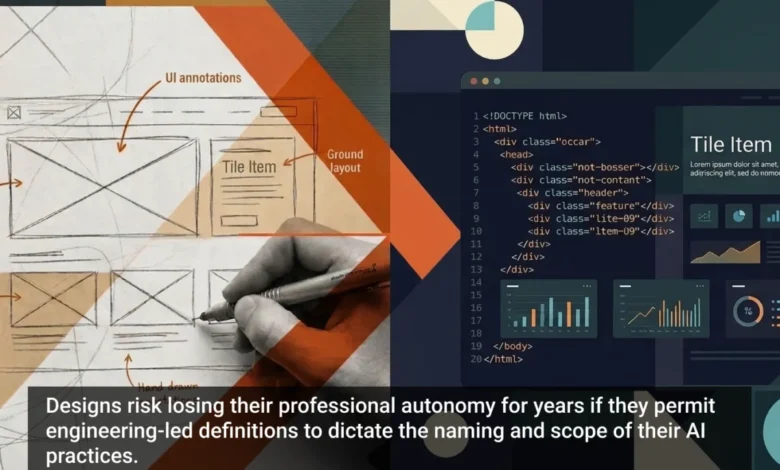
Directed generation begins with a curated input, or a "reference." This is not a mere prompt—which can be vague and prone to model hallucination—but a high-fidelity artifact such as a sketch, a structured visual precedent, or a set of constraints. These references carry embedded decisions regarding proportion, visual hierarchy, and brand tone. By feeding these parameters directly into an AI, the designer acts as an author, not a spectator. This allows the AI to operate within a bounded space, effectively turning the model into a tool for execution at the speed of code while maintaining the integrity of the original creative vision.
Data from current industrial design workflows suggests that this approach yields significant efficiency gains. While traditional, deterministic design requires manual iteration for every component, directed generation allows for “non-deterministic design.” In this model, the designer defines the conditions—the grammar, if you will—under which high-quality, brand-consistent instances emerge. The system then executes these across various surfaces, devices, and contexts, ensuring that scale does not result in the fragmentation of the visual language.
Supporting Data and Industry Implications
Recent industry reports indicate that teams adopting directed generation workflows have seen a 30% to 50% reduction in time-to-market for complex design systems. The shift moves the designer’s labor upstream. Instead of spending hours defining static components in tools like Figma, designers are spending time refining the primitives and constraints that govern the system.
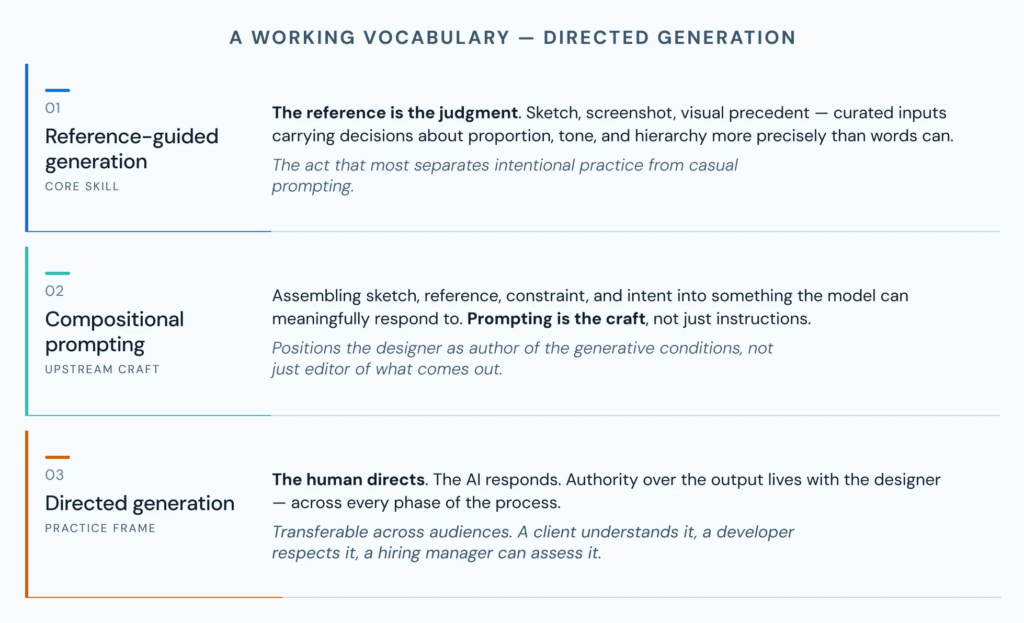
This shift has profound implications for how design systems are documented and maintained. Traditionally, design systems have been treated as fixed libraries of artifacts. Under the directed generation paradigm, these systems become dynamic engines. This transition is not merely a technical upgrade; it requires a new set of professional competencies. Designers must now be adept at "compositional prompting" and "reference-guided practice," skills that demand a deep understanding of systemic logic rather than just pixel-perfect craftsmanship.
Professional Reactions and the Call for New Language
The resistance to the “vibe coding” label is gaining momentum among senior design leaders. Many argue that allowing adjacent fields—specifically software engineering and product management—to dictate the language of design is a tactical error that could weaken the profession’s influence in boardrooms and product strategy meetings.
"Naming an emerging practice is messy, but essential," says one senior design lead at a major technology firm. "If we allow our craft to be defined as ‘vibes,’ we are effectively stripping away the accountability that makes design a professional discipline. We need to distinguish between casual generation and systematic design leadership."
The industry is now beginning to propose new handles for this work. Proposals include:
- Reference-Guided Design: Emphasizing the input-heavy, highly intentional nature of the process.
- Systemic Generation: Highlighting the shift from individual pixels to the logic that governs them.
- Agentic Orchestration: Describing the future state where designers manage autonomous systems that carry forward their creative intent across scale.
The Broader Impact: A New Inflection Point
The current moment in AI-assisted design is reminiscent of the rise of User Experience (UX) design as a formal discipline. In the early 2000s, practitioners who took the time to define their work—codifying interaction design and information architecture—secured the value of their field for decades. Those who failed to define their contributions were often absorbed into adjacent roles with less autonomy.
Today, AI-assisted design is reaching a similar inflection point. The technology is no longer novel; it is normalized. The question for the next five years is not whether designers will use AI, but whether they will lead the methodology of its implementation.
Professional clarity in this space is a prerequisite for professional status. When a designer can articulate the difference between “vibe coding”—which is useful for rapid prototyping and ideation—and “directed generation”—which is necessary for scalable, reliable production—they regain the authorship of their practice.
Ultimately, the debate over terminology is a proxy for the debate over the future of the profession. As the industry moves toward agentic delivery, where systems act with increased autonomy, the designer’s role will continue to evolve into that of a high-level curator and architect of constraints. By rejecting imprecise, devaluing labels, designers can ensure that the tools of the future remain an extension of human intent, rather than a replacement for it. The goal is not to win a debate over semantics, but to establish a standard of practice that is as rigorous, reliable, and deliberate as the products it is intended to create.