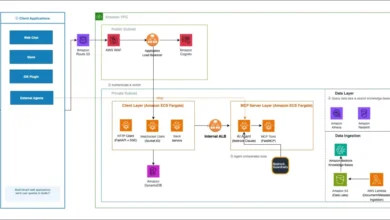
Optimizing Self-Hosted LLM Performance: Amazon Introduces Distributed KV Caching with ElastiCache to Cut Costs and Latency

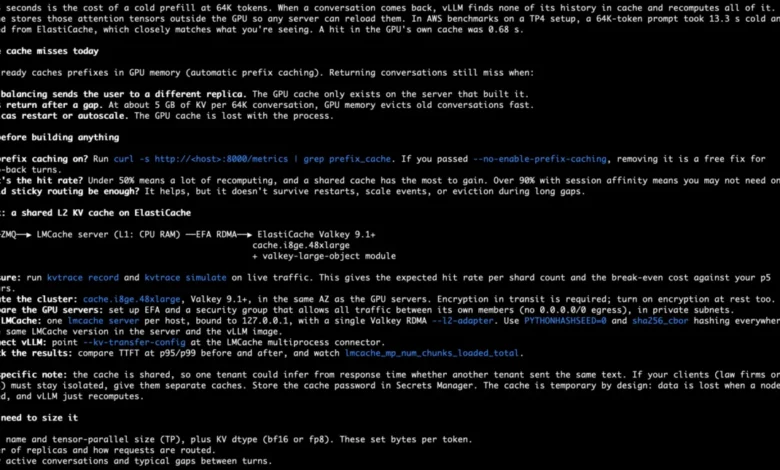
The rapid proliferation of generative artificial intelligence and large language models (LLMs) has fundamentally transformed enterprise operations, presenting organizations with a distinct set of operational and financial challenges. Chief among these challenges is the high cost and latency associated with self-hosting LLMs on dedicated graphical processing units (GPUs). Enterprises increasingly choose to self-host models to retain stringent control over data privacy, operational accuracy, cost structures, and inference latency. However, this architectural approach has historically introduced a significant hardware inefficiency: the problem of redundant GPU computation stemming from isolated, server-specific memory caches.
To address this critical bottleneck, Amazon Web Services (AWS) has officially announced the launch of distributed key-value (KV) caching for self-hosted LLMs using Amazon ElastiCache. This newly released architectural paradigm extends traditional GPU-local caches by introducing a shared, high-performance caching tier alongside the existing GPU fleet. By allowing any server within a cluster to seamlessly reuse KV attention states across multiple sessions, routing shifts, and even unexpected server failures for days at a time, the solution promises to slash self-hosted LLM inference costs by up to 40 percent while accelerating the time to first token (TTFT) by up to 80 percent.
The Underlying Architectural Challenge: Cold Prefills and Redundant Compute
To understand the magnitude of this technological advancement, it is essential to examine the mechanics of modern LLM inference. When an artificial intelligence agent or a chat application processes a conversation, it generates a vast history of tokens. Consider, for example, a specialized legal AI assistant deployed within a corporate environment. Over the course of a multi-turn investigation, a single conversation thread can easily accumulate hundreds of thousands of tokens detailing complex case histories, depositions, and evidentiary logs.
When a lawyer or analyst steps away from their terminal and returns to the conversation thread later in the day, the incoming request is frequently routed to a different GPU server within the hosting cluster. Because that newly assigned server possesses none of the prior conversation history in its localized memory, it faces a phenomenon known as a "cold prefill."
Before the model can generate a single word of its response, the GPU must completely recompute the key-value attention states for every single token accumulated in the historical thread. This exhaustive recomputation phase consumes valuable compute cycles, drives up energy consumption, and introduces frustrating delays—sometimes causing responses to take minutes rather than milliseconds. This exact performance degradation pattern similarly plagues resumed coding agents, autonomous multi-step agentic workflows, and large-scale document question-and-answer systems.
The Integration of Amazon ElastiCache and the Agent Toolkit for AWS
AWS is facilitating the adoption of this technology through the release of a specialized distributed KV caching skill integrated directly into the Agent Toolkit for AWS. Engineered to operate natively within modern developer environments and coding agents such as Kiro, Claude Code, and OpenAI Codex, this tool allows development and engineering teams to evaluate, configure, and troubleshoot distributed KV caching architectures using straightforward natural language prompts.
Rather than forcing administrators to manually calculate the complex variables governing cache performance—such as model architectures, tenant isolation boundaries, hardware sizing, and user traffic patterns—the Agent Toolkit guides engineers through a structured, multi-phase evaluation and deployment process.
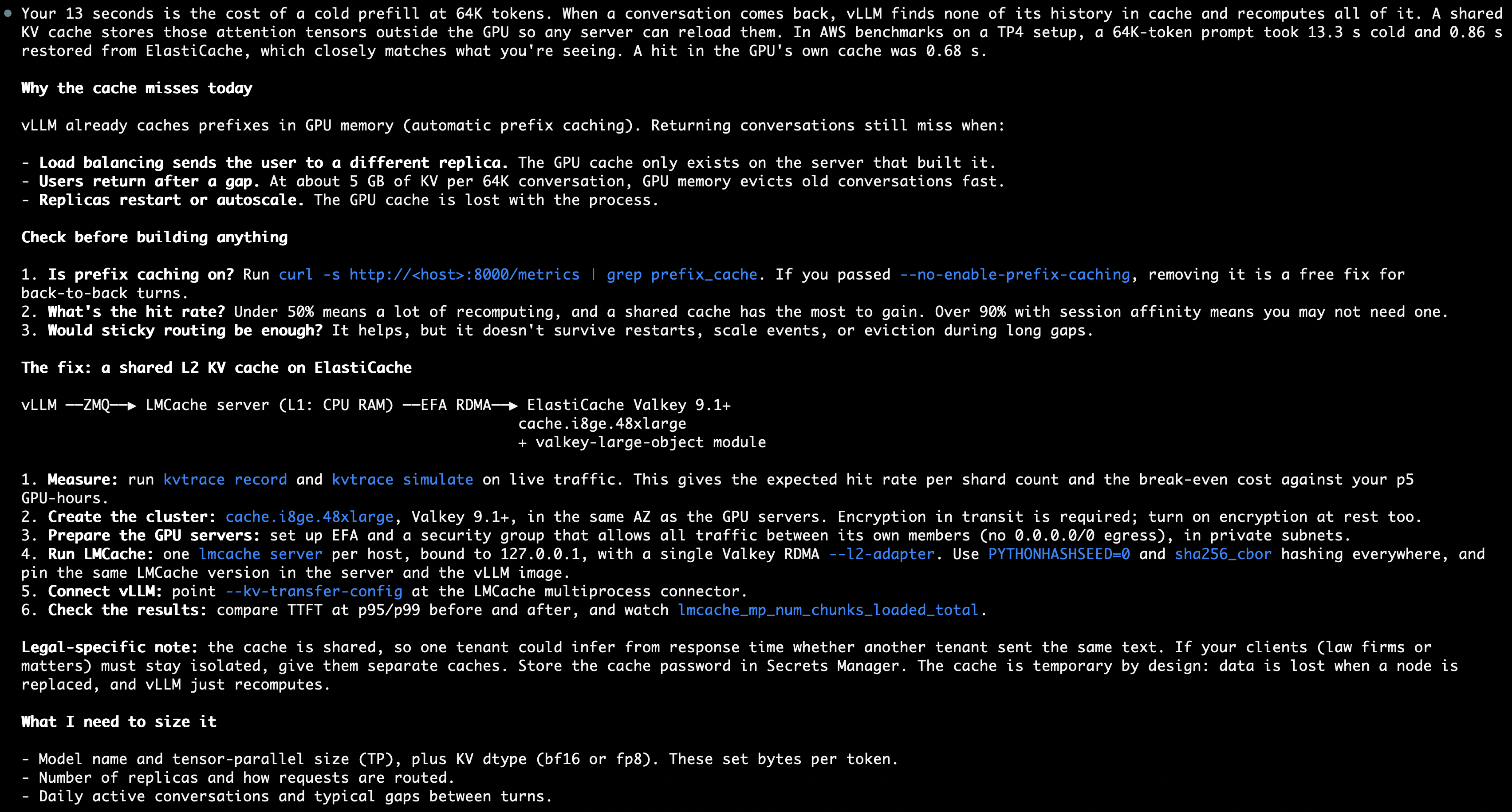
The evaluation framework is powered by KVTrace, a companion utility designed to analyze historical or synthetic traffic workloads directly from vLLM or SGLang deployments prior to the provisioning of any physical infrastructure. Operating at no additional charge, KVTrace records KV cache events over a representative business window, replaying them offline against simulated shared KV caches of various capacities. To ensure strict enterprise security and compliance, the recording mechanism deliberately abstracts token IDs and raw prompt text, capturing only block hashes and token counts. For organizations handling highly sensitive data, additional flags allow administrators to further anonymize block keys.
Step-by-Step Implementation and Operational Workflows
The deployment framework supported by the Agent Toolkit is divided into distinct operational workflows designed to streamline what was previously a highly complex systems engineering task:
-
Workload Diagnosis and Assessment: The system begins by evaluating whether a specific workload will genuinely benefit from a distributed caching layer. If an existing GPU fleet already maintains a prefix cache hit rate exceeding 90 percent through aggressive session affinity, the agent may determine that shared infrastructure is unnecessary. Conversely, for workloads suffering from high latency due to cold prefills, the tool calculates optimal sizing parameters based on tensor parallelism (TP) sizes, KV data types, and user idle times.
-
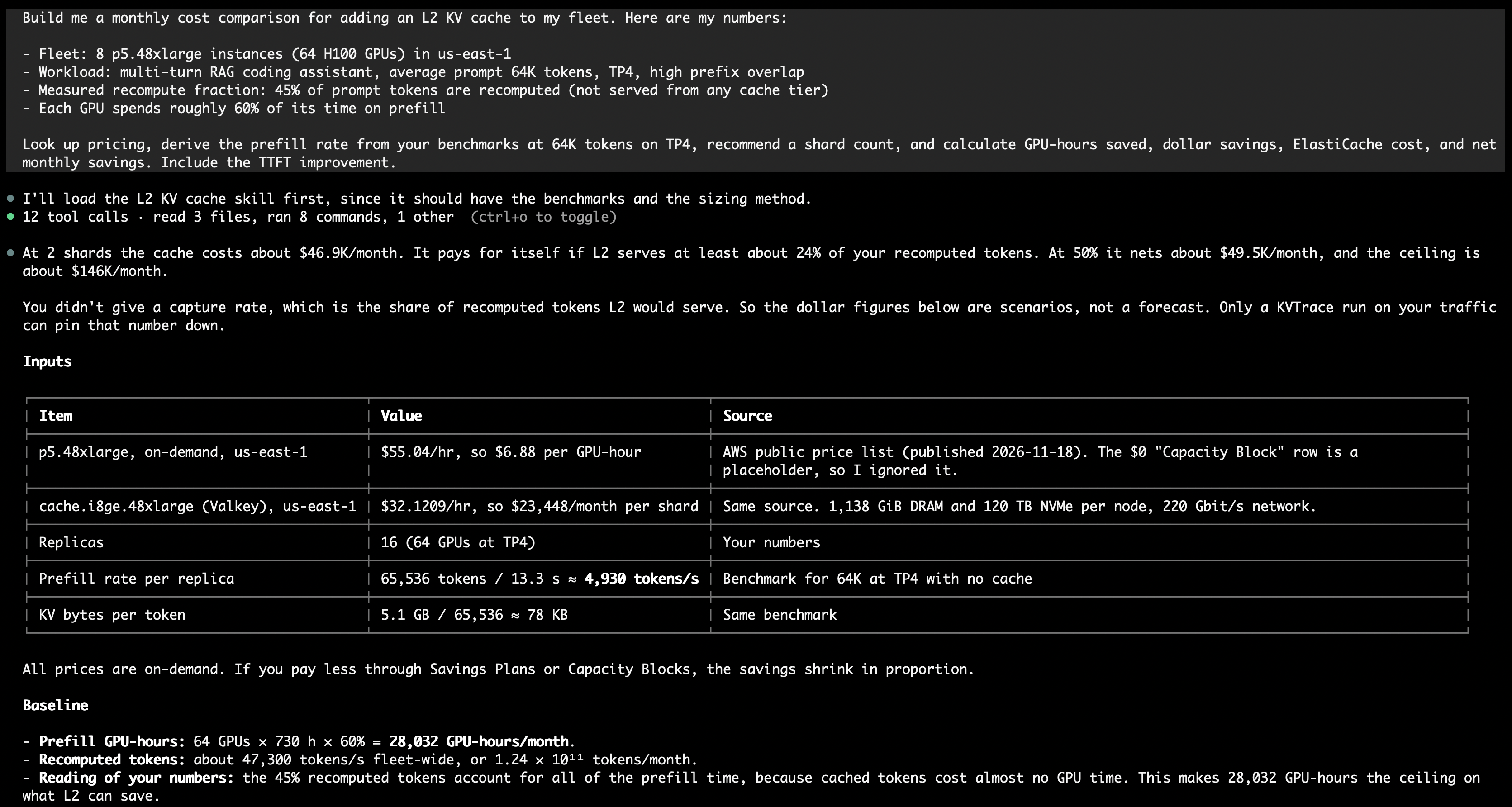
Economic Sizing and Savings Estimation: By cross-referencing live AWS pricing data for specific GPU instances—such as p5 instances—and ElastiCache node tiers, the toolkit calculates projected financial returns. For instance, in standard multi-turn Retrieval-Augmented Generation (RAG) deployments featuring extensive 64,000-token prompts, the system frequently recommends configurations utilizing high-capacity nodes such as cache.i8ge.48xlarge to maximize cost efficiency without over-provisioning infrastructure.
-
Automated Cluster Provisioning and Security Configuration: Once an administrator confirms the deployment parameters, the agent initiates the creation of the underlying AWS resources. This includes provisioning a Valkey 9.1 cluster featuring custom parameter groups optimized for caching eviction policies, establishing appropriate security groups with Elastic Fabric Adapter (EFA) permissions for high-throughput Remote Direct Memory Access (RDMA), and generating dedicated cache user credentials securely stored within AWS Secrets Manager.
-
Comprehensive Troubleshooting and Diagnostic Support: In complex distributed systems, misconfigurations can impede performance. The toolkit features advanced diagnostic capabilities capable of isolating nuanced infrastructure errors. For example, if telemetry data indicates that low-level networking handshakes (such as BLOB.RDMA_HELLO) succeed, but actual data transfers fail with climbing RDMA write errors, the AI agent can accurately diagnose the root cause—such as a missing self-referencing egress rule within the cluster’s security group—and provide precise command-line instructions to resolve the issue.
Implications for Enterprise AI Deployments
The introduction of distributed KV caching via Amazon ElastiCache represents a significant maturation point for enterprise generative AI infrastructure. As organizations transition from exploratory pilot projects to large-scale, production-grade deployments, optimizing operational expenditure (OpEx) and reducing inference latency are paramount.
By decoupling the KV cache from the volatile, expensive memory of individual GPU servers, AWS has effectively eliminated the computational redundancy that has plagued self-hosted LLM architectures since their inception. The ability to retain attention states across days, server reboots, and dynamic routing shifts ensures that interactive AI systems can respond with near-instantaneous speed, dramatically improving user experience while empowering IT leadership to maximize the efficiency and utilization of their underlying GPU investments.
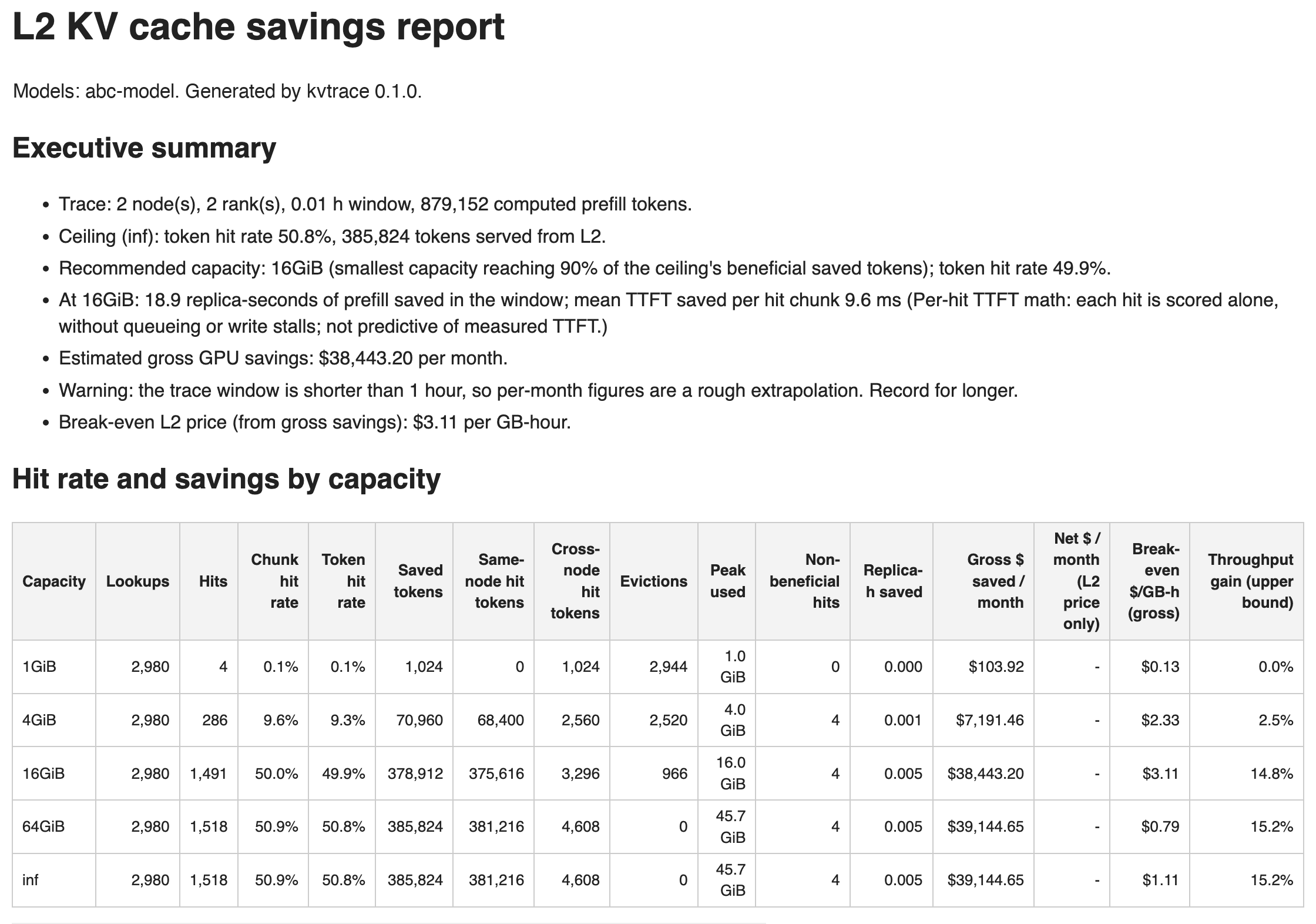
Engineering teams looking to explore the technology can access the distributed KV caching skill through the official Agent Toolkit for AWS GitHub repository, while comprehensive setup guides and command-line interfaces are available directly through the Amazon ElastiCache technical documentation.