New in AWS Quick: More capable flows, an updated web experience, and agents that work together | Amazon Web Services

Artificial intelligence assistants have long promised to supercharge individual productivity, yet organizations continually struggle to bridge the gap between solo efficiency and team-wide operational consistency. Individual breakthroughs—such as a customized spreadsheet script or an ad-hoc data analysis routine—frequently remain trapped in silos, forcing colleagues to reinvent workflows from scratch. To address this persistent enterprise bottleneck, Amazon Web Services (AWS) has announced a major update to AWS Quick, its purpose-built AI workspace designed exclusively for corporate operations. The latest release introduces conversational process automation, multi-agent orchestration, and a completely redesigned web application experience intended to democratize workflow creation and elevate team collaboration.
The release arrives at a critical juncture for enterprise technology. As businesses increasingly adopt generative artificial intelligence, leaders report that while individual employees save hours each week, scaling those benefits across departments requires cumbersome technical interventions. Traditionally, standardizing a multi-step business process meant engaging IT or dedicated data engineering teams to write code, design database schemas, and manage deployment pipelines. AWS Quick aims to dismantle this barrier by allowing non-technical professionals to build, test, and distribute complex automation flows entirely through natural language chat interfaces.
Democratizing Workflow Automation Through Conversational Chat
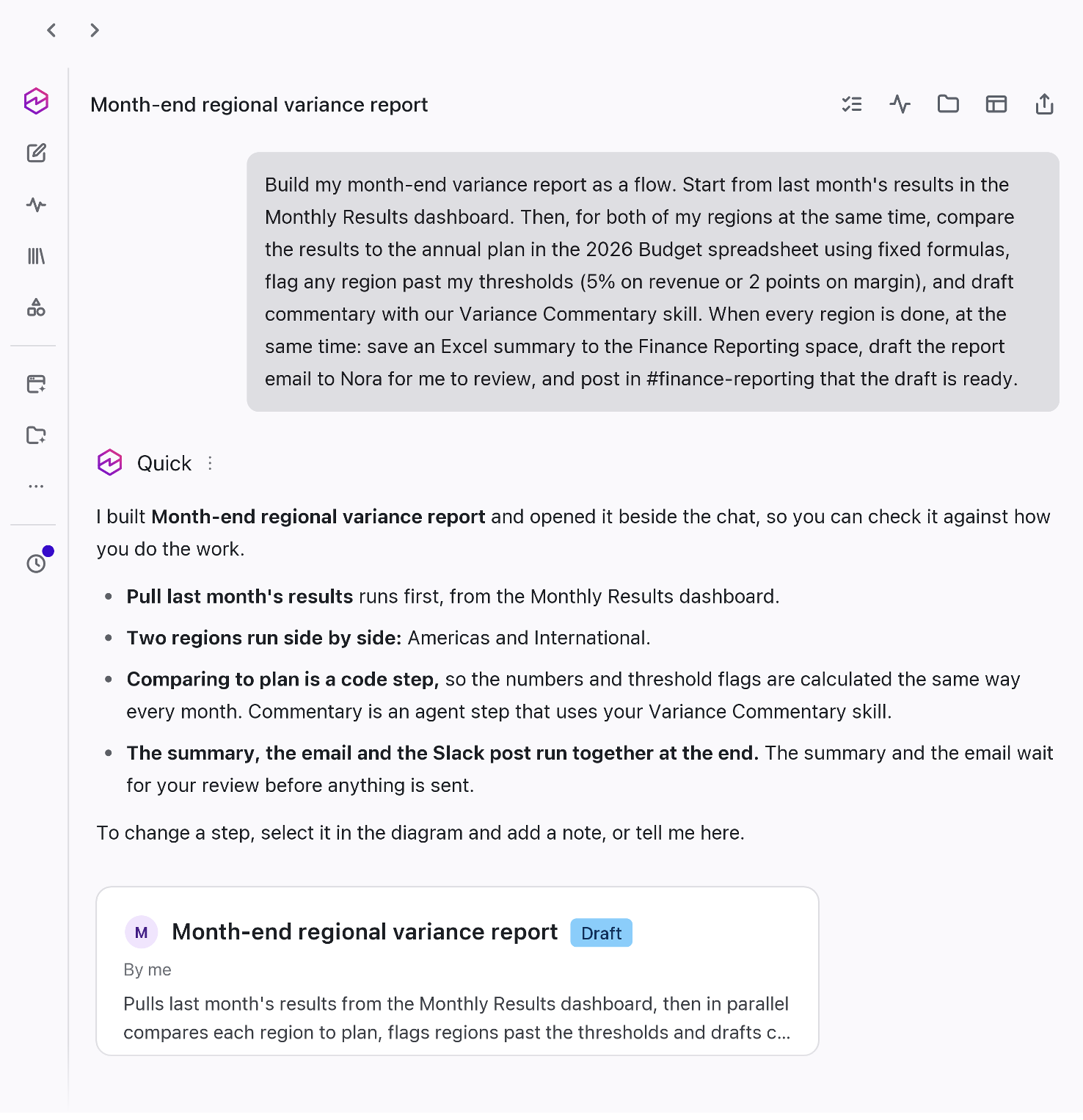
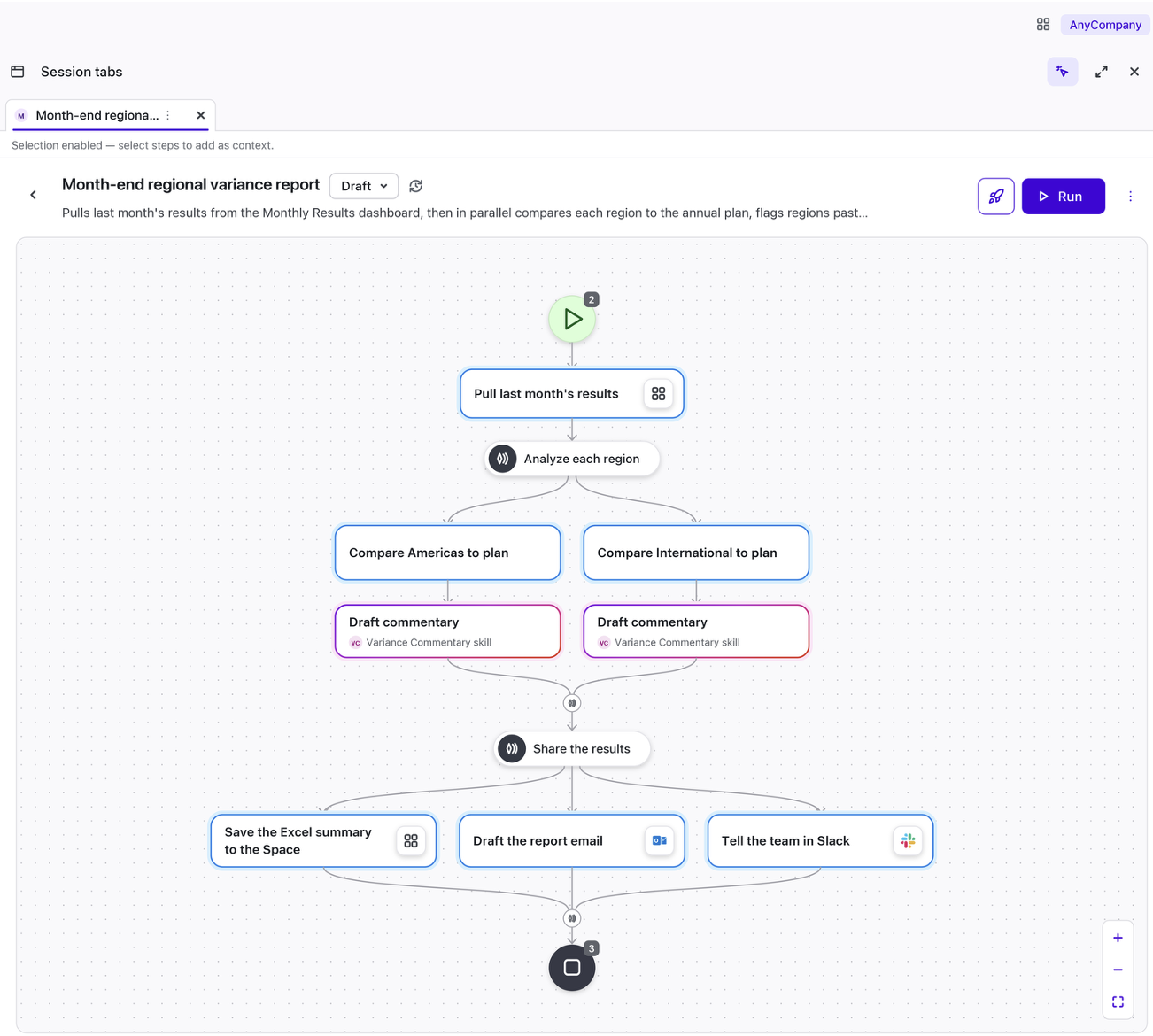
At the core of the new release is an advanced enhancement to AWS Quick Flows, the platform’s engine for business process standardization. Users can now build, run, and refine automated routines conversationally, interacting with the AI workspace in the same manner they would brief a human colleague. The system generates a visual, step-by-step flowchart alongside the chat window, offering immediate transparency and allowing creators to verify that the automated logic mirrors their actual operational procedures.
To illustrate the practical implications of this capability, AWS highlighted the workflow of Maya, a fictional financial planning and analysis manager at a major retail enterprise. Each month, Maya is tasked with preparing a comprehensive cost-and-margin variance report for the vice president of finance. Her routine involves pulling prior-month metrics across multiple operating regions, cross-referencing those figures against established corporate plans within complex spreadsheets, and drafting qualitative commentary explaining significant financial deviations. Historically, this intricate workflow existed only in Maya’s personal notes and memory. When she took time off, teammates were forced to rebuild the report from the ground up, resulting in inconsistent formatting and variable analytical depths.
Under the updated AWS Quick ecosystem, Maya can simply describe her reporting methodology in a chat interface. Quick automatically translates her instructions into a structured flow, combining specialized data connectors, analytical skills, and fixed calculation checks. Once she reviews and approves the visual flowchart, she can publish the asset for her entire team. Consequently, when junior analysts or incoming personnel handle month-end reporting, they execute the exact same standardized workflow with a single prompt, ensuring absolute consistency across reporting cycles.
Enterprise Validation and Efficiency Gains
The shift toward democratized automation is already yielding measurable results for early enterprise adopters. Pomelo, a prominent Latin American fintech provider specializing in card issuance, processing, and payment operations, has integrated AWS Quick into its core operational strategy to manage growing data demands without expanding headcount.
According to Rodrigo Marini, Head of Data at Pomelo Fintech Services S.A.S., the platform has fundamentally reshaped the company’s internal culture. Before implementing Quick, every analytical request or business automation depended heavily on the availability of the central data team. Today, employees across diverse operational departments independently explore information, make data-driven decisions, and construct their own custom agents and workflows within a securely governed environment.
Marini noted that nearly four times as many employees now interact with enterprise data each month compared to previous periods. This decentralization has successfully freed the core data engineering unit to concentrate on high-complexity, high-impact architectural challenges. Crucially, Pomelo has documented a reduction of 80 working hours per month on a single localized use case. Beyond quantitative time savings, leadership emphasizes that the true transformation lies in cultivating an organizational mindset where every employee possesses the capability to experiment, innovate, and optimize their daily operational habits.
Redesigned Web Application Interface
Complementing the workflow automation updates, AWS has overhauled the Quick web application to streamline daily navigation and prioritize time-sensitive tasks. Upon signing in to the browser-based platform, users are greeted by a centralized home screen feed that aggregates incoming emails, urgent messages, and pending items requiring immediate attention into a single, unified view.
Furthermore, the left-hand navigation menu has been reorganized under a consolidated "Customize" header. This section brings together agents, automated flows, specific analytical skills, organizational knowledge bases, and external data connectors into an intuitive hub. Users can seamlessly access agents and skills originally constructed on desktop clients alongside assets shared by colleagues across the enterprise. Crucially, the update preserves legacy dashboards, analytical topics, and collaborative spaces without requiring administrative reconfigurations or downtime.
Multi-Agent Orchestration for Complex Queries
As enterprise use cases grow increasingly sophisticated, individual AI agents often lack the multidisciplinary context required to resolve complex business inquiries. To overcome this limitation, AWS Quick now supports advanced multi-agent orchestration. When a user presents a multifaceted query, the primary conversational agent intelligently delegates sub-tasks to multiple specialized agents simultaneously, drawing upon each entity’s distinct domain expertise, instructions, and contextual knowledge.
For example, an executive investigating unexpected spikes in regional shipping expenditures can pose a single question to their primary Quick assistant. The system dynamically engages a forecasting agent built on historical supply chain planning data alongside a procurement agent linked directly to vendor contracts and pricing schedules. The platform then synthesizes these disparate analytical streams into a cohesive, unified response, explicitly detailing the contributions of each specialized agent while maintaining human oversight over final decision-making.
Expanded Ecosystem Connectors via MCP Servers
Enterprise data rarely resides in a single repository; it is typically distributed across dozens of specialized SaaS platforms and analytics tools. To bridge these infrastructural divides, the latest AWS Quick release incorporates robust new connectors leveraging Model Context Protocol (MCP) servers, enabling natural language interactions across external business applications.
Among the key integrations is a new connector for Meta advertising platforms. By connecting Quick to Meta’s ads MCP server, marketing professionals can create, manage, and analyze advertising campaigns using conversational commands. The platform intelligently cross-references Meta performance metrics with internal first-party and external third-party data sources. To maintain stringent operational safety, Quick enforces a mandatory human-in-the-loop validation protocol, prompting explicit user authorization before executing any write actions, budget adjustments, or campaign modifications within an ad account.
Additionally, a new integration with Amplitude empowers product development and marketing teams to query user behavior, customer engagement metrics, and conversion rates using natural language. These behavioral insights can be effortlessly embedded into dynamic dashboards, executive documents, and automated workflows constructed directly within the Quick ecosystem.
Security, Governance, and Enterprise Autonomy
Throughout the expansion of AWS Quick’s capabilities, Amazon Web Services has maintained a rigorous emphasis on data security, privacy, and granular governance. All newly introduced connectors and multi-agent workflows strictly respect existing enterprise permission structures. Quick automatically restricts data visibility, ensuring that individual users only access information and systems for which they already hold authorized credentials. Furthermore, administrative teams retain absolute control over which external connectors can be integrated into their organizational environment.
A cornerstone of AWS’s enterprise pitch remains its strict data privacy commitment: proprietary customer data processed within Quick is strictly isolated within the client’s secure environment and is never utilized to train foundational machine learning models for external entities. By pairing automated operational efficiency with strict governance frameworks, AWS continues to position Quick as a scalable solution designed to amplify human judgment rather than replace it. The newly released features are available immediately across all AWS regions where Quick is currently supported.