Scaling Mixture-of-Experts Reinforcement Learning Workloads on AWS with Amazon EKS, EFA, and DeepEP

The commercial adoption of trillion-parameter artificial intelligence models has introduced unprecedented infrastructure challenges, particularly in the post-training phase of Large Language Models (LLMs). As organizations increasingly turn to advanced alignment techniques such as Reinforcement Learning from Human Feedback (RLHF) and Group Relative Policy Optimization (GRPO), the underlying hardware and orchestration frameworks are subjected to extreme stress. Recently, Amazon Web Services (AWS) detailed a high-performance reference architecture designed to tackle these bottlenecks by tightly integrating Amazon Elastic Kubernetes Service (Amazon EKS), Elastic Fabric Adapter (EFA), and DeepEP. This development marks a significant milestone in enabling enterprises to train and scale sparse Mixture-of-Experts (MoE) models efficiently without sacrificing compute capacity or incurring prohibitive operational overhead.
Background Context of the AI Infrastructure Shift
Mixture-of-Experts architectures have rapidly emerged as the industry standard for scaling model parameters into the hundreds of billions or trillions while maintaining manageable inference latency through sparsity. However, while sparsity dramatically cuts down active parameters during inference, it does not alleviate the infrastructure complexity associated with full model lifecycles. A typical training pipeline encompasses pre-training, mid-training, supervised fine-tuning (SFT), and rigorous reinforcement learning phases.
Among these, large-scale reinforcement learning presents a uniquely demanding set of requirements. Unlike standard pre-training, which relies on steady, highly structured data pipelines, RL workloads require a continuous loop of distributed inference—often referred to as rollout generation—coupled with synchronized policy updates. In an MoE setup, this complexity multiplies due to Expert Parallelism (EP). Unlike dense models that rely primarily on Tensor Parallelism (TP), Data Parallelism (DP), and Pipeline Parallelism (PP), MoE models require dynamic, fine-grained all-to-all token routing across network devices. As models scale across multiple instances, these routing operations transition from high-bandwidth intra-node NVLink fabrics to slower inter-node connections, creating critical communication bottlenecks.
Chronology and Evolution of Distributed RL Solutions
The evolution of large-scale reinforcement learning frameworks has historically been hindered by the friction between asynchronous inference workers and synchronous training steps. Early iterations of Proximal Policy Optimization (PPO) introduced heavy reliance on separate critic models to estimate values during policy optimization, exacerbating memory and networking pressures. More recent algorithms, such as Group Relative Policy Optimization (GRPO), eliminate the need for a separate critic model by leveraging group-based relative rewards, yet they demand identical high-performance underlying networks to handle massive rollout generation and inter-node communication.
Recognizing these hardware constraints, cloud architects and researchers have progressively refined the software stack. The integration timeline shifted significantly with the adaptation of DeepEP, a topology-aware communication library originally designed to optimize expert-parallel communication. By contributing features to migrate DeepEP communication primitives to libfabric, AWS and its open-source collaborators enabled native EFA support. This evolution allows modern GPU instances, such as AWS P5 and P6 configurations, to bypass traditional operating system overhead using NVIDIA GPUDirect RDMA, directly addressing the latency spikes that previously stalled multi-node training clusters.
Comprehensive Architectural Overview on AWS
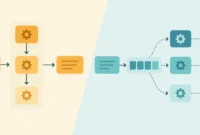
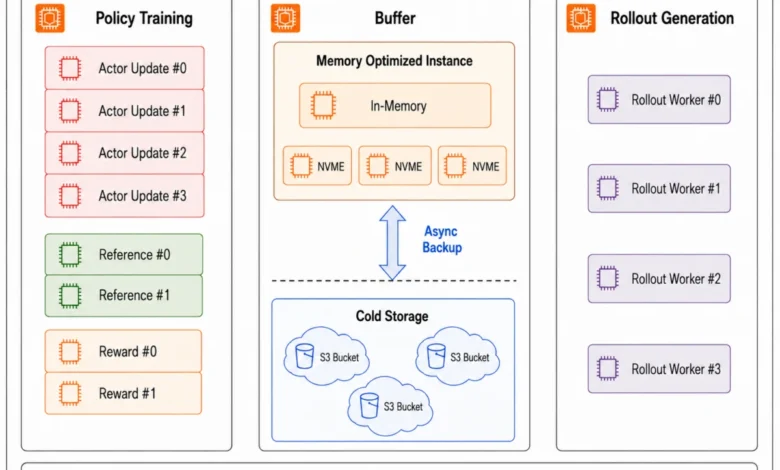
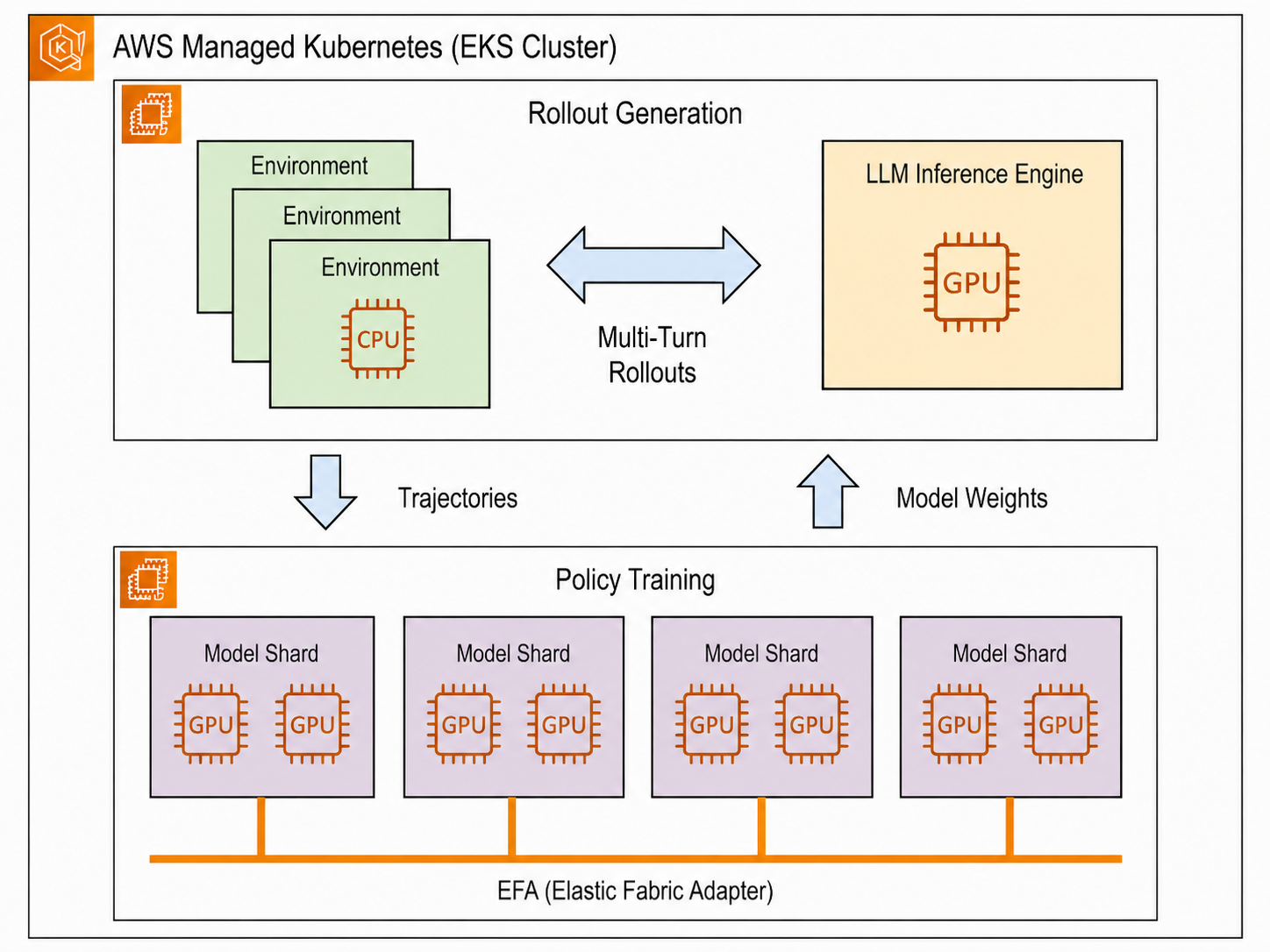
To maintain equilibrium between high-throughput rollout generation and tightly coupled policy training, the newly detailed AWS architecture segregates responsibilities across specialized node groups within an Amazon EKS cluster. The foundational design relies on three core pillars: orchestration via EKS, high-performance networking via EFA, and durable storage via Amazon Simple Storage Service (Amazon S3).
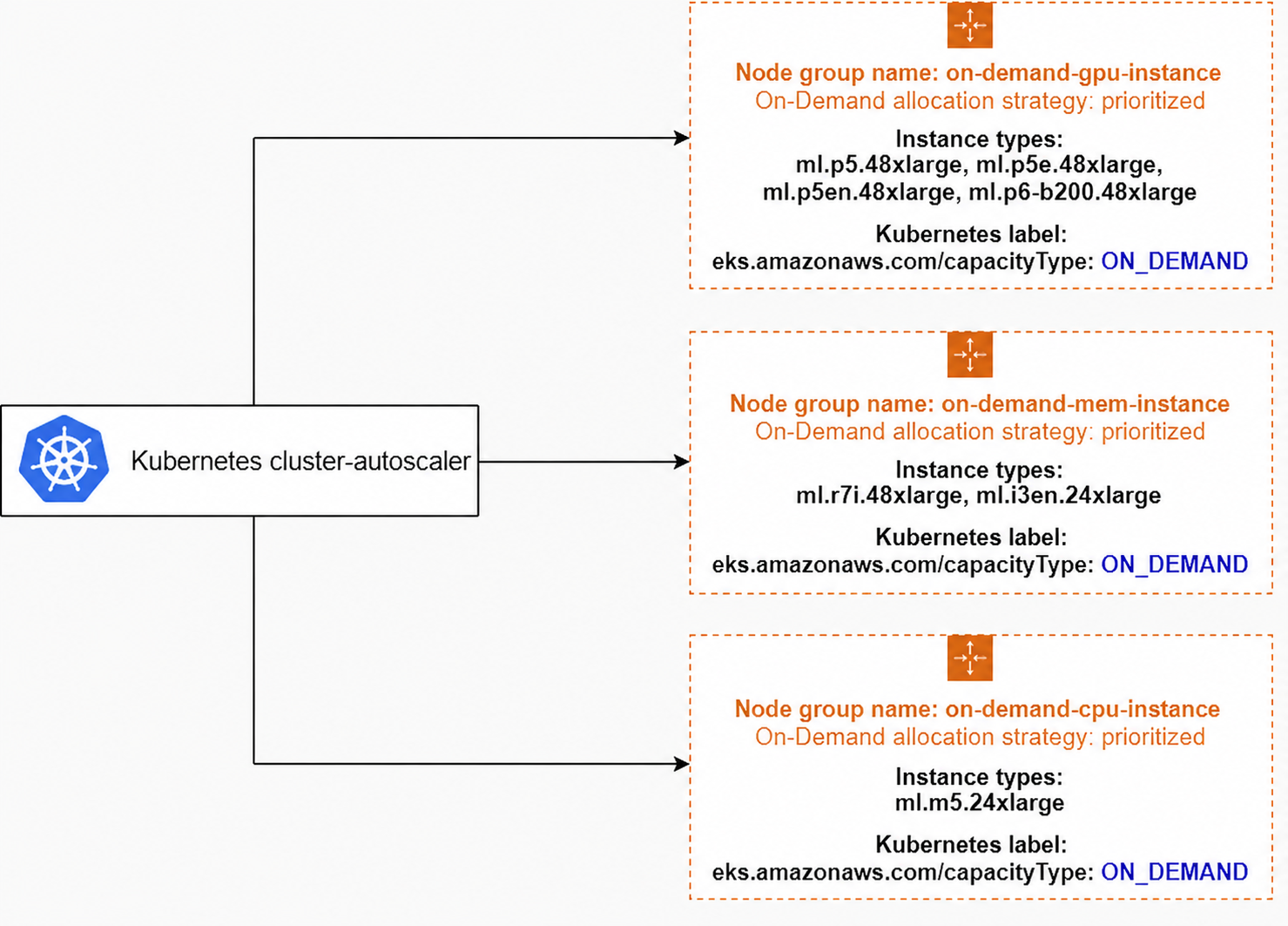
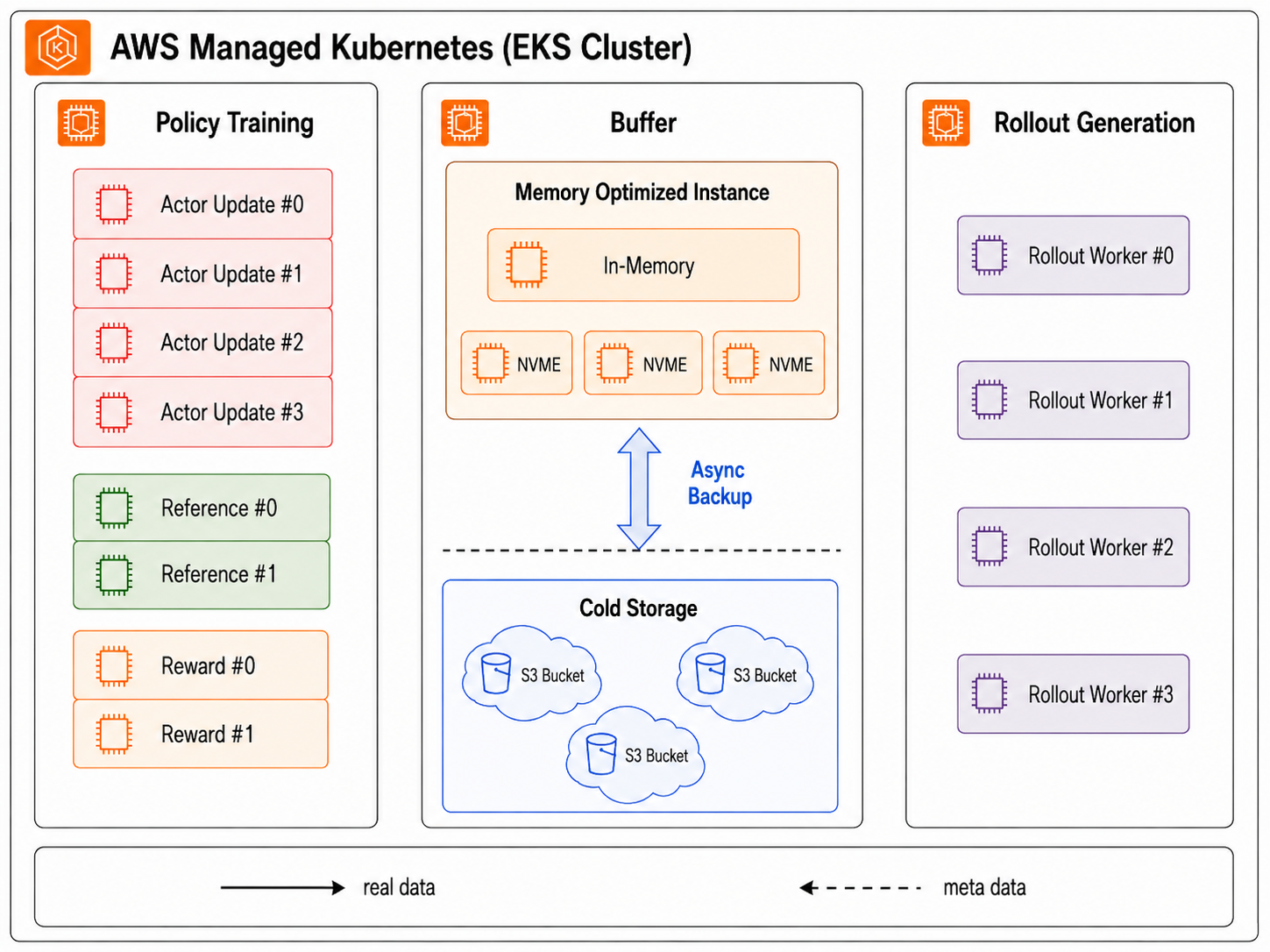
The EKS cluster topology is partitioned into distinct node groups tailored to specific workloads. GPU-accelerated instances handle heavy computations such as policy training and reward-model inference. Meanwhile, CPU-based node groups manage environment execution and data preprocessing tasks. To prevent bottlenecks on the critical path, memory-optimized instances host intermediate experience buffers and checkpoint caches, allowing asynchronous producers and consumers to exchange data seamlessly.
Data flow within this architecture follows a continuous loop. Rollout workers interact with CPU-based environment pods to generate experience samples, which are subsequently stored in memory buffers. Policy-training workers consume these batches, update model weights, and dispatch fresh checkpoints back into the rollout generation cycle. Simultaneously, durable artifacts, including final model weights and intermediate states, are persistently stored in Amazon S3 for system recovery and downstream evaluation.
Performance Optimizations and Quantitative Impact
The primary innovation in this infrastructure blueprint is the deployment of DeepEP over EFA, which fundamentally transforms how sparse token routing is handled across distributed nodes. Standard collective communication libraries are engineered for regular, dense traffic patterns. In contrast, MoE architectures generate dynamic, unpredictable, and highly imbalanced message loads as tokens are routed to specialized experts distributed across different machines.
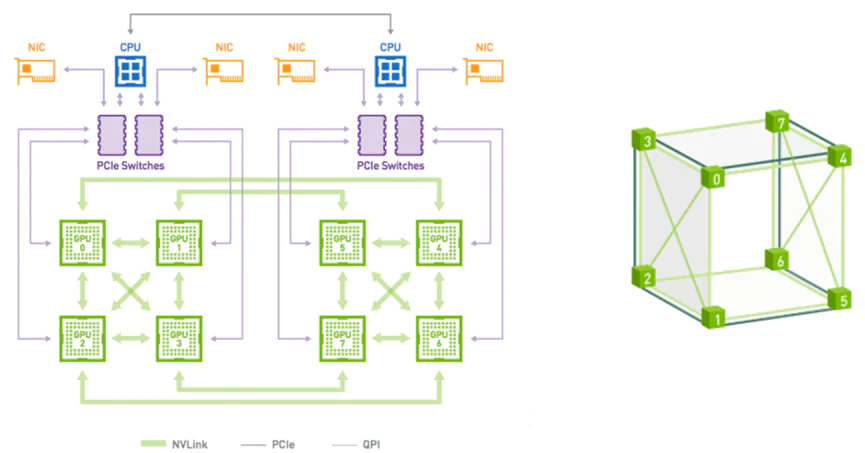
DeepEP mitigates this by replacing generic all-to-all collectives with specialized dispatch and combine kernels. Intra-node transfers are offloaded to high-speed NVLink fabrics via NVSwitch, while inter-node transfers utilize libfabric over EFA. By bypassing the CPU and leveraging RDMA, the system drastically reduces per-message communication latency.
Empirical benchmarks shared by AWS illustrate the dramatic impact of these optimizations. In controlled tests across 48 P5en instances—split evenly with 16 instances dedicated to training and 32 to inference—running a super-sparse MoE model, the implementation of DeepEP over EFA yielded a 40 percent increase in aggregate RL rollout throughput. This marked performance leap was achieved by comparing a legacy Slime-based stack against the optimized DeepEP-over-EFA stack, successfully eliminating NCCL timeouts and hardware idle times that previously plagued scaling efforts.
Cost Efficiency via Amazon EC2 Spot Instances
Beyond raw performance enhancements, the architecture addresses the economic realities of large-scale AI training by strategically incorporating Amazon EC2 Spot Instances for rollout generation. Because rollout tasks consist of distributed inference workloads that can be easily partitioned across independent workers, they are inherently fault-tolerant.
Unlike policy training nodes, which must progress in strict synchronization, the unexpected termination of a Spot-backed rollout worker does not invalidate the entire job. Unfinished tasks are automatically returned to the processing queue and reassigned to active workers, while the core policy-training cluster remains entirely insulated from interruption notices. This separation optimizes cloud expenditure without introducing vulnerability to training stability.
Broader Industry Implications and Analysis
The publication of this reference architecture reflects a maturing engineering consensus regarding the future of generative AI infrastructure. As foundational models transition from dense architectures to highly sparse Mixture-of-Experts designs, the limiting factor in training speeds is shifting decisively away from raw floating-point operations (FLOPs) toward network interconnect bandwidth and software-hardware co-design.
By demonstrating that Kubernetes-orchestrated environments can reliably scale complex reinforcement learning loops across roughly a thousand accelerators, AWS has provided a blueprint that lowers the barrier to entry for training frontier models. Analysts note that as alignment techniques like GRPO become more prevalent, enterprises will increasingly demand cloud-native frameworks that decouple elastic inference from rigid training clusters. The combination of Amazon EKS, EFA, and DeepEP establishes a robust standard for balancing agility, performance, and cost-effectiveness in the hyper-competitive artificial intelligence landscape.