The rapid ascent of Large Language Models (LLMs) and Retrieval-Augmented Generation (RAG) has forced a fundamental shift in how enterprise data architecture is designed. At the heart of this transition is the vector database—a specialized repository for high-dimensional embeddings that enable semantic search. For many organizations, the decision has devolved into a binary choice: should they leverage the familiar, reliable Postgres ecosystem via the pgvector extension, or migrate to a "purpose-built" dedicated vector database? For years, this debate has been dominated by vendor marketing and unsubstantiated claims of superior performance. However, recent empirical benchmarks have finally provided the data necessary to move past the hype and into objective architectural decision-making.
The Rise of the Vector Search Paradigm
To understand the current architectural landscape, one must look at the timeline of vector database development. Before 2020, vector search was primarily the domain of specialized research labs and massive-scale tech companies like Meta, which developed FAISS (Facebook AI Similarity Search). As LLMs became accessible to the public, the need to store and query embeddings—mathematical representations of unstructured data—became a standard requirement for developers.
Initially, developers opted for the path of least resistance. The release of pgvector, an open-source extension for PostgreSQL, allowed teams to treat vector data as a first-class citizen alongside traditional relational data. By mid-2023, pgvector had reached a level of maturity where it could handle HNSW (Hierarchical Navigable Small World) indexing, allowing for approximate nearest neighbor searches that were sufficiently fast for a wide range of production applications.
However, as workloads shifted from prototypes to billion-parameter enterprise systems, dedicated vector databases—such as Pinecone, Qdrant, Weaviate, Milvus, and ChromaDB—began to gain market share. These platforms marketed themselves as "AI-native," promising better scalability, lower latency, and features like hybrid search and automated vectorization that were not natively available in traditional relational databases.
Defining the Architectural Divide
The technical distinction between these two approaches is rooted in their storage engines. pgvector operates as an extension within the Postgres process. This configuration offers significant benefits, most notably atomicity. Because relational data and vector embeddings reside in the same table, developers can execute SQL queries that filter by metadata (such as time, user ID, or category) and perform a vector similarity search in a single transaction. This eliminates the need for "dual-writing" to two separate databases, which is a common source of data inconsistency in distributed architectures.
Conversely, dedicated vector databases are designed from the ground up as specialized systems. They often employ custom storage engines optimized for high-throughput, low-latency similarity searches. For example, systems like Qdrant are built on Rust to ensure memory safety and high performance, while Milvus is designed with a distributed architecture that supports GPU acceleration for massive datasets. The trade-off is operational complexity: the engineering team must manage, monitor, and synchronize a secondary system, often creating a network hop between the source of truth (Postgres) and the vector index (the dedicated database).
Empirical Performance Metrics
The debate over which system is superior often centers on performance metrics like latency, throughput, and index build times. A recent, methodologically transparent benchmark conducted by Tiger Data provides a rare glimpse into how these systems perform at scale. Using 50 million Cohere embeddings (768 dimensions) on AWS r6id.4xlarge instances, the study compared Postgres—utilizing the pgvector and pgvectorscale extensions—against Qdrant.
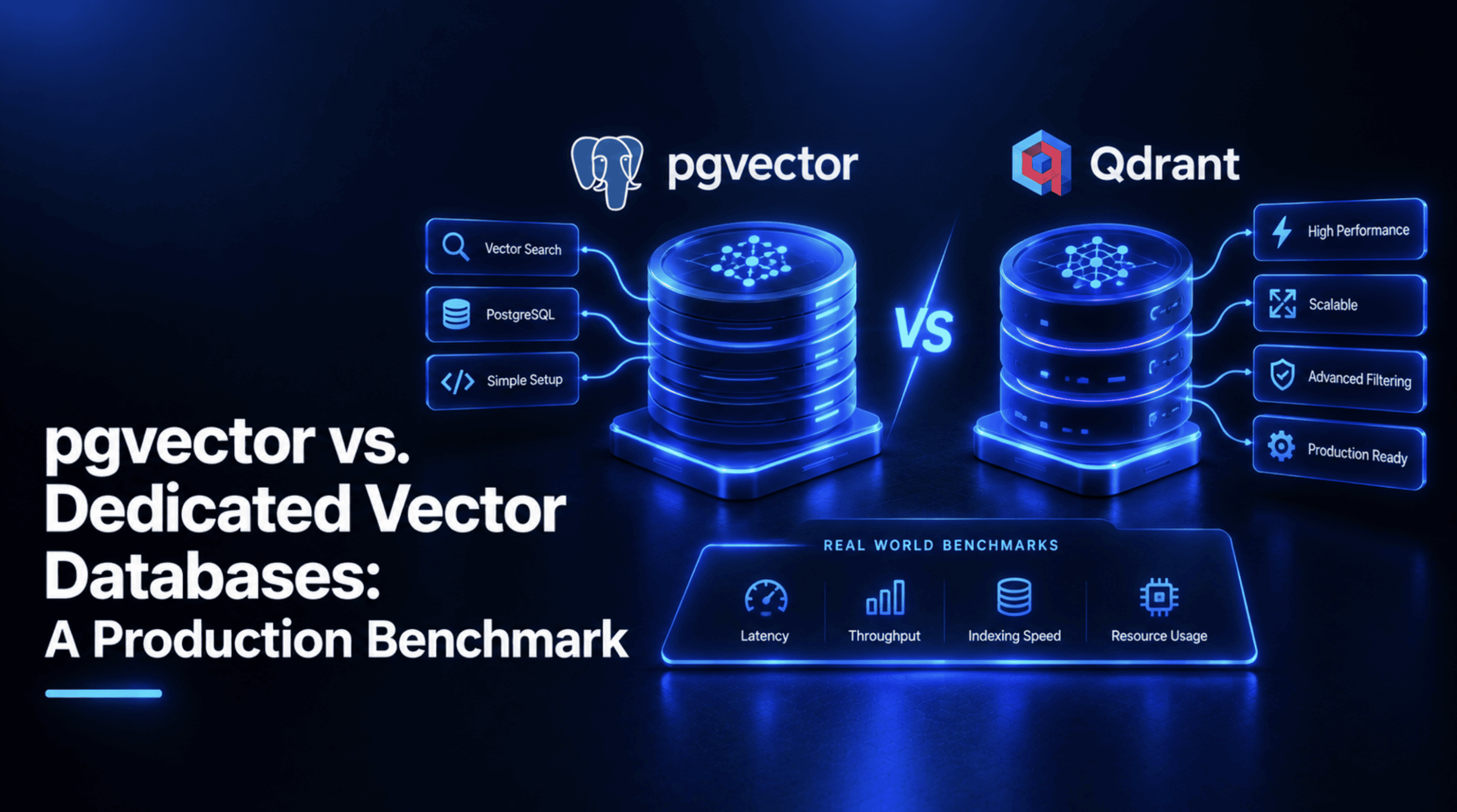
The results suggest that performance is highly dependent on the specific metric a business prioritizes:
- Throughput (QPS): At 99% recall, Postgres (with pgvectorscale) significantly outperformed the dedicated database, handling approximately 471 queries per second (QPS) compared to Qdrant’s 41.47 QPS. This suggests that for high-volume, read-heavy workloads where massive parallelism is required, a well-tuned Postgres instance is highly capable.
- Tail Latency: Qdrant demonstrated superior performance in tail latency. Its p99 latency was 38.71ms, compared to 74.60ms for Postgres. For applications where consistent, sub-40ms response times are a hard requirement—such as real-time chat interfaces or user-facing recommendation engines—the dedicated database’s consistency is a distinct advantage.
- Indexing Speed: Dedicated databases frequently offer faster indexing. In this benchmark, Qdrant built its index in 3.3 hours, while the Postgres configuration required 11.1 hours. This is a critical factor for teams dealing with frequent data ingestion or "hot" updates to their knowledge base.
Strategic Implications for Enterprise Adoption
The implications of these findings are profound for Chief Technology Officers and lead architects. The prevailing "vendor pitch" that Postgres cannot scale to the needs of modern AI is statistically inaccurate. Conversely, the notion that pgvector is a "one-size-fits-all" solution is equally flawed.
For the vast majority of organizations, the primary bottleneck is not the database engine, but the operational burden of the infrastructure. A startup or mid-sized enterprise with a lean DevOps team may find that the "operational tax" of maintaining a dedicated vector database outweighs the marginal latency improvements. In these cases, the simplicity of keeping relational and vector data in one place—leveraging existing backup, security, and monitoring protocols for Postgres—is the most efficient path forward.
However, for enterprises operating at the billion-vector scale, the limitations of a general-purpose database become more apparent. When an organization reaches a scale where they require distributed partitioning, specialized hardware acceleration (like GPUs), or highly complex filtering logic that might degrade the query planner in a monolithic database, the dedicated vector database becomes an architectural necessity rather than a luxury.
The Verdict: Context Over Hype
The "winner" of the vector database race is not determined by a specific brand or technology, but by the specific constraints of the workload. If the priority is data consistency, operational simplicity, and standard query patterns for datasets under 10 million vectors, pgvector is an exceptionally robust choice. It allows developers to maintain a "single source of truth" and reduces the surface area for bugs and synchronization errors.
If, however, the workload involves massive-scale, high-concurrency, or extreme-latency requirements where tail-end performance is the primary metric for user experience, a purpose-built vector database is likely the correct investment. The industry is currently moving toward a more nuanced understanding: vector search is no longer a "specialized" field, but a standard feature of the data stack. Whether that feature lives inside the database you already own or a new one you decide to procure depends entirely on your team’s appetite for operational complexity versus their requirement for specialized performance optimization.
In conclusion, the data suggests that the "wall" many vendors warn about is not a hard physical limit of Postgres, but a transition point in operational scale. Organizations should focus less on the marketing rhetoric surrounding "AI-native" branding and more on the tangible performance metrics—throughput, latency, and operational cost—that directly impact their specific business objectives. The era of blind migration is over; the era of data-driven architectural selection has begun.