The Rising Influence of Rust in the Python Ecosystem: A Paradigm Shift in Developer Tooling

The intersection of Python and Rust represents one of the most significant architectural shifts in modern software engineering. For decades, Python has maintained its status as a dominant, high-level programming language praised for its expressive syntax, ease of use, and extensive application range spanning web development, data science, and automation. However, Python’s interpreted nature and memory management overhead have historically introduced performance bottlenecks, requiring developers to rely on lower-level extensions written in C or C++ to handle computationally intensive tasks. In recent years, Rust—a systems programming language celebrated for its memory safety, zero-cost abstractions, and blazing-fast execution speeds—has emerged as the preferred modern alternative to C and C++. This convergence is reshaping the Python ecosystem, fundamentally altering how core libraries, development tools, and application servers are built, maintained, and deployed.
The Three Pillars of Rust Integration
To understand how Rust integrates with Python, industry observers and software architects generally categorize its implementation into three distinct modalities. This taxonomy clarifies that Rust is not merely replacing Python, but rather augmenting it across different layers of the technology stack.
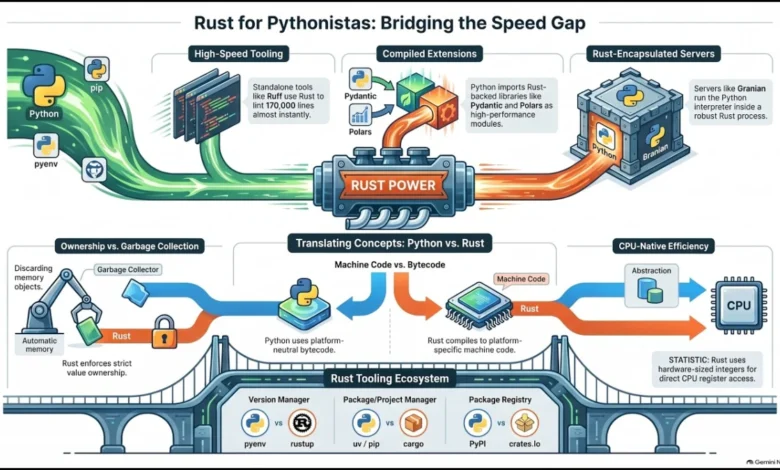
The first category involves standalone developer tools that happen to be written in Rust. Utilities such as Ruff, the ultra-fast Python linter and code formatter, demonstrate this paradigm. Ruff is capable of analyzing the entire CPython codebase from scratch in approximately 0.3 seconds—an execution speed that renders traditional Python-based linters obsolete. While these tools assist Python developers, they operate independently of the Python runtime. They could theoretically be written in any compiled language, but Rust’s performance characteristics and safety guarantees have made it the lingua franca for modern tooling creators, including the team at Astral behind projects like uv and Ruff.
The second category encompasses high-performance libraries that Python imports and executes natively. Libraries such as Pydantic for data validation and Polars for lightning-fast data manipulation are written entirely in Rust under the hood, yet they expose a seamless, idiomatic Python API. Through foreign function interfaces and bridging tools like PyO3, these libraries allow developers to write standard Python code while offloading heavy computations to compiled Rust binaries. This grants applications near-C-level performance without sacrificing Python’s rapid development velocity.
The third and most complex category involves servers and runtime environments that execute Python code inside of a Rust core. Web application servers like Granian utilize Rust to handle network input/output, connection pooling, and concurrency management, embedding the Python interpreter directly within a robust Rust architecture. This inverts the traditional relationship, placing a hyper-optimized Rust shell around the dynamic Python application logic to achieve maximum throughput and reliability.
Architectural Divergence: Memory Management and the Borrow Checker
Adopting Rust within or alongside a Python workflow requires a fundamental shift in cognitive approach, particularly regarding memory management and type systems. Python abstracts memory allocation and deallocation entirely through its built-in garbage collector. Developers can pass objects, variables, and data structures freely throughout an application without manually tracking who owns a particular block of memory.
Rust approaches memory safety from a completely different philosophical standpoint through its compile-time strictness, famously enforced by the "Borrow Checker." The core rule of Rust’s ownership model is straightforward yet demanding: only one variable or scope can own a value at any given time. When that owner goes out of life or scope, the value is automatically deallocated without the runtime overhead of a garbage collector.
While this model eliminates an entire class of catastrophic memory vulnerabilities—such as null pointer dereferencing, buffer overflows, and use-after-free bugs—it imposes a steep initial learning curve. In Python, mutating a shared reference across multiple functions requires minimal thought. In Rust, attempting to share and mutate data freely without adhering to strict borrowing and ownership rules results in immediate compilation failure. Critics note that developers often spend more time satisfying the compiler than writing application logic, though proponents argue this upfront friction leads to more resilient codebases that rarely fail in production due to memory corruption.
Furthermore, Rust requires developers to explicitly define data types and memory sizing down to the hardware level. Integers in Python are boundless and dynamically resize to accommodate arbitrarily large numbers, supported by complex underlying abstraction layers. Rust, conversely, operates much closer to the physical CPU, requiring explicit declarations of bit sizes, signedness, and memory allocation strategies (stack versus heap). This closeness to the hardware is precisely what enables Rust code to run with minimal overhead, fitting neatly into CPU registers and cache hierarchies, but it shifts the cognitive burden back onto the programmer.
The Evolution of Package Management and Tooling Infrastructure
The influence of Rust on Python extends beyond performance metrics into developer ergonomics and project infrastructure. The creation of tools like uv and cargo—Rust’s native package manager—has inspired a renaissance in how Python manages dependencies, virtual environments, and project builds.
Historically, Python’s package management ecosystem has been fragmented, marked by historical reliance on pip, setuptools, and various virtual environment managers that could occasionally introduce friction. The Rust community approached package management with a unified philosophy from the project’s inception. Cargo integrates dependency resolution, building, testing, and publishing into a single, cohesive command-line interface defined by a straightforward TOML configuration file.
This unified experience heavily influenced recent Python tooling developments. Modern Python package managers and build systems have adopted similar design principles, emphasizing speed, deterministic dependency resolution, and out-of-the-box project scaffolding. The cross-pollination of ideas between the Rust and Python communities has accelerated the modernization of Python’s auxiliary tooling, making the developer experience smoother and more predictable.
Interoperability Through PyO3 and Maturin
Bridging the gap between Rust and Python has been heavily streamlined by community-driven projects such as PyO3 and Maturin. PyO3 provides Rust bindings for the Python interpreter, allowing developers to write native Rust code that exposes classes, functions, and modules directly to Python scripts. By utilizing procedural macros provided by PyO3, developers can annotate Rust functions with simple attributes, automatically generating the necessary boilerplate to translate data types between Python and Rust.
Maturin complements PyO3 by acting as a build and publishing tool for hybrid Python-Rust projects. It simplifies the compilation of Rust code into shared libraries and packages them into standard Python wheels across multiple operating systems and architectures. This enables developers to distribute high-performance extensions via PyPI with minimal configuration complexity. End-users install and import these libraries as standard Python packages, often remaining completely unaware that the underlying performance-critical routines are executed by compiled Rust binaries.
Industry Implications and Future Outlook
The integration of Rust into the Python ecosystem signifies a pragmatic maturation of the software development industry. Rather than engaging in language tribalism—where projects must be written entirely in a single language—modern engineering increasingly relies on polyglot architectures that leverage the unique strengths of different toolchains.
Python retains its unrivaled position as a premier language for developer productivity, scripting, rapid prototyping, data analysis orchestration, and artificial intelligence workflows. By selectively delegating performance-critical components, data serialization routines, and concurrency layers to Rust-backed libraries, development teams can achieve exceptional execution speeds and ironclad memory safety without abandoning the flexibility of Python.
As educational resources, community support, and bridging frameworks continue to mature, Rust for Python developers is transitioning from a niche optimization technique to an established industry standard. This symbiotic relationship ensures that Python remains competitive and performant in an era demanding unprecedented computational scale, cementing Rust’s place as a foundational pillar beneath the Python landscape.