Marimo Pair Integrates AI Agents with Reactive Python Notebooks to Transform Stateful Data Science Workflows

The landscape of software engineering has been fundamentally altered by the emergence of autonomous coding agents, yet a significant technological barrier has persisted between these agents and the specific requirements of data science. While tools such as Claude Code, GitHub Copilot, and various agentic frameworks have become proficient at disk-based tasks—scoping features, editing source files, and running test suites—they have historically struggled to interact with the "live state" of data work. In a traditional data science workflow, the developer loads data into memory, executes individual cells, observes real-time responses, and determines subsequent actions based on variables currently held in the system’s RAM. Until recently, AI agents were effectively blind to this in-memory state, seeing only the static files on the disk rather than the dynamic environment of a running kernel.
The release of Marimo Pair, a specialized agent skill developed by the team behind the Marimo reactive notebook, represents a pivotal shift in this paradigm. By dropping a coding agent directly into an active Marimo kernel, the tool grants the AI full access to every variable, data frame, and chart held in memory. This integration transforms the computational notebook into a shared canvas where human developers and AI agents can collaborate in real time, moving beyond simple code generation toward true state-aware pair programming.
The Evolution of the Computational Notebook and the Reactive Paradigm
To understand the impact of Marimo Pair, it is necessary to examine the evolution of the computational notebook. For over a decade, Project Jupyter has been the industry standard, utilizing the .ipynb file format—a JSON-based structure that stores code, markdown, and output data. However, the traditional notebook model suffers from the "hidden state" problem. Because cells can be executed in any order, the state of the kernel often diverges from the linear progression of the code on the screen. This unpredictability creates significant friction for AI agents, which rely on logical consistency to function effectively.
Marimo, a newer entrant in the space, addresses these limitations through reactivity. Unlike Jupyter, Marimo tracks dependencies between cells using a Directed Acyclic Graph (DAG). When a variable is updated in one cell, Marimo automatically re-executes all descendant cells that rely on that variable. Furthermore, Marimo notebooks are stored as pure Python files rather than JSON artifacts. This design choice makes the notebooks more "agent-friendly," as AI models are natively trained on Python source code rather than complex, metadata-heavy JSON structures.
The Technical Architecture of Marimo Pair
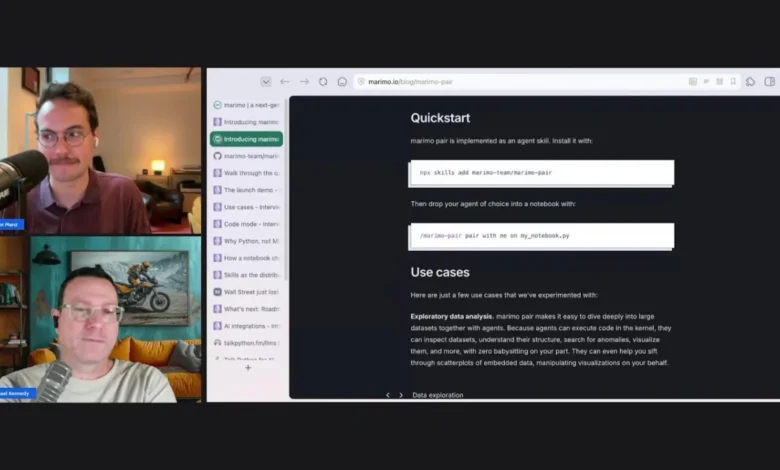
Marimo Pair is distributed as an "agent skill," a modular set of instructions and tools that can be imported into various AI agent harnesses, including Anthropic’s Claude Code, Codex, and OpenCode. The architecture is built upon a semi-private API within the Marimo ecosystem known as "code mode."
When a developer installs the Marimo Pair skill—often through package managers like npm or uv—the agent is taught a single, high-level tool: the ability to execute Python code within a running Marimo kernel. This is a departure from the Model Context Protocol (MCP) approach, which typically requires wiring up multiple specific tools and describing complex schemas. Instead, Marimo Pair leverages the power of Python itself as the interface. The agent can run introspection scripts to list variables, check data types, and query the schema of data frames.
Crucially, this allows for a feedback loop that was previously impossible. If an agent generates code that results in an error or an unexpected visual output, it receives immediate feedback from the kernel. The agent can then "course-correct" by inspecting the live memory, much like a human developer would during a debugging session.
Chronology of Development and Market Context
The development of Marimo Pair coincided with a period of intense volatility and rapid innovation in the AI tooling sector. In late 2025 and early 2026, the industry experienced what some analysts termed the "SaaSpocalypse." This occurred when major AI providers, most notably Anthropic, released highly capable command-line interfaces (CLIs) and agentic frameworks that significantly reduced the market value of traditional software-as-a-service (SaaS) coding assistants.
According to data from industry reports such as the Pragmatic Engineer, the adoption of these tools has shifted dramatically. As of mid-2026, Claude Code holds a commanding lead in the market for developer-focused AI tools, followed by Google’s Copilot and specialized editors like Cursor. Marimo’s decision to release Marimo Pair as a cross-platform skill rather than a proprietary, locked-in feature was a strategic response to this fragmentation. By ensuring that Marimo can be driven by any leading agent, the developers have prioritized interoperability over ecosystem isolation.
Impact on Data Science Workflows: Hands-on and Headless
The integration of AI agents into stateful environments introduces two primary workflows: the "hands-on" exploratory model and the "headless" automated model.
Exploratory Data Analysis (EDA)
In the hands-on model, the notebook serves as a collaborative workspace. A researcher might load a dataset and use the agent to perform tedious tasks, such as cleaning malformed Excel files or writing complex plotting logic for library-specific APIs like Polars or Matplotlib. Because the agent has access to the live state, the user can be more declarative. For instance, a user could point to a specific cluster on a scatter plot and ask the agent to identify the underlying data points. The agent then queries the in-memory selection indices, compares them against the data frame, and provides a natural language summary of the findings.
Headless Notebook Generation
The headless approach allows the agent to build a comprehensive analysis from scratch. Traditional agents often "one-shot" a program, writing an entire file and hoping it runs. In the Marimo Pair environment, the agent builds the notebook cell-by-cell, verifying the output of each step before proceeding. This incremental construction guarantees that the final artifact is not only well-formed but also verified and reproducible. This workflow is particularly valuable for generating standard reporting notebooks or performing initial data triage on large volumes of information.
Token Economics and Efficiency
One of the most significant advantages of the Marimo Pair integration lies in the optimization of the agent’s context window. Traditional agents must often read thousands of lines of log files or metadata-heavy notebook outputs to understand the current state of a project. This "pollutes" the context buffer and increases token costs.
Marimo Pair allows the agent to offload this context into the Python kernel. Instead of the agent needing to remember the entire contents of a data frame, it simply knows that the data frame exists in memory. When specific information is needed, the agent calls a tool to query the live state, retrieving only the relevant subset of data. This "lazy loading" of context makes the interaction more efficient, faster, and more cost-effective for the end-user.
Industry Implications and Future Roadmap
The broader implications of state-aware agents extend into the realm of accessibility. By lowering the barrier to entry for complex data manipulation, Marimo Pair enables individuals with domain expertise but limited programming experience to conduct sophisticated analyses. The "vibe coding" trend—where developers use natural language to direct AI agents—is evolving into "data vibe coding," where the focus shifts from syntax to intent and insight.
Looking ahead, the Marimo team has signaled several key areas for expansion:
- Multimodal Feedback: Future iterations are expected to provide deeper integration for multimodal models. Agents will be able to "see" the visual charts generated in the notebook through automated screenshots, allowing them to comment on visual trends or anomalies that are not easily captured in raw data.
- Cloud Integration: Through services like Molab, Marimo is expanding its cloud-hosted offerings. This allows users to drive powerful remote infrastructure—including high-end GPUs—from a local agent CLI, effectively providing a "remote sandbox" for heavy computational tasks.
- Real-Time Collaboration: Development is underway to allow multiple human users and multiple AI agents to interact with the same running kernel simultaneously. This would facilitate a new form of "ensemble data science" where different agents could be tasked with competing hypotheses within the same notebook canvas.
Conclusion
The release of Marimo Pair marks the end of the era where AI agents were confined to the static world of the file system. By bridging the gap between autonomous agents and stateful, reactive environments, Marimo has provided a blueprint for the future of data science. As AI continues to move from being a simple code generator to a sophisticated analytical partner, the ability to interact with live memory and dynamic state will become the standard requirement for all computational tools. For the data science community, this represents a significant step toward more efficient, reproducible, and insightful analysis, where the human provides the direction and the agent manages the complexity of the execution.