Marimo Pair Bridges the Gap Between AI Coding Agents and Live Python State Through Real Time Notebook Kernel Integration

The evolution of artificial intelligence in software development has reached a critical inflection point where the boundaries between static code and live data execution are beginning to dissolve. For several years, coding agents have demonstrated significant proficiency in traditional software engineering workflows—scoping features, editing files on disk, running tests, and shipping code. However, these tools have historically struggled to adapt to the specific needs of data scientists and researchers, whose work is defined not by static files but by the "live state" of variables held in memory. Marimo, a startup known for its reactive Python notebooks, has addressed this technological divide with the launch of Marimo Pair, an agentic skill that integrates artificial intelligence directly into an active Python kernel.
The Technological Divide Between Software Engineering and Data Science
The fundamental friction in current AI-assisted development lies in the medium through which the agent interacts with the project. Traditional coding agents, such as Claude Code or GitHub Copilot, operate primarily on the file system. They read scripts, modify text files, and execute command-line instructions. While this mirrors the workflow of a standard software developer, it fails to capture the essence of data exploration. In data science, a practitioner typically loads a dataset, inspects its structure, runs an analysis in a notebook cell, observes the visual response, and makes the next decision based on the values currently residing in the computer’s RAM.
Until recently, an AI agent was blind to this ephemeral state. It could see the code used to load a CSV file, but it could not "see" the resulting data frame, its schema, or the distribution of its values unless those details were manually copied and pasted into the chat interface. This lack of situational awareness created a "wall" between the human’s live environment and the agent’s static understanding. Marimo Pair aims to dismantle this wall by allowing agents to drop directly into a running notebook session with full access to every variable and object Python is holding in memory.
The Architecture of Marimo Pair: From Disk to Kernel
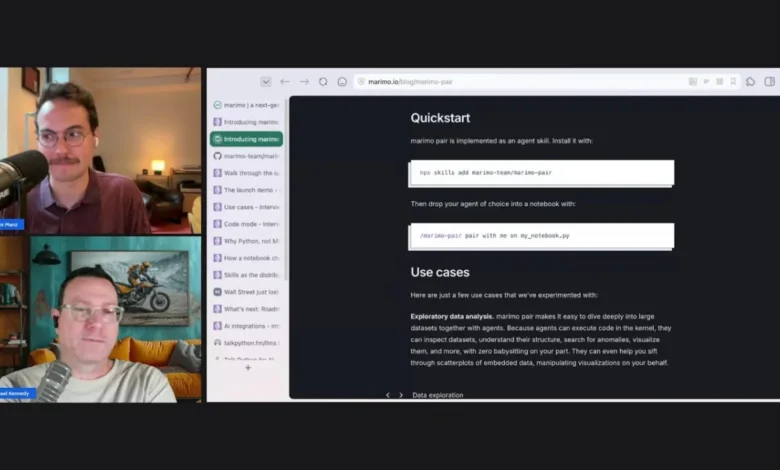
Marimo Pair is distributed as an "agent skill"—a specialized set of instructions contained within a markdown file that teaches an LLM (Large Language Model) how to interact with a specific tool. Unlike complex integrations that require intricate Model Context Protocol (MCP) tool wiring or rigid schema descriptions, Marimo Pair utilizes a single tool: the ability to run Python code inside an active Marimo kernel.
According to Trevor Manz, a lead developer at Marimo, the system employs a semi-private API known as "Code Mode." This interface allows the agent to perform a variety of high-level tasks that were previously reserved for human users. These include:
- Variable Inspection: The agent can query the kernel to list all active variables, identify their types, and inspect their contents without the user needing to provide manual context.
- Stateful Mutations: The agent can create new cells, edit existing ones, and trigger execution within the notebook UI.
- Visual Feedback Loops: Because the agent is operating within a reactive environment, it receives instant feedback on whether a block of code succeeded or failed, allowing it to course-correct in real-time.
This shift from a "file-first" to a "kernel-first" approach ensures that the agent is not just suggesting code, but participating in a shared canvas. For example, if a user directs the agent to "zoom in on the Picasso paintings" within a complex data visualization, the agent can inspect the underlying data frame, filter for the relevant rows, and update the chart coordinates—all within the live state of the notebook.
The Reactive Foundation: Why Marimo Differs from Jupyter
The effectiveness of Marimo Pair is inextricably linked to Marimo’s underlying architecture. Traditional computational notebooks, such as Jupyter, often suffer from "hidden state" issues. Because Jupyter allows cells to be run out of order, the state of the kernel can become disconnected from the code visible on the screen. This inconsistency is notoriously difficult for AI agents to navigate, as they may suggest code based on cell #5 that depends on a variable modified in cell #20.
Marimo solves this by being a "reactive" notebook. It tracks the dependencies between cells based on the variables they declare and use. When a variable in one cell is changed, Marimo automatically re-executes all descendant cells. This deterministic execution order provides a stable foundation for an AI agent. Because the notebook is essentially a reproducible Python program, the agent can operate with the guarantee that the code it sees is a faithful representation of the state it is interacting with.
The Fragmentation of the AI Agent Market
The release of Marimo Pair comes at a time of intense competition and fragmentation in the AI tooling landscape. Data from industry analysts, including reports from The Pragmatic Engineer, indicate that developer preferences are shifting rapidly. While GitHub Copilot maintained an early lead due to corporate approvals and its integration with Microsoft 365, newer entries like Anthropic’s Claude Code and the Cursor editor have gained significant market share by offering more agentic, autonomous capabilities.
Marimo’s strategy involves remaining "agent-agnostic." Rather than building a proprietary chat interface that forces users into a specific ecosystem, Marimo Pair is designed to work with whichever "harness" the developer prefers. Whether a user is operating through a terminal-based CLI like OpenCode, a specialized editor like Cursor, or an integrated extension in VS Code, the Marimo Pair skill provides a consistent bridge to the notebook kernel.
This interoperability is particularly vital given the current "SaaSpocalypse" in the AI sector, where sudden shifts in model performance or subscription models can render specific tools obsolete overnight. By decoupling the skill from the specific model, Marimo ensures that its notebooks remain a useful tool for any frontier model, whether it be from OpenAI, Anthropic, or the open-source community.
Enhanced Efficiency and Token Economics
One of the secondary benefits of kernel-level integration is the optimization of "token economics." In traditional AI interactions, developers often have to feed large chunks of log files, data schemas, or entire notebook JSON files into an LLM’s context window to provide enough information for a task. This is not only expensive but also increases the likelihood of "hallucinations" as the model struggles to parse irrelevant data.
With Marimo Pair, the agent can "offload" context to the Python environment. Instead of printing 10,000 lines of data to understand a schema, the agent can run a single df.info() or df.describe() command within the kernel and receive a concise summary. This allows the model to work with much smaller, more relevant context buffers, leading to faster response times and more accurate outputs. Lead developers have noted that this "runtime inspection" changes model behavior, allowing agents to perform complex data cleaning and exploratory data analysis (EDA) with a level of precision that was previously unattainable.
Use Cases: From Exploratory Analysis to "Headless" Automation
Marimo Pair facilitates two primary workflows: the hands-on interactive session and the headless automation task.
In an interactive session, the agent acts as a true pair programmer. A user might drag an Excel file into the notebook UI and ask the agent to "load these three tables and create a pair plot of the quantitative axes." The agent then handles the tedious task of identifying sheet names, parsing headers, and selecting the correct plotting libraries, while the user focuses on the high-level interpretation of the results.
In a headless workflow, users can task an agent with building an entire analysis from scratch. Because the agent can verify its progress at each step by running the code in the kernel, it can self-correct errors in data ingestion or library versioning before presenting the final notebook to the human. This results in a reproducible artifact that is guaranteed to run, rather than a collection of disconnected code snippets.
Chronology of Development and Future Roadmap
The development of Marimo Pair follows a strategic timeline that reflects the broader evolution of AI in the Python ecosystem:
- Late 2024: Marimo establishes its reactive notebook format, prioritizing Python-centric reproducibility.
- Early 2025: The rise of autonomous coding agents highlights the "state blindness" of AI in data science workflows.
- December 2025: Initial experiments with "Code Mode" begin, testing how agents can drive notebook mutations.
- June 2026: Marimo Pair is officially released as a cross-platform skill, integrating with Claude Code, Codex, and VS Code.
Looking forward, the Marimo team is working on deeper integrations, including real-time collaboration features that would allow multiple human users and multiple AI agents to inhabit the same notebook kernel simultaneously. Additionally, the launch of "Molab"—a cloud-hosted version of Marimo on CoreWeave infrastructure—allows users to connect local AI agents to remote, GPU-accelerated sandboxes. This enables a developer on a lightweight laptop to drive a heavy-duty machine-learning analysis through a simple terminal interface.
Broader Impact on the Data Science Profession
The implications of tools like Marimo Pair extend beyond mere convenience. By lowering the barrier to entry for complex data manipulation, these tools allow subject matter experts—who may not be expert Python programmers—to engage in sophisticated data analysis. The "on-ramp" provided by an agent that can handle the intricacies of library APIs and file formats allows researchers to spend more time on hypothesis testing and less time on syntax.
Furthermore, the emphasis on the "reproducible artifact" ensures that the output of an AI session is not just a transient answer in a chat box, but a permanent, executable program. As AI continues to permeate the technical workforce, the ability to maintain human-readable, verifiable, and stateful records of analysis will remain the gold standard for scientific and business integrity. Marimo Pair represents a significant step toward a future where the partnership between human intuition and machine intelligence is seamless, stateful, and grounded in the reality of the data.