The Case for Intentional Verbosity: Why Unnecessary Syntax Enhances Code Maintainability

The fundamental objective of programming in high-level languages like Python is the creation of software that is as accessible to human developers as it is to machine interpreters. While modern development environments and static analysis tools frequently flag "unnecessary" code—such as explicit returns, redundant parentheses, or verbose keyword arguments—a growing segment of the software engineering community is challenging the doctrine of pure minimalism. This shift in perspective argues that code readability, maintainability, and long-term project health are often better served by being explicit, even when the syntax is technically optional.
The Evolution of Pythonic Minimalism
Python’s design philosophy, codified in the Zen of Python (PEP 20), emphasizes that "explicit is better than implicit." However, in the pursuit of "Pythonic" code, developers often equate brevity with quality. This trend gained momentum with the widespread adoption of automated code formatters like Black and Ruff, which enforce rigid structural standards. While these tools reduce bike-shedding and ensure consistency across large codebases, they can occasionally strip away the semantic nuance that a developer originally intended to convey.
Historically, the Python interpreter has evolved to require less boilerplate. From the introduction of f-strings in PEP 498 to the gradual optimization of dictionary methods, the language has moved toward a more concise syntax. Yet, the language’s core maintainers have consistently resisted removing optional features that serve as documentation, such as the ability to explicitly return None.
Explicit Returns and the Principle of Clarity
A frequent target for code linters is the explicit return None statement. In Python, a function that reaches its end without a return statement implicitly returns None. Consequently, many automated tools suggest removing the explicit return to minimize character count.
However, adherence to PEP 8, the official style guide for Python code, suggests a more nuanced approach. PEP 8 states that if any return statement in a function returns an expression, all return statements should do so, or they should explicitly state return None. This consistency is not merely aesthetic; it is functional. When a function returns None as a deliberate result—perhaps indicating a failure to find an item in a sequence—an explicit return None communicates the developer’s intent. It informs the next developer that the None value is a calculated outcome, not an accidental omission.
Balancing Logic: The Else-Return Debate
The use of else blocks following return statements is another area where efficiency conflicts with readability. While it is technically true that a return statement terminates a function and renders an else clause redundant, removing the else can obscure the logical symmetry of a function.
Consider a comparison function, such as earliest_date(date1, date2). By retaining the else, the developer signals that both branches of the conditional logic are of equal status. Removing the else implies that one condition is the "normal" path and the other is an "exceptional" exit. In complex business logic, where both outcomes are equally valid and expected, preserving the else block maintains the parity of the conditions, allowing a reader to grasp the function’s intent at a single glance.
The Role of Keyword Arguments in API Stability
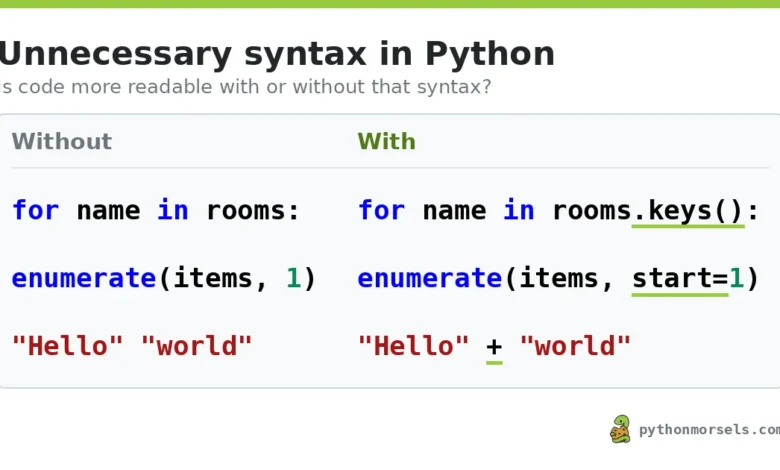
One of the most significant arguments for retaining "unnecessary" syntax pertains to keyword arguments. When calling functions like enumerate(items, start=1) or open(filename, mode="wt"), the arguments start and mode are technically redundant if the developer relies on positional order. However, the use of keywords transforms the code into a form of self-documentation.
Data from recent industry surveys on code maintenance suggest that developers spend approximately 70% of their time reading existing code rather than writing new features. When a function call uses positional arguments for complex configurations, the reader is forced to context-switch to the documentation to verify what the arguments represent. By contrast, explicit keyword arguments act as inline documentation, significantly reducing the cognitive load on the maintainer.
Contextualizing Dictionary and File Operations
The keys() method in Python dictionaries is a classic example of "unnecessary" code that arguably provides value. While iterating directly over a dictionary yields its keys, calling .keys() makes the operation explicit. This distinction becomes vital in large, polyglot codebases where developers may move between languages with different default iteration behaviors.
Similarly, the inclusion of the t (text) mode in file operations, though redundant due to Python’s default behavior, clarifies the developer’s intent. In environments where binary data handling is common, explicitly stating mode="rt" guards against future errors when the code is ported to or refactored alongside binary-focused libraries like gzip.
The Human-Centric Perspective on Code Structure
Beyond logic and syntax, the visual structure of code plays a vital role in its comprehension. The use of trailing commas, parentheses, and intentional whitespace are often categorized as stylistic choices or "noise," yet they serve a critical purpose in modern collaborative development.
- Version Control (Git): Trailing commas in lists or dictionaries ensure that when a new item is added to a collection, the resulting diff shows only the change to that item, rather than a modification of the preceding line. This reduces the noise in code reviews and simplifies merge conflict resolution.
- Visual Scoping: Extra parentheses in complex comprehension or mathematical expressions can clarify operator precedence. While the Python interpreter follows strict rules, human readers do not always internalize the order of operations perfectly. Providing structural cues prevents logic errors during future modifications.
- Whitespace for Readability: Using line breaks to separate the components of a dictionary comprehension or a long string concatenation allows for better visual parsing. Even if the interpreter ignores the whitespace, the developer benefits from a clearer view of the data structure.
Implications for Modern Software Development
The move toward automated formatting has brought unprecedented levels of consistency to the software industry. However, this has inadvertently created a culture where "minimalism is perfection." The reality of enterprise-scale software development is that code is not just for machines; it is for the team.
When a developer removes a piece of syntax that is "technically unnecessary," they must weigh the gain in brevity against the loss in clarity. If the removal of a keyword or an else block requires the reader to pause and mentally reconstruct the logic, then that syntax was not truly unnecessary—it was functional.
Conclusion
The debate between minimal syntax and explicit verbosity is a microcosm of the larger challenges in software engineering. As systems grow more complex and teams become more distributed, the cost of ambiguity increases. While automated tools provide a valuable baseline for code quality, they cannot replace the human judgment required to write maintainable, expressive code.
Developers are encouraged to look beyond the "less is more" mantra and evaluate their code based on the needs of the human reader. Whether it is adding a trailing comma to ease version control or including an explicit return to signal intent, the most effective code is that which communicates its purpose clearly. In the end, the most "Pythonic" code is not necessarily the shortest; it is the code that is most easily understood, maintained, and extended by the community. By prioritizing clarity over raw brevity, engineers can build systems that are not only efficient but also resilient against the inevitable churn of time and personnel.