Navigating the 3 AM Crisis: Inside Cloud Resilience, AWS Best Practices, and the Evolution of Incident Response

It is 3:00 AM, a critical production system has flatlined, and the engineering lead is staring blankly at a monitoring dashboard. In the high-stakes world of cloud computing, determining whether an outage stems from a simple application bug, an unexpected billing spike, or a sophisticated data breach is a nerve-wracking diagnostic puzzle. Behind the scenes, executive leadership and stakeholders wait anxiously for answers, while the financial toll ticks upward with every passing minute.
For the past fifteen years, cloud architect Matt Lea has been the person enterprises call when severe outages threaten bottom-line revenue. According to Lea, the true measure of a company’s incident readiness is rarely determined during the chaotic hours of an emergency. Instead, every critical factor that dictates the outcome of a middle-of-the-night outage is decided months earlier, on ordinary weekday afternoons, when engineering teams make quiet architectural compromises for the sake of short-term convenience.
The Anatomy of Cloud Complexity and Misconfiguration
As organizations increasingly migrate critical workloads to platforms like Amazon Web Services (AWS), Microsoft Azure, and Google Cloud Platform (GCP), they often encounter an unexpected hurdle: overwhelming architectural complexity. Modern cloud ecosystems now encompass hundreds of specialized services, ranging from mainstream relational databases and virtual servers to niche solutions for artificial intelligence and robotics. For many development teams, navigating this sprawling product catalog introduces significant friction and misconfiguration risks.
Lea emphasizes that foundational discipline remains the primary defense against catastrophic failures. Drawing from industry-wide operational data, a significant percentage of high-profile security leaks and unexpected downtime events trace back to preventable configuration errors. To combat this, cloud engineers must adhere to strict operational guidelines that eliminate ambiguity and reduce human error during deployment.
1. Infrastructure as Code (IaC) vs. Manual Provisioning
One of the most persistent operational traps is manual infrastructure provisioning—logging into the cloud console to manually click through menus, configure virtual servers, and tweak firewalls. While fast for initial prototyping, this "hand-napped" approach creates undocumented environments that are nearly impossible to replicate or audit accurately.
Modern engineering standards mandate the use of Infrastructure as Code (IaC) tools such as Terraform, OpenTofu, or AWS CloudFormation. By defining network topologies, compute nodes, and storage buckets in version-controlled configuration files, teams ensure reproducibility. If a primary environment suffers a catastrophic failure, an IaC-driven pipeline can rebuild the infrastructure precisely as it was, eliminating guesswork. However, automation demands caution: engineers must carefully review execution plans prior to applying changes to prevent accidental deletions of stateful resources like production databases.
2. Identity and Access Management: Moving Beyond Static Keys
Hardcoding static AWS access keys into application environments or configuration files remains a leading vector for credential theft and unauthorized access. Automated botnets continuously monitor public code repositories like GitHub, harvesting leaked keys within seconds of publication.
Industry best practices dictate replacing long-lived access keys with temporary, role-based permissions managed through Identity and Access Management (IAM) systems. By binding IAM roles directly to compute instances or serverless functions, services obtain precisely scoped, time-limited credentials without exposing static secrets. Furthermore, adhering to the principle of least privilege—specifically avoiding wildcard permissions such as s3:*—ensures that a compromised component cannot execute unchecked administrative commands across an entire cloud account.
3. Network Segmentation and the Myth of Public Subnets
Architectural safety requires deliberate network isolation. Backend data layers, including relational databases and internal caching services, should never reside in public subnets accessible directly from the public internet. Instead, traffic must flow through a secure perimeter via managed load balancers, routing through private subnets protected by strict security groups.
Security groups act as virtual firewalls, regulating inbound and outbound traffic at the instance level. Engineers must avoid overly permissive security rules that allow unrestricted access from arbitrary IP addresses (0.0.0.0/0). Implementing robust bastion hosts or secure session managers (such as AWS Systems Manager Session Manager) allows administrative access without exposing management ports to the open internet, effectively mitigating the risk of lateral movement by malicious actors.
The Cultural Shift: From "Pets" to "Cattle" and Automated Pipelines
Historically, physical server hardware was treated like a pet: meticulously maintained, hand-tuned, and deeply mourned if it suffered permanent hardware failure. In modern cloud architecture, this mindset is obsolete. Virtual machines and container tasks should be treated like cattle—disposable, interchangeable, and easily replaced.
Containerization technologies, such as Docker, paired with orchestration platforms like AWS ECS, allow teams to encapsulate applications and their precise runtime dependencies into immutable images. If a container exhibits erratic behavior or performance degradation, automated monitoring systems can terminate the instance and spin up a pristine replacement in milliseconds.
Coupled with Continuous Integration and Continuous Deployment (CI/CD) pipelines, automated testing and deployment frameworks ensure that code updates flow smoothly from development branches to production environments without manual intervention. Automated testing gates catch syntax errors, regression bugs, and schema mismatches before they reach live users.
Cloud War Games: Inoculating Teams Against Panic
Technical safeguards alone cannot prepare an organization for the psychological weight of a major production outage. When system failures coincide with aggressive distributed denial-of-service (DDoS) attacks or sudden resource consumption spikes—such as the viral application billing incidents popularized across developer communities—even experienced engineers can experience decision fatigue and panic.
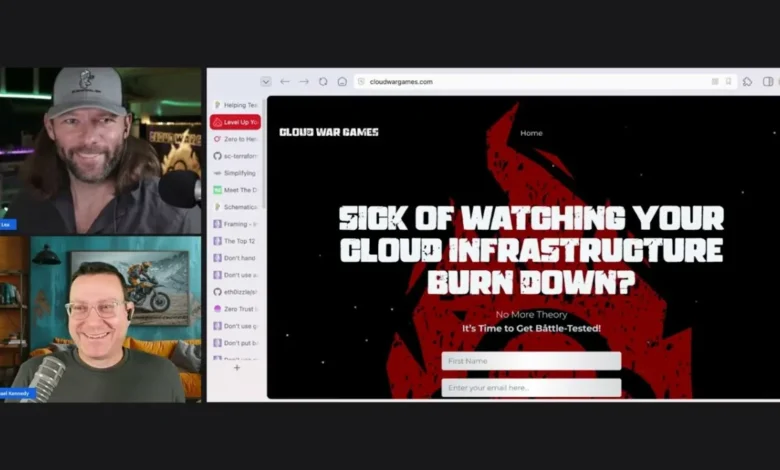
To bridge this gap, initiatives like Cloud War Games focus on stress inoculation through simulated disaster scenarios. Rather than waiting for a catastrophic event to strike during peak retail windows like Black Friday, organizations intentionally inject faults into non-production environments to test their incident response pipelines.
These structured simulations evaluate several critical competencies:
- Diagnostic Speed: How quickly can engineers isolate the root cause using centralized logging tools like AWS CloudWatch Insights?
- Communication Protocols: Do on-call engineers effectively escalate critical alerts to leadership without causing operational bottlenecks?
- Collaboration and Soft Skills: Do team members work cohesively under pressure, or do they retreat into isolated troubleshooting silos?
Following each simulation, mandatory post-mortem reviews analyze what went right, where communication broke down, and how architectural defenses can be hardened to prevent recurrence. This iterative feedback loop transforms high-stress failures into structured engineering improvements.
Economic Visibility and Cost Governance
Beyond security and availability, financial predictability is a cornerstone of mature cloud operations. The scalability that makes cloud computing attractive can rapidly turn into a financial liability if resource consumption goes unmonitored.
Recent high-profile incidents involving unanticipated serverless function loops, unoptimized database queries, or legacy software deprecation fees underscore the necessity of active cost governance. Modern engineering teams must integrate cost monitoring directly into their operational workflows. Utilizing cloud budgeting tools, anomaly detection alarms, and resource tagging strategies ensures that unexpected spikes in infrastructure expenditure are flagged and addressed before generating prohibitive corporate liabilities.
Conclusion
The evolution of cloud architecture has democratized software deployment, enabling single developers to build applications that scale to millions of users globally. However, this power brings heightened responsibility. True cloud resilience is not forged in the heat of a 3:00 AM crisis; it is built methodically on ordinary afternoons through disciplined infrastructure-as-code practices, rigorous access control, robust network segmentation, and proactive disaster simulations. By embracing these principles, organizations can safeguard their digital assets, protect their bottom lines, and ensure that their engineering teams sleep soundly when the unexpected occurs.