Marimo Pair Redefines Data Science Workflows by Integrating AI Agents Directly into Reactive Python Notebook Kernels

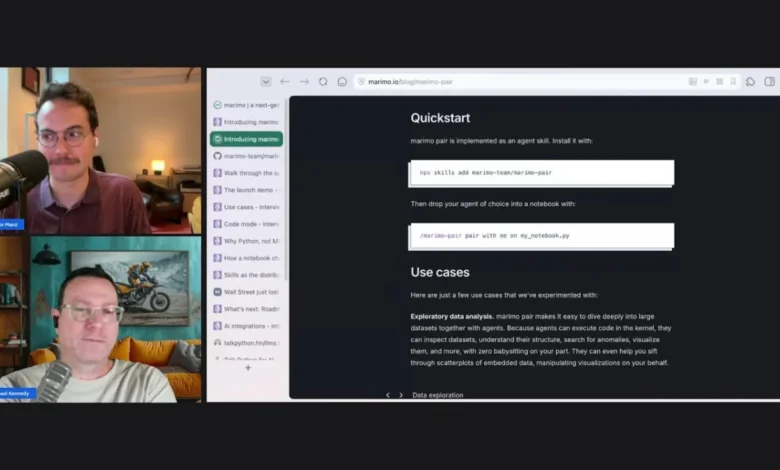
The landscape of artificial intelligence in software engineering has reached a pivotal turning point with the introduction of Marimo Pair, a specialized agent skill designed to bridge the gap between static code editing and live data exploration. For years, coding agents have excelled at disk-based tasks—scoping features, editing files, and running tests—but have remained largely disconnected from the "live state" of data science work. On June 30, 2026, during a technical briefing, Marimo lead Trevor Manz unveiled a solution that effectively dismantles the wall between AI agents and the Python kernel, allowing large language models (LLMs) to see and interact with variables held in active memory.
This development addresses a fundamental friction point in the data science lifecycle. Unlike traditional software development, where the file system is the primary source of truth, data work is inherently stateful and exploratory. Practitioners typically load a dataset, inspect its properties, run isolated cells, and decide their next move based on intermediate results stored in memory. Until the release of Marimo Pair, agents were blind to this interactive process, forcing users to manually copy-paste outputs or describe data schemas to the model. By dropping a coding agent directly into a running Marimo notebook, the environment becomes a shared canvas where the agent can perform runtime inspections and drive the authorship of the notebook in real-time.
The Evolution of Reactive Notebooks and the Agentic Gap
To understand the impact of Marimo Pair, it is necessary to examine the evolution of its underlying platform. Marimo emerged as a high-performance alternative to traditional computational notebooks like Jupyter and Google Colab. While traditional notebooks often suffer from "hidden state" problems—where cells can be run out of order, leading to inconsistent results—Marimo utilizes a reactive dataflow engine. In a Marimo notebook, the relationship between cells is determined by the variables they declare and consume. If a user modifies a variable in one cell, all descendant cells automatically re-execute, ensuring the notebook remains a reproducible Python program rather than a fragmented log of past executions.
Despite these architectural advantages, the rise of "agentic" workflows in 2025 and 2026 presented a new challenge. Modern agents like Claude Code and Codex became highly efficient at manipulating repositories, yet they struggled with the fluid nature of notebooks. Most agents operated by reading and writing to the .ipynb or .py files on disk. In the context of a notebook, these files are often polluted with massive JSON outputs or stale data that do not reflect the current state of the kernel. Marimo Pair was developed to solve this by providing a "Code Mode" API—a semi-private interface that allows agents to query the kernel directly, bypassing the limitations of disk-based file editing.
Technical Architecture: Code Mode and Skill Distribution
Marimo Pair is distributed as an "agent skill," a standardized format for teaching LLMs how to use specific tools. This skill can be integrated into popular agent harnesses such as Anthropic’s Claude Code, OpenAI’s Codex, and the open-source OpenCode AI. The installation process leverages modern package managers, including npm and the increasingly popular uv tool. By running a single command, such as uvx dino -a npm skills add marimoteam/marimopair, developers can equip their local agents with the ability to "pair" with a Marimo session.
The core of the technology lies in its execution model. When an agent is invoked through Marimo Pair, it is granted access to a single, powerful tool: run_python. Unlike the Model Context Protocol (MCP) tools that require complex schema descriptions and wiring, Marimo Pair allows the agent to write and execute raw Python code within the active notebook kernel. This allows for complex composition of tasks. An agent can loop through a list of variables, check their data types, perform null-value analysis, and generate visualization code, all while receiving instant feedback from the kernel.
Furthermore, the system employs a decoupled architecture. The skill instructions provided to the agent are lightweight, teaching it only how to connect to the kernel and use the help command. Once connected, the agent uses Python’s introspection capabilities to discover the specific APIs available in that version of Marimo. This prevents version mismatch issues, ensuring that as Marimo evolves, the agent remains capable of driving the latest features without requiring a manual update to the skill definition.
Chronology of Development and Market Context
The journey toward Marimo Pair began in mid-2025 with the release of AnyWidget, a toolkit designed by Trevor Manz to create interactive UI elements for Python environments. By late 2025, the Marimo team recognized that their users were increasingly using agents for traditional software development but reverting to manual coding for data tasks.
In early 2026, the industry experienced what analysts have termed the "SaaSpocalypse." This occurred when Anthropic released a series of highly efficient markdown-based coding skills that significantly reduced the need for specialized software-as-a-service platforms, leading to a massive shift in market valuations for developer tool companies. The Marimo team pivoted their strategy to align with this trend, choosing not to build a proprietary "walled garden" chat interface but instead making Marimo a first-class tool for the agents that developers were already using.
By June 2026, Marimo Pair moved from internal testing to a public beta. The release coincided with new data from the Pragmatic Engineer newsletter, which indicated that Claude Code had captured a dominant share of the engineer-led AI market, while Microsoft’s Copilot remained the standard for large-scale corporate deployments. Marimo Pair was specifically designed to work across this fragmented ecosystem, supporting both local terminal-based agents and integrated development environment (IDE) extensions in VS Code and Cursor.
Impact on Data Science: From Vibe Coding to Verifiable Analysis
The introduction of Marimo Pair signals a shift away from "vibe coding"—a term used to describe the practice of generating large blocks of code through prompts without rigorous verification. In a traditional agent workflow, a model might generate a 200-line script to analyze a CSV file. If that script fails due to a minor schema misunderstanding, the agent must start over or guess the fix.
With Marimo Pair, the workflow is incrementally verifiable. The agent builds the notebook cell by cell:
- Ingestion: The agent loads the data and verifies the success of the operation.
- Inspection: The agent runs a cell to check for null values or outliers, "seeing" the result in memory.
- Visualization: The agent generates a plot. If the user finds the plot insufficient, they can point to it and ask for a specific change, such as "zoom in on the Picasso paintings" or "change the color scale to reflect log density."
- Refinement: The agent adjusts the code based on the live visual output and the user’s feedback.
This "headless" execution capability also allows for high-throughput data exploration. Users can task an agent with creating five different exploratory notebooks for five different datasets simultaneously. Because the agent is running within the Marimo kernel, it can correct its own errors in real-time, resulting in a finished, reproducible Python file that is guaranteed to run from top to bottom.
Broader Implications and Future Roadmap
The implications of Marimo Pair extend beyond individual productivity. As organizations grapple with the reproducibility crisis in data science, the ability to generate analysis artifacts that are both human-readable and machine-verifiable is becoming essential. Marimo’s decision to keep the notebook format as pure Python code—rather than the opaque JSON used by Jupyter—means that the output of an agentic session can be easily tracked via version control systems like Git.
Looking ahead, the Marimo roadmap includes tighter integration with VS Code’s native notebook editor and expanded multimodal capabilities. The team is currently developing features that allow agents to "see" screenshots of plots generated in the notebook, enabling them to provide qualitative feedback on visual trends. Additionally, a cloud-hosted version named "MoLab" has been released on CoreWeave infrastructure, providing GPU-accelerated sandboxes where local agents can drive remote high-performance computing tasks.
Industry experts suggest that Marimo Pair may represent the "Google Docs moment" for data science. By allowing multiple agents and humans to collaborate on a single, stateful canvas, the platform is moving toward a future where the distinction between writing code and analyzing data becomes increasingly blurred. As AI agents continue to move from being mere autocomplete tools to active participants in the scientific process, the importance of "live state" access cannot be overstated. Marimo Pair has effectively set a new standard for how interactive programming environments must adapt to the age of artificial intelligence.