The landscape of software development has undergone a seismic shift over the last year, driven by the rapid maturation of "agentic" AI tools that can scope features, edit files, and run tests with minimal human intervention. However, a significant technological divide has persisted between traditional software engineering and the nuanced world of data science. While coding agents have become proficient at manipulating files on a disk, they have historically struggled with the stateful, in-memory nature of data exploration. This barrier effectively isolated AI assistants from the live execution environment where data scientists spend the majority of their time. The release of Marimo Pair, a new agent skill designed for the reactive Marimo notebook ecosystem, marks a turning point in this evolution by allowing AI agents to step inside the running Python kernel and interact with live variables, charts, and data structures.
The Technological Divide: Disk vs. Memory
For most of the history of AI-assisted coding, the interaction model has been static. Tools like GitHub Copilot, Cursor, and Claude Code typically operate by reading a project’s source code from the file system, proposing edits, and saving those changes back to the disk. This workflow is highly effective for building web applications or microservices, where the source code is the primary artifact.
Data science work, however, is fundamentally different. It is an iterative process of loading data into memory, inspecting a subset of that data, running a cell to see how a model responds, and then deciding the next step based on the results sitting in the system’s RAM. Until recently, an AI agent had no visibility into this live state. It could see the code used to load a CSV file, but it could not see the actual data frame produced by that code. This lack of context forced human users to "babysit" the AI, manually copying and pasting error messages or data summaries into a chat box to give the agent a glimpse of the current environment.
Marimo Pair addresses this by providing agents with a "skill" that grants them direct access to the active Marimo kernel. Instead of just editing a .py file on disk, the agent can now list every variable currently held in memory, inspect their types, and even trigger the execution of specific notebook cells. This transforms the notebook from a static file into a shared canvas where the human and the AI operate on the same live data simultaneously.
The Evolution of the Reactive Notebook
To understand the impact of Marimo Pair, one must first look at the underlying architecture of Marimo itself. While traditional computational notebooks like Jupyter have been the industry standard for over a decade, they suffer from the "hidden state" problem. In a standard notebook, cells can be run in any order, which often leads to a situation where the variables visible on the screen do not match the values stored in the kernel. This inconsistency is a major source of bugs and makes reproducibility difficult.
Marimo, a reactive Python notebook, was designed to solve this by treating the notebook as a directed acyclic graph (DAG). When a variable is updated in one cell, Marimo automatically re-executes all descendant cells that depend on that variable. This ensures that the notebook is always in a consistent state. For an AI agent, this reactivity is a critical safety feature. It prevents the agent from making decisions based on stale data or out-of-order execution, providing a deterministic environment that significantly improves the reliability of the agent’s outputs.
Technical Implementation: The Code Mode API
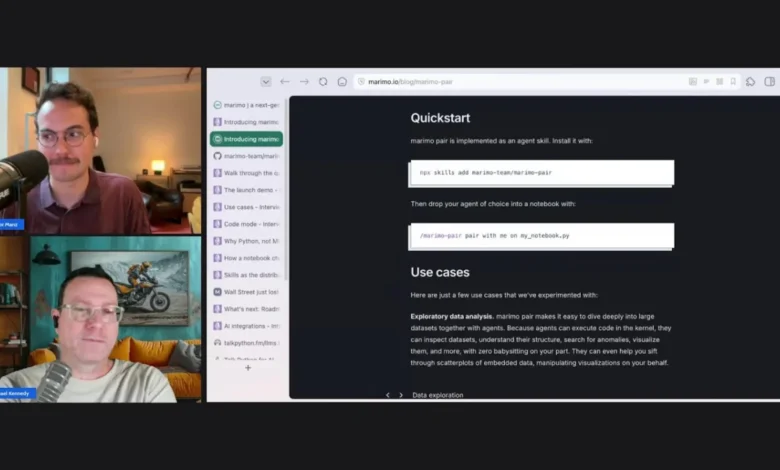
Marimo Pair functions through a semi-private API known as "Code Mode." This interface is specifically designed for agents running Python code within the kernel. When a user installs the Marimo Pair skill—available through marketplaces for tools like Claude Code or Codex—the agent is taught how to invoke a single, powerful tool: execute_python.
Through this tool, the agent can perform several high-level operations:
- Runtime Inspection: The agent can query the kernel to see the schema of a data frame, the number of rows in a table, or the specific value of a constant.
- Visual Context: Using multi-modal capabilities, the agent can "see" the charts and plots generated in the notebook. If a user circles a cluster of points on a scatter plot, the agent can identify which data points were selected and explain their significance.
- Notebook Mutation: The agent can programmatically create new cells, edit existing ones, and run them. Because this is done through Python code rather than a rigid JSON schema, the agent can compose complex tasks, such as creating a loop to generate five different diagnostic plots at once.
This deep integration eliminates the need for complex Model Context Protocol (MCP) wiring or detailed schema descriptions. The agent simply uses Python, the native language of the data scientist, to interact with the environment.
The 2026 AI Tooling Landscape: A Market in Flux
The introduction of Marimo Pair comes at a time of intense competition in the AI developer tool market. According to data from industry analysts such as The Pragmatic Engineer, the hierarchy of AI assistants has shifted dramatically. As of mid-2026, Anthropic’s Claude Code has surged to a dominant position among professional software engineers, followed by tools like Cursor and GitHub Copilot.
A significant portion of the market remains fragmented due to corporate subscription models and platform-specific restrictions. Many enterprises approve the use of Microsoft’s Copilot because it is bundled with existing 365 subscriptions, even if individual developers prefer the agentic capabilities of Claude or the integrated experience of Cursor. Furthermore, the "SaaSpocalypse" of early 2025—in which a series of major AI releases caused a massive $285 billion correction in the technology sector—highlighted the volatility of the industry.
In this environment, the Marimo team made a strategic decision to distribute Marimo Pair as an "agent skill" rather than a built-in proprietary chat panel. By decoupling the agent’s instructions from the notebook’s core software, Marimo ensures that its notebooks remain a useful tool regardless of which AI assistant a developer chooses to use. This "bring-your-own-agent" philosophy allows Marimo to remain relevant as users fluctuate between Claude, Codex, and various open-source models.
Efficiency and Token Economics
One of the most immediate benefits of Marimo Pair is the improvement in "token economics." In the context of Large Language Models (LLMs), tokens are the basic units of text that determine the cost and speed of an AI’s response. When an agent works strictly on disk, it must often read thousands of lines of code and data outputs to orient itself. This fills up the agent’s "context window," making it slower and more prone to hallucinations.
Marimo Pair allows the agent to offload context into the Python kernel. Instead of the agent reading 10,000 rows of a CSV file to understand its structure, the agent can simply run a df.info() command inside the kernel. The kernel processes the data and returns only the relevant summary to the agent. This targeted retrieval of information makes the agent significantly more efficient, reducing the cost per task and allowing it to focus on higher-level analytical reasoning.
Transforming the Workflow: From "Vibe Coding" to Precision Analysis
The term "vibe coding" emerged in the mid-2020s to describe a style of development where a user provides a vague prompt and hopes the AI generates a functional program. While popular for simple scripts, vibe coding is notoriously unreliable for complex data analysis.
Marimo Pair encourages a more disciplined, iterative approach. Trevor Manz, a core developer at Marimo, describes two primary workflows that have emerged:
- The Hands-On Pair: In this mode, the human and the AI work together in real-time. The human might direct the high-level strategy—"Let’s look at the correlation between marketing spend and user retention"—while the AI handles the boilerplate code for data ingestion and visualization.
- The Headless Assistant: In this mode, a user can task the agent with a long-running exploratory task. For example, a user could provide an Excel file with multiple sheets and ask the agent to "generate a comprehensive diagnostic notebook." The agent then builds the notebook cell by cell, verifying its own work at each step by checking the outputs in the kernel. When the human returns, they are presented with a fully functional, reproducible Marimo notebook.
Remote Execution and GPU Acceleration
The utility of Marimo Pair extends beyond local development. Through integrations with infrastructure providers like CoreWeave, Marimo has launched "Molab," a cloud-hosted version of its reactive notebooks. This environment provides users with access to high-performance GPUs, which are essential for modern machine learning and large-scale data processing.
Marimo Pair allows a developer to drive these remote, GPU-accelerated environments from their local machine. A user can run a lightweight agent harness like Claude Code in their local terminal, connect it to a remote Marimo kernel running on a massive cloud server, and perform pair programming with the AI in a high-performance sandbox. This setup provides the best of both worlds: the convenience of a local development interface and the power of cloud-scale hardware.
Conclusion and Future Outlook
The release of Marimo Pair represents a significant step toward the "Google Docs" equivalent for data science—a world where humans and AI agents collaborate seamlessly on live, reproducible artifacts. By breaking down the wall between the file system and the execution kernel, Marimo has provided a blueprint for how stateful programming environments should interact with the next generation of AI assistants.
As the industry moves forward, the focus is expected to shift toward even tighter integrations, including real-time multi-user collaboration where multiple humans and multiple agents can interact within the same kernel. For now, Marimo Pair offers a practical solution to the fragmentation of the AI market, ensuring that the power of agentic loops is finally accessible to the world of data science. Developers and data scientists can begin using the tool by installing the skill through the Marimo GitHub repository or the respective agent marketplaces, marking the start of a more integrated era of computational analysis.