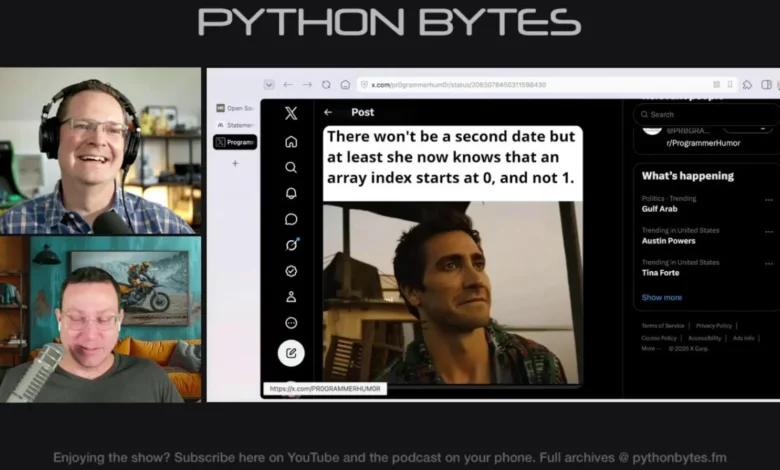
The landscape of Python-focused media and developer productivity underwent a significant transformation on June 16, 2026, as Michael Kennedy and Calvin Hendryx-Parker convened for a landmark crossover episode of the Talk Python To Me and Python Bytes podcasts. Marking the beginning of a new era for Python Bytes following the departure of long-time co-host Brian Okken, the episode served as a comprehensive audit of the "agentic" and infrastructure tools currently defining the workflows of high-level software engineers and technology business owners. This shift in personnel coincides with a broader industry pivot toward agentic artificial intelligence (AI), where software tools no longer merely suggest code completions but actively orchestrate complex development tasks, environment management, and security audits.
A New Leadership Era for Python Bytes
The transition of Calvin Hendryx-Parker to the co-host position of Python Bytes represents a strategic alignment of expertise within the Python community. Hendryx-Parker, a prominent figure in the Python Software Foundation (PSF) and a veteran in the managed services and software consulting space, brings a "terminal-first" philosophy to the show. His background in college-era Unix environments and long-term commitment to open-source orchestration provides a counterpoint to Michael Kennedy’s extensive experience in developer education and full-stack application architecture.
The crossover episode, titled "All Our Tools," was designed to provide listeners with a personal look at the internal stacks used to keep major Python properties—including Talk Python Training and various open-source libraries—operational. This collaborative session highlights a recurring theme in modern software engineering: the move away from monolithic Integrated Development Environments (IDEs) toward highly customized, modular "developer cockpits" composed of specialized terminal emulators, shell extensions, and AI-driven orchestration layers.
The Rise of Agentic AI in Software Engineering
The most significant portion of the technical discussion centered on the evolution of AI from passive assistants to active agents. Both hosts identified a distinct move away from simple autocomplete features, such as the early iterations of GitHub Copilot, toward tools that possess "agentic" capabilities—the ability to understand a codebase, run tests, and iterate based on error feedback.
Orchestration and Spec-Driven Development
Calvin Hendryx-Parker highlighted "Pi," an open-source orchestrating agentic harness, as a central component of his current workflow. Unlike traditional AI wrappers, Pi is designed to be "stripped back" and unopinionated, allowing developers to bring their own models, whether they are proprietary models like Claude 3.5 Sonnet or local models running via Ollama.
A critical companion to this is "Superpowers," a spec-driven development tool. This methodology emphasizes a workflow of brainstorming, planning, execution, verification, and review. According to Hendryx-Parker, this approach prevents the "token burn" associated with AI models that fall into logical loops. By using a spec-driven harness, the AI agent is forced to verify its work against a set of requirements before committing changes to the filesystem. This reflects a broader industry trend where "Agentic Engineering" is replacing "Vibe Coding," ensuring that AI-generated code meets rigorous software engineering standards.
The Claude Ecosystem and Adversarial Pushback
Michael Kennedy noted a similar reliance on the Claude ecosystem, specifically "Claude Code" and the "Opus" and "Haiku" models. A notable development in this space is the implementation of "adversarial pushback" within AI agents. Modern agents now frequently launch sub-agents specifically tasked with finding flaws in the primary agent’s proposed solution. This internal check-and-balance system mirrors traditional peer review processes, significantly reducing the frequency of hallucinations and logical errors in production-grade Python code.
The Renaissance of the Terminal
Despite the proliferation of GUI-based tools, the episode underscored a major resurgence in terminal usage, driven by new software that leverages GPU acceleration and modern UI paradigms.
Warp vs. Kitty: The Battle for the Command Line
The hosts presented two distinct paths for the modern command-line interface. Michael Kennedy has adopted "Warp," a terminal that treats the command line like a modern text editor. Warp includes features like AI-integrated command search, collaborative workflows for teams, and "blocks" that allow developers to treat command output as discrete objects.
Conversely, Hendryx-Parker remains a proponent of "Kitty," a GPU-accelerated terminal emulator. The primary advantage of Kitty, beyond its extreme performance, is its cross-platform consistency. For developers moving between macOS and Linux workstations, Kitty provides a unified configuration and "muxing" (multiplexing) system. This allows for complex window tiling and tab management without the overhead of traditional tools like Tmux, though the latter remains essential for session persistence.
Shell Enhancements and Navigation
The "trifecta" of shell productivity mentioned includes:
- Zsh and OhMyZShell: An opinionated layer that provides visual indicators for Git branches, Python virtual environments, and command status.
- Starship: A cross-shell prompt written in Rust that offers high-speed, highly customizable status indicators that work identically across Zsh, Fish, and Bash.
- Zoxide: A smarter "cd" command that learns the developer’s most-visited directories, allowing for near-instant navigation across deep project structures.
Infrastructure, Connectivity, and Remote Work
As software development becomes increasingly decentralized, the tools used to secure and bridge different environments have become as critical as the compilers themselves.
Tailscale and the Overlay Network
Michael Kennedy described "Tailscale" as a transformative technology for his business operations. Based on the WireGuard protocol, Tailscale creates a secure, private "overlay network" between devices regardless of their physical location. This allows developers to access local database servers or AI models running on high-powered basement "homelab" servers from a laptop at a coffee shop without exposing any ports to the public internet. This "zero-trust" approach to networking has become a standard for independent developers who need to manage production infrastructure securely.
Mobility with Blink and Mosh
For developers seeking a mobile-first or "iPad-only" workflow, the combination of "Blink Shell" and "Mosh" (Mobile Shell) was identified as the gold standard. Mosh improves upon SSH by allowing connections to remain active even as a device changes IP addresses or loses connectivity. Blink Shell provides a professional-grade terminal on iOS, including an embedded version of VS Code, effectively turning a tablet into a full-powered remote engineering workstation.
Productivity Utilities and Documentation
The crossover episode also touched upon the "creature comforts" that reduce the friction of daily operations, particularly in the realms of transcription and documentation.
The Impact of Whisper Models
The release of OpenAI’s Whisper model has revolutionized transcription, leading to tools like "MacWhisper" and "Handy." These applications allow developers to record meetings or dictate code and documentation locally with high accuracy. Hendryx-Parker noted that he uses a "push-to-talk" mode for dictation, passing the audio through the Claude Haiku model for real-time grammar and technical term correction. This use case highlights how "Small Language Models" (SLMs) are being used for specific, high-speed utility tasks rather than just general-purpose chat.
Documentation as a Service: Great Docs
Documentation remains a perennial challenge in the Python ecosystem. The hosts praised "Great Docs," a new tool from Posit built on the Quarto publishing system. Great Docs allows developers to generate high-quality, searchable API references that include "LLM-friendly" skills—essentially metadata that helps AI agents understand how to use a specific library. Kennedy recently used this to overhaul the documentation for his entire suite of open-source libraries, including FastAPI-Chameleon and Umami-Python.
Regulatory Implications and the Fable Controversy
A significant point of discussion involved the sudden disappearance of "Fable" and "Mythos," two highly advanced AI security tools from Anthropic. These tools were reportedly so effective at finding zero-day vulnerabilities in software like the Firefox browser that they were deemed potentially dangerous.
The U.S. government reportedly intervened, suggesting that access to these models be restricted to U.S. citizens to prevent their use in state-sponsored cyber warfare. Anthropic, unable or unwilling to implement such granular geographic and citizenship-based restrictions, opted to withdraw the tools from public access entirely. This event serves as a stark reminder of the looming regulatory landscape facing AI developers. As these tools become capable of identifying and patching—or exploiting—critical infrastructure vulnerabilities, the intersection of private software development and national security will only tighten.
Broader Impact and Industry Implications
The "All Our Tools" crossover episode serves as a snapshot of a developer ecosystem in a state of rapid evolution. The core takeaway is the transition from "Generalist" tools to "Specialized Orchestration." The modern Python developer is no longer just a writer of code; they are an orchestrator of multiple AI agents, a manager of private overlay networks, and a curator of highly customized terminal environments.
The emphasis on local-first AI processing and secure networking (Tailscale, Ollama, MacWhisper) indicates a growing desire for privacy and independence from the "SaaS-ification" of developer tools. Furthermore, the shift toward agentic workflows suggests that the next generation of software will be built faster and with higher verification standards, provided that developers master the new suite of orchestration harnesses like Pi and Superpowers.
As Python continues to dominate fields from data science to web development, the tools highlighted by Kennedy and Hendryx-Parker will likely become the baseline requirements for professional engineering in the late 2020s. The episode concludes that while the specific tools may change, the philosophy of "constant sharpening"—the habit of refining one’s environment to remove friction—remains the most important tool in a developer’s kit.