Tabular Foundation Models Redefine Data Analysis, Outperforming Traditional Methods in Zero-Shot Predictions

A seismic shift is underway in the landscape of tabular data analysis, traditionally dominated by gradient-boosted trees (GBDTs). A new class of models, dubbed "tabular foundation models" (FMs) or "tabular LLMs," is consistently outperforming established methods on key community benchmarks, fundamentally altering the paradigm of how predictions are made on spreadsheets. These transformer-based models, capable of zero-shot predictions without extensive hyperparameter tuning, represent a significant leap, challenging a decade-long consensus in machine learning.
The emergence of these foundation models marks a pivotal moment, mirroring the impact of large language models (LLMs) in natural language processing and transformer architectures in computer vision. For years, the go-to solution for tabular data tasks—from classification to regression—has been meticulously tuned and ensembled GBDTs like LightGBM, XGBoost, and CatBoost. However, the latest leaderboard results from TabArena, a prominent community benchmark, indicate a clear inversion of this status quo. Every single-model entry surpassing the best-tuned GBDT configuration is now a tabular foundation model, with only AutoGluon’s complex ensemble pipelines offering competition from traditional approaches.
The Rise of Zero-Shot Tabular Prediction
Tabular foundation models are single, pre-trained models designed to make predictions on any spreadsheet zero-shot. Unlike traditional machine learning models that require extensive training and hyperparameter optimization on each new dataset, FMs operate by taking known labeled rows as context, much like a language model processes a prompt with examples. They then predict labels for unseen rows in a single forward pass, transforming the "training" phase into an inference task. This approach, known as in-context learning, was first popularized for tabular data by the TabPFN papers, demonstrating its viability and potential.

The architecture of these models, while sharing the transformer backbone with text LLMs, is distinctly tailored for tabular data. A text LLM processes word-pieces from a fixed vocabulary, pre-training on vast internet text corpora for next-token prediction. In contrast, tabular FMs deal with numbers and categories, which lack a fixed vocabulary. They pre-train on millions of synthetic tables generated by random structural causal models (SCMs)—random cause-and-effect graphs designed to emit plausible fake datasets. Their objective is to predict held-out cells and labels within these synthetic tables, thereby learning a general procedure for understanding feature relationships and targets in novel tables, rather than acquiring world knowledge. This specialized pretraining enables them to infer patterns and relationships within a new table without explicit gradient training on that specific data.
The family of tabular foundation models has expanded rapidly since its inception, with notable entrants including Prior Labs’ TabPFN and its successors, Inria’s SODA team’s TabICL and TabICLv2, Layer 6’s TabDPT, and Google Research’s recently unveiled TabFM. Each of these models has contributed to the growing evidence of the superiority of this new paradigm.
TabICLv2: An Open-Source Pioneer with Verified Performance
Among the frontrunners, TabICLv2 stands out as a particularly significant development due to its unrestricted open weights, small size, and demonstrated reproducibility. With approximately 28 million parameters, TabICLv2 is significantly smaller than typical text LLMs (e.g., t0-alpha’s 102M parameters, or billions for larger models), yet it consistently outperforms much larger and more complex traditional tabular models. Its open-source nature, with weights available on HuggingFace under a BSD-3 license, allows for independent auditing and verification—a critical factor for establishing trust in benchmark results.
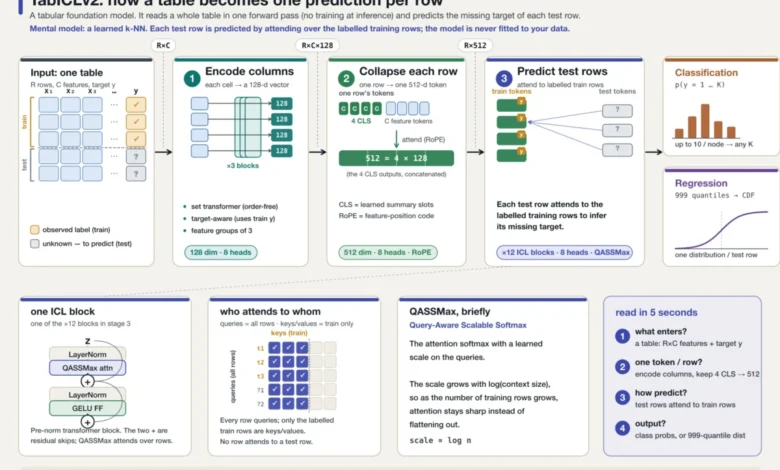
The model’s architecture is a sophisticated three-stage transformer pipeline:

- Column Embedding Transformer: This initial stage processes each column individually, converting raw values into embeddings that capture the context-specific meaning of numbers or categories within that feature. For instance, the number "450" would be embedded differently if it appeared in a "price" column versus a "postcode" column.
- Row Aggregation Transformer: After column embeddings, this stage collapses each row into a single fixed-length vector. It uses learned query tokens (similar to
[CLS]tokens in BERT) to attend over the per-feature embeddings, summarizing the entire row’s information. - In-Context Learning Transformer: This final stage performs the actual prediction. Test-row vectors attend over labeled train-row vectors, identifying similar examples and inferring labels based on these "neighbors." Crucially, this process occurs without gradient descent at prediction time, leveraging the pre-trained understanding of relationships.
TabICLv2 also features advanced prediction heads: a hierarchical classifier for multi-class tasks and a regression head that outputs 999 quantiles, providing a full predictive distribution rather than a single point estimate. This offers a more robust understanding of uncertainty, trained using pinball loss to accurately target different quantiles. The second version, TabICLv2, incorporates innovations like Query-Aware Rescaled Softmax (QASSMax) for improved attention over long contexts, feature grouping to maintain column identity, and early injection of target embeddings, enabling it to scale more effectively than its predecessor.
An independent audit confirmed TabICLv2’s performance. Rerunning the model from scratch on a single AWS A10G GPU, covering all 51 datasets of TabArena’s Lite protocol, the audited TabICLv2 achieved an Elo rating of 1559, closely aligning with the official 1575, well within statistical margins of error. This extensive verification process, costing just over $2 for a 2.1-hour GPU session, underscores the model’s reproducibility and the integrity of the benchmark.
The TabArena Leaderboard: A New Hierarchy Emerges
The TabArena benchmark, comprising 51 diverse datasets ranging from 748 to 150,000 rows and 5 to 1,777 features, evaluates methods using appropriate metrics (ROC-AUC, log-loss, RMSE) and aggregates performance into an Elo rating. This rating system anchors a default RandomForest model at 1000 Elo, where a 400-point gap signifies 10:1 win odds.
The 2026-07-15 snapshot of the official TabArena board paints a stark picture:

- Foundation Model Dominance: Every single-model entry above the best-tuned and ensembled GBDT configuration is a tabular foundation model. LightGBM, even with full tuning and ensembling, achieves an Elo of 1432. TabICLv2, requiring no tuning, sits 158 Elo points above it at 1590.
- Cost-Effectiveness: Beyond accuracy, FMs offer surprising efficiency. TabICLv2’s median prediction time is 0.38 seconds per 1,000 rows, significantly faster than tuned-and-ensembled LightGBM (2.64 s/1K). Its "fit" time (context storage, not gradient training) is roughly a hundred times shorter than tuned GBDT protocols. While FMs typically require GPUs and GBDTs run on CPUs, the overall cost of a full 51-dataset TabICLv2 sweep on an on-demand A10G GPU was a mere $2, highlighting their potential for economical deployment.
- TabFM at the Apex: Google Research’s TabFM currently tops the leaderboard with an Elo rating of 1707, a remarkable 98 Elo clear of the next entry (an AutoGluon pipeline) and 123 Elo ahead of the next single model. Despite its impressive performance, TabFM lacks a public technical paper, and its weights are released under a non-commercial license, raising questions about its underlying mechanisms and full reproducibility for broader research.
The Limitations of Text LLMs for Tabular Data
A crucial distinction often blurred by the "tabular LLM" moniker is the difference between table-native foundation models and general-purpose text LLMs prompted with serialized tabular data. An experiment involving Claude Opus 4.8, provided with datasets as text prompts, revealed significant limitations for the latter approach. While text LLMs showed promise on datasets where column names carried strong real-world semantic meaning (e.g., churn, credit, blood-donation tables), they performed poorly on data rich in pure patterns but devoid of linguistic context (e.g., app-permission vectors, sensor data). The 28M-parameter table-native TabICLv2 won 43 out of 49 comparable datasets, costing a fraction of the $1.50 per thousand predictions incurred by the prompted text LLM. This highlights that while general LLMs are powerful, specialized, table-native foundation models are far more effective for most tabular tasks.
Where Traditional Trees Still Hold Ground: A Regime Analysis
Despite the overarching dominance of tabular FMs, a granular analysis reveals specific data regimes where tuned GBDTs maintain an edge. Against the best-tuned and ensembled GBDTs, TabICLv2 wins on 40 of 51 datasets. The 11 losses, however, cluster notably:
- High Dimensionality: FMs struggle with very wide tables. Of the six datasets exceeding 100 features, GBDTs won five. Examples include Bioresponse (1,776 features), hiva_agnostic (1,617), and QSAR-TID-11 (1,024). Below 100 features, FMs win 86-88% of datasets.
- Scale with High-Cardinality Categoricals: GBDTs also perform better on large datasets with a high number of unique values in categorical features. The largest error gap in favor of trees was on the Amazon employee access dataset, a classic example of this type. The FM’s win rate dropped from 89% for tables under 3,000 rows to 64% for those over 20,000 rows.
This regime split provides critical practical guidance: for wide tables or those with complex, high-cardinality categorical features, a well-tuned GBDT might still be the optimal choice.

The Contamination Conundrum: Trust and Data Provenance
The integrity of pretraining data is a persistent concern in the age of foundation models. TabICLv2 and the original TabPFN models are pretrained exclusively on synthetic data, generated from random SCMs. This approach inherently rules out benchmark contamination, as no real-world table, including those found in benchmarks like TabArena, can leak into their pretraining corpus.
However, subsequent foundation models have increasingly incorporated real-world data to achieve higher accuracy. RealTabPFN-2.5, for instance, continues pretraining on a "curated corpus of 43 real-world tabular datasets" from OpenML and Kaggle, implementing robust deduplication pipelines. TabDPT goes further, pretraining on 123 OpenML datasets outright. Given that TabArena’s datasets are also sourced from OpenML, this overlap raises valid concerns about potential contamination, where a model might have seen parts of the benchmark data during its pretraining, artificially inflating its performance. While developers assert rigorous deduplication, independent verification remains challenging.
This creates an epistemic dilemma: models with the cleanest, synthetic-only provenance offer the highest degree of trust and reproducibility, but they may be out-scored by models that leverage real-world data in their pretraining. For practitioners requiring absolute certainty about model performance on novel data, synthetic-only models like TabICLv2 provide the most transparent and auditable evidential position. For those prioritizing peak performance, even with an element of trust required regarding data provenance, models like TabFM or RealTabPFN-2.5 might be considered, with the caveat that their reported gains should be interpreted as potential upper bounds.
Hybrid Approaches: The Promise of Ensemble Models

The complementarity between different model types suggests significant headroom for hybrid approaches. Analysis of TabArena’s per-split validation and test errors allows for simulating "oracle" routers (which cheat by using test errors to pick the best model) and "deployable" routers (which use only validation errors available at deployment).
An oracle that picks between TabICLv2 and tuned LightGBM on a per-dataset basis achieved an Elo of 1674, a +103 gain over TabICLv2 alone, despite LightGBM sitting 160 Elo points below it. This indicates that even the datasets where trees perform better are highly valuable when combined. An oracle combining two foundation models (FM+FM) achieved an even higher 1707 Elo, surpassing all single models except the unaudited TabFM.
Crucially, a deployable router, picking between TabICLv2 and TabPFN-2.6 based on validation error, scored 1645 Elo—above both individual models and recovering approximately half of the oracle’s potential. This demonstrates that routing between complementary foundation models can genuinely enhance accuracy using only information available at deployment time.
However, the same deployable router backfired when applied across the FM/GBDT divide. Val-picking between TabICLv2 and tuned LightGBM resulted in an Elo of 1534, which is lower than simply always using TabICLv2. This suggests that validation errors might not be directly comparable across such different model families, potentially due to GBDTs’ bagged internal validation estimates appearing overly optimistic compared to FMs. Thus, while the potential for hybrid FM+GBDT systems is high, a more sophisticated selection signal than raw validation error is needed to realize it.
The Future of Tabular AI: Implications and Outlook

The findings from TabArena and the independent audits herald a new era for tabular data analysis. The paradigm has shifted from labor-intensive hyperparameter tuning and model ensemble building for every new dataset to leveraging powerful, pre-trained foundation models that offer robust zero-shot performance.
For data scientists, the implications are profound:
- Simplified Workflows: The "training" phase for many tabular tasks can now be reduced to mere seconds of inference, eliminating hours or days of hyperparameter search.
- Empirical Decision Rules: For tables under a hundred features and with modest row counts, open-weight foundation models like TabICLv2 are now the strongest and most efficient choice.
- Targeted Use of GBDTs: Traditional GBDTs retain their relevance for specific, challenging regimes, particularly wide tables (over ~100 features) and those with high-cardinality categorical features.
- Embracing Hybrid Strategies: While routing between FMs is shown to be effective, further research is needed to develop robust deployable routers for combining FMs and GBDTs, unlocking the full potential of complementary models.
- Prioritizing Reproducibility: The emphasis on open weights, synthetic pretraining, and auditable benchmarks reinforces the importance of transparent and reproducible research in AI.
The journey continues, with open questions remaining regarding the full potential of models like TabFM, the performance of other gated FMs, and the optimal strategies for combining these powerful new tools with established methods. The next steps in research will likely involve further independent audits of models like TabPFN-2.6 and the exploration of weighted FM+GBDT ensembles to bridge the performance gap on high-dimensional datasets. What is clear, however, is that tabular foundation models have firmly established their place at the forefront of data analysis, promising unprecedented efficiency and accuracy for a wide array of real-world applications.
Disclaimer: The views and opinions expressed in this article are those of the author and do not represent those of any employer or affiliated organizations. The content is based on personal experience and reflection and should not be taken as professional or academic advice.
References:
(References section, if provided in original, would go here. As the original had an empty reference list, this remains a placeholder.)